논문 해설
On Representational and Functional Alignment of Training Data Attribution Methods for Language Models
언어 모델을 위한 학습 데이터 어트리뷰션 방법의 표현적 정렬과 기능적 정렬에 관하여
- 연구 문제 학습 데이터 귀속 방법들은 정보원이 달라 직접 비교가 어렵고, 기존 비교는 하위 과제 성능이나 전체 순위 상관에 머물렀습니다.
- 주요 결과 같은 패러다임 안에서는 표현 정렬이 높고 기능적 정렬은 중간 수준이었으며, 패러다임 사이의 정렬은 전반적으로 낮고 과제에 따라 달랐습니다.
기존 비교의 한계
학습 데이터 귀속(training data attribution) 방법은 학습 문서가 모델의 예측에 얼마나 기여했는지를 점수로 매깁니다. 이 방법들은 그래디언트, 모델 내부 상태, 표면적 유사도처럼 서로 다른 정보원에 기대기 때문에, 방법들을 직접 비교할 기준이 부족했습니다. 기존 연구는 주로 하위 과제 성능이나 전체 순위의 상관으로만 비교했습니다.
이 논문은 하위 과제 성능에 기대지 않고 귀속 방법끼리 직접 비교하려 합니다. 하위 과제 성능은 과제 메커니즘에 따라 달라지므로 전이 가능성이 제한되고, 전체 순위 상관은 데이터 선택처럼 상대적 중요도만 맞으면 되는 상황을 충분히 반영하지 못합니다. 그래서 정렬을 기능적 정렬, 표현 정렬, 교차 방법 예측 가능성의 세 차원으로 나눕니다.
세 가지 정렬 지표
기능적 정렬은 두 방법이 테스트 인스턴스마다 만든 전체 귀속 벡터 사이의 상관을 Spearman의 ρ, Kendall의 τ, 순위 기반 중첩인 RBO로 재고, 인스턴스별 값을 평균합니다. 표현 정렬은 귀속에 쓰인 문서 표현의 유사성 구조를 봅니다. 전역 지표로는 내적 커널에 기반한 CKA를, 이웃 집합으로 제한한 국소 지표로는 CKNNA를 씁니다.
교차 방법 예측 가능성은 한 방법의 점수 차이를 특징으로 삼아 다른 방법의 쌍별 순위 이진 레이블을 로지스틱 회귀로 맞히는 정확도로 측정합니다. 각 테스트 인스턴스마다 2000개의 무작위 쌍을 만들고 80/20으로 나눕니다. 이 지표는 전체 순위가 어긋나더라도 국소적인 상대 중요도에는 일치할 수 있음을 보기 위한 장치입니다.
12개 방법과 7개 모델의 실험 설계
논문은 그래디언트 기반, 모델 내부 표현, 임베딩 유사도, 어휘 중첩의 네 패러다임에 걸친 12개 귀속 방법을 비교합니다. 실험 모델은 LoRA로 한 에폭 미세조정한 Qwen3-Base 0.6B, 1.7B, 4B, 8B, Olmo-3-1025-7B, OLMo-2-0425-1B, Llama-3.2-1B이며, 데이터셋은 SFT, math, code, squad_v2, ftrace입니다. 테스트 문서는 데이터셋과 모델 조합마다 1000개씩 사용했습니다.
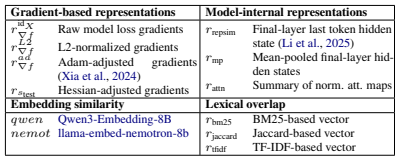
Table 1 : Summary of attribution methods studied.
원문 · CC BY 4.0 · Loris Schoenegger, Benjamin Roth · On Representational and Functional Alignment of Training Data Attribution Methods for Language Models · 원문 그림 인용 · 원본 PDF 3쪽에서 그림 영역을 추출했습니다.
Table 8 :LoRA fine-tuning hyperparameters.We use the default parameters from the Hugging Face documentation, adjusting the target modules and effective batch size for our specific model architectures.
원문 · CC BY 4.0 · Loris Schoenegger, Benjamin Roth · On Representational and Functional Alignment of Training Data Attribution Methods for Language Models · 원문 그림 인용 · 원본 PDF 29쪽에서 그림 영역을 추출했습니다.이 값은 실험에 사용된 설정이며 모든 방법에 대한 일반 설정으로 확장할 수 없습니다. 정렬 패턴의 안정성은 군집의 공동 상관과 혼합효과 모형의 우도비 검정으로 확인했습니다.
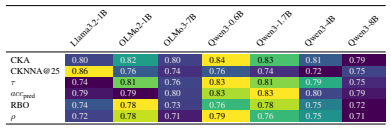
Table 2 : Average cophenetic correlation across tasks per base model.
원문 · CC BY 4.0 · Loris Schoenegger, Benjamin Roth · On Representational and Functional Alignment of Training Data Attribution Methods for Language Models · 원문 그림 인용 · 원본 PDF 12쪽에서 그림 영역을 추출했습니다.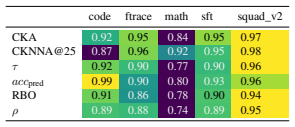
Table 3 : Average cophenetic correlation across base models per task.
원문 · CC BY 4.0 · Loris Schoenegger, Benjamin Roth · On Representational and Functional Alignment of Training Data Attribution Methods for Language Models · 원문 그림 인용 · 원본 PDF 12쪽에서 그림 영역을 추출했습니다.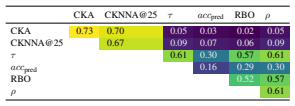
Table 4 : Average cophenetic correlation between align- ment measures.
원문 · CC BY 4.0 · Loris Schoenegger, Benjamin Roth · On Representational and Functional Alignment of Training Data Attribution Methods for Language Models · 원문 그림 인용 · 원본 PDF 12쪽에서 그림 영역을 추출했습니다.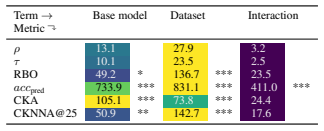
Table 5 :Likelihood-ratio tests.Results of likelihood-ratio tests comparing the full mixed-effects model against reduced variants with base model, dataset, or interaction terms removed. See Section 3.3.3.
원문 · CC BY 4.0 · Loris Schoenegger, Benjamin Roth · On Representational and Functional Alignment of Training Data Attribution Methods for Language Models · 원문 그림 인용 · 원본 PDF 20쪽에서 그림 영역을 추출했습니다.패러다임 내부와 사이의 정렬 차이
결과에서 같은 패러다임의 방법들은 높은 표현 정렬을 보였습니다. 그래디언트 기반 방법들과 임베딩 기반 방법들에서 블록 대각 구조가 뚜렷했습니다. 기능적 정렬은 중간 수준이었고, 이 패턴은 임베딩 기반 방법에서만 분명했습니다. 패러다임 사이의 기능적 정렬은 낮았으며 그래디언트 기반과 임베딩 기반 방법의 상관은 거의 없었습니다.
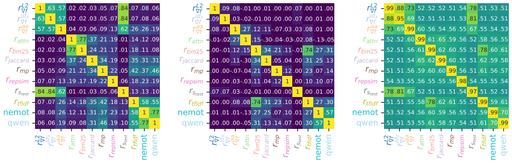
Figure 3 :Pairwise alignment.Left: representational alignment (CKA ∈[0,1] ), center: functional alignment (Spearman’s ρ∈[−1,1] ), and right: cross-method predictability (acc ∈[0,1] ) averaged across tasks and models. Higher values suggest better alignment. For CKNNA@25, RBO, and Kendall’sτ, see Appendix B.
원문 · CC BY 4.0 · Loris Schoenegger, Benjamin Roth · On Representational and Functional Alignment of Training Data Attribution Methods for Language Models · 원문 그림 인용 · 원본 PDF 7쪽에서 그림 영역을 추출했습니다.교차 방법 예측 가능성은 같은 패러다임 내부에서 0.75를 넘었고, 교차 패러다임 쌍 중 0.65를 넘은 것은 어휘 기반과 임베딩 기반 사이뿐이었습니다. 이 결과는 귀속 방법이 같은 패러다임 안에서는 부분적으로 대체 가능하지만, 패러다임 사이에서는 신뢰할 수 있는 대체재가 아님을 시사합니다. 과제에 따른 차이도 있었고 교차 패러다임 정렬은 과제에 따라 달라졌습니다.
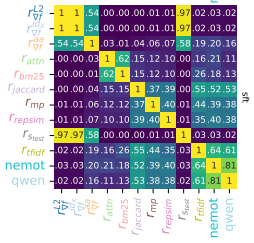
Figure 5 : Per-task CKA results.
원문 · CC BY 4.0 · Loris Schoenegger, Benjamin Roth · On Representational and Functional Alignment of Training Data Attribution Methods for Language Models · 원문 그림 인용 · 원본 PDF 13쪽에서 그림 영역을 추출했습니다.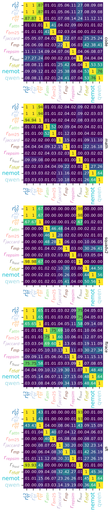
Figure 6 : Per-task CKNNA@25 results.
원문 · CC BY 4.0 · Loris Schoenegger, Benjamin Roth · On Representational and Functional Alignment of Training Data Attribution Methods for Language Models · 원문 그림 인용 · 원본 PDF 14쪽에서 그림 영역을 추출했습니다.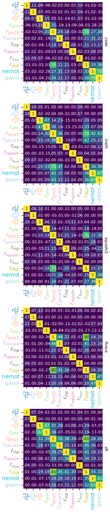
Figure 7 : Per-task Spearman’sρresults.
원문 · CC BY 4.0 · Loris Schoenegger, Benjamin Roth · On Representational and Functional Alignment of Training Data Attribution Methods for Language Models · 원문 그림 인용 · 원본 PDF 14쪽에서 그림 영역을 추출했습니다.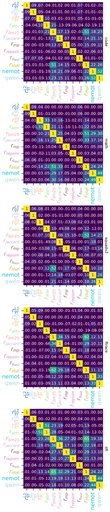
Figure 8 : Per-task Kendall’sτresults.
원문 · CC BY 4.0 · Loris Schoenegger, Benjamin Roth · On Representational and Functional Alignment of Training Data Attribution Methods for Language Models · 원문 그림 인용 · 원본 PDF 15쪽에서 그림 영역을 추출했습니다.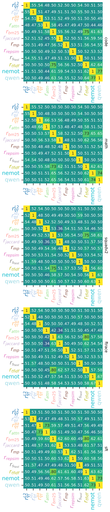
Figure 9 : Per-task RBO results.
원문 · CC BY 4.0 · Loris Schoenegger, Benjamin Roth · On Representational and Functional Alignment of Training Data Attribution Methods for Language Models · 원문 그림 인용 · 원본 PDF 15쪽에서 그림 영역을 추출했습니다.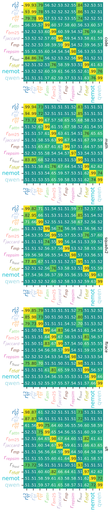
Figure 10 : Per-task cross-method predictability results.
원문 · CC BY 4.0 · Loris Schoenegger, Benjamin Roth · On Representational and Functional Alignment of Training Data Attribution Methods for Language Models · 원문 그림 인용 · 원본 PDF 16쪽에서 그림 영역을 추출했습니다.표현 기반 방법과 어휘 기반 방법이 다른 이유
저자들은 어휘 기반 방법이 표면 형태와 지시문의 중첩을 주로 포착하기 때문에 구조와 행동이 같지만 단어가 다른 문서를 놓친다고 해석합니다. 반면 그래디언트 기반과 임베딩 기반 방법은 지시문과 응답 패턴의 구조적 유사도를 더 잘 잡는다고 봅니다. 이 해석은 이웃 비교의 정성 분석에 근거한 것이며, 이 논문이 원인을 직접 측정한 것은 아닙니다.
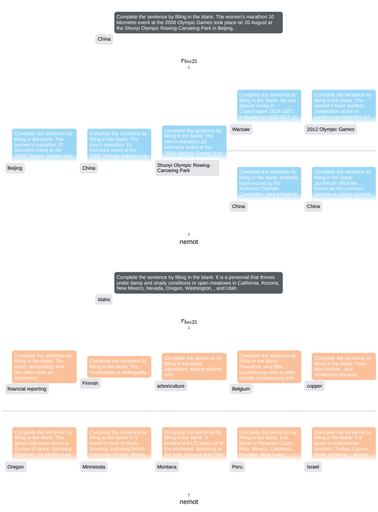
Figure 17 : Instances with highest (top) and lowest (bottom) 5-nearest neighbor overlap across representations rbm25 and nemot forOlmo-3-7B_ftrace_date-lm_conversational.
원문 · CC BY 4.0 · Loris Schoenegger, Benjamin Roth · On Representational and Functional Alignment of Training Data Attribution Methods for Language Models · 원문 그림 인용 · 원본 PDF 22쪽에서 그림 영역을 추출했습니다.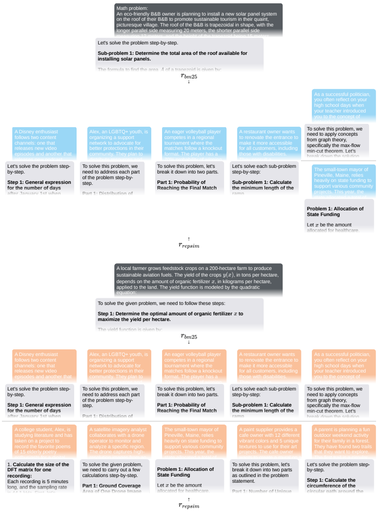
Figure 18 : Instances with highest (top) and lowest (bottom) 5-nearest neighbor overlap across representations rbm25 andr repsim forOlmo-3-7B_tulu-3-sft-personas-math.
원문 · CC BY 4.0 · Loris Schoenegger, Benjamin Roth · On Representational and Functional Alignment of Training Data Attribution Methods for Language Models · 원문 그림 인용 · 원본 PDF 23쪽에서 그림 영역을 추출했습니다.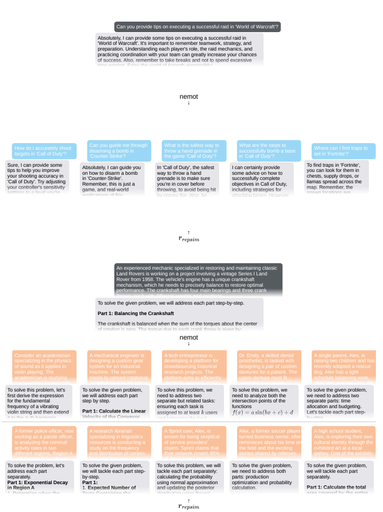
Figure 21 : Instances with highest (top) and lowest (bottom) 5-nearest neighbor overlap across representations nemot andr repsim forOlmo-3-7B_tulu-3-sft-olmo-2-mixture-0225.
원문 · CC BY 4.0 · Loris Schoenegger, Benjamin Roth · On Representational and Functional Alignment of Training Data Attribution Methods for Language Models · 원문 그림 인용 · 원본 PDF 26쪽에서 그림 영역을 추출했습니다.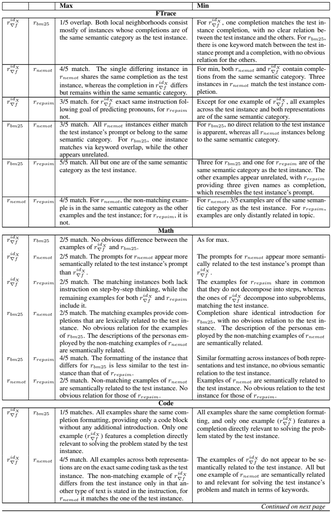
Table 7 : Full observations from the qualitative analysis, grouped by dataset.
원문 · CC BY 4.0 · Loris Schoenegger, Benjamin Roth · On Representational and Functional Alignment of Training Data Attribution Methods for Language Models · 원문 그림 인용 · 원본 PDF 27쪽에서 그림 영역을 추출했습니다.또한 낮은 평균 순위 상관이 곧 대체 불가능을 뜻하지 않는다는 점도 강조합니다. 전체 상관은 낮아도 쌍별 일치가 높을 수 있으므로, 평균 상관만으로 방법을 배제하면 쓸모 있는 방법을 놓칠 수 있습니다.
텍스트 생성 과제에 한정된 범위
논문은 실험이 텍스트 생성 과제에 한정된다고 밝힙니다. 분류처럼 더 단순한 과제 형식에서는 패러다임 사이의 정렬이 달라질 수 있습니다. 모델은 최대 8B 파라미터로 제한했고, 그래디언트 기반 계산 비용 때문에 LoRA 미세조정 모델만 분석했습니다. 전체 파라미터를 대상으로 한 귀속에서는 패턴이 다를 수 있습니다.
논문 정보
- 저자
- Loris Schoenegger, Benjamin Roth
- 학회·저널
- arXiv · 프리프린트
- 최초 공개일
- 2026년 11월 14일
- 등록일
- 2026년 11월 17일
- 수정일
- 2026년 11월 14일
- 버전
- v1
- arXiv
- 2611.19286
- 분류
- cs.CL
- 원문 이용 조건
- CC BY 4.0
- 제공 범위
- 논문 정보, 해설, 허용된 원문 그림
AI 해설은 논문 원문과 별개의 설명이며 오류가 있을 수 있습니다. 원문과 그림은 각 출처의 이용 조건과 따로 표시된 권리를 따릅니다.
초록
Existing approaches to training data attribution derive influence estimates from different sources of information, including gradients, model-internal states, and surface-level similarity. However, comparisons between attribution methods remain incomplete, often relying on indirect evaluations through downstream task performance. In this work, we introduce a framework for directly comparing methods along three dimensions: functional alignment, which measures correlation between full attribution vectors; representational alignment, which captures structural similarity of the representations underlying attribution; and cross-method predictability, which evaluates agreement on local pairwise ranking decisions. We observe strong representational and moderate functional alignment within paradigms. Alignment across paradigms is low and task-dependent, yet stable across models. Our results suggest that the similar downstream performance observed across paradigms in prior work can be attributed to agreement on the relative importance of documents, rather than to agreement on rankings of the full training data.
원문 인용
Loris Schoenegger, Benjamin Roth (2026). On Representational and Functional Alignment of Training Data Attribution Methods for Language Models. arXiv:2611.19286v1. https://arxiv.org/abs/2611.19286v1
BibTeX
@misc{schoenegger2026representational,
  title = {{On Representational and Functional Alignment of Training Data Attribution Methods for Language Models}},
  author = {Loris Schoenegger and Benjamin Roth},
  year = {2026},
  eprint = {2611.19286},
  archivePrefix = {arXiv},
  url = {https://arxiv.org/abs/2611.19286v1}
}