논문 해설
AbductionBench: Benchmarking Abductive Reasoning in Large Language Models
AbductionBench: 대규모 언어 모델의 귀납적 추론 벤치마크
- 연구 문제 여러 귀추 추론 벤치마크가 과제 형식과 채점 방식이 달라 결과를 비교하기 어렵고, 최종 답만으로는 증거 사용과 가설 수정을 알기 어렵습니다.
- 연구 방법 과제를 가설 생성·선택, 응용 영역, 증거 전달 방식으로 나누어 27개 데이터셋을 하나의 프로토콜로 실행하고 최종 답과 추론 과정을 따로 측정합니다.
- 주요 결과 CoT는 일관된 이득을 주지 않았고, Jev는 짧은 증거 선택에서는 경쟁력이 있었지만 긴 사례에서는 뒤처졌습니다. 상호작용 과제의 관련 행동은 후반에 줄었고, 수동 과제에서 모델은 초기 가설을 거의 수정하지 않았습니다.
기존 추론 평가의 한계
대규모 언어 모델의 귀추(abductive) 추론 능력은 여러 벤치마크에서 따로 평가되어 왔으며, 과제 형식과 채점 방식이 서로 달라 결과를 나란히 비교하기 어렵습니다. 이 논문은 설명 생성, 설명 선택, 증거를 한꺼번에 주는 방식과 순차적으로 주는 방식이 서로 다른 능력을 드러낸다고 보고, 이를 하나의 실행 및 보고 프로토콜로 묶는 AbductionBench를 제안합니다. 최종 답의 정확도만으로는 모델이 증거를 실제로 사용했는지, 대안을 비교했는지, 가설을 수정했는지 알기 어렵다는 점이 출발점입니다.
과제 축과 증거 전달 방식
AbductionBench는 과제를 가설 생성 또는 선택, 응용 영역, 증거 전달 방식의 세 축으로 기술합니다. 증거 전달 방식은 모든 증거를 처음에 주는 정적(static) 방식, 고정된 순서로 증거가 도착하고 모델이 매 턴 가설을 수정하는 수동(passive) 방식, 모델의 질문이나 행동이 다음 관찰을 결정하는 상호작용(interactive) 방식으로 나뉩니다. 평가는 최종 답을 과제별 채점으로 측정하고, 정적 과제의 추론 과정은 CoT 추적으로, 수동·상호작용 과제는 턴 단위 지표로 따로 분석합니다.
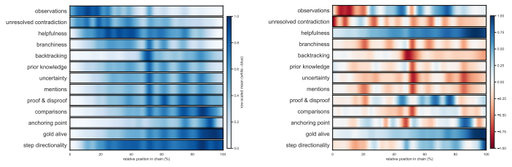
Figure 3 : Judged trace measures by relative position in the chain (0–100%), pooled over the eight LLMs. (a) Mean, each row min–max scaled. (b) Correct-minus-incorrect difference, computed within each dataset and averaged; each row scaled symmetrically around zero, so blue marks positions where correct chains score higher and red where incorrect chains score higher. Row intensities are not comparable across measures.
원문 · CC BY 4.0 · Moein Salimi, Amir Qeysarbeigi, Babak Hosseini Mohtasham, Faraz Doagoye Tehrani, Mahdi Naieni, Hanieh Sartipi, Ali Nouri, Amin Aghakasiri, Reyhane Khayatzade Mahani, Mahdi Jafari Siavoshani, Mohammad Hossein Rohban · AbductionBench: Benchmarking Abductive Reasoning in Large Language Models · 원문 그림 인용 · 원본 PDF 8쪽에서 그림 영역을 추출했습니다.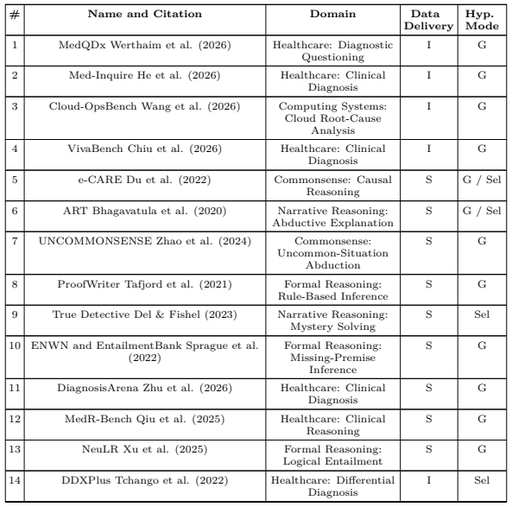
Table 2 : Summary of datasets used. Data Delivery Mode:I= Interactive,S= Static. Hypothesis Processing Mode:G= Generation,Sel= Selection;G / Seldenotes datasets with separate generation and selection tasks.
원문 · CC BY 4.0 · Moein Salimi, Amir Qeysarbeigi, Babak Hosseini Mohtasham, Faraz Doagoye Tehrani, Mahdi Naieni, Hanieh Sartipi, Ali Nouri, Amin Aghakasiri, Reyhane Khayatzade Mahani, Mahdi Jafari Siavoshani, Mohammad Hossein Rohban · AbductionBench: Benchmarking Abductive Reasoning in Large Language Models · 원문 그림 인용 · 원본 PDF 15쪽에서 그림 영역을 추출했습니다.주요 실험 결과
CoT는 모든 조건에서 정확도를 높이지 않았으며, 과제에 따라 도움이 되거나 해가 되었습니다. Jev는 비교적 짧고 압축된 증거에서 선택하는 과제에서 소형 LLM과 비슷하거나 높았지만, 긴 사례에서는 크게 뒤처졌습니다. 상호작용 과제에서는 관련 행동의 비율이 후반으로 갈수록 줄었고, 수동 과제에서는 모델이 새 증거가 와도 초기 가설을 거의 바꾸지 않았습니다. 이 결과들은 특정 모델과 데이터셋 조건에서 얻은 것입니다.
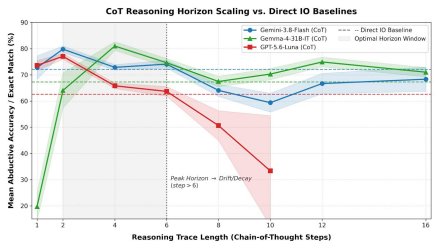
Figure 1 : Accuracy by CoT trace length (steps) against each model’s IO baseline (dashed); bands are±SEM, points withn<5omitted.
원문 · CC BY 4.0 · Moein Salimi, Amir Qeysarbeigi, Babak Hosseini Mohtasham, Faraz Doagoye Tehrani, Mahdi Naieni, Hanieh Sartipi, Ali Nouri, Amin Aghakasiri, Reyhane Khayatzade Mahani, Mahdi Jafari Siavoshani, Mohammad Hossein Rohban · AbductionBench: Benchmarking Abductive Reasoning in Large Language Models · 원문 그림 인용 · 원본 PDF 2쪽에서 그림 영역을 추출했습니다.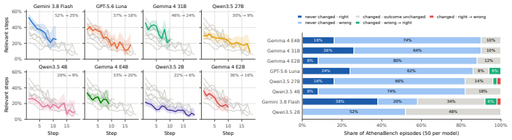
Figure 4 : Relevance and revision over the course of an episode. The left panel (a) tracks the share of actions judged relevant to the gold answer at each step of the interactive episodes, one colored panel per model (95% Wilson bands) against the other seven in gray; a step is plotted only once at least 30 of the model’s episodes reach it, so models that answer early trace shorter curves, and corner labels give relevance at the first and last plotted step. MedQDx counts its questions only. The right panel (b) shows, for AthenaBench’s passive setting, the share of each model’s 50 episodes whose predicted actor never changed, changed without changing the outcome, or flipped between wrong and right from the first turn to the last.
원문 · CC BY 4.0 · Moein Salimi, Amir Qeysarbeigi, Babak Hosseini Mohtasham, Faraz Doagoye Tehrani, Mahdi Naieni, Hanieh Sartipi, Ali Nouri, Amin Aghakasiri, Reyhane Khayatzade Mahani, Mahdi Jafari Siavoshani, Mohammad Hossein Rohban · AbductionBench: Benchmarking Abductive Reasoning in Large Language Models · 원문 그림 인용 · 원본 PDF 8쪽에서 그림 영역을 추출했습니다.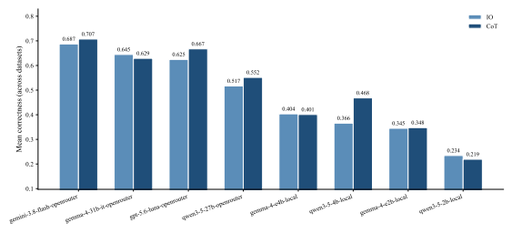
Figure 5 :Mean correctness per model, averaged across datasets, for theioandcotprompt- ing variants.Models are ordered bycotcorrectness, descending.cotimproves correctness for four of eight models, is roughly flat forgemma-4-e2b-local, and reduces it slightly forgemma-4-31b-itandgemma-4-e4b-local; the largest gain isqwen3-5-4b-local (+0.102) and the largest loss is negligible (−0.015,qwen3-5-2b-local).
원문 · CC BY 4.0 · Moein Salimi, Amir Qeysarbeigi, Babak Hosseini Mohtasham, Faraz Doagoye Tehrani, Mahdi Naieni, Hanieh Sartipi, Ali Nouri, Amin Aghakasiri, Reyhane Khayatzade Mahani, Mahdi Jafari Siavoshani, Mohammad Hossein Rohban · AbductionBench: Benchmarking Abductive Reasoning in Large Language Models · 원문 그림 인용 · 원본 PDF 21쪽에서 그림 영역을 추출했습니다.한계와 해석의 범위
저자들은 판정자(judge) 출력을 무작위로 검토하고 프롬프트를 고쳤지만, 판정자 품질에 대한 체계적 평가와 전체 일치도 통계는 보고하지 않았다고 밝힙니다. 또한 모델 구성이 제한되어 있고, 상호작용·수동 과제의 수가 적으며, 시간 비용 때문에 에피소드를 한 번씩만 실행했습니다. 추론 과정 지표는 작성된 추론의 관찰 가능한 특성이므로 모델 내부 계산을 직접 대표한다고 볼 수 없습니다.
논문 정보
- 저자
- Moein Salimi, Amir Qeysarbeigi, Babak Hosseini Mohtasham, Faraz Doagoye Tehrani, Mahdi Naieni, Hanieh Sartipi, Ali Nouri, Amin Aghakasiri, Reyhane Khayatzade Mahani, Mahdi Jafari Siavoshani, Mohammad Hossein Rohban
- 학회·저널
- arXiv · 프리프린트
- 최초 공개일
- 2026년 11월 7일
- 등록일
- 2026년 11월 10일
- 수정일
- 2026년 11월 7일
- 버전
- v1
- arXiv
- 2611.10705
- 분류
- cs.LG
- 원문 이용 조건
- CC BY 4.0
- 제공 범위
- 논문 정보, 해설, 허용된 원문 그림
AI 해설은 논문 원문과 별개의 설명이며 오류가 있을 수 있습니다. 원문과 그림은 각 출처의 이용 조건과 따로 표시된 권리를 따릅니다.
초록
Abductive reasoning is the inference of plausible explanations for observed evidence. Evaluating this capability requires more than a single task: a system may need to generate an explanation, discriminate among competing hypotheses, revise its hypotheses as evidence arrives, or decide what evidence to seek next. Yet these capabilities are typically evaluated through isolated benchmarks with different task formulations and scoring procedures, so claims that a model is ``good at abduction'' may reflect only a narrow aspect of this capability. We introduce AbductionBench, a unified framework whose taxonomy characterizes abductive tasks. We instantiate this framework on 27 datasets spanning ten domains and evaluate eight LLMs from four model families evaluated on single-choice selection tasks. Beyond harmonizing heterogeneous tasks, AbductionBench separates final-answer evaluation from analysis of the observable reasoning traces and interaction histories produced alongside those answers. We analyze written traces as observable model outputs rather than faithful representations of internal computation, characterizing evidence use, hypothesis comparison, uncertainty, contradiction handling, and answer commitment. Jev matches or exceeds small LLMs when selecting among explanations over compact evidence but falls substantially behind on longer cases, suggesting that candidate discrimination and extended evidence integration place different demands on a system. In interactive tasks, the proportion of actions judged relevant declines at later steps, and a relevant first question is associated with a correct final answer; in the passive task, models rarely revise their initial hypothesis as new evidence arrives. Together, these findings highlight the value of evaluating abductive reasoning through both final answers and observable evidence use, hypothesis revision, and information gathering.
원문 인용
Moein Salimi, Amir Qeysarbeigi, Babak Hosseini Mohtasham, Faraz Doagoye Tehrani, Mahdi Naieni, Hanieh Sartipi, Ali Nouri, Amin Aghakasiri, Reyhane Khayatzade Mahani, Mahdi Jafari Siavoshani, Mohammad Hossein Rohban (2026). AbductionBench: Benchmarking Abductive Reasoning in Large Language Models. arXiv:2611.10705v1. https://arxiv.org/abs/2611.10705v1
BibTeX
@misc{salimi2026abductionbench,
  title = {{AbductionBench: Benchmarking Abductive Reasoning in Large Language Models}},
  author = {Moein Salimi and Amir Qeysarbeigi and Babak Hosseini Mohtasham and Faraz Doagoye Tehrani and Mahdi Naieni and Hanieh Sartipi and Ali Nouri and Amin Aghakasiri and Reyhane Khayatzade Mahani and Mahdi Jafari Siavoshani and Mohammad Hossein Rohban},
  year = {2026},
  eprint = {2611.10705},
  archivePrefix = {arXiv},
  url = {https://arxiv.org/abs/2611.10705v1}
}