논문 해설
Audited Gradients, Anchored Policies: Model-Based Reinforcement Learning for Efficient Flow Control
감사된 그래디언트, 고정된 정책: 효율적인 흐름 제어를 위한 모델 기반 강화학습
- 연구 문제 대리 모델의 예측 정확도와 행동 기울기 정확도가 다를 수 있으므로, 행동 기울기를 고충실도 솔버와 비교 검증하는 문제입니다.
- 연구 방법 기울기 감사를 통과하면 대리 모델 기울기로, 실패하면 측정 기울기로 피드백 법칙을 추출하고 이를 정책 초기값과 anchor 기준으로 사용합니다.
- 주요 결과 회전 원통, 세 원통 클러스터, 강제 난류, 파라메트릭 혼돈 방정식 네 과제에서 제어기가 모델 자유 기준선과 비교되었고, 일부 사례에서는 차이가 검출되지 않았습니다.
문제: 대리 모델의 기울기가 믿을 만한가
유동 제어기를 설계하려면 후보 제어기마다 고충실도 솔버로 지배 방정식을 풀어야 하므로 비용이 큽니다. 미분 가능한 대리 모델은 이 비용을 줄이지만, 예측 오차가 작아도 행동에 대한 목적함수의 미분, 즉 행동 기울기가 틀릴 수 있습니다. 이 논문은 정책 최적화가 이 행동 기울기를 사용한다는 점에서, 궤적 예측 정확도와 기울기 정확도를 별도로 검증해야 한다고 설명합니다.
이 연구는 대리 모델의 행동 기울기를 고충실도 솔버의 중앙 차분 추정과 held-out 상태에서 비교하는 action gradient audit을 제안합니다. 그 결과에 따라 기울기 방향으로 피드백 법칙을 추출하고, 이 법칙을 정책 초기값과 anchor penalty의 기준으로 씁니다. 따라서 질문은 기울기 검증이 실제로 제어기 구성의 기준이 될 수 있는지입니다.
Audit과 법칙 추출, anchor 정책 최적화
감사 절차는 대리 모델의 행동 기울기 ĝ와 고충실도 중앙 차분 기울기 gHF를 같은 상태와 같은 행동, 같은 horizon에서 비교합니다. 비교 통계량은 pooled correlation, sign agreement, 행동기 성분별 상관의 중앙값입니다. 세 기준을 모두 넘을 때에만 대리 모델 기울기가 제어기 구성에 쓰이며, 실패하면 측정된 기울기가 사용됩니다.
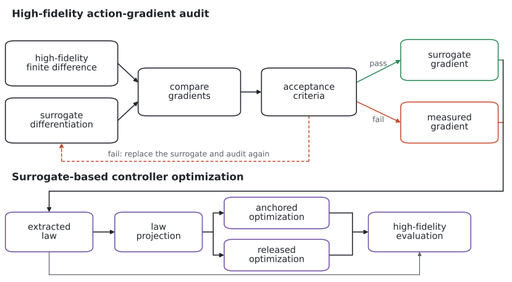
Figure 1 : Surrogate action gradients are compared with high-fidelity central differences on held-out states under fixed acceptance criteria. After a pass, the extracted law is fitted to the surrogate gradient, which is inexpensive to evaluate. After a failure instead, it is fitted to the measured gradient, unless a replacement surrogate passes a new audit. The extracted law is transferred to the neural policy by law projection, and used as the reference of the anchor penalty, which a cone around the law replaces in the case of a failure. The law, the anchored controller and the released controller are each evaluated in the solver. Black boxes refer to the audit, green and orange paths to its two outcomes, and purple boxes to the controller construction.
원문 · CC BY 4.0 · Ruige Kong, Stefania Fresca · Audited Gradients, Anchored Policies: Model-Based Reinforcement Learning for Efficient Flow Control · 원문 그림 인용 · 원본 PDF 3쪽에서 그림 영역을 추출했습니다.대리 모델이 통과하든 실패하든 감사에서 얻은 하강 방향에 저차원 파라메트릭 법칙을 최소제곱으로 맞춥니다. 이 법칙은 법칙 투영으로 신경 정책의 초기값이 되며, 정책 손실에 anchor 항으로 들어가 법칙 근처에 묶어 둡니다. anchor 가중치는 고정하거나 학습 중 0까지 줄일 수 있으며, 전자를 anchored, 후자를 released 제어기라고 부릅니다.
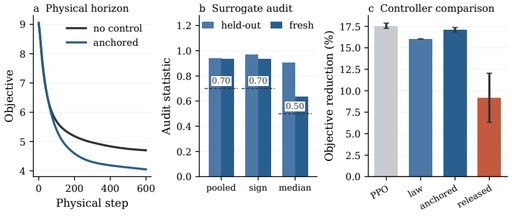
Figure 12 : Anchor regularization recovers most of the reduction that model-free training reaches, and removing it loses about half of that. Panel a compares the uncontrolled objective with the objective under the policy that holds the anchor, over one 600-step horizon. Panel b shows the two gradient audits against the acceptance thresholds,τ1 =τ2 = 0.70for the correlation and the sign agreement andτ3 = 0.50for the median per-actuator correlation, on gradient labels held out of surrogate fitting and on 16 new states. Panel c compares matched model-free training with the extracted law, the policy that holds the anchor, and the policy after the anchor is removed. Its rows are PPO over three training seeds, the extracted law over eight initial conditions, and the anchored and released policies over four training seeds each. Error bars show sample standard deviations across training seed means for the model-free, anchored and released rows, and across the eight initial conditions for the extracted law.
원문 · CC BY 4.0 · Ruige Kong, Stefania Fresca · Audited Gradients, Anchored Policies: Model-Based Reinforcement Learning for Efficient Flow Control · 원문 그림 인용 · 원본 PDF 39쪽에서 그림 영역을 추출했습니다.하강 조건과 명제 1의 적용 범위
하강 보조정리는 Lipschitz 상수 L과 스텝 크기 η에 대해 근사 기울기 ĝ 방향의 갱신이 고충실도 목적함수를 줄이는 조건을 제시합니다. 명제 1은 정확한 기울기 g에 대해 인증된 감소량과 ĝ에 대해 인증된 감소량의 비가 cos²θ와 같다고 말합니다. 이 비는 L과 ∥ĝ∥에 독립입니다.
다만 이 결과는 한 상태에서 한 번의 행동 갱신에 대한 국소 결과입니다. 기울기 상관이 높다는 사실만으로 궤적 전체 성능이 예측되지는 않으며, L도 추정되지 않습니다. 그래서 임계값은 경험적 허용 기준이며 학습된 제어기 성능과 이론적으로 연결되어 있지 않다고 저자들은 밝힙니다.

Table 3 : No reported audit decision changes over a wide interval around each threshold. The intervals measure the stability of each decision and do not derive the thresholds.
원문 · CC BY 4.0 · Ruige Kong, Stefania Fresca · Audited Gradients, Anchored Policies: Model-Based Reinforcement Learning for Efficient Flow Control · 원문 그림 인용 · 원본 PDF 25쪽에서 그림 영역을 추출했습니다.회전 원통 후류 결과
이 값들은 법칙을 Re=100에서 고정해 얻은 결과입니다.
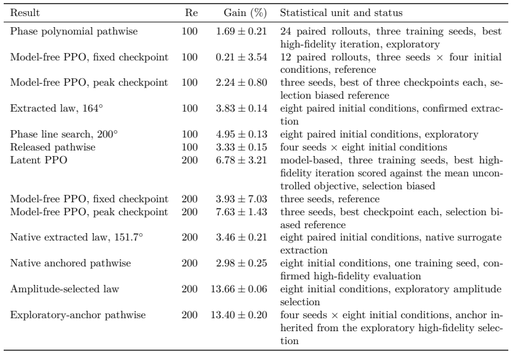
Table 6 : The extracted law and the released pathwise controller atRe = 100, and the native extracted law and native anchored pathwise controller atRe = 200, are the rotating cylinder rows fixed before evaluation. Uncertainty is a sample standard deviation over the unit stated in the last column. Exploratory rows are not reported as confirmed controller results. A row marked reference is a baseline that the other rows are compared with. The fixed checkpoint is the PPO controller at the end of its interaction budget, and the peak checkpoint is the best scoring checkpoint of each seed, which uses the evaluation history and is consequently selection biased.
원문 · CC BY 4.0 · Ruige Kong, Stefania Fresca · Audited Gradients, Anchored Policies: Model-Based Reinforcement Learning for Efficient Flow Control · 원문 그림 인용 · 원본 PDF 31쪽에서 그림 영역을 추출했습니다.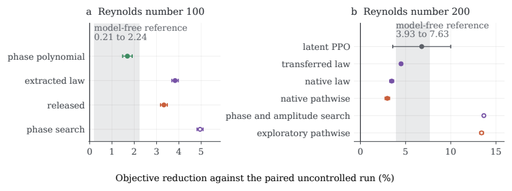
Figure 11 : The extracted law exceeds every trained controller at Reynolds number 100, and at Reynolds number 200 the model-free baseline exceeds the native law and the native pathwise controller, and only the exploratory rows exceed the model-free baseline. The transferred law at Reynolds number 200 uses the shedding period measured at that Reynolds number, which gives4.50%against4 .34%with the period of Reynolds number 100. The left panel shows Reynolds number 100. The right panel shows Reynolds number 200. Error bars are standard deviations over training seeds or paired initial conditions as stated in the text. The shaded band spans the two model-free PPO references, the fixed budget checkpoint and the selected peak checkpoint. At Reynolds number 100 these are0.21and2 .24%, and at Reynolds number 200 they are 3.93and7 .63%. The latent PPO row is model-based and is not part of that band, and it is the best training iteration scored against the mean uncontrolled objective. PPO uses 32,768 and 16,384 solver interactions per seed. The model-based training configurations use about 4,600. Hollow markers denote results that inherit an exploratory high-fidelity search.
원문 · CC BY 4.0 · Ruige Kong, Stefania Fresca · Audited Gradients, Anchored Policies: Model-Based Reinforcement Learning for Efficient Flow Control · 원문 그림 인용 · 원본 PDF 38쪽에서 그림 영역을 추출했습니다.세 원통 클러스터 결과
이 사례는 예측 정확도가 행동 기울기의 유용성을 보장하지 않는다는 근거입니다.
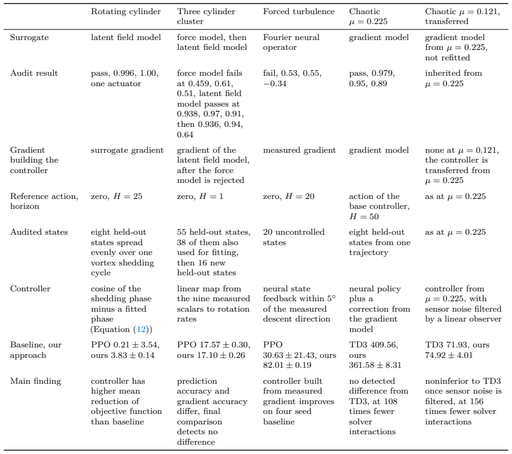
Table 2 : The audit decides which gradient builds each controller. The surrogate passes in three of the five reported conditions, on the three cylinder cluster after one replacement. The measured gradient builds the controller on forced turbulence, and the controller built atµ = 0.225is transferred to µ = 0.121. In all five conditions the surrogate-based controller improves on the model-free baseline or is not distinguished from it. Audit configuration and final high-fidelity outcome for the five reported conditions. On the three flow test cases the values are reductions of the objective in %, and higher is better. On the chaotic equation they are accumulated state costs, and lower is better. Each uncertainty is the sample standard deviation over the units stated in the corresponding subsection. The audit criteria are the pooled correlation, the sign agreement and the median actuator correlation, in this order.
원문 · CC BY 4.0 · Ruige Kong, Stefania Fresca · Audited Gradients, Anchored Policies: Model-Based Reinforcement Learning for Efficient Flow Control · 원문 그림 인용 · 원본 PDF 13쪽에서 그림 영역을 추출했습니다.강제 2차원 난류 결과
따라서 이 사례의 제어기는 측정된 기울기로 법칙을 만들고, 대리 모델은 법칙 주변의 작은 잔차만 최적화하는 방식으로 구성되었습니다. 여덟 학습 시드 모두 제어기 검사를 통과했습니다.
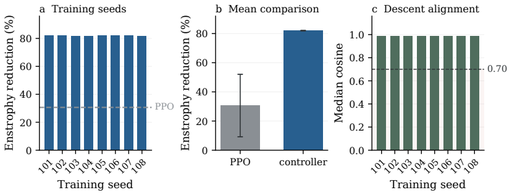
Figure 15 : All eight training seeds, fixed before training, pass the controller check and exceed the model-free baseline. Panel a shows the enstrophy reduction for each of eight controller training seeds. Every seed passes the controller check, and the dashed line is the mean of four independently trained PPO seeds. Panel b compares the mean across training seeds with PPO. The error bar is the sample standard deviation across the eight training seed means, and for PPO across its four training seed means. The mean advantage over PPO is 51.38percentage points, with a Welch95%confidence interval from17.28to85 .48. Panel c shows the median cosine between the controller action and the high-fidelity descent direction for every training seed, with the threshold of0.70of the controller check. Each training seed is evaluated over eight held-out initial conditions.
원문 · CC BY 4.0 · Ruige Kong, Stefania Fresca · Audited Gradients, Anchored Policies: Model-Based Reinforcement Learning for Efficient Flow Control · 원문 그림 인용 · 원본 PDF 41쪽에서 그림 영역을 추출했습니다.다만 상태 의존성이 약한 기울기 필드에서는 세 가지 감사 통계량이 상태별 변화를 충분히 평가하지 못하는 한계가 저자들에 의해 지적됩니다.
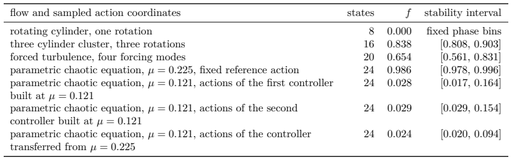
Table 5 : The state dependence of the measured gradient field runs from total to almost none across these conditions. Each value off is computed from the high-fidelity finite differences at the listed action coordinates and reference action. Each interval is a percentile stability interval from10,000resamples of the sampled states, or of the sources for the three deployed-action rows. It shows how far the value moves under resampling and is not a confidence interval. The rotating cylinder entry uses eight shedding-phase bins fixed by construction, so no resampling interval applies to it.
원문 · CC BY 4.0 · Ruige Kong, Stefania Fresca · Audited Gradients, Anchored Policies: Model-Based Reinforcement Learning for Efficient Flow Control · 원문 그림 인용 · 원본 PDF 26쪽에서 그림 영역을 추출했습니다.파라메트릭 혼돈 방정식 전이 결과
파라메트릭 혼돈 방정식에서 µ=0.225의 기울기 모델은 감사를 통과했고, 그 제어기는 재학습 없이 µ=0.121로 전이되었습니다.
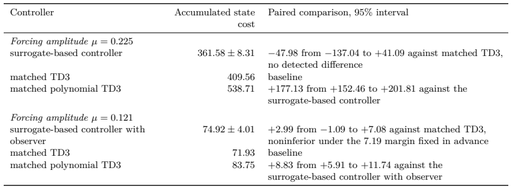
Table 8 : Atµ = 0.225the comparison detects no difference between the surrogate-based controller and matched TD3, and atµ = 0.121the controller with observer is noninferior to matched TD3. Uncertainty is the sample standard deviation across eight initial fields. Each paired comparison is computed field by field against the controller named in the last column, and a positive paired difference means the row controller has the higher cost. Costs at the two forcing amplitudes cannot be compared with each other. Matched TD3 and polynomial TD3 are single trained checkpoints, and their spread across fields is not reported.
원문 · CC BY 4.0 · Ruige Kong, Stefania Fresca · Audited Gradients, Anchored Policies: Model-Based Reinforcement Learning for Efficient Flow Control · 원문 그림 인용 · 원본 PDF 37쪽에서 그림 영역을 추출했습니다.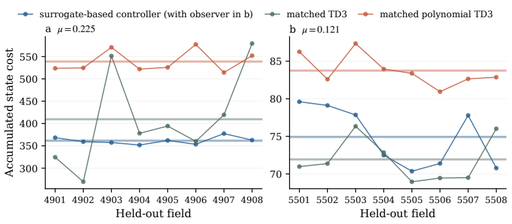
Figure 16 : The comparison detects no difference from plain TD3 atµ = 0.225, the controller with observer is noninferior to it atµ = 0.121, and both cost less than polynomial TD3, on eight held-out fields each. Panel a compares the surrogate-based controller with matched plain and polynomial TD3 atµ = 0.225. Panel b makes the same field-matched comparison for the controller with observer atµ = 0.121. Thin lines show individual fields and heavier horizontal lines show controller means. Lower accumulated state cost is better.
원문 · CC BY 4.0 · Ruige Kong, Stefania Fresca · Audited Gradients, Anchored Policies: Model-Based Reinforcement Learning for Efficient Flow Control · 원문 그림 인용 · 원본 PDF 43쪽에서 그림 영역을 추출했습니다.이 결과는 µ=0.121에서 관측기와 강도 선택을 별도로 두었다는 조건을 포함합니다. 감사 통과는 감사한 행동 근처에서의 국소적 결과이며, 배치된 행동에서 다시 측정했을 때는 실패했다는 점을 함께 읽어야 합니다.

Table 7 : The gradient model of each deployed controller fails all three acceptance criteria when the derivative is measured around the actions of that controller. The audit triples and state-independent fractions are measured atµ = 0.121. Each audit triple is pooled correlation, sign agreement, and median per-actuator correlation. All three miss the predefined thresholds0.70,0.70, and0.50.
원문 · CC BY 4.0 · Ruige Kong, Stefania Fresca · Audited Gradients, Anchored Policies: Model-Based Reinforcement Learning for Efficient Flow Control · 원문 그림 인용 · 원본 PDF 36쪽에서 그림 영역을 추출했습니다.한계와 남은 질문
저자들은 임계값이 경험적이며 학습된 제어기 성능과 이론적으로 연결되지 않는다고 밝힙니다. 명제 1의 결과는 한 상태의 한 번 갱신에 한정되며, 궤적 전체 성능으로 확장하려면 측정된 평활도 상수가 필요합니다. 실험은 낮은 Reynolds 수의 2차원 흐름과 1차원 혼돈 방정식에 한정되어 3차원 흐름으로의 확장은 다음 과제로 남아 있습니다.
또한 강제 난류처럼 기울기 필드가 거의 상태에 무관한 경우 기존 감사 통계량이 상태 간 변화를 충분히 평가하지 못합니다. 원문은 이 제약을 감사 기준의 개선 과제로 제시합니다.

Table 4 : Replacing the median per-actuator correlation by the minimum changes none of the four decisions listed, while a threshold on the median per-state cosine would accept the forced turbulence surrogate. Values are computed from the stored audit gradients.
원문 · CC BY 4.0 · Ruige Kong, Stefania Fresca · Audited Gradients, Anchored Policies: Model-Based Reinforcement Learning for Efficient Flow Control · 원문 그림 인용 · 원본 PDF 26쪽에서 그림 영역을 추출했습니다.논문 정보
- 저자
- Ruige Kong, Stefania Fresca
- 학회·저널
- arXiv · 프리프린트
- 최초 공개일
- 2026년 11월 9일
- 등록일
- 2026년 11월 11일
- 수정일
- 2026년 11월 9일
- 버전
- v1
- arXiv
- 2611.13203
- 분류
- cs.LG
- 원문 이용 조건
- CC BY 4.0
- 제공 범위
- 논문 정보, 해설, 허용된 원문 그림
AI 해설은 논문 원문과 별개의 설명이며 오류가 있을 수 있습니다. 원문과 그림은 각 출처의 이용 조건과 따로 표시된 권리를 따릅니다.
초록
Feedback controllers for flows are expensive to design, since each candidate must be evaluated with a high-fidelity solver. Differentiable surrogates reduce that cost, but they also introduce a failure mode that prediction error cannot detect. Policy optimization uses the derivative of the objective with respect to the action, which we call the action gradient and which can be computed either through the surrogate or through the high-fidelity solver. Optimization through the surrogate uses only its action gradient, and a surrogate can follow the flow trajectory closely while misestimating this derivative. The surrogate action gradient is compared against a central finite-difference estimate from the high-fidelity solver on held-out states, under acceptance criteria fixed before the comparison, and we call that comparison an audit. A low-dimensional feedback law is then fitted to the surrogate action gradient when the surrogate passes the audit, and to the solver estimate when it does not. This law initializes a neural policy, and a quadratic penalty holds the policy near it during optimization. The proposed approach is validated on four test cases. The resulting controllers outperform or match a model-free baseline, while using 3 to 156 times fewer high-fidelity solver interactions across the four test cases. One surrogate predicts the objective at correlation 0.9996 but its action gradient at only 0.459, so prediction accuracy does not identify a usable surrogate. Another surrogate, whose action gradient agrees with the solver estimate at correlation 0.996, makes the objective 0.52% worse when the policy is optimized through it without the anchor penalty, so an accurate gradient alone does not provide a working controller. Finally, a surrogate that passes the audit at one fixed action fails it around the actions the deployed controller applies, so a pass is local.
원문 인용
Ruige Kong, Stefania Fresca (2026). Audited Gradients, Anchored Policies: Model-Based Reinforcement Learning for Efficient Flow Control. arXiv:2611.13203v1. https://arxiv.org/abs/2611.13203v1
BibTeX
@misc{kong2026audited,
  title = {{Audited Gradients, Anchored Policies: Model-Based Reinforcement Learning for Efficient Flow Control}},
  author = {Ruige Kong and Stefania Fresca},
  year = {2026},
  eprint = {2611.13203},
  archivePrefix = {arXiv},
  url = {https://arxiv.org/abs/2611.13203v1}
}