논문 해설
Approximation of Log-Partition Function in Policy Mirror Descent Induces Implicit Regularization for LLM Post-Training
정책 미러 하강에서의 로그-분할함수 근사가 LLM post-training을 위한 암묵적 정규화를 유도한다
- 연구 문제 PMD-MEAN은 KL 정규화 정책 개선 문제를 풀 때 로그 분배함수를 평균 보상으로 근사하는 실용적 방법입니다. 이 논문은 그 근사가 실제로 어떤 목적을 최적화하는지, 그리고 제한된 롤아웃에서 그 목적이 학습 안정성에 어떤 영향을 주는지를 묻습니다.
- 연구 방법 PMD-MEAN의 population 해를 Lambert-W 함수로 닫힌 형태로 표현하고, 이 갱신이 적응형 혼합 KL–χ2 정규화를 쓰는 mirror descent 부문제와 동등하다는 것을 보입니다. 이를 바탕으로 유한 롤아웃에서의 목표 추정 오차와 수렴 속도를 PMD-PART와 비교합니다.
- 주요 결과 Qwen2.5-7B 실험에서 PMD-MEAN(τ=0.005)은 AIME 2024 19.69, AIME 2025 19.48, 평균 19.58의 Avg@32 점수를 보고합니다. Qwen3-30B-A3B-Base에서는 PMD-MEAN(τ=0.1)이 평균 44.01을 보고합니다. 두 모델 모두 GRPO 기준선보다 높은 점수입니다.
연구 문제와 배경
정책 거울 하강법(PMD)은 KL 정규화 정책 개선 부문제를 반복적으로 푸는 틀입니다. 이상적인 갱신은 현재 정책을 보상의 지수로 재가중한 뒤 분배함수로 정규화하는 형태입니다. 그러나 LLM 후처리처럼 행동 공간이 매우 큰 상황에서는 제한된 롤아웃으로 이 분배함수를 정확히 추정하기 어렵습니다.
이 어려움을 피하기 위해 PMD-MEAN은 로그 분배함수를 현재 샘플링 정책 아래의 평균 보상으로 바꾸고, 로그 정책 공간에서 회귀합니다. 반면 PMD-PART는 분배함수를 롤아웃으로 추정하여 목표를 맞춥니다. 이 논문은 PMD-MEAN이 실제로 무엇을 최적화하는지, 그리고 그것이 유한 샘플 오차에 어떤 영향을 주는지를 묻습니다.
PMD-MEAN의 닫힌 형태 해
PMD-MEAN의 손실은 로그 정책 비율 log(π/πt)와 평균 기준 advantage ∆y/τ의 차이를 제곱한 값을 기댓값으로 취합니다. 이 population 최소화 문제의 해는 현재 정책 πt(y)에 exp(∆y/τ − W(λ/τ² · exp(∆y/τ)))를 곱한 형태입니다. 여기서 W는 Lambert-W 함수이고, λ는 정규화가 1이 되도록 정하는 상수입니다.
PMD의 이상적 갱신에서는 정규화 항이 행동 y와 무관한 로그 분배함수입니다. 반면 PMD-MEAN에서는 Lambert-W 항이 행동마다 달라집니다. 이진 보상에서 τ가 작을 때 긍정 행동의 비율은 1/p 쪽으로, 부정 행동의 비율은 e^(−p/τ) 쪽으로 움직이며, 이는 PMD-PART의 e^(−1/τ) 스케일과 다른 지수율을 가집니다. 따라서 평균 보상이 작은 초기 단계에서 PMD-MEAN의 갱신이 더 보수적으로 나타납니다.
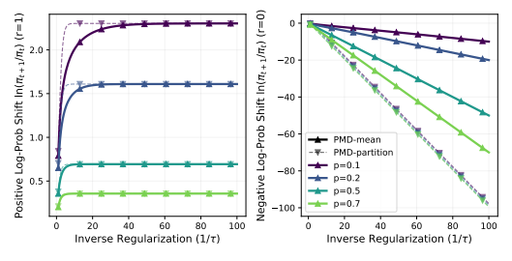
Figure 2 : The (log) probability ratio of updates in PMD-MEANis more conservative than that in PMD-PARTfor binary rewards.
원문 · CC BY 4.0 · Zhenghao Xu, Qin Lu, Changlong Yu, Tuo Zhao · Approximation of Log-Partition Function in Policy Mirror Descent Induces Implicit Regularization for LLM Post-Training · 원문 그림 인용 · 원본 PDF 6쪽에서 그림 영역을 추출했습니다.혼합 KL–χ2 정규화로 읽기
이 논문은 PMD-MEAN의 해를 직접 정규화 항으로 다시 씁니다. 목적은 보상의 기댓값에서 τKL(π∥πt)과 (λ/2τ)χ2(π∥πt)를 뺀 형태로 쓰이며, 이것이 기본 PMD-MEAN 해와 같은 KKT 조건을 만족한다고 보입니다. 즉 PMD-MEAN은 KL과 χ2 항이 섞인 mirror descent 부문제를 풀고 있는 것으로 해석됩니다.
이때 χ2 계수 λ/τ는 고정 하이퍼파라미터가 아니라 현재 롤아웃의 보상 분포에 따라 정해지는 적응형 계수입니다. 이진 보상에서는 λ/τ가 τ→0에서도 O(1) 크기로 남습니다. 따라서 KL 계수가 작아도 χ2 항이 정책 비율의 큰 변화를 억제합니다.
유한 롤아웃에서의 수렴과 목표 추정 오차
논문은 회귀 기반 불완전 PMD 분석을 사용합니다. 이상적 목표의 수렴률은 이진 보상과 작은 τ 설정에서 비교됩니다. PMD-PART의 이상적 수렴률은 1 − 1/(1 − pt + pt e^(1/τ))로 표현되고, PMD-MEAN은 1 − exp(−pt/τ)(1+o(1))로 표현됩니다. 두 방법 모두 τ가 0에 가까워지면 1에 가까워지지만, pt가 작을 때는 PMD-PART가 더 빠르게 접근합니다.
그러나 유한 롤아웃에서는 목표 추정 오차 ∆2가 중요해집니다. PMD-PART에서는 n이 작고 pt가 작을 때 오차가 크게 나타나며, 논문은 이 영역에서 PMD-MEAN의 오차가 더 작다고 주장합니다. 정련된 분석에서는 PMD-MEAN의 오차 항이 n이 커질수록 사라진다고 제시됩니다. 이 결과들은 주어진 가정과 점근 근사 아래의 이론적 비교입니다.
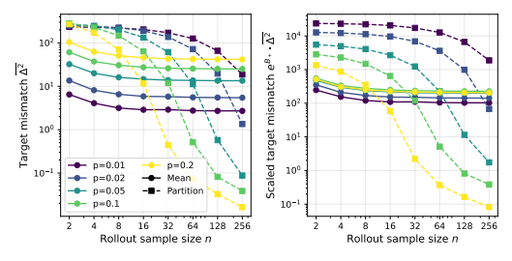
Figure 3 : Target estimation error of PMD-MEAN and PMD-PART under τ = 0.05 and pt ranges from 0.01 to 0.2. Left: the target estimation error ∆2. Right: The scaled estimation error with corresponding prefactor e B+ in (22). The plot shows the average from 100 random seeds. When the rollout sample size n is small, the error of PMD-PART is much larger for small pt.
원문 · CC BY 4.0 · Zhenghao Xu, Qin Lu, Changlong Yu, Tuo Zhao · Approximation of Log-Partition Function in Policy Mirror Descent Induces Implicit Regularization for LLM Post-Training · 원문 그림 인용 · 원본 PDF 9쪽에서 그림 영역을 추출했습니다.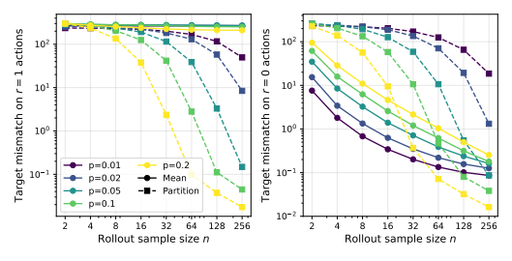
Figure 6 : Target estimation error for positive and negative actions in PMD-MEANand PMD-PART under τ= 0.05 and pt ranges from 0.01 to 0.2. Left: positive actions. Right: negative actions. The plot shows the average from 100 random seeds. The error in PMD-MEANmainly comes from a systematic mismatch between positive targets.
원문 · CC BY 4.0 · Zhenghao Xu, Qin Lu, Changlong Yu, Tuo Zhao · Approximation of Log-Partition Function in Policy Mirror Descent Induces Implicit Regularization for LLM Post-Training · 원문 그림 인용 · 원본 PDF 18쪽에서 그림 영역을 추출했습니다.수학 추론 실험 결과
실험은 DAPO-Math-17k로 학습한 Qwen2.5-7B와 Qwen3-30B-A3B-Base에서 AIME 2024와 AIME 2025의 Avg@32 점수로 평가합니다. Qwen2.5-7B에서 GRPO는 AIME 2024 17.08, AIME 2025 10.52, 평균 13.80입니다. PMD-MEAN(τ=0.005)은 19.69, 19.48, 평균 19.58로 높습니다. τ=0.01과 0.02의 PMD-MEAN도 평균 17.55와 19.58을 보고합니다.
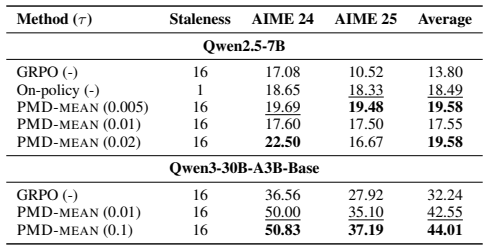
Table 1 : Overall evaluation scores (Avg@32). Staleness indicates the number of ministeps using rollouts from the same old policy.
원문 · CC BY 4.0 · Zhenghao Xu, Qin Lu, Changlong Yu, Tuo Zhao · Approximation of Log-Partition Function in Policy Mirror Descent Induces Implicit Regularization for LLM Post-Training · 원문 그림 인용 · 원본 PDF 10쪽에서 그림 영역을 추출했습니다.Qwen3-30B-A3B-Base에서는 GRPO가 36.56, 27.92, 평균 32.24입니다. PMD-MEAN(τ=0.1)은 50.83, 37.19, 평균 44.01입니다. 이 점수는 각 모델과 τ 설정에 묶인 결과이며, 다른 모델이나 과제로 일반화하기 전에 같은 설정을 확인해야 합니다. 같은 표에서 GSPO와 비교하면 7B에서는 PMD-MEAN이 19.58로 GSPO의 13.75보다 높고, 30B에서는 44.01이 GSPO의 43.96과 거의 같습니다.
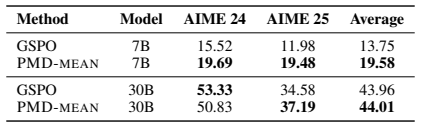
Table 3 : Comparison of PMD-MEANand GSPO (Avg@32).
원문 · CC BY 4.0 · Zhenghao Xu, Qin Lu, Changlong Yu, Tuo Zhao · Approximation of Log-Partition Function in Policy Mirror Descent Induces Implicit Regularization for LLM Post-Training · 원문 그림 인용 · 원본 PDF 11쪽에서 그림 영역을 추출했습니다.학습 안정성과 효율
논문은 학습 곡선을 보고 PMD-MEAN이 학습 중 안정적이라고 설명합니다. 반면 PMD-PART는 Figure 4에서 불안정하며 큰 τ에서도 붕괴할 수 있다고 보고합니다. 이 안정성은 주로 학습 곡선과 정책 비율의 경향으로 제시되므로, 최종 점수와 분리해 읽어야 합니다.
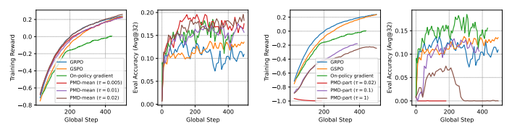
Figure 4 : Training curves (smoothed) of PMD-MEAN(upper) and PMD-PART(lower) with baselines for Qwen2.5-7B on DAPO-Math-17k (left) and the averaged evaluation accuracy on AIME 2024 and AIME 2025 (right). The global step of on-policy gradient is divided by 16 to match other algorithms.
원문 · CC BY 4.0 · Zhenghao Xu, Qin Lu, Changlong Yu, Tuo Zhao · Approximation of Log-Partition Function in Policy Mirror Descent Induces Implicit Regularization for LLM Post-Training · 원문 그림 인용 · 원본 PDF 10쪽에서 그림 영역을 추출했습니다.효율 측면에서 Table 2는 on-policy 방식의 전체 시간을 0.0569 ms/token, PMD-MEAN을 0.0126 ms/token으로 보고합니다. 본문은 큰 전역 배치가 추론 비용을 나누어 주어 약 4.6배 속도 향상이 있다고 설명합니다. 이 값은 해당 실험 설정의 측정이며, 다른 하드웨어나 배치 설정으로 옮길 수 없습니다.

Table 2 : Comparing efficiency of on-policy gradient and PMD-MEAN. Timing is in milliseconds per token. While the actor update cost is comparable, a larger global batch size (high staleness) amortizes the inference cost and reduces overall training time.
원문 · CC BY 4.0 · Zhenghao Xu, Qin Lu, Changlong Yu, Tuo Zhao · Approximation of Log-Partition Function in Policy Mirror Descent Induces Implicit Regularization for LLM Post-Training · 원문 그림 인용 · 원본 PDF 10쪽에서 그림 영역을 추출했습니다.적용 범위와 한계
이 논문의 핵심 분석은 이진 보상 r(y)∈{0,1}과 작은 τ 설정에 맞춰져 있습니다. 따라서 연속 보상이나 다른 정규화 강도에서 같은 결론이 성립하는지는 이 분석만으로 판단할 수 없습니다. 실험도 수학 추론 과제와 두 기반 모델에 제한됩니다.
또한 본문의 30B 향상폭 설명과 표 1의 값은 서로 다르게 계산됩니다. 따라서 수치를 인용할 때는 표 값과 본문 서술을 함께 확인해야 합니다. 안정성 주장은 학습 곡선에 근거하며, 저자들은 적응형 τ 설계를 향후 과제로 남깁니다.
논문 정보
- 저자
- Zhenghao Xu, Qin Lu, Changlong Yu, Tuo Zhao
- 학회·저널
- arXiv · 프리프린트
- 최초 공개일
- 2026년 2월 5일
- 등록일
- 2026년 10월 29일
- 수정일
- 2026년 2월 5일
- 버전
- v1
- arXiv
- 2602.05933
- 분류
- cs.LG
- 원문 이용 조건
- CC BY 4.0
- 제공 범위
- 논문 정보, 해설, 허용된 원문 그림
AI 해설은 논문 원문과 별개의 설명이며 오류가 있을 수 있습니다. 원문과 그림은 각 출처의 이용 조건과 따로 표시된 권리를 따릅니다.
초록
Policy mirror descent (PMD) provides a principled framework for reinforcement learning (RL) by iteratively solving KL-regularized policy improvement subproblems. While this approach has been adopted in training advanced LLMs such as Kimi K1.5/K2, the ideal closed-form PMD updates require reliable partition function estimation, a significant challenge when working with limited rollouts in the vast action spaces of LLMs. We investigate a practical algorithm, termed PMD-mean, that approximates the log-partition term with the mean reward under the sampling policy and performs regression in log-policy space. Specifically, we characterize the population solution of PMD-mean and demonstrate that it implicitly optimizes mirror descent subproblems with an adaptive mixed KL--$χ^2$ regularizer. This additional $χ^2$ regularization constrains large probability changes, producing more conservative updates when expected rewards are low and enhancing robustness against finite-sample estimation errors. Experiments on math reasoning tasks show that PMD-mean achieves superior performance with improved stability and time efficiency. These findings deepen our understanding of PMD-mean and illuminate pathways toward principled improvements in RL algorithms for LLMs. Code is available at https://github.com/horizon-rl/OpenKimi.
원문 인용
Zhenghao Xu, Qin Lu, Changlong Yu, Tuo Zhao (2026). Approximation of Log-Partition Function in Policy Mirror Descent Induces Implicit Regularization for LLM Post-Training. arXiv:2602.05933v1. https://arxiv.org/abs/2602.05933v1
BibTeX
@misc{xu2026approximation,
  title = {{Approximation of Log-Partition Function in Policy Mirror Descent Induces Implicit Regularization for LLM Post-Training}},
  author = {Zhenghao Xu and Qin Lu and Changlong Yu and Tuo Zhao},
  year = {2026},
  eprint = {2602.05933},
  archivePrefix = {arXiv},
  url = {https://arxiv.org/abs/2602.05933v1}
}