논문 해설
Rethinking RGB-D Salient Object Detection: Models, Data Sets, and Large-Scale Benchmarks
RGB-D 돌출 객체 탐지 재고: 모델, 데이터셋, 대규모 벤치마크
- 연구 문제 저품질 깊이 맵을 명시적으로 걸러내는 모델과 사람 중심 RGB-D 데이터셋이 필요합니다.
- 연구 방법 깊이 정제 유닛과 세 갈래 특징 학습 모듈로 구성된 D3Net을 제안합니다.
- 주요 결과 논문은 D3Net이 평가 대상 다섯 지표에서 기존 연구를 능가한다고 보고합니다.
RGB-D 돌출 객체 검출의 문제
깊이 정보는 스마트폰에도 널리 탑재되어 있지만, 기존 RGB-D 돌출 객체 검출 연구는 Kinect나 라이트 필드 카메라로 얻은 데이터에 주로 의존해 왔습니다. 저자들은 스마트폰 카메라에서 얻은 사람 중심의 실제 장면 데이터가 부족하다고 지적합니다. 또한 저품질 깊이 맵은 잘못된 검출을 일으킬 수 있지만, 기존 모델은 깊이 맵을 명시적으로 걸러내지 않고 RGB와 깊이 특징을 여러 전략으로 융합해 왔습니다. 이 논문은 이 두 공백을 데이터셋 구축, 모델 설계, 대규모 벤치마크로 함께 다룹니다.
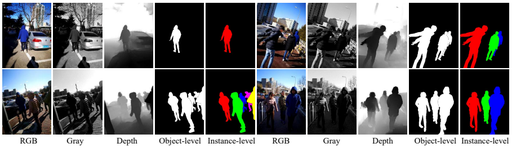
Figure 3 . Examples of images, depth maps and annotations ( i.e., object-level, instance-level) in our SIP dataset with different numbers of salient objects, object sizes, object positions, scene complexities, and lighting conditions. Note that the “RGB” and “Gray” images are captured by two different monocular cameras from short distances. Thus, the “Gray” images are slightly different from the grayscale images obtained from colorful (RGB) image. Our SIP dataset provides a new direction such as depth estimating from “RGB” and “Gray” images, and instance-level RGB-D salient object detection.
원문 · CC BY 4.0 · Deng-Ping Fan, Zheng Lin, Jia-Xing Zhao, Yun Liu, Zhao Zhang, Qibin Hou, Menglong Zhu, Ming-Ming Cheng · Rethinking RGB-D Salient Object Detection: Models, Data Sets, and Large-Scale Benchmarks · 원문 그림 인용 · 원본 PDF 2쪽에서 그림 영역을 추출했습니다.D3Net의 구조와 깊이 정제 유닛
D3Net은 깊이 정제 유닛(DDU)과 세 갈래 특징 학습 모듈(FLM)로 구성됩니다. FLM은 RgbNet, RgbdNet, DepthNet의 세 하위 네트워크로 이루어지며, 각 하위 네트워크는 224×224로 재조정된 입력을 받아 Srgb, Srgbd, Sdepth 예측 맵을 만듭니다. 백본으로는 VGG-16을 사용하고 FPN 형태의 상향식·하향식 경로와 측면 연결을 적용합니다. 학습 단계에서는 세 하위 네트워크가 각각 교차 엔트로피 손실로 학습되며, DDU는 테스트 단계에서만 사용됩니다. 테스트 단계에서 Sdepth와 Srgbd 사이의 MAE 기반 거리 δ가 임계값 t=0.15 이하이면 게이트 Fcu가 1이 되어 Srgbd를 선택하고, 그렇지 않으면 Srgb를 선택합니다.
이 게이트는 깊이 맵을 아예 제거하는 것이 아니라 깊이 경로로 인한 예측을 억제하고 RGB 경로를 선택하는 방식으로 작동합니다.
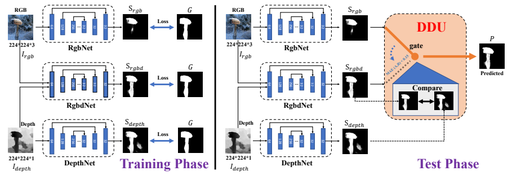
Figure 5 . Illustration of the proposed D 3Net. In the training stage (Left), the input RGB and depth images are processed with three parallel sub-networks, e.g., RgbNet, RgbdNet, and DepthNet. The three sub-networks are based on a same modified structure of Feature Pyramid Networks (FPN) (see § IV-A for details). We introduced these sub-networks to obtain three saliency maps ( i.e., Srgb, Srgbd, and Sdepth ) which considered both coarse and fine details of the input. In the test phase (Right), a novel depth depurator unit (DDU) ( § IV-B) is utilized for the first time in this work to explicitly discard ( i.e., Srgbd) or keep ( i.e., Srgbd) the saliency map introduced by the depth map. In the training/test phase, these components form a nested structure and are elaborately designed ( e.g., gate connection in DDU) to automatically learn the salient object from the RGB image and Depth image jointly.
원문 · CC BY 4.0 · Deng-Ping Fan, Zheng Lin, Jia-Xing Zhao, Yun Liu, Zhao Zhang, Qibin Hou, Menglong Zhu, Ming-Ming Cheng · Rethinking RGB-D Salient Object Detection: Models, Data Sets, and Large-Scale Benchmarks · 원문 그림 인용 · 원본 PDF 6쪽에서 그림 영역을 추출했습니다.벤치마크 설정과 주요 비교 결과
논문은 NJU2K와 NLPR의 학습 목록을 사용해 CPFP와 동일한 학습 설정을 따르고, NJU2K와 NLPR의 테스트 세트 및 STERE, DES, SSD, LFSD, SIP 전체를 평가에 사용합니다. 평가 지표는 MAE, F-measure, S-measure, E-measure, PR 곡선입니다. 저자들은 D3Net이 평가한 다섯 지표에서 기존 연구를 능가한다고 보고하며, CPFP 대비 여섯 데이터셋에서 1.0%에서 5.8%, SIP에서 1.4%의 향상을 제시합니다. 다만 이 수치는 해당 학습 설정과 테스트 조건에서 얻은 결과이며, 다른 데이터나 모델 조건으로 일반화하지 않아야 합니다.
DDU 분석과 한계
DDU의 상한과 하한을 분석하기 위해 RgbNet 또는 RgbdNet 중 최적 경로를 선택해 집계했습니다. 이 분석에서 D3Net은 상한과 약 1.6%의 평균 격차를 보였습니다. 또 SIP 데이터셋의 이미지 수는 대부분의 RGB 돌출 객체 검출 데이터셋보다 적다고 저자들은 밝힙니다. 세 하위 네트워크로 구성된 구조는 가벼운 장치에서 메모리를 늘릴 수 있다는 한계도 있습니다.
논문 정보
- 저자
- Deng-Ping Fan, Zheng Lin, Jia-Xing Zhao, Yun Liu, Zhao Zhang, Qibin Hou, Menglong Zhu, Ming-Ming Cheng
- 학회·저널
- arXiv · 프리프린트
- 최초 공개일
- 2019년 7월 15일
- 등록일
- 2026년 11월 6일
- 수정일
- 2020년 7월 11일
- 버전
- v2
- arXiv
- 1907.06781
- DOI
- 10.1109/tnnls.2020.2996406
- 분류
- cs.CV
- 원문 이용 조건
- CC BY 4.0
- 제공 범위
- 논문 정보, 해설, 허용된 원문 그림
AI 해설은 논문 원문과 별개의 설명이며 오류가 있을 수 있습니다. 원문과 그림은 각 출처의 이용 조건과 따로 표시된 권리를 따릅니다.
초록
The use of RGB-D information for salient object detection has been extensively explored in recent years. However, relatively few efforts have been put towards modeling salient object detection in real-world human activity scenes with RGBD. In this work, we fill the gap by making the following contributions to RGB-D salient object detection. (1) We carefully collect a new SIP (salient person) dataset, which consists of ~1K high-resolution images that cover diverse real-world scenes from various viewpoints, poses, occlusions, illuminations, and backgrounds. (2) We conduct a large-scale (and, so far, the most comprehensive) benchmark comparing contemporary methods, which has long been missing in the field and can serve as a baseline for future research. We systematically summarize 32 popular models and evaluate 18 parts of 32 models on seven datasets containing a total of about 97K images. (3) We propose a simple general architecture, called Deep Depth-Depurator Network (D3Net). It consists of a depth depurator unit (DDU) and a three-stream feature learning module (FLM), which performs low-quality depth map filtering and cross-modal feature learning respectively. These components form a nested structure and are elaborately designed to be learned jointly. D3Net exceeds the performance of any prior contenders across all five metrics under consideration, thus serving as a strong model to advance research in this field. We also demonstrate that D3Net can be used to efficiently extract salient object masks from real scenes, enabling effective background changing application with a speed of 65fps on a single GPU. All the saliency maps, our new SIP dataset, the D3Net model, and the evaluation tools are publicly available at https://github.com/DengPingFan/D3NetBenchmark.
원문 인용
Deng-Ping Fan, Zheng Lin, Jia-Xing Zhao, Yun Liu, Zhao Zhang, Qibin Hou, Menglong Zhu, Ming-Ming Cheng (2019). Rethinking RGB-D Salient Object Detection: Models, Data Sets, and Large-Scale Benchmarks. arXiv:1907.06781v2. https://doi.org/10.1109/tnnls.2020.2996406
BibTeX
@article{fan2019rethinking,
  title = {{Rethinking RGB-D Salient Object Detection: Models, Data Sets, and Large-Scale Benchmarks}},
  author = {Deng-Ping Fan and Zheng Lin and Jia-Xing Zhao and Yun Liu and Zhao Zhang and Qibin Hou and Menglong Zhu and Ming-Ming Cheng},
  year = {2019},
  eprint = {1907.06781},
  archivePrefix = {arXiv},
  doi = {10.1109/tnnls.2020.2996406},
  url = {https://arxiv.org/abs/1907.06781v2}
}