논문 해설
Optimal Rates for Adaptive Private $k$-PCA
적응형 차분 프라이버시 $k$-PCA의 최적 수렴률
- 연구 문제 확률적 설정에서 차분 프라이버시를 지키면서 상위 k 부분공간을 추정할 때, 기존 방법은 샘플 복잡도나 잡음 수준에서 최적이 아닙니다.
- 연구 방법 AdaDPO는 Oja 기반의 d×k 블록 갱신을 쓰고, 범위 추정과 잘라낸 평균으로 잡음 크기를 실제 변동에 맞춥니다. TAdaDPO는 워밍업 후 접공간 투영 업데이트로 스펙트럼 의존성을 개선합니다.
- 주요 결과 합성 스파이크 공분산 실험에서 AdaDPO는 지정된 기준선보다 낮은 부분공간 오차를 보고합니다. TAdaDPO는 평탄 꼬리 가우시안 설정에서 하한과 로그 인자 차이 내에서 일치한다고 주장됩니다.
확률적 private PCA의 문제
이 논문은 n개의 독립 대칭 행렬 A_i가 공통 기댓값 Σ를 갖는 확률적 설정에서, 개별 샘플 A_i를 차분 프라이버시로 보호하면서 상위 k 고유공간을 추정하는 문제를 다룹니다. 기존 고정 데이터셋 private PCA 방법은 결정적 노름 경계를 클리핑으로 강제하므로, 확률적 설정에 옮기면 샘플 크기나 잡음 수준이 최적이 되지 않는다고 원문은 설명합니다. 선행 적응형 방법인 k-DP-PCA는 한 방향씩 추정하고 투영을 제거하는 디플레이션 구조여서 k에 대한 추가 의존성이 생깁니다.
AdaDPO의 비-디플레이션 적응형 갱신
AdaDPO는 Oja 알고리즘을 기반으로 d×k 부분공간 Q를 한 번에 갱신합니다. 각 반복에서 PrivRange가 투영된 샘플 A_iQ의 범위 파라미터를 개인정보 보호 방식으로 추정하고, TruncatedMean이 추정된 중심 주변으로 값을 잘라 평균을 계산한 뒤 Gaussian 잡음을 더합니다. 이때 잡음의 크기는 고정된 최악 반경이 아니라 실제 변동에서 얻은 범위에 맞춰지므로, 확률적 변동이 작아지면 클리핑 반경과 잡음도 함께 작아집니다. 원문은 대칭 잡음 표현이 Q에 독립적이도록 GOE 기반 표기를 사용해 Oja 분석을 적용할 수 있게 한다고 설명합니다.
TAdaDPO의 접공간 정제
TAdaDPO는 AdaDPO로 얻은 일정 정확도의 워밍업 추정치 Q_0에서 시작해, 새로운 샘플에 대해 접공간 투영 업데이트 Π_{t-1}A_iQ_{t-1}만 사용합니다. 원문은 Q 내부 성분이 기저의 좌표만 바꾸고 부분공간을 바꾸지 않으므로, 접공간 성분만 남기면 부분공간을 움직이는 잔차 보정에 집중할 수 있다고 설명합니다. 이 정제 단계는 국소 모델인 Assumption B 아래에서 분석되며, 그 결과 스펙트럴 인자가 λ1/(λk−λk+1) 대신 √(λ1λ_{k+1})/(λk−λ_{k+1}) 형태로 나타난다고 보고합니다.
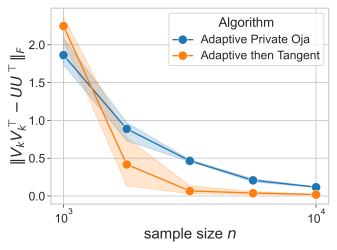
Figure 2 :Comparison of AdaDPO with a two-stage variant that warm-starts withAdaDPO and then runs TAdaDPO.
원문 · CC BY 4.0 · Johanna Düngler, Amartya Sanyal · Optimal Rates for Adaptive Private $k$-PCA · 원문 그림 인용 · 원본 PDF 11쪽에서 그림 영역을 추출했습니다.Assumption A와 B의 적용 범위
Assumption A는 행렬 집중과 꼬리 조건을 포함한 전역 모델로, AdaDPO의 유틸리티 분석에만 사용됩니다. 원문은 프라이버시 보장이 분포에 의존하지 않는다고 명시하며, 이는 이 연구가 Cai 등의 평탄 꼬리 조건과 구분되는 지점입니다. Assumption B는 워밍업 이후 상수 정확도 이웃에서만 필요한 국소 접공간 모델이며, 전역 모델로부터 얻는 경계를 더 날카로운 접공간 척도로 대체합니다.
실험 비교와 해석 범위
스파이크 공분산 데이터에서 AdaDPO를 k-DP-PCA, k-DP-Oja, DP-Gauss-1·2, 잡음 거듭제곱법 기준선과 비교합니다. 원문은 ε=1, δ=0.01 설정에서 10회 시행의 평균과 95% 신뢰구간을 보고하며, 차원과 고유값 간격, 잡음 수준과 표본 크기를 바꾼 결과에서 AdaDPO가 더 낮은 부분공간 오차를 보인다고 설명합니다. 이 비교는 특정 합성 스파이크 모델과 지정된 기준선 조정에 한정되며, 기준선들은 원래 결정적 bounded 데이터 설정을 클리핑으로 맞춘 것입니다.
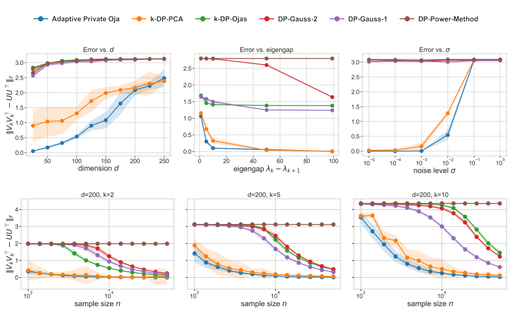
Figure 1 :Comparison ofAdaDPOwith baselines on the spiked covariance model. We plot the mean over 10 trials, with shaded regions representing 95% confidence intervals. We setε = 1, δ = 0.01. For the top row figures we set k= 5.
원문 · CC BY 4.0 · Johanna Düngler, Amartya Sanyal · Optimal Rates for Adaptive Private $k$-PCA · 원문 그림 인용 · 원본 PDF 8쪽에서 그림 영역을 추출했습니다.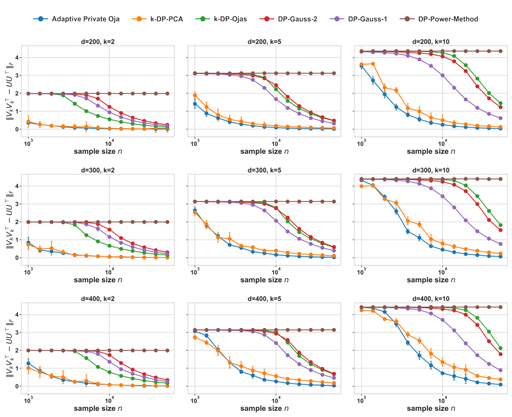
Figure 3 :Comparison ofAdaDPOwith baselines for varying k and d on the spiked covariance model. We plot the mean over 10 trials, with the bars representing the standard deviation.
원문 · CC BY 4.0 · Johanna Düngler, Amartya Sanyal · Optimal Rates for Adaptive Private $k$-PCA · 원문 그림 인용 · 원본 PDF 71쪽에서 그림 영역을 추출했습니다.한계와 남은 질문
원문은 현재 개인정보 보호 범위 추정이 중간·경계 꼬리 집중 결과에 의존하므로, 무거운 꼬리 데이터로 확장하려면 추가 연구가 필요하다고 논의합니다. 또한 AdaDPO는 전체 d×k 반복을 사용하므로 스트리밍 구현에 적합하지만, 완전한 온라인 적응형 프라이버시 보정은 향후 과제로 남아 있습니다.
논문 정보
- 저자
- Johanna Düngler, Amartya Sanyal
- 학회·저널
- arXiv · 프리프린트
- 최초 공개일
- 2026년 11월 9일
- 등록일
- 2026년 11월 10일
- 수정일
- 2026년 11월 9일
- 버전
- v1
- arXiv
- 2611.12419
- 분류
- cs.LG · stat.ML
- 원문 이용 조건
- CC BY 4.0
- 제공 범위
- 논문 정보, 해설, 허용된 원문 그림
AI 해설은 논문 원문과 별개의 설명이며 오류가 있을 수 있습니다. 원문과 그림은 각 출처의 이용 조건과 따로 표시된 권리를 따릅니다.
초록
Given $n$ i.i.d. random matrices $A_i \in \mathbb{R}^{d \times d}$ with common expectation $Σ$, the goal of \emph{Differentially Private Stochastic PCA} is to identify a $k$-dimensional subspace capturing the leading variance directions of $Σ$, while preserving differential privacy~(DP) for each individual sample $A_i$. \citet{dungler2025iterative} introduced \kdppca, the first algorithm to simultaneously (1) achieve sample complexity $n=\widetilde O(d)$ for sub-Gaussian data, (2) adapt its privacy noise to the intrinsic randomness of the data, and (3) extend seamlessly to any target dimension $k\le d$. However, its sample complexity has a suboptimal dependence on $k$. We propose the first algorithm that achieves optimal sample complexity in both $d$ and $k$, while retaining properties (2) and (3) of \kdppca. Additionally, prior utility guarantees require a minimum sample size with exponential dependence on the eigengap. Our method removes this dependence. It also improves the dependence on spectral parameters, matching known lower bounds for the spiked covariance model. Unlike deflation-based approaches like \kdppca, our algorithm updates the full $d\times k$ subspace jointly rather than one eigenvector at a time. This non-deflation structure simplifies the algorithm, reduces the number of hyper-parameters, and improves computational efficiency, particularly when using block linear algebra libraries.
원문 인용
Johanna Düngler, Amartya Sanyal (2026). Optimal Rates for Adaptive Private $k$-PCA. arXiv:2611.12419v1. https://arxiv.org/abs/2611.12419v1
BibTeX
@misc{dngler2026optimal,
  title = {{Optimal Rates for Adaptive Private $k$-PCA}},
  author = {Johanna Düngler and Amartya Sanyal},
  year = {2026},
  eprint = {2611.12419},
  archivePrefix = {arXiv},
  url = {https://arxiv.org/abs/2611.12419v1}
}