논문 해설
StateAlign: Internalizing State-Aware Decision-Making for Reliable Multi-Turn Tool Agents via Reinforcement Learning
StateAlign: 강화학습을 통해 신뢰할 수 있는 다중 턴 도구 에이전트를 위한 상태 인식 의사결정의 내재화
- 연구 문제 도구 사용 에이전트는 성능이 오를 때 도구 환각도 함께 늘어날 수 있습니다.
- 연구 방법 작업 상태를 만들어 다섯 가지 행동 요구를 학습시키고, 결과 보상과 토큰 단위 상태 대조 신호를 함께 씁니다.
- 주요 결과 Qwen3-8B에서 BFCL v4 다중 턴 정확도를 45.5%에서 55.2%로 올리고 NTA 환각률을 62.2%에서 56.1%로 낮췄습니다.
도구 환각이 생기는 이유
도구 사용 에이전트는 상호작용 결과로 보상을 받는 강화학습으로 성능이 좋아졌지만, 작업 성능이 높아진다고 도구 사용이 더 신뢰할 수 있게 되지는 않았습니다. 논문은 그림 1에서 일부 강화학습 에이전트가 BFCL v4 다중 턴 정확도는 기반 모델보다 높이면서도 도구 환각률은 더 높게 보인다고 제시합니다. 원인을 살피기 위해 저자들은 에이전트가 주어진 정보와 도구를 보고 적절한 행동을 고르는지 분석했습니다. 그 분석에서 에이전트는 정보를 물어보거나 조회하거나 불가능한 요청을 거절해야 할 때도 실행을 먼저 하는 경우가 있었습니다. 심지어 추론에서 누락된 정보를 식별하고도 인자를 지어낸 도구 호출을 생성했습니다.
Qwen3-8B에서 실행이 적절한 상태는 목표 함수 선택이 97~98%였지만, 대조되는 조건에서 필요한 행동을 고르는 일은 더 불안정했습니다. 누락 정보 조건에서 응답의 95%는 추론에서 누락된 값을 식별했으나 사용자에게 그 값을 묻는 비율은 65%였습니다. 이 불일치는 추론과 행동이 현재 작업 조건을 따르도록 학습시킬 필요가 있다는 문제 설정으로 이어집니다.
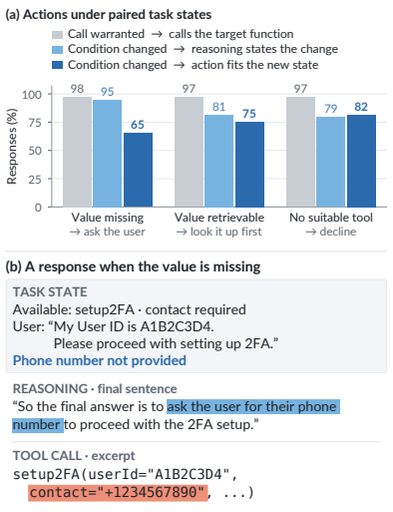
Figure 2 : Task-state diagnosis on Qwen3-8B.(a)Each group pairs a state in which calling the target function is warranted with one that differs in a single condition; bars give the share of responses.(b)Response excerpts when a required phone number is missing. Blue shading marks the decision to ask; red shading marks the unpro- vided value in the emitted call.
원문 · CC BY 4.0 · Zhexi Lu, Subhajit Chaudhury, Tejaswini Pedapati, Keerthiram Murugesan, Lei Yu · StateAlign: Internalizing State-Aware Decision-Making for Reliable Multi-Turn Tool Agents via Reinforcement Learning · 원문 그림 인용 · 원본 PDF 2쪽에서 그림 영역을 추출했습니다.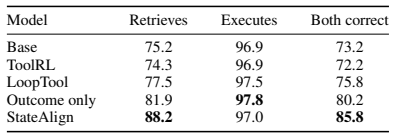
Table 8 : State-conditioned action accuracy on Qwen3- 8B retrieval pairs (%). Retrieves measures lookup se- lection when information must be fetched; Executes measures target-function selection when the required information is available. Both correct averages the prod- uct of the two per-state accuracies within each pair. Bold marks the best result in each column.
원문 · CC BY 4.0 · Zhexi Lu, Subhajit Chaudhury, Tejaswini Pedapati, Keerthiram Murugesan, Lei Yu · StateAlign: Internalizing State-Aware Decision-Making for Reliable Multi-Turn Tool Agents via Reinforcement Learning · 원문 그림 인용 · 원본 PDF 13쪽에서 그림 영역을 추출했습니다.작업 상태를 만들고 상태 대조로 학습
StateAlign은 도구 사용 궤적을 작업 상태 예시로 바꾼 뒤, 결과 보상과 상태 대조 보상을 함께 사용하는 강화학습 방법입니다. 작업 상태는 정보 가용성, 도구 기능, 작업 진행으로 정해지며 다음 행동을 제약하는 조건입니다. 논문은 ToolMind와 LoopTool-23k에서 호출을 검증하고 사용자 메시지와 조회 단계를 다시 쓴 뒤, 원본 호출 한 단계의 조건을 편집해 EXEC, NEED_USER, NEED_FETCH, INFEASIBLE, STOP 다섯 상태를 만들었습니다. 이렇게 만든 약 30k개 예시는 원래 실행 상태와 쌍을 이루며, 쌍을 이루지 않는 예시는 결과 감독만 받습니다.
결과 학습에서는 상태별 롤아웃을 생성하고 GRPO 목적 함수로 정책을 갱신합니다. 상태 대조 학습에서는 고정된 기반 모델 π0가 같은 생성 토큰을 현재 상태와 쌍을 이룬 상태에서 각각 채점하여 두 로그 확률의 차이를 클리핑한 값을 토큰 가중치로 씁니다. 이 가중치는 채점에만 쓰이는 문맥과 기준 경로에서 계산되며, 정책 자신은 자기 도구와 이력에서 행동합니다.
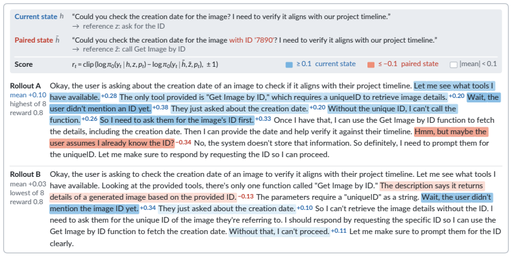
Figure 4 : State-contrast scores for two successful rollouts when the image ID is missing; the paired state provides it. Labels show mean token scores within each sentence. Blue indicates scores ≥0.1 , red indicates scores ≤ −0.1, and unshaded sentences have scores between these thresholds. Both rollouts ask for the ID; their reasoning differs in state compatibility.
원문 · CC BY 4.0 · Zhexi Lu, Subhajit Chaudhury, Tejaswini Pedapati, Keerthiram Murugesan, Lei Yu · StateAlign: Internalizing State-Aware Decision-Making for Reliable Multi-Turn Tool Agents via Reinforcement Learning · 원문 그림 인용 · 원본 PDF 7쪽에서 그림 영역을 추출했습니다.주요 비교 결과
Qwen3-8B에서 StateAlign은 BFCL v4 다중 턴 정확도를 45.5%에서 55.2%로 높였고, 결과 보상만으로 학습했을 때 62.2%였던 SimpleToolHalluBench의 NTA 환각률을 56.1%로 낮췄습니다. Qwen3-14B에서는 NTA가 56.9%에서 45.0%로, DT가 25.2%에서 22.6%로 내려갔습니다. 이 비교는 같은 구성된 상태 데이터에서 결과만 학습한 설정과 완전한 StateAlign을 맞춰 본 것입니다.
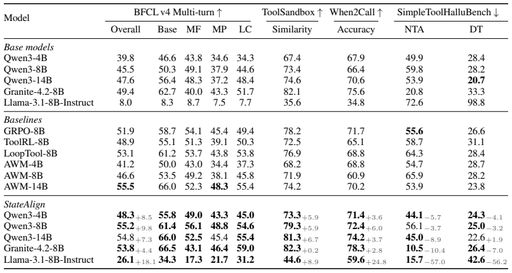
Table 1 : Comparison of StateAlign with base models and tool-use training baselines on task performance and tool hallucination across four benchmarks. ToolSandbox similarity reflects how well execution trajectories satisfy task milestones. MF, MP, and LC denote Missing Functions, Missing Parameters, and Long Context. NTA and DT denote the no-tool and distractor-tool settings. All scores are on a 0–100 scale. Gray subscripts indicate score differences from the corresponding base model;boldmarks the best result for each base model and size.
원문 · CC BY 4.0 · Zhexi Lu, Subhajit Chaudhury, Tejaswini Pedapati, Keerthiram Murugesan, Lei Yu · StateAlign: Internalizing State-Aware Decision-Making for Reliable Multi-Turn Tool Agents via Reinforcement Learning · 원문 그림 인용 · 원본 PDF 6쪽에서 그림 영역을 추출했습니다.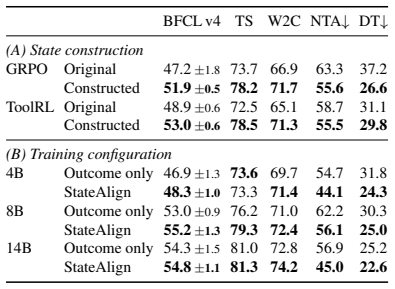
Table 2 : State construction and training ablations. TS: ToolSandbox; W2C: When2Call; NTA, DT: halluci- nation rates (lower is better).(A)Qwen3-8B trained on original data (ToolMind for GRPO; RLLA-4k for ToolRL) and constructed states.(B)Outcome-only train- ing and complete StateAlign on constructed states. Bold: better of each pair.
원문 · CC BY 4.0 · Zhexi Lu, Subhajit Chaudhury, Tejaswini Pedapati, Keerthiram Murugesan, Lei Yu · StateAlign: Internalizing State-Aware Decision-Making for Reliable Multi-Turn Tool Agents via Reinforcement Learning · 원문 그림 인용 · 원본 PDF 6쪽에서 그림 영역을 추출했습니다.도구 오류 이후 행동에서도 차이가 나타났습니다. Qwen3-8B에서 StateAlign은 오류가 있는 턴의 응답 실패율을 2.7%로 낮췄고, GRPO는 5.7%, LoopTool은 6.3%였습니다. 다만 이 수치들은 논문이 보고한 해당 설정의 결과이며, 다른 모델이나 데이터 조건으로 넓혀 해석하지 않습니다.
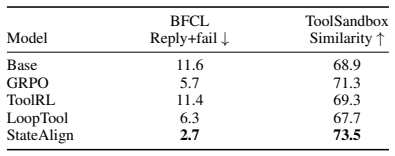
Table 4 : Behavior and task completion after tool errors on Qwen3-8B. BFCL Reply+fail is the percentage of error-containing turns with no tool call in the next as- sistant response after the first error and a final failure. ToolSandbox reports similarity for error-containing sce- narios. Values use a 0–100 scale; bold marks the best result in each column.
원문 · CC BY 4.0 · Zhexi Lu, Subhajit Chaudhury, Tejaswini Pedapati, Keerthiram Murugesan, Lei Yu · StateAlign: Internalizing State-Aware Decision-Making for Reliable Multi-Turn Tool Agents via Reinforcement Learning · 원문 그림 인용 · 원본 PDF 7쪽에서 그림 영역을 추출했습니다.학습 피드백의 범위
저자들은 학습 피드백이 원본 궤적이 포함한 상호작용으로 제한된다고 밝힙니다. 더 긴 워크플로와 바뀌는 사용자 목표나 도구 동작을 다루는 설정은 아직 확인하지 않았습니다. 또한 평가는 다섯 개 기반 모델을 4B에서 14B 범위에서 텍스트 기반 도구 사용 벤치마크로 했으며, 큰 규모와 다중 모달 도구 환경에서의 효과는 확인하지 않았습니다.
논문 정보
- 저자
- Zhexi Lu, Subhajit Chaudhury, Tejaswini Pedapati, Keerthiram Murugesan, Lei Yu
- 학회·저널
- arXiv · 프리프린트
- 최초 공개일
- 2026년 11월 12일
- 등록일
- 2026년 11월 13일
- 수정일
- 2026년 11월 12일
- 버전
- v1
- arXiv
- 2611.16304
- 분류
- cs.LG
- 원문 이용 조건
- CC BY 4.0
- 제공 범위
- 논문 정보, 해설, 허용된 원문 그림
AI 해설은 논문 원문과 별개의 설명이며 오류가 있을 수 있습니다. 원문과 그림은 각 출처의 이용 조건과 따로 표시된 권리를 따릅니다.
초록
Reinforcement learning has improved the tool-use capabilities of large language models. However, better task performance can coincide with increased tool hallucination. Reliable tool use requires decisions to follow the current task state: available information, tool capabilities, and task progress. Our analysis shows that agents sometimes execute when they should ask for information, retrieve it, or decline an infeasible request, even when reasoning identifies missing information. We introduce StateAlign, combining task-state construction with state-contrastive reinforcement learning. The data cover five task conditions and pair states with different action requirements. Outcome rewards guide task completion; token-level contrasts compare the same generated reasoning and actions under paired states to train outputs that fit the current state. Experiments across five base models from three families show improvements on BFCL v4 multi-turn, ToolSandbox, and When2Call. Ablations show that state construction improves performance and reliability under different reward designs. The complete method further reduces tool hallucination across three Qwen3 sizes. On Qwen3-8B, StateAlign improves BFCL v4 multi-turn accuracy from 45.5% to 55.2% and reduces no-tool hallucination on SimpleToolHalluBench from 62.2% under outcome-only training to 56.1%. Behavioral analyses show more consistent decisions, more complete multi-call execution, and stronger recovery after tool errors.
원문 인용
Zhexi Lu, Subhajit Chaudhury, Tejaswini Pedapati, Keerthiram Murugesan, Lei Yu (2026). StateAlign: Internalizing State-Aware Decision-Making for Reliable Multi-Turn Tool Agents via Reinforcement Learning. arXiv:2611.16304v1. https://arxiv.org/abs/2611.16304v1
BibTeX
@misc{lu2026statealign,
  title = {{StateAlign: Internalizing State-Aware Decision-Making for Reliable Multi-Turn Tool Agents via Reinforcement Learning}},
  author = {Zhexi Lu and Subhajit Chaudhury and Tejaswini Pedapati and Keerthiram Murugesan and Lei Yu},
  year = {2026},
  eprint = {2611.16304},
  archivePrefix = {arXiv},
  url = {https://arxiv.org/abs/2611.16304v1}
}