논문 해설
User Embeddings are Superpositions of Interpretable Behavioral Modes
사용자 임베딩은 해석 가능한 행동 모드들의 중첩이다
- 연구 문제 사용자 임베딩은 행동 정보를 압축하지만 밀집되어 있어 추천 이유나 임베딩 내용을 해석하기 어렵습니다.
- 연구 방법 사용자 임베딩을 해석 가능한 행동 모드의 희소한 중첩으로 보고, 희소 자동인코더로 모드를 복원하며 자연어 이름을 붙입니다.
- 주요 결과 합성 데이터에서 SAE는 고전 희소 기준선보다 더 많은 알려진 모드를 복원했고, 실제 Open e-commerce 데이터에서는 자연어 audience 검색에서 K-Means encoding과 FastICA보다 높은 Lift와 AUROC를 보고했습니다.
사용자 임베딩은 왜 해석하기 어려운가
추천·개인화 시스템은 사용자를 밀집 벡터인 사용자 임베딩으로 표현합니다. 이 임베딩은 행동 정보를 압축해 담지만 밀집되고 불투명하여, 특정 추천의 이유를 찾거나 임베딩이 사용자에 대해 무엇을 담고 있는지 감사하기 어렵습니다. 또한 임베딩 공간을 텍스트처럼 자연어로 질의하는 것도 일반적으로 불가능합니다. 이 논문은 기계적 해석가능성의 중첩(superposition) 가설을 사용자 임베딩에 적용하여, 사용자 임베딩을 해석 가능한 행동 모드들의 희소한 결합으로 볼 수 있는지를 검증합니다.
행동 모드의 선형 중첩과 SAE 분해
논문은 행동 모드 Pk의 혼합으로 사용자 행동을 생성하는 모델을 세웁니다. 평균 풀링 임베딩 u는 기대값에서 u≈Σk wk dk로 쓰이며, 여기서 dk는 모드 k의 관측 특징 기대 임베딩 중심이고 wk는 사용자별 비음수 가중치입니다. 이 관계는 특징의 평균을 취하는 임베딩에서 엄밀한 기대값 근사로 제시되며, 트랜스포머 인코더에는 중첩 가설에 기반한 그럴듯한 근사로 확장됩니다. 복원을 위해 저자들은 ReLU SAE를 사용합니다. 인코더는 ReLU(Wenc u+b)로 희소 코드를 만들고, 디코더 열은 단위 벡터로 정규화되어 모드 방향을 추정합니다. 학습 목적은 재구성 오차와 활성 잠재값의 L1 벌칙의 합입니다.
합성 데이터에서의 모드 복원 검증
SAE는 dhidden=300으로 학습하며 평균 활성 잠재 수를 실제 모드 수에 맞추도록 적응형 희소성 벌칙을 씁니다. 고전 기준선으로 PCA, FastICA, K-Means encoding, NMF 등을 비교하며, 이들은 실제 평균 L0에 맞춰 희소화합니다. 모드 복원 지표는 성분과 정답 모드 사이의 상관, 사용자별 코사인, 디코더와 중심 사이 코사인 0.7 이상의 복원 비율입니다. 결과에서 SAE는 높은 과중첩 영역에서 모든 고전 기준선과 같거나 더 나은 모드 복원을 보고하며, PCA는 거의 모드를 복원하지 못합니다.
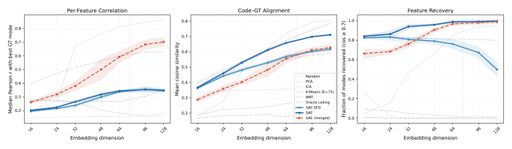
Figure 1 :Mode recovery vs. embedding dimension m (mean ± 1 std over 5 random projections). Left: median per-feature Pearson r with best-matching ground-truth mode. Center: mean per-user cosine similarity between projected codes and ground-truth weight vector. Right: fraction of modes recovered at decoder–centroid cosine similarity≥0.7. The vertical line marksm= 75, the ground-truth mode count.
원문 · CC BY 4.0 · Jonathan Kozaczuk, Zheng Dong, Noyan Evirgen, Keivan Majidi, Eddie K. H. Ng, Chris Porter, Qi Zhao, Jia Geng, Changmao Li, Brandon R. Feng · User Embeddings are Superpositions of Interpretable Behavioral Modes · 원문 그림 인용 · 원본 PDF 6쪽에서 그림 영역을 추출했습니다.트랜스포머 임베딩과 합성 결과의 한계
비선형 인코더에서는 Eq.(2)가 근사적으로만 성립하므로, 논문은 합성 데이터의 SASRec 임베딩에서 같은 실험을 반복합니다. 이 결과는 합성 데이터와 해당 인코더 설정에서 얻은 것이며, 다른 인코더나 실제 데이터로 자동 일반화되지는 않습니다. 또한 SAE 중심 복원 비율은 코사인 임계값에 따라 달라지며 저자들은 임계값 변화에 따른 결과를 함께 보고합니다.
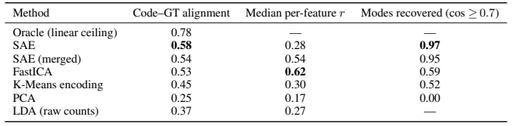
Table 6 :Mode recovery on mean-pooled SASRec embeddings ( d=256) of the synthetic data, all methods at matchedL 0. LDA is fit to raw user–item counts and has no decoder directions.
원문 · CC BY 4.0 · Jonathan Kozaczuk, Zheng Dong, Noyan Evirgen, Keivan Majidi, Eddie K. H. Ng, Chris Porter, Qi Zhao, Jia Geng, Changmao Li, Brandon R. Feng · User Embeddings are Superpositions of Interpretable Behavioral Modes · 원문 그림 인용 · 원본 PDF 18쪽에서 그림 영역을 추출했습니다.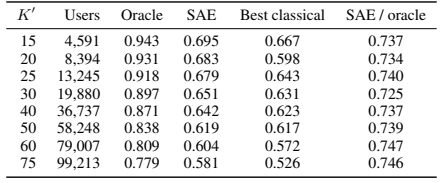
Table 7 :Sensitivity to the number of modes K ′ on the d=256 transformer embeddings. Code–GT alignment for the oracle, the SAE, and the best of PCA, FastICA, and K-Means encoding at eachK ′.
원문 · CC BY 4.0 · Jonathan Kozaczuk, Zheng Dong, Noyan Evirgen, Keivan Majidi, Eddie K. H. Ng, Chris Porter, Qi Zhao, Jia Geng, Changmao Li, Brandon R. Feng · User Embeddings are Superpositions of Interpretable Behavioral Modes · 원문 그림 인용 · 원본 PDF 18쪽에서 그림 영역을 추출했습니다.Open e-commerce에서의 자연어 audience 검색
실제 데이터인 Open e-commerce 1.0에서는 카테고리 기반 SVD 임베딩에 SAE를 학습하고, LLM이 각 잠재 특성을 명명한 뒤 질의 시점에 특성 관련도를 0–10으로 점수화합니다. 점수 5 이상 특성의 활성 가중합으로 사용자를 순위화합니다. FastICA는 Coverage가 더 높지만 Lift와 AUROC의 우위는 SAE에 있습니다. 이 수치는 5개 SAE 학습 시드에 걸친 평균이며, 텍스트 임베딩 기준선은 같은 범주 정보를 쓰는 변형입니다.
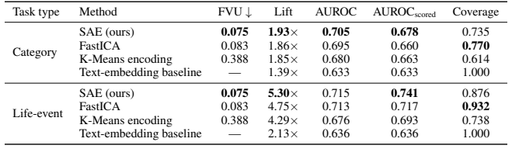
Table 1 :Open e-commerce zero-shot NL audience retrieval, metrics averaged per task block (6 category tasks and 2 life-event tasks, see Appendix C.2). AUROCscored restricts AUROC to users with nonzero scores. Text baseline is the matched-input category-pooled variant (Section 5). Text baseline has no FVU.
원문 · CC BY 4.0 · Jonathan Kozaczuk, Zheng Dong, Noyan Evirgen, Keivan Majidi, Eddie K. H. Ng, Chris Porter, Qi Zhao, Jia Geng, Changmao Li, Brandon R. Feng · User Embeddings are Superpositions of Interpretable Behavioral Modes · 원문 그림 인용 · 원본 PDF 8쪽에서 그림 영역을 추출했습니다.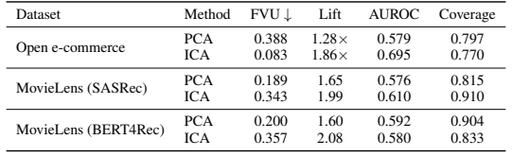
Table 8 :Additional baselines on both datasets. Metrics averaged across tasks. SAE significantly exceeds every classical baseline on Lift at matched L0 (cross-seed Wilcoxon, Appendix D); ICA is SAE’s closest competitor on AUROC (tied on life-event AUROC, SAE wins elsewhere) and achieves higher Coverage by construction (denser activations). NMF is excluded as it requires non-negative preprocessing that doesn’t naturally arise in either embedding space and underperforms classical baselines at allm(Section 4).
원문 · CC BY 4.0 · Jonathan Kozaczuk, Zheng Dong, Noyan Evirgen, Keivan Majidi, Eddie K. H. Ng, Chris Porter, Qi Zhao, Jia Geng, Changmao Li, Brandon R. Feng · User Embeddings are Superpositions of Interpretable Behavioral Modes · 원문 그림 인용 · 원본 PDF 18쪽에서 그림 영역을 추출했습니다.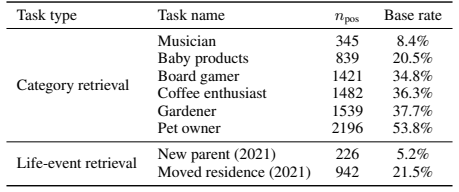
Table 9 :Open e-commerce task definitions. npos is the number of users satisfying the positive definition out of the evaluated user set for each task block (4085 users with at least one post-2021 window for category retrieval; 4373 users with a 2021 survey response for life-event retrieval).
원문 · CC BY 4.0 · Jonathan Kozaczuk, Zheng Dong, Noyan Evirgen, Keivan Majidi, Eddie K. H. Ng, Chris Porter, Qi Zhao, Jia Geng, Changmao Li, Brandon R. Feng · User Embeddings are Superpositions of Interpretable Behavioral Modes · 원문 그림 인용 · 원본 PDF 19쪽에서 그림 영역을 추출했습니다.MovieLens에서의 트랜스포머 임베딩 검색과 특성화
MovieLens 1M에서는 SASRec과 BERT4Rec 임베딩으로 32개의 자연어 질의를 평가합니다. 정답은 제목 패턴 규칙으로 만들며, 양성 사용자는 해당 제목을 3편 이상 시청한 사용자입니다. 이 설정에서 SAE와 K-Means encoding은 Lift와 AUROC에서 통계적으로 구별되지 않지만, SAE는 Coverage에서 큰 차이를 보고합니다. 또한 SAE 상위 k 특성은 K-Means 상위 k보다 중복이 적고 목표 시청자를 더 많이 덮는다고 보고됩니다. 이 특성화 결과는 20개 franchise 시청자 집합에 대한 특정 실험으로, 중복 감소가 곧바로 검색 성능 향상을 뜻하지는 않습니다.
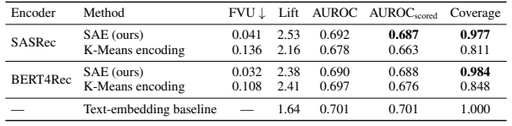
Table 2 :MovieLens zero-shot NL audience retrieval, averaged over 2 SAE-training seeds × 32 non- compositional queries (query list in Appendix E.2). FVU is from a single SAE seed per encoder. Text baseline is encoder-independent. Bold: SAE significantly better than K-Means encoding (p<0.05, cross-seed paired Wilcoxon, see Appendix D).
원문 · CC BY 4.0 · Jonathan Kozaczuk, Zheng Dong, Noyan Evirgen, Keivan Majidi, Eddie K. H. Ng, Chris Porter, Qi Zhao, Jia Geng, Changmao Li, Brandon R. Feng · User Embeddings are Superpositions of Interpretable Behavioral Modes · 원문 그림 인용 · 원본 PDF 8쪽에서 그림 영역을 추출했습니다.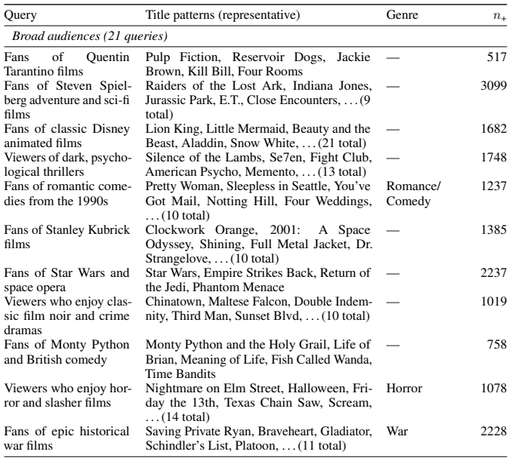
Table 13 :Natural-language audience queries on MovieLens 1M with title-pattern and genre-constraint ground- truth definitions.n + is the resulting number of positive users out of 6040.
원문 · CC BY 4.0 · Jonathan Kozaczuk, Zheng Dong, Noyan Evirgen, Keivan Majidi, Eddie K. H. Ng, Chris Porter, Qi Zhao, Jia Geng, Changmao Li, Brandon R. Feng · User Embeddings are Superpositions of Interpretable Behavioral Modes · 원문 그림 인용 · 원본 PDF 24쪽에서 그림 영역을 추출했습니다.적용 범위와 남은 질문
저자들은 ReLU SAE 변형만 실험했으며 다른 SAE 변형과 희소 pre-training 알고리즘은 검증하지 않았다고 밝힙니다. 실험한 데이터는 긍정적 상호작용만 있는 두 소비 도메인이며, 두 실제 인코더는 모두 트랜스포머 순차 추천기입니다. 따라서 이동성이나 명시적 부정 피드백처럼 다른 상호작용 의미나 MLP·CNN 인코더에서의 결과는 아직 확인되지 않았습니다.
논문 정보
- 저자
- Jonathan Kozaczuk, Zheng Dong, Noyan Evirgen, Keivan Majidi, Eddie K. H. Ng, Chris Porter, Qi Zhao, Jia Geng, Changmao Li, Brandon R. Feng
- 학회·저널
- arXiv · 프리프린트
- 최초 공개일
- 2026년 11월 5일
- 등록일
- 2026년 11월 7일
- 수정일
- 2026년 11월 5일
- 버전
- v1
- arXiv
- 2611.08487
- 분류
- cs.LG
- 원문 이용 조건
- CC BY 4.0
- 제공 범위
- 논문 정보, 해설, 허용된 원문 그림
AI 해설은 논문 원문과 별개의 설명이며 오류가 있을 수 있습니다. 원문과 그림은 각 출처의 이용 조건과 따로 표시된 권리를 따릅니다.
초록
User embeddings are central components of modern recommendation, personalization, and behavioral modeling systems. Though these embeddings can compactly encode rich behavioral information, they are inherently dense and opaque, limiting interpretability. To address this gap, we argue that user embeddings can be understood as sparse superpositions of interpretable behavioral modes. This structure is directly predicted by generative models of user behavior for linear embeddings and extends approximately to deep-learning representations by the superposition hypothesis. Superimposed modes can naturally be recovered by sparse dictionary learning methods, such as sparse autoencoders (SAEs), and recovered modes can be automatically named and queried in natural language. We validate mode recovery against known ground truth on synthetic data, where SAEs recover modes better than classical sparse baselines, including on transformer-encoded embeddings. We then apply the method to classical and transformer-based user embeddings from two real-world datasets. We also show how the corresponding natural-language labels enable zero-shot audience retrieval and characterization over embeddings never trained on text. The framework is post-hoc and model-agnostic, requiring no modification to the upstream embedding system.
원문 인용
Jonathan Kozaczuk, Zheng Dong, Noyan Evirgen, Keivan Majidi, Eddie K. H. Ng, Chris Porter, Qi Zhao, Jia Geng, Changmao Li, Brandon R. Feng (2026). User Embeddings are Superpositions of Interpretable Behavioral Modes. arXiv:2611.08487v1. https://arxiv.org/abs/2611.08487v1
BibTeX
@misc{kozaczuk2026user,
  title = {{User Embeddings are Superpositions of Interpretable Behavioral Modes}},
  author = {Jonathan Kozaczuk and Zheng Dong and Noyan Evirgen and Keivan Majidi and Eddie K. H. Ng and Chris Porter and Qi Zhao and Jia Geng and Changmao Li and Brandon R. Feng},
  year = {2026},
  eprint = {2611.08487},
  archivePrefix = {arXiv},
  url = {https://arxiv.org/abs/2611.08487v1}
}