논문 해설
A quantum information theoretic analysis of reinforcement learning-assisted quantum architecture search
강화학습 기반 양자 아키텍처 탐색에 대한 양자 정보 이론적 분석
- 연구 문제 RL로 찾은 admissible ansatz가 만드는 얽힘의 범위와 그 성질을 양자 정보 이론으로 분석합니다.
- 연구 방법 DDQN 기반 RL-VQSD로 얻은 ansatz의 concurrence 상한과 하한을 입력 얽힘, 초기화, 큐비트 기여도에 따라 측정합니다.
- 주요 결과 상한과 하한은 DDQN 초기화에 대해 대체로 일관되며, 입력 concurrence 0.322 부근에서 상관이 바뀝니다.
문제 배경: ansatz 탐색의 어려움
변분 양자 알고리즘(VQA)은 양자 회로의 매개변수를 고전 최적화기와 되먹임 루프로 정하는 방식이며, 이때 회로 템플릿인 ansatz를 어떻게 구성하느냐가 표현력과 효율을 좌우합니다. 강화학습으로 ansatz를 자동 탐색하는 RL-QAS가 여러 응용에서 쓰이고 있지만, 이 논문은 탐색된 admissible ansatz의 성질을 양자 정보 이론의 측도로 분석하는 데 초점을 둡니다.
분석 대상은 변분 양자 상태 대각화(VQSD) 문제이며, 강화학습으로 개선한 RL-VQSD가 사용됩니다. 기존 VQSD의 ansatz는 큐비트 수에 따라 깊이와 게이트 수가 지수적으로 커지므로, 대각화를 수행하는 최적 ansatz를 찾는 일이 여전히 열린 문제로 제시됩니다. 따라서 저자들은 에이전트가 제안한 ansatz가 얽힘과 어떤 관계를 맺는지 확인하려 합니다.
RL-VQSD의 구성과 학습 과정
VQSD는 학습, 고윳값 판독, 고유벡터 준비의 세 부루틴으로 구성됩니다. 학습 단계에서는 게이트 열 U(θ)의 매개변수를 조정해 ρ를 대각 상태로 바꾸며, 판독 단계에서는 계산 기저 측정으로 고윳값을 추정합니다. RL-VQSD에서는 double deep-Q network(DDQN) 에이전트가 ε-greedy 정책으로 U(θ)의 구조를 탐색하고, ADAM으로 신경망 가중치를 최적화합니다. DDQN은 행동 선택과 Q값 평가를 두 네트워크로 나누어 Q 학습의 과대추정을 줄입니다.
보상은 Ct(θ)가 임계값 ζ보다 작으면 +R을 주고, 그렇지 않으면 −log(Ct(θ)−ζ)를 주는 형태입니다. 여기서 비용 Ct(θ)는 Tr(ρ²)−Tr(ρt(θ)²)로 정의되고, 매개변수 최적화에는 COBYLA가 쓰입니다. 원문은 이 학습 설정이 참고문헌 [12]의 설정과 유사하다고 밝힙니다.
admissible ansatz의 concurrence 상한과 하한
연구의 첫 질문은 RL 에이전트가 제안한 admissible ansatz가 생성하는 상태의 concurrence가 어떤 범위에 있는지입니다. 저자들은 2-큐비트 무작위 상태를 qiskit의 random density matrix로 샘플링하고, 시드마다 DDQN 가중치 초기화를 바꿔 RL-VQSD를 10000 에피소드 실행했습니다. 표 I의 최대 concurrence 표준편차는 10^-3 수준으로 보고되며, 최소 concurrence 편차는 그보다 큽니다. 이로부터 상한과 하한이 가중치 초기화에 대해 대체로 일관된다는 결과가 제시됩니다.
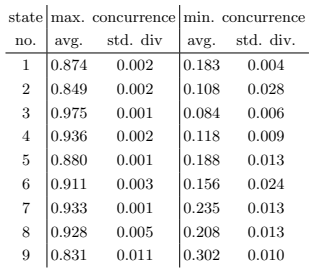
원문 그림 TABLE I: The average and standard deviation of the final state’s maximum (max. concurrence) and minimum concur- rence (min. concurrence) after evolution through the circuit for five different initialisations of the DDQN weights for dif- ferent quantum seed states. To obtain the results, we run RL-VQSD to diagonalize 2-qubit random quantum states for 10000 episodes. The agent then proposes Es < 10000 ad- missible ansatzes, which generate Es states after the random quantum state evolves them. The max. (min.) concurrence is attributed to the ansatz that generates a state with the high- est (lowest) concurrence following the evolution of the random quantum state.
원문 · CC BY 4.0 · Abhishek Sadhu, Aritra Sarkar, Akash Kundu · A quantum information theoretic analysis of reinforcement learning-assisted quantum architecture search · 원문 그림 인용 · 원본 PDF 4쪽에서 그림 영역을 추출했습니다.concurrence는 두 큐비트 상태의 얽힘 정도를 재는 측도이며, 최대 얽힘 상태에서 1, 분리 가능 상태에서 0입니다. 이 결과는 입력 상태 시드와 DDQN 초기화 조건 아래에서 얻은 것이며, 다른 데이터셋이나 다른 과제에 대한 일반화는 본문 실험에서 확인되지 않습니다.
입력 얽힘에 따른 상한·하한 상관과 위상 전이
입력 상태 concurrence를 기준으로 상한과 하한의 Pearson 상관을 살펴보면, 처음 11개 점에서 PCC는 −0.982로 강한 반상관을 보입니다. 입력 concurrence가 0.322를 넘으면 상관은 약한 상관으로 바뀌며, 이 지점이 위상 전이 지점으로 제시됩니다.
구간 분할 PCC인 ηk 분석에서도 k = 0.322 부근에서 상관 측도의 부호가 바뀝니다. 저자들은 입력 얽힘이 낮을 때 dephasing 부루틴이 비대각항을 제거하기 쉬워 ansatz가 분리 상태를 만들거나 얽힘을 최대로 올리는 방향을 택한다고 해석합니다. 이는 저자의 해석이며 별도 증명이 아닙니다. 또한 임의의 가중치 w에 대해 ηk^w가 유효한 상관 측도인지는 열린 문제로 남아 있습니다.
얽힘 강화 블록과 학습 효율
Entanglement Enhancing 블록은 RL-ansatz 앞에 붙는 초기 블록으로, θ=0.5의 CRX 게이트를 포함합니다. 예를 들어 시드 27의 입력 상태에서 이 블록은 concurrence를 0.198에서 0.215로 올립니다.
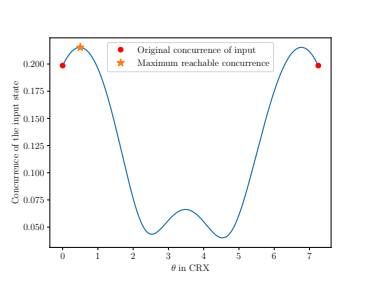
FIG. 5 : The concurrence of input state with θ of CRX(θ) gate in Entanglement Enhancingincreases the con- currence of the input random state from 0 .198 to 0 .215 when θ = 0.5.
원문 · CC BY 4.0 · Abhishek Sadhu, Aritra Sarkar, Akash Kundu · A quantum information theoretic analysis of reinforcement learning-assisted quantum architecture search · 원문 그림 인용 · 원본 PDF 7쪽에서 그림 영역을 추출했습니다.표 II에서 θ=0.5 설정은 처음 3500 에피소드 동안 θ=0 설정보다 2.08배 많은 보상을 모으고 2.22배 많은 성공 에피소드를 얻었다고 보고됩니다. 표 III에서는 θ=0.5 설정의 비용 함수가 5.12×10^-7로 θ=0의 6.08×10^-7보다 낮고, 최소 2-qubit 게이트 수는 2로 θ=0의 5보다 적습니다. 이 결과는 하나의 입력 상태와 지정된 학습 조건에서 얻은 것입니다.
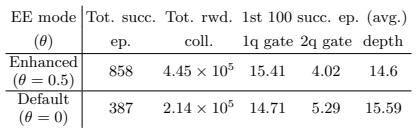
원문 그림 TABLE II: Turning on theEntanglement Enhancing (EE) mode (denoted as Enhanced ( θ = 0 .5)) enhances the learning of the performance of the RL-agent in the absence of the EE mode (denoted as Default ( θ = 0)). In the first 3500 episodes, the Enhanced ( θ = 0 .5) col- lects 2.08 times more reward (tot. rwd. coll.) and 2 .22 times more successful episodes (Tot. succ. ep.) than De- fault ( θ = 0). Moreover, the average number of 2-qubit (2q gate) and depth over the first 100 successful episodes reduced in the case of Enhanced ( θ = 0.5) settings com- pared to Default ( θ = 0), showing enhanced learning of the RL-agent for entanglement enhanced input state.
원문 · CC BY 4.0 · Abhishek Sadhu, Aritra Sarkar, Akash Kundu · A quantum information theoretic analysis of reinforcement learning-assisted quantum architecture search · 원문 그림 인용 · 원본 PDF 7쪽에서 그림 영역을 추출했습니다.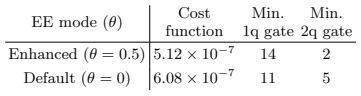
원문 그림 TABLE III: Turning on the Entanglement Enhanc- ing (EE) mode (denoted as Enhanced ( θ = 0 .5)) opti- mises the number of minimum number of 2-qubit gates (Min. 2q gate) in RL-ansatz better than in the absence of the EE mode (denoted as Default ( θ = 0)). Moreover, the Enhanced ( θ = 0 .5) mode minimises the cost func- tion better than the Default ( θ = 0) mode.
원문 · CC BY 4.0 · Abhishek Sadhu, Aritra Sarkar, Akash Kundu · A quantum information theoretic analysis of reinforcement learning-assisted quantum architecture search · 원문 그림 인용 · 원본 PDF 7쪽에서 그림 영역을 추출했습니다.큐비트별 조건부 엔트로피와 고윳값 탐색의 한계
큐비트 기여도는 조건부 양자 엔트로피의 변화로 측정됩니다. Δq1q0은 두 큐비트의 조건부 엔트로피 변화 차이이며, 이 값이 양수이면 q0의 기여가 더 크고 음수이면 q1의 기여가 더 큽니다. 원문은 Δq1q0의 누적 가중치가 음수 영역에서 4.854, 양수 영역에서 5.524라고 보고하며 두 큐비트가 대체로 비슷하게 기여한다고 해석합니다.
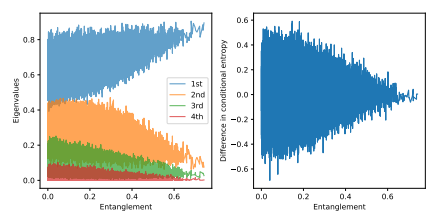
FIG. 1 : The difference in conditional entropy converges towards the zero as the entanglement of the sampled in- put state increases. Meanwhile, as the input state gets closer to the maximally entangled state (with concur- rence 1), the magnitude of the largest eigenvalue in- creases while the other eigenvalue decreases.
원문 · CC BY 4.0 · Abhishek Sadhu, Aritra Sarkar, Akash Kundu · A quantum information theoretic analysis of reinforcement learning-assisted quantum architecture search · 원문 그림 인용 · 원본 PDF 4쪽에서 그림 영역을 추출했습니다.두 번째 분석에서는 35개 2-qubit 혼합 상태의 고윳값과 큐비트 간 조건 엔트로피 상관을 비교합니다. 가장 큰 두 고윳값을 얻는 ansatz는 약한 상관 영역에 있고, 가장 작은 고윳값을 얻으려면 약한 반상관이 필요하다고 보고됩니다. 따라서 저자들은 같은 ansatz 구조로 큰 고윳값과 작은 고윳값을 동시에 잘 찾기 어렵다고 해석합니다.
적용 범위와 남은 질문
저자들은 위상 전이 지점 0.322가 문제에 특이적이므로, 다른 알고리즘 부류에서 같은 현상이 유지되는지는 후속 연구로 남긴다고 밝힙니다. 또한 상관 측도 η_k^w의 유효성은 임의의 w 구간에 대해 증명되지 않은 열린 문제입니다.
분석 대부분은 2-큐비트 상태와 특정 시드의 샘플에 기반합니다. 따라서 결과를 더 큰 큐비트 수나 다른 VQA 과제로 확장하려면 별도의 검증이 필요합니다.
논문 정보
- 저자
- Abhishek Sadhu, Aritra Sarkar, Akash Kundu
- 학회·저널
- arXiv · 프리프린트
- 최초 공개일
- 2024년 4월 9일
- 등록일
- 2026년 11월 6일
- 수정일
- 2024년 8월 15일
- 버전
- v3
- arXiv
- 2404.06174
- DOI
- 10.1007/s42484-024-00181-0
- 분류
- quant-ph
- 원문 이용 조건
- CC BY 4.0
- 제공 범위
- 논문 정보, 해설, 허용된 원문 그림
AI 해설은 논문 원문과 별개의 설명이며 오류가 있을 수 있습니다. 원문과 그림은 각 출처의 이용 조건과 따로 표시된 권리를 따릅니다.
초록
In the field of quantum computing, variational quantum algorithms (VQAs) represent a pivotal category of quantum solutions across a broad spectrum of applications. These algorithms demonstrate significant potential for realising quantum computational advantage. A fundamental aspect of VQAs involves formulating expressive and efficient quantum circuits (namely ansatz), and automating the search of such ansatz is known as quantum architecture search (QAS). Recently, reinforcement learning (RL) techniques is utilized to automate the search for ansatzes, known as RL-QAS. This study investigates RL-QAS for crafting ansatz tailored to the variational quantum state diagonalisation problem. Our investigation includes a comprehensive analysis of various dimensions, such as the entanglement thresholds of the resultant states, the impact of initial conditions on the performance of RL-agent, the phase transition behaviour of correlation in concurrence bounds, and the discrete contributions of qubits in deducing eigenvalues through conditional entropy metrics. We leverage these insights to devise an entanglement-guided admissible ansatz in QAS to diagonalise random quantum states using optimal resources. Furthermore, the methodologies presented herein offer a generalised framework for constructing reward functions within RL-QAS applicable to variational quantum algorithms.
원문 인용
Abhishek Sadhu, Aritra Sarkar, Akash Kundu (2024). A quantum information theoretic analysis of reinforcement learning-assisted quantum architecture search. arXiv:2404.06174v3. https://doi.org/10.1007/s42484-024-00181-0
BibTeX
@article{sadhu2024quantum,
  title = {{A quantum information theoretic analysis of reinforcement learning-assisted quantum architecture search}},
  author = {Abhishek Sadhu and Aritra Sarkar and Akash Kundu},
  year = {2024},
  eprint = {2404.06174},
  archivePrefix = {arXiv},
  doi = {10.1007/s42484-024-00181-0},
  url = {https://arxiv.org/abs/2404.06174v3}
}