논문 해설
DDBot: Differentiable Physics-based Digging Robot for Unknown Granular Materials
DDBot: 미지의 입상 물질을 위한 미분 가능 물리 기반 굴착 로봇
- 연구 문제 미지의 과립 재료를 소형 고정밀로 디깅하려면 복잡한 접촉 역학과 알려지지 않은 물성을 함께 다뤄야 하며, 이 논문은 미분 가능 시뮬레이션으로 이를 해결하려 합니다.
- 연구 방법 DDBot은 GPU 가속 미분 가능 MLS-MPM 시뮬레이터, 다섯 파라미터 디깅 스킬, 데모 초기값, 기울기 클리핑과 라인 서치를 결합해 물성 식별과 스킬 최적화를 수행합니다.
- 주요 결과 최적화된 스킬은 실제 UR5e 디깅에서 중심 차이 평균 6 mm 이하, 깊이 차이 평균 2.5 mm, 면적 차이 평균 10.8 cm2를 보였고, 흙 디깅 과제에서 직접 궤적 최적화와 SAC보다 높은 성능을 보였습니다.
미지 과립 재료에서 정밀 디깅이 어려운 이유
이 논문은 흙과 모래 같은 과립 재료를 소형 고정밀로 파는 디깅 과제를 다룹니다. 과립 재료는 접촉 역학이 복잡하고 물성이 미리 알려져 있지 않아, 로봇이 얕은 깊이와 정확한 위치로 삽을 넣어 원하는 형상을 만드는 일이 어렵습니다. 물리 시뮬레이션으로 이를 다루려면 MPM 계열의 정확도가 필요하지만, 영률이나 포아송 비, 밀도, 마찰각을 실제 동역학에 맞추도록 조정하기는 직관적이지 않습니다. 또한 저자들은 강화학습은 데이터 요구량이 크고 일반화에 약하며, 모델 예측 제어는 최종 상태 비용에 의존해 물리 과정을 충분히 반영하지 않는다고 지적합니다. 이 때문에 연구 질문은 미분 가능 시뮬레이션으로 미지 물성을 식별하고 디깅 스킬을 1차 기울기 방법으로 최적화할 수 있는지로 설정됩니다.
저자들은 과립 재료를 SVK 탄성과 Drucker-Prager 소성으로 모델링한 기울기 기반 연구는 기존에 없었다고 보고합니다.
미분 가능 시뮬레이터와 파라미터화 디깅 스킬
DDBot은 GPU 병렬 계산과 자동 미분을 갖춘 MLS-MPM 기반 시뮬레이터를 사용합니다. 시뮬레이션의 물성 파라미터와 스킬 파라미터에 대한 기울기는 체인 룰로 계산되며, 이를 통해 RMSprop 같은 1차 기울기 방법으로 두 파라미터 집합을 갱신합니다. 디깅 동작은 다섯 개의 스킬 파라미터 θ로 표현되며, 네 단계(이동과 회전, 삽 삽입, 밀기, 복귀와 들어올리기)로 구성된 가변 길이 궤적을 만듭니다. 각 단계의 타임스텝 수는 반올림 연산을 거치는데, 이 연산은 미분 불가능하므로 반올림 변형과 미반올림 변형을 따로 유도해 기울기가 끊기지 않는 경로를 확인합니다. 최적화는 사람이 만든 목표 형상을 바탕으로 한 데모 초기값에서 시작하며, 기울기 폭주를 막기 위해 기울기 클리핑을 쓰고 요철이 많은 손실 지형에서는 라인 서치를 더합니다.
라인 서치는 기울기 방향으로 다섯 개의 step size를 시험하고 HMD 손실을 가장 줄이는 후보를 선택합니다.
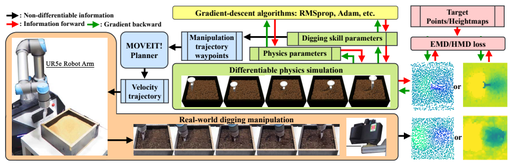
Fig. 1 : The DDBot (D ifferentiable Digging Robot ) system overview. DDBot has five modules. 1) A robot platform (orange) that performs real-world manipulation and collects real-world surface point clouds of the granular materials. The five small images visualise a real-world digging trajectory that matches the trajectory optimised in simulation shown in the green box. 2) A differentiable physics simulator (green) that simulates the digging skill trajectory given the physics and skill parameters. 3) A differentiable loss function (pink) that compares the geometrical differences between the simulated and real manipulation results. 4) A gradient-based optimisation algorithm (yellow) that updates the physics or skill parameters. 5) The Robot Operating System (ROS) communication protocol and the MoveIt! motion planning library [16] that generates a velocity trajectory from the skill parameters to control the real robot.
원문 · CC BY 4.0 · Xintong Yang, Minglun Wei, Yu-Kun Lai, Ze Ji · DDBot: Differentiable Physics-based Digging Robot for Unknown Granular Materials · 원문 그림 인용 · 원본 PDF 3쪽에서 그림 영역을 추출했습니다.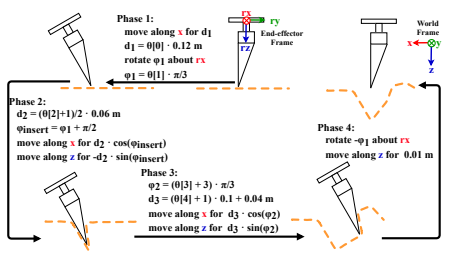
Fig. 2 : Visualising the digging skill modelled by Eqs. 8 to 22. Orange dashed line: soil or sand.
원문 · CC BY 4.0 · Xintong Yang, Minglun Wei, Yu-Kun Lai, Ze Ji · DDBot: Differentiable Physics-based Digging Robot for Unknown Granular Materials · 원문 그림 인용 · 원본 PDF 6쪽에서 그림 영역을 추출했습니다.시스템 식별과 기울기 처리의 효과
시스템 식별 실험은 흙과 모래의 실제 점군을 목표로 물성 파라미터를 추정합니다. 라인 서치를 쓰지 않은 최적화는 발산하거나 큰 분산을 보였고, 라인 서치를 추가하면 최적화가 안정되어 분산이 줄었습니다. 기울기 처리 비교에서는 정규화와 동적 스케일링이 단순 클리핑보다 낮은 성능을 보였습니다. 손실 함수 비교에서는 HMD가 EMD보다 약간 나은 검증 손실을 보였습니다. 저자들은 HMD 손실, 기울기 클리핑, 라인 서치, 좋은 초기값을 함께 쓸 때 가장 안정적이고 효율적인 결과를 얻는다고 해석합니다. 이 결론은 다섯 개의 무작위 시드에서 얻은 흙과 모래 실험에 근거하며, 대표 값으로 흙의 영률은 182683 kPa, 모래의 영률은 121378 kPa가 보고됩니다.
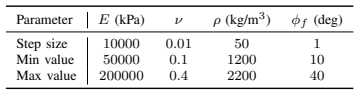
원문 그림 TABLE II: Stepsizes and the ranges of values for the physics parameters: Young’s modulus E, Poisson’s ratio ν, material density ρ, and sand friction angle ϕf , selected based on an open-source structural engineering dataset [38].
원문 · CC BY 4.0 · Xintong Yang, Minglun Wei, Yu-Kun Lai, Ze Ji · DDBot: Differentiable Physics-based Digging Robot for Unknown Granular Materials · 원문 그림 인용 · 원본 PDF 9쪽에서 그림 영역을 추출했습니다.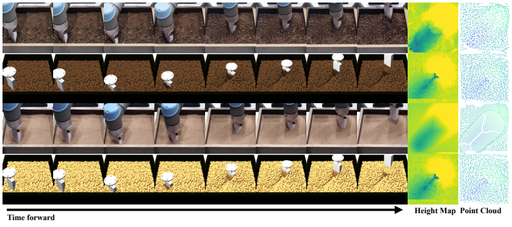
Fig. 7 : Visualising the real and simulated system identification validation trajectories with the best parameters found (“ClipGrad- LS-HM-ManInit” in Table III).
원문 · CC BY 4.0 · Xintong Yang, Minglun Wei, Yu-Kun Lai, Ze Ji · DDBot: Differentiable Physics-based Digging Robot for Unknown Granular Materials · 원문 그림 인용 · 원본 PDF 12쪽에서 그림 영역을 추출했습니다.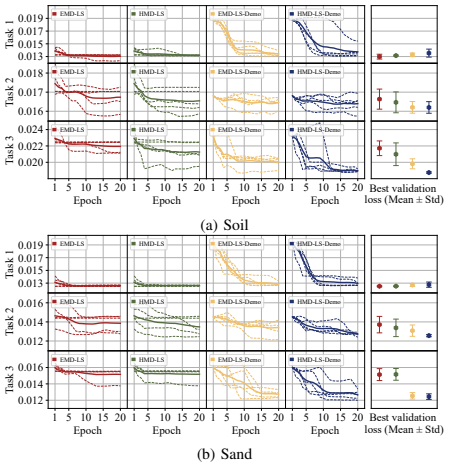
Fig. 8 : Validation losses of the soil and sand digging tasks for the proposed gradient-based skill optimisation method. Validation loss: the sum of the EMD and HMD loss averaged over the sampling resolution (40×40). SO: gradient-based skill optimisation. EMD: Earth mover’s distance. HMD: height map distance. LS: line search. Demo: demonstration-based skill prior.
원문 · CC BY 4.0 · Xintong Yang, Minglun Wei, Yu-Kun Lai, Ze Ji · DDBot: Differentiable Physics-based Digging Robot for Unknown Granular Materials · 원문 그림 인용 · 원본 PDF 13쪽에서 그림 영역을 추출했습니다.실제 로봇 배치와 기준선 비교
디깅 스킬 최적화는 흙과 모래에 대해 목표 형상 세 개씩, 총 여섯 과제에서 평가됩니다. 데모 초기값을 쓴 경우 과제 2와 3에서 수렴이 빨라졌지만, 첫 번째 과제에서는 데모 없이 최적화한 쪽이 더 나았습니다. 최적화된 스킬을 UR5e 로봇에 배치하자 구멍의 중심 차이는 평균 6 mm 이하, 깊이 차이는 평균 2.5 mm, 면적 차이는 평균 10.8 cm2로 보고됩니다. 기준선 비교에서 흙 디깅 과제(데모 있음)는 스킬 기울기 최적화와 CMA-MAE가 직접 궤적 최적화와 SAC보다 일관되게 높은 성능을 보였습니다. 직접 궤적 최적화는 불규칙하고 과격한 궤적에서만 낮은 손실을 얻었고, SAC는 여러 과제에서 지역 최솟값에 머물렀습니다.
계산 비용은 20회 업데이트 기준 약 18분에서 20분이며, 좋은 초기값에서는 5회 안에 약 5분 만에 수렴하는 경우가 있다고 보고됩니다.
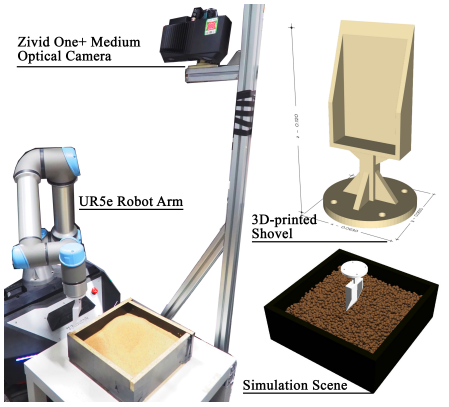
Fig. 3 : Real manipulation platform
원문 · CC BY 4.0 · Xintong Yang, Minglun Wei, Yu-Kun Lai, Ze Ji · DDBot: Differentiable Physics-based Digging Robot for Unknown Granular Materials · 원문 그림 인용 · 원본 PDF 9쪽에서 그림 영역을 추출했습니다.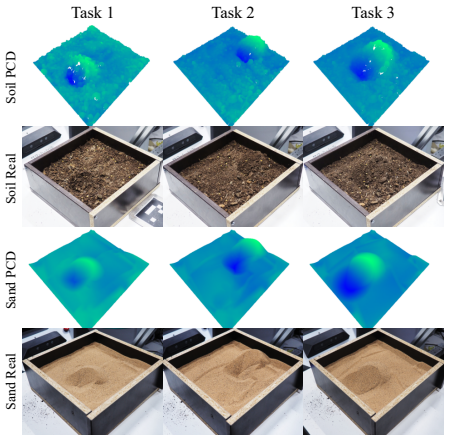
Fig. 4 : Digging task goal visualisation. PCD: point cloud.
원문 · CC BY 4.0 · Xintong Yang, Minglun Wei, Yu-Kun Lai, Ze Ji · DDBot: Differentiable Physics-based Digging Robot for Unknown Granular Materials · 원문 그림 인용 · 원본 PDF 10쪽에서 그림 영역을 추출했습니다.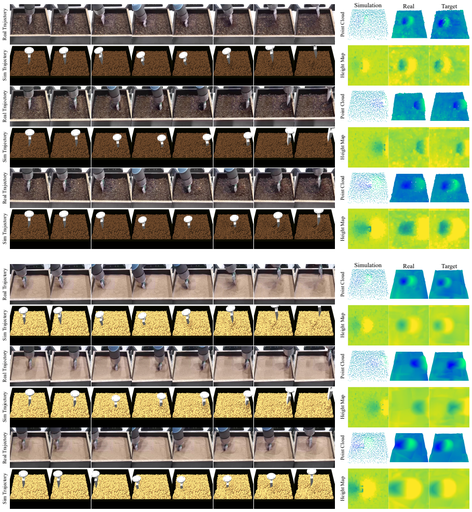
Fig. 9 : Visualisation of the simulated and real trajectories associated with the best validation losses for soil and sand digging tasks found by the proposed gradient-based skill optimisation method.
원문 · CC BY 4.0 · Xintong Yang, Minglun Wei, Yu-Kun Lai, Ze Ji · DDBot: Differentiable Physics-based Digging Robot for Unknown Granular Materials · 원문 그림 인용 · 원본 PDF 14쪽에서 그림 영역을 추출했습니다.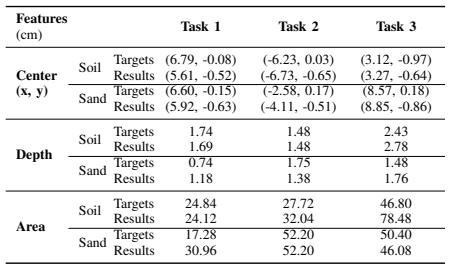
원문 그림 TABLE IV: Statistics of the real-world dug holes (cm). The averaged differences of hole centre, depth and area across the six tasks are (0.60, 0.59) cm, 0.25 cm and 10.8 cm 2.
원문 · CC BY 4.0 · Xintong Yang, Minglun Wei, Yu-Kun Lai, Ze Ji · DDBot: Differentiable Physics-based Digging Robot for Unknown Granular Materials · 원문 그림 인용 · 원본 PDF 15쪽에서 그림 영역을 추출했습니다.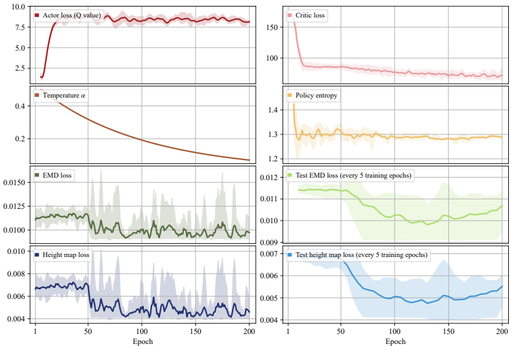
Fig. 13 : Goal-conditioned SAC training statistics on soil task 1.
원문 · CC BY 4.0 · Xintong Yang, Minglun Wei, Yu-Kun Lai, Ze Ji · DDBot: Differentiable Physics-based Digging Robot for Unknown Granular Materials · 원문 그림 인용 · 원본 PDF 24쪽에서 그림 영역을 추출했습니다.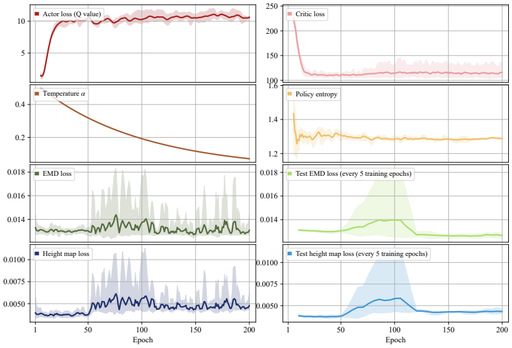
Fig. 14 : Goal-conditioned SAC training statistics on soil task 2.
원문 · CC BY 4.0 · Xintong Yang, Minglun Wei, Yu-Kun Lai, Ze Ji · DDBot: Differentiable Physics-based Digging Robot for Unknown Granular Materials · 원문 그림 인용 · 원본 PDF 24쪽에서 그림 영역을 추출했습니다.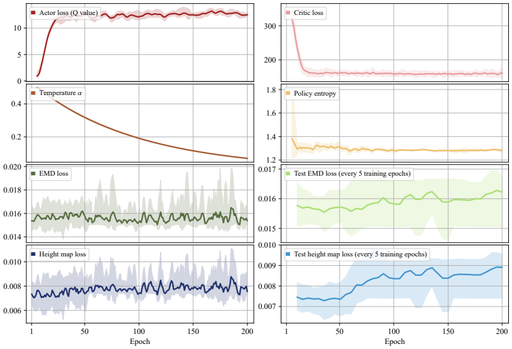
Fig. 15 : Goal-conditioned SAC training statistics on soil task 3.
원문 · CC BY 4.0 · Xintong Yang, Minglun Wei, Yu-Kun Lai, Ze Ji · DDBot: Differentiable Physics-based Digging Robot for Unknown Granular Materials · 원문 그림 인용 · 원본 PDF 25쪽에서 그림 영역을 추출했습니다.적용 범위와 한계
저자들이 밝힌 주요 한계는 작업 시작 상태가 평평한 재료로 고정되어 있다는 점과, 한 번에 하나의 스킬만 최적화한다는 점입니다. 여러 스킬의 순서를 최적화하는 문제는 이산 결정을 포함하므로 현재 기울기 체인으로는 다루지 않습니다. 과립 재료의 3차원 재구성이 정밀하게 어렵다는 점도 확장의 장벽으로 제시됩니다. 실험 범위도 흙과 모래 각각의 세 목표 형상과 다섯 개의 무작위 시드로 제한되어 있습니다. 기준선 비교는 흙 디깅 과제에서 데모가 주어진 조건으로 수행되었으므로, 이 결과를 모든 재료나 모든 초기 조건으로 넓혀 해석하면 안 됩니다.
논문 정보
- 저자
- Xintong Yang, Minglun Wei, Yu-Kun Lai, Ze Ji
- 학회·저널
- arXiv · 프리프린트
- 최초 공개일
- 2025년 10월 20일
- 등록일
- 2026년 11월 6일
- 수정일
- 2026년 1월 6일
- 버전
- v4
- arXiv
- 2510.17335
- DOI
- 10.1109/tro.2025.3636815
- 분류
- cs.RO
- 원문 이용 조건
- CC BY 4.0
- 제공 범위
- 논문 정보, 해설, 허용된 원문 그림
AI 해설은 논문 원문과 별개의 설명이며 오류가 있을 수 있습니다. 원문과 그림은 각 출처의 이용 조건과 따로 표시된 권리를 따릅니다.
초록
Automating the manipulation of granular materials poses significant challenges due to complex contact dynamics, unpredictable material properties, and intricate system states. Existing approaches often fail to achieve efficiency and accuracy in such tasks. To fill the research gap, this article studies the small-scale and high-precision granular material digging task with unknown physical properties. A key scientific problem addressed is the feasibility of applying first-order gradient-based optimization to complex differentiable granular material simulation and overcoming associated numerical instability. A new framework, named differentiable digging robot (DDBot), is proposed to manipulate granular materials, including sand and soil. Specifically, we equip DDBot with a differentiable physics-based simulator, tailored for granular material manipulation, powered by GPU-accelerated parallel computing and automatic differentiation. DDBot can perform efficient differentiable system identification and high-precision digging skill optimization for unknown granular materials, which is enabled by a differentiable skill-to-action mapping, a task-oriented demonstration method, gradient clipping and line search-based gradient descent. Experimental results show that DDBot can efficiently (converge within 5 to 20 minutes) identify unknown granular material dynamics and optimize digging skills, with high-precision results in zero-shot real-world deployments, highlighting its practicality. Benchmark results against state-of-the-art baselines also confirm the robustness and efficiency of DDBot in such digging tasks.
원문 인용
Xintong Yang, Minglun Wei, Yu-Kun Lai, Ze Ji (2025). DDBot: Differentiable Physics-based Digging Robot for Unknown Granular Materials. arXiv:2510.17335v4. https://doi.org/10.1109/tro.2025.3636815
BibTeX
@article{yang2025ddbot,
  title = {{DDBot: Differentiable Physics-based Digging Robot for Unknown Granular Materials}},
  author = {Xintong Yang and Minglun Wei and Yu-Kun Lai and Ze Ji},
  year = {2025},
  eprint = {2510.17335},
  archivePrefix = {arXiv},
  doi = {10.1109/tro.2025.3636815},
  url = {https://arxiv.org/abs/2510.17335v4}
}