논문 해설
Module-Aware Optimization for Graph Neural Networks
그래프 신경망을 위한 모듈 인식 최적화
- 연구 문제 GNN의 가중치 행렬은 그래프 전파된 표현에 작용하므로, 파라미터 공간의 업데이트 크기만으로는 층 출력의 변화를 제어하기 어렵습니다.
- 연구 방법 GraphMuon은 Muon의 직교화를 그래프 전파 입력의 공분산으로 정의되는 메트릭에서 수행하고, 업데이트 스케일을 표현 수준 섭동으로 정규화합니다.
GNN 가중치 업데이트의 기하가 문제인 이유
GNN의 가중치 행렬은 이전 층의 표현에 직접 작용하는 것이 아니라, 그래프 전파를 거친 표현 X_g=SH에 작용합니다. 따라서 같은 크기의 파라미터 업데이트라도 그래프 구조와 노드 표현의 통계에 따라 층 출력에 주는 변화가 크게 달라질 수 있습니다. 기존 AdamW는 좌표별 모멘트로 업데이트를 정규화하여 그래프 전파가 증폭하거나 감쇠하는 방향을 명시적으로 구분하지 않으며, Muon은 행렬 구조를 이용하지만 직교화가 입력에 무관하게 같은 유클리드 기하를 사용합니다. 이 글은 이 불일치를 해결하려는 GraphMuon을 다룹니다.
그래프 메트릭 직교화와 스텝 정규화
GraphMuon은 층별 공분산 C_g=(1/n)X_g^T X_g를 계산하고 이를 trace로 정규화하고 정칙화한 행렬 C̄_g를 사용합니다. 그래프 인식 직교화는 모멘텀 행렬을 C̄_g^{τ/2}로 사영한 뒤 Newton–Schulz 직교화를 적용하고 C̄_g^{-τ/2}로 되돌려 방향 D를 얻습니다. τ=0이면 vanilla Muon과 같아지며 τ가 커질수록 그래프 유도 메트릭을 더 강하게 반영합니다. 이어서 스텝 정규화는 원시(정규화되지 않은) 공분산 C_g에 대해 s_g=sqrt(tr(D^T C_g D)/(||D||_F^2+ε_scale))를 계산하고 업데이트를 이 값으로 나눕니다. tr(D^T C_g D)=(1/n)||X_g D||_F^2이므로 이 스케일은 표현 수준의 섭동 크기를 반영합니다.
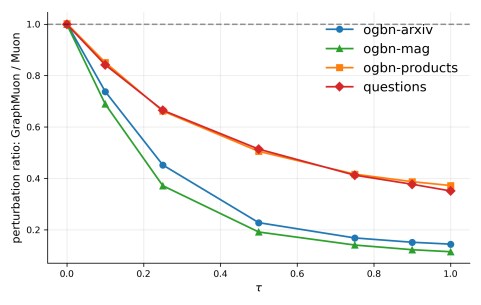
Figure 5 : Effect of the graph-awareness parameter τ on representation-level perturbations. The plot reports the perturbation ratio between GraphMuon and vanilla Muon as τ varies. Values below one indicate that the graph-aware direction induces a smaller representation-level perturbation than the corresponding Euclidean Muon direction. Across datasets, increasing τ generally moves the update away from the Euclidean Muon geometry and toward the graph-induced metric, supporting the interpretation ofτas a continuous control over graph awareness.
원문 · CC BY 4.0 · Guy Hadad, Haggai Roitman, Moshe Eliasof, Bracha Shapira · Module-Aware Optimization for Graph Neural Networks · 원문 그림 인용 · 원본 PDF 19쪽에서 그림 영역을 추출했습니다.표현 수준 섭동 제어와 Muon 증폭의 명제
스텝 정규화를 적용한 업데이트 ΔW_Graph=−αD/s_g는 Theorem 1에 따라 (1/√n)||X_g ΔW_Graph||_F ≤ α||D||_F를 만족합니다. ε_scale=0이고 X_g D≠0이면 등호가 성립합니다. 반면 vanilla Muon 업데이트는 (1/√n)||X_g ΔW_Muon||_F ≤ α sqrt(λ_max(C_g))||D||_F로 상계되며, Proposition 1은 Muon의 극분해 제약을 만족하는 방향 D*가 (1/√n)||X_g D*||_F = sqrt(Σ_{i=1}^{d_{ℓ+1}} λ_i) ≥ sqrt(λ_max(C_g))를 달성함을 보입니다. 즉 Euclidean 극분해 제약만으로는 그래프 증폭을 막을 수 없습니다.
또한 Theorem 2는 정확한 그래프 메트릭 극분해 방향 D_{g,τ}가 Procrustes 문제의 해이고 τ=0일 때 vanilla Muon의 극분해 업데이트와 일치함을 보입니다. 이 결과들은 Newton–Schulz 근사가 아니라 정확한 극분해 인자를 가정한 이상적 버전에 대한 것입니다.
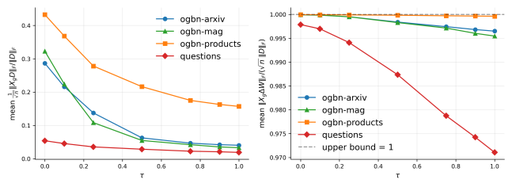
Figure 2 : Empirical validation of GraphMuon’s representation-level perturbation control. Left: before graph-aware normalization, Euclidean-orthogonalized directions induce graph-dependent perturbations whose magnitude varies across datasets and values of τ . Right: after scaling by sg, the normalized perturbation is tightly controlled near the theoretical bound from Theorem 1, confirming that GraphMuon calibrates updates by their effect on Xg rather than by Euclidean parameter-space scale alone.
원문 · CC BY 4.0 · Guy Hadad, Haggai Roitman, Moshe Eliasof, Bracha Shapira · Module-Aware Optimization for Graph Neural Networks · 원문 그림 인용 · 원본 PDF 6쪽에서 그림 영역을 추출했습니다.검증 손실 시간-목표 비교
주요 평가는 AdamW가 달성한 최소 평균 검증 손실을 목표로, 각 옵티마이저가 그 목표에 도달하는 에포크와 누적 벽시계 시간을 측정하는 방식입니다. OGBN-ARXIV, OGBN-MAG, OGBN-PRODUCTS의 GCN 설정에서 GraphMuon은 AdamW 대비 각각 2.32×, 2.42×, 1.32×의 속도 향상을 보고합니다. 같은 비교표에서 OGBN-PRODUCTS의 Muon은 목표에 도달하지 못했습니다. 이 속도 지표는 검증 손실 목표 도달 시간을 측정한 것이며, 동일 설정의 테스트 정확도는 별도 결과로 제시됩니다.
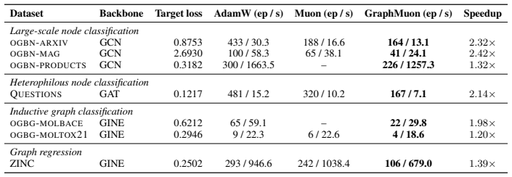
Table 1 : Validation-loss time-to-target across graph-learning tasks. The target is the minimum mean validation loss achieved by AdamW for each dataset–architecture configuration. Entries report epochs / cumulative wall-clock seconds to reach the target. Speedup is relative to AdamW; higher is better. Bold indicates the fastest optimizer. “–” denotes failure to reach the target within the training budget.
원문 · CC BY 4.0 · Guy Hadad, Haggai Roitman, Moshe Eliasof, Bracha Shapira · Module-Aware Optimization for Graph Neural Networks · 원문 그림 인용 · 원본 PDF 8쪽에서 그림 영역을 추출했습니다.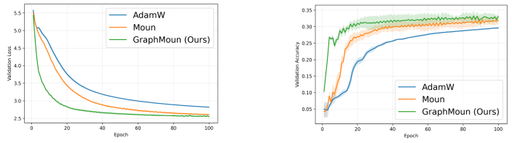
Figure 4 : Training dynamics on OGBN-MAG. The left panel shows validation loss and the right panel shows validation accuracy over training. GRAPHMUONmakes faster progress in both metrics: it reduces validation loss earlier and reaches strong validation accuracy in fewer epochs than AdamW and Muon, suggesting that graph-induced update geometry can accelerate GNN learning.
원문 · CC BY 4.0 · Guy Hadad, Haggai Roitman, Moshe Eliasof, Bracha Shapira · Module-Aware Optimization for Graph Neural Networks · 원문 그림 인용 · 원본 PDF 9쪽에서 그림 영역을 추출했습니다.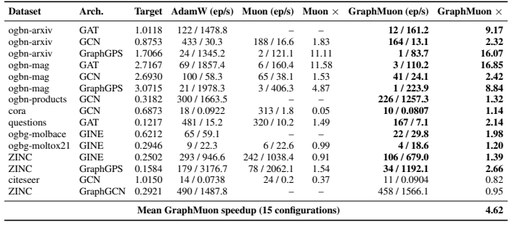
Table 14 : Complete validation-loss time-to-target results across 15 dataset–architecture configurations. Each optimizer entry reports epochs / wall-clock seconds. Speedups are measured against AdamW’s wall-clock time;boldindicates configurations where GraphMuon achieves the lowest time-to-target. – denotes failure to reach the target within the training budget.
원문 · CC BY 4.0 · Guy Hadad, Haggai Roitman, Moshe Eliasof, Bracha Shapira · Module-Aware Optimization for Graph Neural Networks · 원문 그림 인용 · 원본 PDF 28쪽에서 그림 영역을 추출했습니다.구성요소 절제 실험
절제 실험은 OGB 벤치마크에서 Muon의 최소 검증 손실을 두 자리로 내림한 완화된 목표를 사용하여 Muon 대비 속도 향상을 비교합니다. OGBN-ARXIV에서 그래프 인식 직교화만 적용하면 5.39×, 그래프 인식 스텝 정규화만 적용하면 8.34×, 두 구성요소를 모두 적용한 GraphMuon은 9.02×입니다. 같은 절에서 OGBN-MAG와 OGBN-PRODUCTS도 전체 조합에서 가장 큰 향상을 보입니다. 이 결과는 두 구성요소가 함께 작동할 때의 속도 향상을 보여 주며, 구성요소별 효과의 크기는 데이터셋마다 다릅니다.
적용 범위와 한계
저자들은 매우 작은 그래프나 노드 수가 hidden dimension에 비해 적은 경우 C_g가 저차원적이고 잡음이 많아 그래프 메트릭 추정이 불안정할 수 있다고 설명합니다. 이 경우 AdamW가 경쟁력을 유지할 수 있다고 봅니다. 또한 작은 inductive 그래프 수준 과제에서는 그래프 유도 업데이트 증폭보다 희소한 지역 특징과 미니배치 변동이 주된 최적화 문제일 수 있다고 제시합니다. 이는 저자들의 해석이며 이 논문의 실험으로 직접 확인한 실패 사례는 아닙니다.
논문 정보
- 저자
- Guy Hadad, Haggai Roitman, Moshe Eliasof, Bracha Shapira
- 학회·저널
- arXiv · 프리프린트
- 최초 공개일
- 2026년 11월 5일
- 등록일
- 2026년 11월 7일
- 수정일
- 2026년 11월 5일
- 버전
- v1
- arXiv
- 2611.08379
- 분류
- cs.LG
- 원문 이용 조건
- CC BY 4.0
- 제공 범위
- 논문 정보, 해설, 허용된 원문 그림
AI 해설은 논문 원문과 별개의 설명이며 오류가 있을 수 있습니다. 원문과 그림은 각 출처의 이용 조건과 따로 표시된 권리를 따릅니다.
초록
Different optimizers impose different geometries on parameter updates. Adaptive methods such as Adam and AdamW use coordinate-wise updates, while matrix-aware optimizers such as Muon utilize weight-matrix structure through orthogonalized updates. For Graph Neural Networks (GNNs), however, the effective geometry of its weight matrices is shaped not only by its learned channel-mixing weights, but also by the graph-propagated representations it acts on. Thus, even if an update is well normalized as a matrix, its effect on the layer output can be amplified when applied to graph-propagated features. To address this gap, we introduce GraphMuon, a graph-aware optimizer that adapts Muon's matrix updates to the covariance structure of graph-propagated layer inputs. GraphMuon performs orthogonalization in a metric defined by these propagated representations and normalizes step sizes according to the update's induced effect on the layer representation. We show that theoretically, vanilla Muon can suffer from graph-induced update amplification, while our GraphMuon can mitigate this effect. As such, our GraphMuon yields a graph-metric analogue of Muon's polar update step. Empirically, GraphMuon achieves $1.32\times$-$2.42\times$ validation-loss time-to-target speedups over AdamW on three large-scale OGB benchmarks. Across 15 dataset-architecture configurations spanning node classification, inductive graph classification, and graph regression, it achieves lower time-to-target in 13 cases, while maintaining competitive or superior predictive performance. Code is available at https://github.com/guy-hadad/GraphMuon.
원문 인용
Guy Hadad, Haggai Roitman, Moshe Eliasof, Bracha Shapira (2026). Module-Aware Optimization for Graph Neural Networks. arXiv:2611.08379v1. https://arxiv.org/abs/2611.08379v1
BibTeX
@misc{hadad2026module,
  title = {{Module-Aware Optimization for Graph Neural Networks}},
  author = {Guy Hadad and Haggai Roitman and Moshe Eliasof and Bracha Shapira},
  year = {2026},
  eprint = {2611.08379},
  archivePrefix = {arXiv},
  url = {https://arxiv.org/abs/2611.08379v1}
}