논문 해설
ForeSay: Tell the Future in Words, Branch the Details in Noise for Precipitation Nowcasting
ForeSay: 말로 미래를 예측하고, 잡음 속에서 세부를 분기하는 강수 초단기 예측
- 연구 문제 멤버마다 노이즈에서 전체 샘플링을 반복해 앙상블 비용이 N배가 되고, 픽셀 평균이 heavy 강수 코어를 흐리게 만듭니다.
- 연구 방법 VLM이 미래 storm 진화를 텍스트로 예측해 모든 멤버에 공유하고, 공유 trunk 뒤에 노이즈만 분기하며, 평균 대신 앵커 기반 픽셀 투표로 합칩니다.
- 주요 결과 Swedish 데이터셋에서 heavy 강수 CSI를 LangPrecip 0.074 대비 0.136으로 84% 높였고, 5.2배 계산량으로 8개 독립 멤버에 가까운 성능을 보였습니다.
강수 나우캐스팅 앙상블의 비용과 평균 블러 문제
강수 나우캐스팅에서 생성 모델로 앙상블을 만들면 두 가지 문제가 생깁니다. 첫째, 각 멤버가 노이즈에서 전체 샘플링 궤적을 처음부터 다시 밟으므로 N개 멤버 앙상블의 비용이 단일 예측의 N배가 됩니다. 둘째, 멤버들이 강한 비의 위치를 서로 다르게 잡으면 픽셀별 평균이 heavy 강수 코어를 흐리게 만듭니다. 저자들은 두 문제의 원인을 같은 곳에서 찾습니다. 각 멤버의 노이즈 하나에 거시적 storm 진화와 국지적 대류 세부가 함께 얽혀 있다는 점입니다. 이 논문은 이 둘을 분리해 거시적 진화는 모든 멤버가 공유하고, 국지적 세부만 멤버마다 다르게 샘플링하는 것을 목표로 합니다.
미래 시나리오 텍스트를 공유 조건으로 쓰기
ForeSay는 관측된 레이더 프레임 h를 받아 VLM이 미래 storm 진화를 텍스트 시나리오 c로 예측하게 합니다. 학습은 세 단계입니다. 교사 VLM인 Qwen-VL-Max가 실제 미래를 보고 참조 설명 c*를 오프라인으로 만들고, 학생 VLM인 Qwen3.5-9B에 LoRA를 붙여 이력 h만으로 c*를 생성하도록 토큰 단위 교차 엔트로피로 학습합니다. 생성된 토큰의 penultimate 층 은닉 상태를 조건 c로 씁니다. 세 번째 단계에서는 VLM과 VAE를 동결하고 DiffCast 계열이 아닌 DiT 속도장 vθ(zτ, τ; h, c)만 Rectified Flow 손실로 학습합니다. 생성기는 교사의 c*를 보지 않고 학생이 예측한 c를 씁니다.
여기서 LoRA는 학생 VLM의 선형층에만 적용된 저랭크 어댑터이며, 생성기 DiT 자체는 이 단계에서 학습됩니다.
공유 trunk 이후 노이즈 분기
분기 샘플링은 학습을 따로 하지 않는 방식입니다. 한 번의 trunk에서 s*=4 단계까지 모든 멤버가 같은 경로를 밟고, 그 시점의 데이터 추정 x̂0와 노이즈 추정 ε̂를 얻습니다. 각 멤버 b는 x̂0는 그대로 유지하고 ε̂를 새로 뽑은 노이즈 εb로 바꿉니다. λ=1에서는 zb = (1−τs)x̂0 + τs εb로 쓸 수 있으며, 이는 z + τs(εb − ε̂)와 같습니다. 즉 분기 연산은 trunk의 노이즈 성분을 제거하고 데이터 성분은 유지합니다. 이후 T−s 단계는 멤버마다 독립적으로 진행합니다. 계산량은 s + N(T−s)이며 s=4, N=8, T=10이면 52번의 네트워크 평가로 단일 예측의 5.2배입니다.
독립 샘플링 8개는 8.0배입니다.
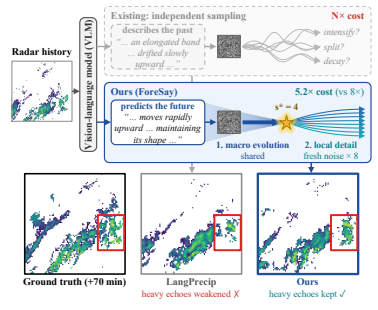
Figure 1 .Describing the pastvs. predicting the future.Conditioned only on the observed history, LangPrecip [ 22] leaves the evolution to each member’s noise (paths illustrative) and repeats every step. ForeSay conditions on the predicted evolution, so members share the early steps and then branch (5.2× vs. 8× cost). Bottom: forecasts at +70 min, with red boxes marking the same heavy-echo region.
원문 · CC BY 4.0 · Xudong Ling, Wenjie Luo, Chaorong Li, Tianxi Huang, Tao He, Guiduo Duan · ForeSay: Tell the Future in Words, Branch the Details in Noise for Precipitation Nowcasting · 원문 그림 인용 · 원본 PDF 2쪽에서 그림 영역을 추출했습니다.
Table 9 . Sweep of the number of members N with the vote fixed at k= 2 (Swedish precipitation held-out set, 500 samples, s= 4 , λ= 1 ). CSI is at the highest tier (≥6.3 mm/h ). Cost is s+N(T−s) network evaluations relative to a single sample (10 steps). FB is the frequency bias, and1is unbiased.
원문 · CC BY 4.0 · Xudong Ling, Wenjie Luo, Chaorong Li, Tianxi Huang, Tao He, Guiduo Duan · ForeSay: Tell the Future in Words, Branch the Details in Noise for Precipitation Nowcasting · 원문 그림 인용 · 원본 PDF 17쪽에서 그림 영역을 추출했습니다.분기 단계를 posterior width로 고르기
분기 단계 s가 너무 이르면 멤버가 거의 독립 샘플처럼 되어 절약이 적고, 너무 늦으면 x̂0가 국지 세부를 고정해 멤버들이 한 예측의 복제처럼 모입니다. 저자들은 flow-matching의 Tweedie 항등식 Cov(x0|zτ)에서 프레임 f의 posterior width Uf(τ)를 도입합니다. 이 양은 τ²/(1−τ)[df + τ divf v]로 쓰이며, divf v는 프레임 f 블록의 Jacobian 대각 합입니다. 이를 Hutchinson 추정과 Rademacher 탐침으로 프레임당 JVP 한 번씩 계산하여 후반 프레임(f=8–16)의 평균 폭이 최대가 되는 s*를 찾습니다. 이 Swedish 검증 집합에서 s*=4가 선택되었고, 레이블 없이 단일 궤적에서 계산합니다.
앵커 기반 지지 합의 디코딩
멤버 평균은 멤버 간 위치 어긋남 때문에 heavy 코어를 흐리게 만듭니다. 제안된 디코딩은 첫 번째 완전 T 단계 샘플을 앵커로 두고, 임계값 thr 이상 멤버 비율 P̂(p)를 픽셀마다 셉니다. P̂(p)가 k/N 이상이고 앵커가 thr 미만이면 멤버 최댓값을 추가합니다. P̂(p)가 k/N 미만이고 앵커가 thr 이상이면 thr−δ로 낮춰 제거합니다. 나머지 픽셀은 앵커 값을 그대로 둡니다. 저자들은 thr을 각 데이터셋의 최고 강도 tier로 두고 k=2, N=8을 선택했습니다. 이 방식은 평균을 쓰지 않으므로 픽셀 평균이 만드는 블러를 피하지만, 위치가 어긋난 heavy 코어에서 CRPS가 커질 수 있다는 한계가 논문에서 함께 제시됩니다.
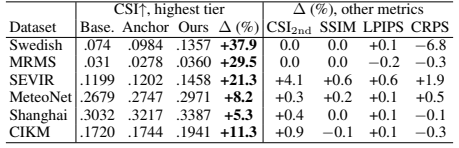
Table 5 .Effect of support-consensus decoding.Anchor ( 1.0×)vs. decoded ensemble ( 5.2×), paired on the same anchor. Base.: the strongest baseline (Tabs. 1 and 2). ∆: relative change (%) of Ours over the anchor, with the sign set so that positive is better. Radar CSI uses the 128×128 protocol, and the other metrics use the native 256×256 output. Full values in App. Tabs. 13 and 14.
원문 · CC BY 4.0 · Xudong Ling, Wenjie Luo, Chaorong Li, Tianxi Huang, Tao He, Guiduo Duan · ForeSay: Tell the Future in Words, Branch the Details in Noise for Precipitation Nowcasting · 원문 그림 인용 · 원본 PDF 10쪽에서 그림 영역을 추출했습니다.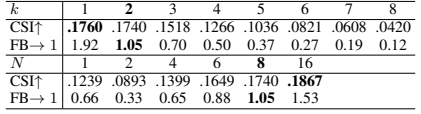
Table 6 . Number of votes k (top, N= 8 ) and ensemble size N (bottom, k= 2 ) on the held-out set. CSI is at ≥6.3 mm/h and FB is the frequency bias (1is unbiased).N= 1is the anchor. Full sweeps are in App. Tabs. 8 and 9.
원문 · CC BY 4.0 · Xudong Ling, Wenjie Luo, Chaorong Li, Tianxi Huang, Tao He, Guiduo Duan · ForeSay: Tell the Future in Words, Branch the Details in Noise for Precipitation Nowcasting · 원문 그림 인용 · 원본 PDF 10쪽에서 그림 영역을 추출했습니다.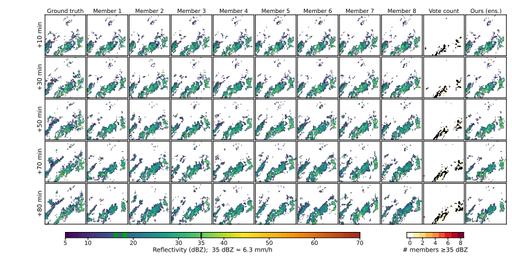
Figure 10 .All eight members of the branched ensemblein Fig. 3 of the main text at five lead times ( s∗ = 4, N= 8 ). The members share the position, orientation and motion of the rain band and differ in the location and extent of the heavy cores.Vote count: number of members at or above 35 dBZ (≈6.3 mm/h) at each pixel.Ours (ens.): the field delivered by support-consensus decoding.
원문 · CC BY 4.0 · Xudong Ling, Wenjie Luo, Chaorong Li, Tianxi Huang, Tao He, Guiduo Duan · ForeSay: Tell the Future in Words, Branch the Details in Noise for Precipitation Nowcasting · 원문 그림 인용 · 원본 PDF 23쪽에서 그림 영역을 추출했습니다.Swedish와 MRMS에서 heavy 강수 CSI
Swedish 데이터셋과 MRMS에서 LangPrecip 설정을 따라 16개 미래 프레임을 평가했습니다. ForeSay의 디코딩된 앙상블은 Swedish에서 높은 임계값 CSI 0.136을 기록해 LangPrecip의 0.074 대비 84% 높았습니다. MRMS 8 mm/h CSI는 0.036으로 LangPrecip 0.031 대비 16% 높았습니다. 같은 Swedish 설정에서 전체 horizon의 consensus decoding은 CRPS를 6.8% 높였습니다. 저자들은 이 비용이 픽셀 단위 투표가 heavy 코어를 예측 위치에 고정하기 때문이라고 해석합니다. 두 데이터셋 모두 s=4, N=8, 5.2배 계산량 설정입니다.
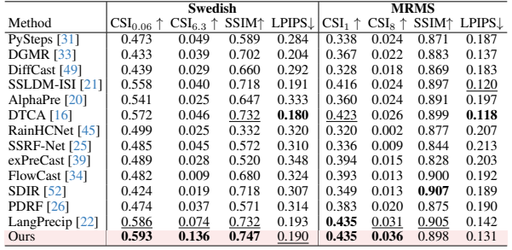
Table 2 . Comparison on the Swedish precipitation dataset and MRMS (80-minute lead time, averaged over16frames). Ours is the decoded ensemble (s= 4 , N= 8 , 5.2×) with thr at the highest tier. LangPrecip on MRMS uses CFG scale 4. Best in bold, second best underlined. FSS and CRPS are in App. Tabs. 15 and 16.
원문 · CC BY 4.0 · Xudong Ling, Wenjie Luo, Chaorong Li, Tianxi Huang, Tao He, Guiduo Duan · ForeSay: Tell the Future in Words, Branch the Details in Noise for Precipitation Nowcasting · 원문 그림 인용 · 원본 PDF 8쪽에서 그림 영역을 추출했습니다.
Table 13 . Anchor (single model, 1.0×) → decoded ensemble (5.2×) on the Swedish precipitation dataset and MRMS, paired on the same anchor (16 frames, 80-minute lead time). Thresholds in mm/h. The better value of each pair is in bold. This table gives the exact values behind Tab. 5 of the main text.
원문 · CC BY 4.0 · Xudong Ling, Wenjie Luo, Chaorong Li, Tianxi Huang, Tao He, Guiduo Duan · ForeSay: Tell the Future in Words, Branch the Details in Noise for Precipitation Nowcasting · 원문 그림 인용 · 원본 PDF 18쪽에서 그림 영역을 추출했습니다.네 공개 레이더 벤치마크의 최고 임계값 CSI
이때 SEVIR와 MeteoNet은 5→20 프레임, CIKM은 5→10 프레임입니다. 같은 프로토콜의 상대 이득은 데이터셋마다 다른 비교군과 조건에서 얻은 값이므로, Shanghai의 +11.7%를 다른 벤치마크에 그대로 옮기지 않습니다.
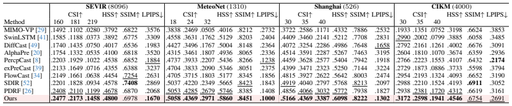
Table 1 . Comparison on the four radar extrapolation benchmarks (official test sets, sample counts in parentheses,128×128 protocol). CSI is given at the three highest thresholds of each benchmark (SEVIR in VIL 0–255, the others in dBZ). ↑/↓: higher/lower is better. Best in bold, second best underlined. Ours is the decoded ensemble with thr at the highest tier. CSI-M and CSI at all thresholds are in App. Tab. 11.
원문 · CC BY 4.0 · Xudong Ling, Wenjie Luo, Chaorong Li, Tianxi Huang, Tao He, Guiduo Duan · ForeSay: Tell the Future in Words, Branch the Details in Noise for Precipitation Nowcasting · 원문 그림 인용 · 원본 PDF 6쪽에서 그림 영역을 추출했습니다.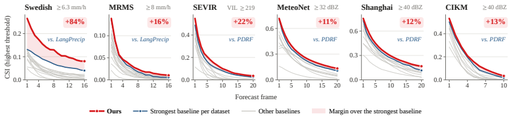
Figure 5 .Highest-threshold CSI versus forecast frame on all six datasets.Ours is the decoded ensemble ( 5.2×). The strongest baseline of each dataset is drawn in blue and named in the panel, with our relative gain in mean CSI (Tabs. 1 and 2). The shaded band is the margin between the two, and grey lines are the remaining baselines. Curves for every metric are in App. Figs. 8, 11 and 13–19.
원문 · CC BY 4.0 · Xudong Ling, Wenjie Luo, Chaorong Li, Tianxi Huang, Tao He, Guiduo Duan · ForeSay: Tell the Future in Words, Branch the Details in Noise for Precipitation Nowcasting · 원문 그림 인용 · 원본 PDF 6쪽에서 그림 영역을 추출했습니다.
Table 10 . Evaluation settings of the four radar extrapolation benchmarks. The sample count is the number of test samples, and each sample has 5 input frames. Thresholds follow the convention of each benchmark, in VIL counts (0–255) for SEVIR and in dBZ for the others.
원문 · CC BY 4.0 · Xudong Ling, Wenjie Luo, Chaorong Li, Tianxi Huang, Tao He, Guiduo Duan · ForeSay: Tell the Future in Words, Branch the Details in Noise for Precipitation Nowcasting · 원문 그림 인용 · 원본 PDF 17쪽에서 그림 영역을 추출했습니다.
Table 11 . CSI-M and CSI at every intensity threshold on the four radar extrapolation benchmarks (official test sets, 128×128 protocol, sample counts in parentheses). Best in bold, second best underlined. CSI-M is the CSI averaged over thresholds. The subscripts are the thresholds of each benchmark, in VIL (0–255) for SEVIR and in dBZ for MeteoNet, Shanghai and CIKM.
원문 · CC BY 4.0 · Xudong Ling, Wenjie Luo, Chaorong Li, Tianxi Huang, Tao He, Guiduo Duan · ForeSay: Tell the Future in Words, Branch the Details in Noise for Precipitation Nowcasting · 원문 그림 인용 · 원본 PDF 18쪽에서 그림 영역을 추출했습니다.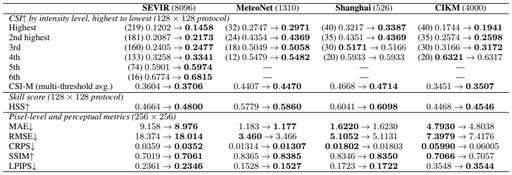
Table 14 . Anchor alone versus decoded ensemble on the official test sets of the four radar benchmarks. Each cell reads “anchor (1.0×) → ensemble (5.2×)”, with the better value in bold. CSI and HSS follow the 128×128 protocol of Table 1 of the main text and Table 11. The threshold of each tier is given in parentheses (VIL 0–255 for SEVIR, dBZ for the others), and HSS is averaged over thresholds. MAE, RMSE, CRPS, SSIM and LPIPS are computed on the native 256×256 output, since the table contains no baseline. MAE and RMSE are in the original units of each dataset and are not comparable across datasets. Appendix F compares the two resolutions.
원문 · CC BY 4.0 · Xudong Ling, Wenjie Luo, Chaorong Li, Tianxi Huang, Tao He, Guiduo Duan · ForeSay: Tell the Future in Words, Branch the Details in Noise for Precipitation Nowcasting · 원문 그림 인용 · 원본 PDF 19쪽에서 그림 영역을 추출했습니다.조건 텍스트와 분기의 기여 분리
Swedish 데이터셋에서 과거 이력 텍스트와 미래 시나리오 텍스트를 비교했습니다. 분기와 합의 디코딩을 함께 쓰면 레이더만 0.1273, 과거 이력 텍스트 0.1275, 미래 시나리오 0.1357로 바뀌었습니다. 즉 과거 이력 텍스트는 분기 이후에 거의 이득을 주지 않았고, 미래 시나리오가 분기 이후에도 이득을 유지했습니다. 노이즈 강도 λ에서 λ=0이면 멤버가 앵커로 붕괴하고, λ=1은 ens8과 비슷한 기술과 다양성을 보였습니다.
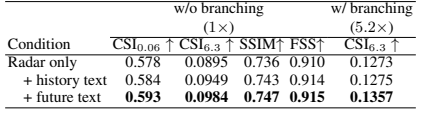
Table 3 . Conditioning ablation on the Swedish precipitation dataset. History text describes the observed frames as in LangPrecip, and future text is our predicted scenario. W/o branching: the anchor. W/ branching: the decoded ensemble.
원문 · CC BY 4.0 · Xudong Ling, Wenjie Luo, Chaorong Li, Tianxi Huang, Tao He, Guiduo Duan · ForeSay: Tell the Future in Words, Branch the Details in Noise for Precipitation Nowcasting · 원문 그림 인용 · 원본 PDF 8쪽에서 그림 영역을 추출했습니다.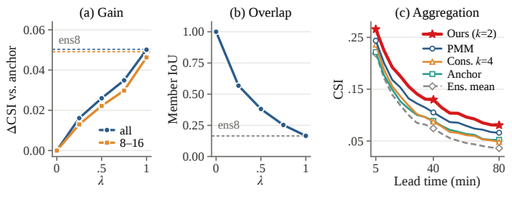
Figure 7 .Branching and aggregation ablations.(a) CSI gain over the anchor and (b) member IoU at frame 12 versus the noise strength λ (held-out set), with ens8 dashed. (c) Heavy-rain CSI per lead time for different aggregations of the same N= 8 members (test set, FB not comparable to Tab. 6). All-frame CSI (FB): ours 0.1357 (1.18), PMM 0.1165 (0.73), consensus k= 4 0.1002 (0.62), anchor0.0984(0.73), ensemble mean0.0852(0.50).
원문 · CC BY 4.0 · Xudong Ling, Wenjie Luo, Chaorong Li, Tianxi Huang, Tao He, Guiduo Duan · ForeSay: Tell the Future in Words, Branch the Details in Noise for Precipitation Nowcasting · 원문 그림 인용 · 원본 PDF 9쪽에서 그림 영역을 추출했습니다.단일 시나리오 조건의 한계
저자들이 밝힌 주요 한계는 단일 예측 시나리오를 모든 멤버에 조건화한다는 점입니다. 이 방식은 거시적 불확실성을 모델링하지 않으며, 텍스트가 틀리면 앙상블 전체가 같은 오류를 공유합니다. 특히 레이더 이력만으로 storm이 강해질지, 약해질지, 갈라질지 구분하기 어려운 경우가 문제가 됩니다. 저자들은 여러 시나리오를 샘플링하고 각 시나리오마다 분기를 두는 확장을 향후 과제로 제시합니다. 픽셀별 합의는 위치가 어긋나면 CRPS를 키울 수 있습니다. 이 논문의 검증은 여섯 데이터셋과 제시된 백본·설정에 한정됩니다.
논문 정보
- 저자
- Xudong Ling, Wenjie Luo, Chaorong Li, Tianxi Huang, Tao He, Guiduo Duan
- 학회·저널
- arXiv · 프리프린트
- 최초 공개일
- 2026년 11월 16일
- 등록일
- 2026년 11월 17일
- 수정일
- 2026년 11월 16일
- 버전
- v1
- arXiv
- 2611.20815
- 분류
- cs.AI
- 원문 이용 조건
- CC BY 4.0
- 제공 범위
- 논문 정보, 해설, 허용된 원문 그림
AI 해설은 논문 원문과 별개의 설명이며 오류가 있을 수 있습니다. 원문과 그림은 각 출처의 이용 조건과 따로 표시된 권리를 따릅니다.
초록
Precipitation nowcasting involves two distinct scales of uncertainty: macroscopic storm evolution and fine-scale local convective variations. Current generative ensemble methods entangle both scales within independent random noise draws. This coupling causes two practical limitations: every ensemble member must execute the full sampling trajectory from scratch, so an N-member ensemble costs N times a single forecast; moreover, divergent trajectories spatially misalign heavy-rain echoes across members, causing standard pixel-wise averaging to blur critical high-intensity extremes. We present ForeSay, a generative nowcasting framework that decouples macroscopic evolution prediction from local stochastic detail generation. Given historical radar frames, a vision-language model first predicts a textual scenario of future storm dynamics to condition a Rectified Flow generator. Guided by this shared macroscopic prior, ensemble members share early trunk sampling steps to establish the storm trajectory and branch with fresh noise only in later steps to explore local convective details. Because members then differ mainly in local details, self-anchored support-consensus decoding replaces pixel averaging with discrete support voting to preserve sharp heavy-rain cores. Across six datasets, ForeSay achieves the best CSI at the highest precipitation thresholds, with relative improvements over the strongest baseline on each dataset ranging from over 10% to 84%. Our 8-member ensemble retains the forecasting skill and diversity of eight independently sampled runs while reducing computational cost from 8x to 5.2x that of a single forecast.
원문 인용
Xudong Ling, Wenjie Luo, Chaorong Li, Tianxi Huang, Tao He, Guiduo Duan (2026). ForeSay: Tell the Future in Words, Branch the Details in Noise for Precipitation Nowcasting. arXiv:2611.20815v1. https://arxiv.org/abs/2611.20815v1
BibTeX
@misc{ling2026foresay,
  title = {{ForeSay: Tell the Future in Words, Branch the Details in Noise for Precipitation Nowcasting}},
  author = {Xudong Ling and Wenjie Luo and Chaorong Li and Tianxi Huang and Tao He and Guiduo Duan},
  year = {2026},
  eprint = {2611.20815},
  archivePrefix = {arXiv},
  url = {https://arxiv.org/abs/2611.20815v1}
}