논문 해설
Point-DynRF: Point-based Dynamic Radiance Fields from a Monocular Video
Point-DynRF: 단안 비디오로부터 점 기반 동적 방사장 학습
- 연구 문제 단안 비디오의 동적 장면에서 입력 카메라 궤적을 벗어난 시점은 기존 흐름 기반 방법에서 흐릿해지거나 동적 객체가 중복되는 문제가 있습니다.
- 연구 방법 Point-DynRF는 신경 3D 점 구름으로 전역 기하를 표현하고, 렌더링 시각마다 점 부분집합을 골라 동적 방사장과 점 구름을 공동 최적화합니다.
- 주요 결과 NVIDIA 데이터셋 평균에서 PSNR 25.3, SSIM 0.92, LPIPS 0.08을 보고하며, 장기 합성 평가에서 입력 궤적 밖 시점의 열화가 줄었다고 보고합니다.
기존 방법의 한계와 연구 질문
단안 비디오에서 동적 장면의 새로운 시점을 합성하려면 정적 배경과 움직이는 객체를 함께 설명해야 합니다. 기존 흐름 기반 방법은 인접한 입력 프레임 사이의 기하 일관성만 강제하기 때문에 전역 장면 기하를 충분히 표현하지 못합니다. 그 결과 입력 카메라 궤적에서 시간적·공간적으로 멀리 떨어진 시점에서는 화질이 떨어지고, 흐릿하거나 동적 객체가 중복되는 현상이 나타납니다. Point-DynRF는 이 문제를 다루기 위해 신경 3D 점 구름으로 전역 기하를 표현하고 동적 방사장을 체적 렌더링으로 학습합니다.
신경 점 구름과 동적 광선 진행
Point-DynRF는 입력 프레임마다 사전 학습된 DPT의 disparity 지도를 프레임별 scale과 shift로 변환해 깊이 지도를 만들고, 전경 마스크와 함께 각 픽셀을 역투영하여 신경 3D 점 구름을 만듭니다. 각 점은 시공간 위치, 점별 강성 γ, 무작위로 초기화된 신경 특징 벡터를 가집니다. 렌더링 시각 t마다 시간 값이 t이거나 강성이 λ=0.5보다 큰 점만 골라 부분집합 Pt를 구성하고, 광선은 이 부분집합 위에서만 진행합니다. 이 선택으로 배경은 항상 포함되고, 동적 점은 그 시각의 것만 사용되어 다른 시각의 객체가 중복되는 현상을 줄입니다.
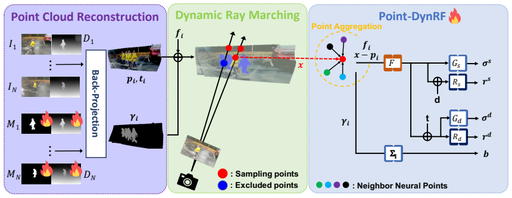
Figure 2 . An overview of network architecture. Our framework consists of three components. First, we initialize per-frame depth maps Dn and foreground masks Mn for a given N frames. Then, we back-project each pixel of N frames to reconstruct our neural 3D point clouds. Each neural point i contains its spatio-temporal locations (pi, ti), a point-wise rigidness γi, a randomly initialized neural feature vector fi to represent the local scene representation. Then, we select a subset point cloud at a rendering time step t and assign sampling points where the ray meets the neural points as they march. Finally, we regress a volume density and a radiance on both view-dependent and time-dependent radiance fields. The volume density and radiance for each sampling point in the ray are integrated via volume rendering to output an RGB color.
원문 · CC BY 4.0 · Byeongjun Park, Changick Kim · Point-DynRF: Point-based Dynamic Radiance Fields from a Monocular Video · 원문 그림 인용 · 원본 PDF 3쪽에서 그림 영역을 추출했습니다.이웃 점 집계와 블렌딩 가중치
선택된 부분집합에서 각 샘플 점 x마다 이웃 신경 점 K=8개를 조회하고, MLP F가 점별 국소 특징을 인코딩합니다. 정적 밀도 σs와 동적 밀도 σd는 각각 Gs와 Gd의 MLP 층으로 회귀되며, 거리 기반 가중치 wi로 이웃 점을 합산합니다. 방사는 정적 방사 rs와 시간 의존 방사 rd로 나뉘어 회귀됩니다. 블렌딩 가중치 bx는 이웃 점의 (1−γi)를 가중합한 값이 λ를 넘으면 1, 아니면 0으로 정해져, 샘플 점마다 정적 또는 동적 방사장 중 하나가 지배하도록 합니다.
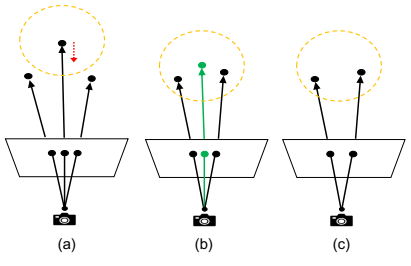
Figure 4 . Missing rays. Assuming a ray is marched when it has three neighbor points for a shading point. (a) If the depth value is too large, the distance between neighboring pixels in 3D world coordinates is larger than the querying radius and fails to march the ray. Moreover, the subset point cloud is changed as the render time varies, causing rays can be marched (b) or sometimes not (c).
원문 · CC BY 4.0 · Byeongjun Park, Changick Kim · Point-DynRF: Point-based Dynamic Radiance Fields from a Monocular Video · 원문 그림 인용 · 원본 PDF 6쪽에서 그림 영역을 추출했습니다.공동 최적화와 기하 손실
학습에서는 입력 프레임의 재구성 손실, 정적·동적 방사장 손실, 기하 손실, 깊이 조정 손실, 마스크 조정 손실을 함께 사용합니다. 기하 손실에서는 RAFT의 광학 흐름으로 깊이 지도의 scale과 shift를 감독하며 배경 픽셀에만 흐름 손실을 적용합니다. 깊이와 전경 마스크는 고정된 입력이 아니라 학습 가능한 프레임별 변수로 바뀌어, 체적 렌더링된 깊이와 동적성 지도에 맞추어 갱신됩니다. 이 공동 최적화로 신경 점 구름과 동적 방사장이 서로 보완하며 함께 정제됩니다.

Figure 9 . Refinement of depth map. For a input frame (a) and initialized disparity map (b), optimized disparity map (c) well rep- resent the boundary of a dynamic object. Also, expected depth map (d) is well aligned with the disparity map.
원문 · CC BY 4.0 · Byeongjun Park, Changick Kim · Point-DynRF: Point-based Dynamic Radiance Fields from a Monocular Video · 원문 그림 인용 · 원본 PDF 8쪽에서 그림 영역을 추출했습니다.NVIDIA 데이터셋 비교
NVIDIA Dynamic Scene 데이터셋에서 Point-DynRF는 PSNR, SSIM, LPIPS로 평가되었습니다. Umbrella 시퀀스는 COLMAP이 부정확한 카메라 포즈를 추정하여 제외되었습니다. 평균에서 Point-DynRF는 PSNR 25.3, SSIM 0.92, LPIPS 0.08을 기록했으며, 원문은 모든 장면에서 SSIM이 가장 높다고 보고합니다. 다만 Playground 장면에서는 부정확한 카메라 포즈 때문에 동적 객체의 위치가 실제와 약간 어긋나는 것으로 설명됩니다. 이 결과는 해당 데이터셋과 COLMAP 포즈 조건에서 얻은 것입니다.
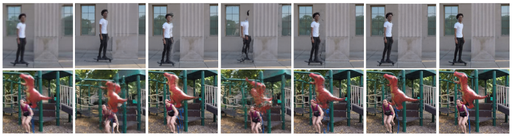
Figure 5 . Comparison to baselines on NVIDIA Dynamic Scene Dataset [47].
원문 · CC BY 4.0 · Byeongjun Park, Changick Kim · Point-DynRF: Point-based Dynamic Radiance Fields from a Monocular Video · 원문 그림 인용 · 원본 PDF 7쪽에서 그림 영역을 추출했습니다.장기 합성과 넓은 궤적 평가
장기 합성 평가는 넓은 범위의 카메라 궤적을 가진 실제 장면에서 수행되었으며, DVS, RoDynRF, DynIBaR와 비교되었습니다. 고정 카메라 시점에서 시간 t0와 t1의 새 뷰를 생성한 결과, 원문은 DVS가 미관측 시점에서 빠르게 열화되어 배경에 아티팩트를 만든다고 보고합니다. DynIBaR는 입력 궤적에 과적합되어 동적 객체를 생성하지 못한다고 설명됩니다. 원문은 이 차이를 Point-DynRF가 전역 장면 기하를 신경 3D 점으로 활용하기 때문으로 해석합니다.
절제 실험과 구성요소의 효과
절제 실험에서 전체 모델의 PSNR은 25.30, SSIM은 0.916, LPIPS는 0.081입니다. 점 구름 부분집합 선택을 제거한 w/o Pt 변형은 PSNR이 1.68 낮아지고 SSIM이 0.161 낮아지며, 이는 동적 광선 진행이 화질에 기여함을 뒷받침합니다. 흐름 손실 Lflow와 깊이 조정 손실 Ldepth를 제거하면 각각 PSNR이 1.07, 0.85 감소하여 신경 점의 정확도가 동적 방사장 성능에 영향을 준다고 저자들은 해석합니다. 모든 구성요소가 같은 크기로 기여한다는 결론은 아니며, 제거한 항목마다 감소 폭이 다릅니다.
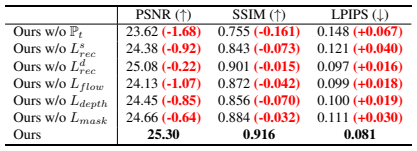
Table 3 . Ablation Study of our proposed losses. We report the PSNR, SSIM and LPIPS on the average of NVIDIA Dynamic Scene Dataset [47].
원문 · CC BY 4.0 · Byeongjun Park, Changick Kim · Point-DynRF: Point-based Dynamic Radiance Fields from a Monocular Video · 원문 그림 인용 · 원본 PDF 8쪽에서 그림 영역을 추출했습니다.계산 비용과 실패 조건
렌더링 시간은 Point-DynRF가 이미지당 11초로, DVS와 RoDynRF의 8초보다 깁니다. 원문은 이웃 신경 점 탐색이 추가 계산 비용을 만든다고 설명하며, 학습 시간은 20 GPU hours로 보고됩니다. 실패 사례는 부정확한 카메라 포즈, 깊이 지도, 전경 마스크가 결합되어 배경 점이 동적 점보다 카메라에 가깝게 비정상 초기화될 때 나타납니다. 이 경우 배경 점이 동적 객체 앞에 놓여 아티팩트가 생깁니다. 이 실패는 보고된 초기화 조건에서 확인된 것이며 모든 입력에서의 실패율을 측정한 결과는 아닙니다.
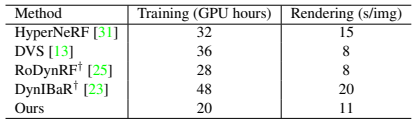
Table 2 . Comparison of Training and Rendering Time. Meth- ods denoted by † refer to reported performance in the paper.
원문 · CC BY 4.0 · Byeongjun Park, Changick Kim · Point-DynRF: Point-based Dynamic Radiance Fields from a Monocular Video · 원문 그림 인용 · 원본 PDF 8쪽에서 그림 영역을 추출했습니다.논문 정보
- 저자
- Byeongjun Park, Changick Kim
- 학회·저널
- arXiv · 프리프린트
- 최초 공개일
- 2023년 10월 14일
- 등록일
- 2026년 11월 5일
- 수정일
- 2023년 10월 24일
- 버전
- v2
- arXiv
- 2310.09647
- 분류
- cs.CV
- 원문 이용 조건
- CC BY 4.0
- 제공 범위
- 논문 정보, 해설, 허용된 원문 그림
AI 해설은 논문 원문과 별개의 설명이며 오류가 있을 수 있습니다. 원문과 그림은 각 출처의 이용 조건과 따로 표시된 권리를 따릅니다.
초록
Dynamic radiance fields have emerged as a promising approach for generating novel views from a monocular video. However, previous methods enforce the geometric consistency to dynamic radiance fields only between adjacent input frames, making it difficult to represent the global scene geometry and degenerates at the viewpoint that is spatio-temporally distant from the input camera trajectory. To solve this problem, we introduce point-based dynamic radiance fields (\textbf{Point-DynRF}), a novel framework where the global geometric information and the volume rendering process are trained by neural point clouds and dynamic radiance fields, respectively. Specifically, we reconstruct neural point clouds directly from geometric proxies and optimize both radiance fields and the geometric proxies using our proposed losses, allowing them to complement each other. We validate the effectiveness of our method with experiments on the NVIDIA Dynamic Scenes Dataset and several causally captured monocular video clips.
원문 인용
Byeongjun Park, Changick Kim (2023). Point-DynRF: Point-based Dynamic Radiance Fields from a Monocular Video. arXiv:2310.09647v2. https://arxiv.org/abs/2310.09647v2
BibTeX
@misc{park2023point,
  title = {{Point-DynRF: Point-based Dynamic Radiance Fields from a Monocular Video}},
  author = {Byeongjun Park and Changick Kim},
  year = {2023},
  eprint = {2310.09647},
  archivePrefix = {arXiv},
  url = {https://arxiv.org/abs/2310.09647v2}
}