논문 해설
Settling the Burn-in Gap: Sharp Risk Bounds for Tail-Averaged SGD in Linear Regression
번인 격차 해소: 선형 회귀에서 꼬리 평균 SGD의 날카로운 위험 상한
- 연구 문제 constant-stepsize SGD의 tail averaging에서 초기 오차가 남기는 excess risk에 대해 기존 상계와 하계가 느슨했던 문제를 다룹니다.
- 연구 방법 burn-in 전파를 연산자 다항식으로 전개하고, pair-midpoint 항등식과 커널 배가 상수로 spectral feedback 계수 χs,N을 1/2 이하로 보장하는 stepsize 규칙을 제시합니다.
- 주요 결과 두 차원 분리 구성에서는 기존 하계보다 강한 Ω(1/(γN²)) 하계를 보입니다.
연구 문제와 기존 상·하계의 간극
이 논문은 constant-stepsize SGD에 tail averaging을 적용했을 때 초기 오차가 남기는 excess risk를 다룹니다. 기존 Zou et al. (2021)의 상계는 head 초기화 부분공간에서 감쇠되지 않은 기여를 포함하고, 하계는 head 초기화로부터 생기는 분산을 생략합니다. 저자들은 두 경계가 모두 느슨하다고 보고, burn-in 구간에서 빠른 모드의 분산이 지수적으로 감쇠되는 반면 느린 모드로 흩어진 네제곱 에너지는 averaging window까지 남는다고 설명합니다. 따라서 질문은 burn-in 이후 excess risk의 상계와 하계가 상수 차이로 일치할 수 있는지입니다.
tail averaging과 spectral feedback 조건
알고리즘은 상수 stepsize γ로 w_t를 갱신하고, 처음 s번의 burn-in 반복은 평균에 넣지 않은 뒤 s부터 s+N−1까지의 반복을 평균합니다. 분석의 핵심 계수는 χs,N이며, 이는 수신 가중치 Ft와 전파 커널 k(h)=Σi λi²(1−γλi)^{2h}로 정의되는 피드백 비율입니다. 저자들은 χs,N ≤ χ0 < 1일 때 다중 경유 피드백 항이 (1−χs,N)^{-1} 배로 흡수된다고 보입니다. pair-midpoint 항등식은 Ft를 k 함수의 쌍별 중점 평균으로 표현하며, 이를 이용해 임의 스펙트럼에서는 T=s+N−1에 의존하는 γ 조건으로, 다항 감쇠 스펙트럼에서는 지평과 무관한 상수 γ로 χs,N ≤ 1/2를 보장합니다.
상계와 하계의 일치 범위
정리 4.1과 4.2는 각각 상계와 하계를 제시하며, well-specified 모델과 Assumption 3.1, 3.2, 3.4 아래에서 두 경계의 항들이 α, β, 1−χ0에만 의존하는 상수 배 안에서 일치한다고 주장합니다. 이 일치는 χs,N ≤ χ0 < 1이라는 조건 아래에서 성립하며, 저자들은 s가 N과 같은 규모인 경우에 대한 따름정리 4.5에서 항별 비교를 정리합니다. 따라서 이 결과의 적용 범위는 해당 피드백 조건을 만족하는 설정입니다.
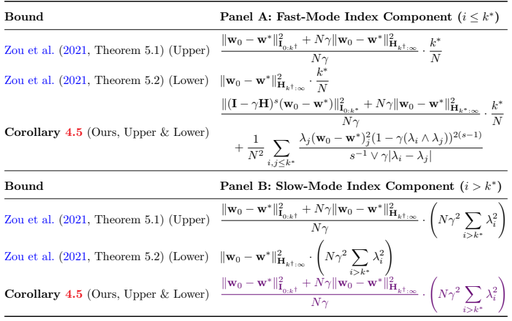
Table 1 : Comparison of the fast-mode (i≤k ∗) and slow-mode (i > k∗) index components in the total bias-induced variance bound for tail-averaged SGD ws:s+N in the canonical regime c0N≤s≤C 0N , omitting multiplicative constants depending on α, β, c0, C0, and the stability margin (1 −γαtr (H) in Zou et al. (2021, Theorem 5.1), and 1−χ 0 in Corollary 4.5 underχ s,N ≤χ 0 <1).
원문 · CC BY 4.0 · Qingyue Zhao, Xuheng Li, Quanquan Gu · Settling the Burn-in Gap: Sharp Risk Bounds for Tail-Averaged SGD in Linear Regression · 원문 그림 인용 · 원본 PDF 12쪽에서 그림 영역을 추출했습니다.분리 구성과 대조 결과
두 차원 노이즈 없는 가우시안 회귀 구성에서 H=diag(1,(4γN)^{-1}), w0−w*=e1, s=N을 사용하면, 저자들이 제시한 하계는 Ω(1/(γN²))입니다. 같은 구성에서 Zou et al. (2021, Theorem 5.2)의 하계는 지수적으로 작은 값인 (1−γ)^{2N}/(100γ²N²)입니다. 이 결과는 해당 하계의 지수적·다항적 차이를 보이는 구체 구성에 한정됩니다. 스칼라 구성에서 fourth-moment 분포가 χs,N을 통제하지 못할 때 리스크 비율이 N에 따라 커진다는 결과도 함께 제시되며, 이는 구조적 조건이나 Bs 정보가 필요함을 보여줍니다.
적용 범위와 한계
저자들은 χs,N ≤ χ0 < 1 조건이 없는 큰 s의 스칼라 영역에서는 상계와 하계의 일치를 직접 주장하지 않으며, 대신 burn-in 편향 공분산 Bs에 조건부인 경계를 제시합니다. 또한 임의 스펙트럼의 일정 stepsize 규칙은 지평 T에 의존하고, 상수 stepsize 보장은 다항 감쇠 스펙트럼 가정에서 얻어집니다. 이 논문의 결과는 well-specified 선형 회귀와 명시된 fourth-moment 가정 아래의 분석이며, 다른 모델이나 데이터 분포로 자동 확장되지는 않습니다.
논문 정보
- 저자
- Qingyue Zhao, Xuheng Li, Quanquan Gu
- 학회·저널
- arXiv · 프리프린트
- 최초 공개일
- 2026년 11월 10일
- 등록일
- 2026년 11월 11일
- 수정일
- 2026년 11월 10일
- 버전
- v1
- arXiv
- 2611.13383
- 분류
- cs.LG · math.OC · stat.ML
- 원문 이용 조건
- CC BY 4.0
- 제공 범위
- 논문 정보, 해설, 허용된 원문 그림
AI 해설은 논문 원문과 별개의 설명이며 오류가 있을 수 있습니다. 원문과 그림은 각 출처의 이용 조건과 따로 표시된 권리를 따릅니다.
초록
We study the excess risk of constant-stepsize online stochastic gradient descent (SGD) with tail-averaging for high-dimensional linear regression. Building on the instance-dependent spectral framework of Zou et al. (2021), we establish matching initialization-explicit upper and lower bounds on the total excess risk of tail-averaged SGD in terms of the population covariance spectrum $\mathbf{H}$ and initialization $\mathbf{w}_0-\mathbf{w}^*$ whenever a trajectory spectral feedback condition holds. Existing analyses exhibit a fundamental gap in the effective variance: the upper bound of Zou et al. (2021) retains an undamped contribution from the initial error in the head eigenspace $\mathbf{I}_{0:k^\dagger}$, whereas their lower bound omits the variance induced by the head initialization altogether. We show that both the existing upper and lower bounds are loose: the single-hop fast-mode variance contribution from the head initialization is exponentially damped during the burn-in phase, whereas fourth-moment energy scattered from the head initialization into slow spectral modes during the early burn-in steps survives undamped into the averaging window. We prove that our spectral feedback condition is satisfied in two concrete constant-stepsize regimes: (i) for arbitrary covariance spectra $\mathbf{H}$ and any finite horizon, under an explicit horizon-dependent stepsize chosen prior to execution; and (ii) for polynomially decaying spectra $λ_i\asymp i^{-a}$ ($a>1$), under a single horizon-independent positive stepsize. Finally, we complement these positive results with explicit one- and two-dimensional separation constructions proving an exponential-versus-polynomial gap in the lower bound of Zou et al. (2021) and showing why fourth-moment assumptions alone cannot determine the asymptotic exponential decay rate without additional structural conditions.
원문 인용
Qingyue Zhao, Xuheng Li, Quanquan Gu (2026). Settling the Burn-in Gap: Sharp Risk Bounds for Tail-Averaged SGD in Linear Regression. arXiv:2611.13383v1. https://arxiv.org/abs/2611.13383v1
BibTeX
@misc{zhao2026settling,
  title = {{Settling the Burn-in Gap: Sharp Risk Bounds for Tail-Averaged SGD in Linear Regression}},
  author = {Qingyue Zhao and Xuheng Li and Quanquan Gu},
  year = {2026},
  eprint = {2611.13383},
  archivePrefix = {arXiv},
  url = {https://arxiv.org/abs/2611.13383v1}
}