논문 해설
Kencorpus: A Kenyan Language Corpus of Swahili, Dholuo and Luhya for Natural Language Processing Tasks
Kencorpus: 자연어 처리 과제를 위한 케냐 언어 코퍼스 (스와힐리어, 돌루오어, 루히야어)
- 연구 문제 스와힐리어, 돌루오어, 루히야어처럼 데이터가 부족한 저자원 언어에서 기계학습에 쓸 수 있는 코퍼스를 만드는 문제를 다룹니다.
- 연구 방법 학교·미디어·출판사 등에서 텍스트와 음성을 수집하고 5단계 정제 파이프라인과 품사·질의응답·번역 주석을 적용해 Kencorpus를 구축합니다.
- 주요 결과 Kencorpus는 텍스트 4,442개와 음성 1,152개를 포함하며, 개념 증명 STT 시스템은 단어 오류율 18.87%, 의미 네트워크 기반 QA는 Exact Match 80%를 보고했습니다.
저자원 언어의 데이터 부족 문제
기계학습과 딥러닝 기반 자연어처리는 대량의 학습 데이터를 필요로 하지만, 아프리카의 많은 토착 언어는 이러한 데이터가 부족하여 디지털 정보 접근에서 소외되어 있습니다. 이 논문은 케냐에서 널리 쓰이는 스와힐리어, 돌루오어, 루히야어를 대상으로 텍스트와 음성을 수집하고 주석을 붙여 Kencorpus라는 코퍼스를 구축하는 문제를 다룹니다. 저자들은 이 작업이 저자원 언어에서 기계학습 과제를 실제로 수행할 수 있는 기반이 된다고 설명합니다.
Kencorpus의 구축과 정제 과정
데이터는 학교, 지역사회, 미디어, 출판사에서 연구 보조원을 통해 수집되었습니다. 원자료는 디지털화, 선별, 진단, 처리, 문서화의 5단계 정제 파이프라인을 거칩니다. 디지털화 단계에서는 손글씨 원고와 스캔 PDF를 OCR로 텍스트화하며, 선별과 진단 단계에서는 OCR 오류와 철자·문장 부호의 불일치를 찾아냅니다. 교정은 학교에서 수집한 손글씨 텍스트에만 적용되었고 단어 수 기준으로 전체 텍스트의 12%였습니다. 미디어와 출판사의 텍스트는 원래 형태를 유지했습니다.
품사 주석과 질의응답 주석
돌루오어와 루히야어 텍스트에는 Petrov 등이 제안한 12개 보편 품사 태그 집합을 적용해 품사 주석을 붙였습니다. 여러 언어에 같은 태그를 쓰기 위해 추가 태그를 만들지 않고 이 12개 태그만 사용했습니다. 스와힐리어 텍스트에는 질의응답 쌍을 작성하여 KenSwQuAD 데이터셋을 구성했으며, 번역 데이터는 돌루오어와 루히야어에서 스와힐리어로의 문장 단위 번역으로 만들었습니다.
개념 증명 시스템과 결과
구축한 코퍼스가 실제 기계학습 과제에 쓰일 수 있는지 두 개의 개념 증명 시스템으로 확인하였습니다. STT 시스템은 CMU Sphinx 툴킷 기반으로 Swahili 음성 파일을 학습하여 단어 오류율 18.87%를 보고했습니다. QA 실험에서는 XLM-RoBERTa 기반 모델이 100개 이야기와 500개 QA 쌍에서 F1 59.4%를 보였고, 의미 네트워크(SN) 방법은 80% Exact Match를 보고했습니다. 두 QA 결과는 같은 조건의 비교가 아니므로 직접 순위를 매기지 않습니다.
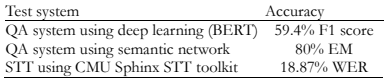
Table 4.6 : Kencorpus proof of concept system performance
원문 · CC BY 4.0 · Barack Wanjawa, Lilian Wanzare, Florence Indede, Owen McOnyango, Edward Ombui, Lawrence Muchemi · Kencorpus: A Kenyan Language Corpus of Swahili, Dholuo and Luhya for Natural Language Processing Tasks · 원문 그림 인용 · 원본 PDF 16쪽에서 그림 영역을 추출했습니다.데이터 양의 한계와 적용 범위
저자들은 BERT 기반 QA 시스템의 낮은 성능을 데이터 양의 부족으로 해석합니다. 이 해석은 저자들의 해석이며, 데이터 양을 늘린 별도 실험이 보고된 것은 아닙니다. 또한 STT 결과는 Swahili 음성 파일 27시간 31분 규모의 한 설정에서 얻은 것이므로 다른 언어나 데이터 조건으로 일반화하기 어렵습니다. 저자들은 텍스트 교정 범위와 섭외 조건에 따른 데이터 품질 차이도 함께 밝혔습니다.
논문 정보
- 저자
- Barack Wanjawa, Lilian Wanzare, Florence Indede, Owen McOnyango, Edward Ombui, Lawrence Muchemi
- 학회·저널
- arXiv · 프리프린트
- 최초 공개일
- 2022년 8월 25일
- 등록일
- 2026년 11월 6일
- 수정일
- 2023년 7월 8일
- 버전
- v2
- arXiv
- 2208.12081
- DOI
- 10.21248/jlcl.36.2023.243
- 분류
- cs.CL
- 원문 이용 조건
- CC BY 4.0
- 제공 범위
- 논문 정보, 해설, 허용된 원문 그림
AI 해설은 논문 원문과 별개의 설명이며 오류가 있을 수 있습니다. 원문과 그림은 각 출처의 이용 조건과 따로 표시된 권리를 따릅니다.
초록
Indigenous African languages are categorized as under-served in Natural Language Processing. They therefore experience poor digital inclusivity and information access. The processing challenge with such languages has been how to use machine learning and deep learning models without the requisite data. The Kencorpus project intends to bridge this gap by collecting and storing text and speech data that is good enough for data-driven solutions in applications such as machine translation, question answering and transcription in multilingual communities. The Kencorpus dataset is a text and speech corpus for three languages predominantly spoken in Kenya: Swahili, Dholuo and Luhya. Data collection was done by researchers from communities, schools, media, and publishers. The Kencorpus' dataset has a collection of 5,594 items - 4,442 texts (5.6M words) and 1,152 speech files (177hrs). Based on this data, Part of Speech tagging sets for Dholuo and Luhya (50,000 and 93,000 words respectively) were developed. We developed 7,537 Question-Answer pairs for Swahili and created a text translation set of 13,400 sentences from Dholuo and Luhya into Swahili. The datasets are useful for downstream machine learning tasks such as model training and translation. We also developed two proof of concept systems: for Kiswahili speech-to-text and machine learning system for Question Answering task, with results of 18.87% word error rate and 80% Exact Match (EM) respectively. These initial results give great promise to the usability of Kencorpus to the machine learning community. Kencorpus is one of few public domain corpora for these three low resource languages and forms a basis of learning and sharing experiences for similar works especially for low resource languages.
원문 인용
Barack Wanjawa, Lilian Wanzare, Florence Indede, Owen McOnyango, Edward Ombui, Lawrence Muchemi (2022). Kencorpus: A Kenyan Language Corpus of Swahili, Dholuo and Luhya for Natural Language Processing Tasks. arXiv:2208.12081v2. https://doi.org/10.21248/jlcl.36.2023.243
BibTeX
@article{wanjawa2022kencorpus,
  title = {{Kencorpus: A Kenyan Language Corpus of Swahili, Dholuo and Luhya for Natural Language Processing Tasks}},
  author = {Barack Wanjawa and Lilian Wanzare and Florence Indede and Owen McOnyango and Edward Ombui and Lawrence Muchemi},
  year = {2022},
  eprint = {2208.12081},
  archivePrefix = {arXiv},
  doi = {10.21248/jlcl.36.2023.243},
  url = {https://arxiv.org/abs/2208.12081v2}
}