논문 해설
Teaching Transformers Causal Reasoning through Axiomatic Training
공리적 학습을 통해 트랜스포머에게 인과 추론을 가르치기
- 연구 문제 인과 공리를 데이터 없이 기호적 시연으로 학습할 수 있는지, 그리고 그 능력이 더 복잡한 그래프로 일반화되는지 묻습니다.
- 연구 방법 전이 공리와 d-분리 규칙의 튜플을 합성하여 67M 트랜스포머를 처음부터 학습하고, 같은 데이터로 Llama-3-8B-Instruct를 미세조정합니다.
- 주요 결과 처음부터 학습한 모델은 긴 사슬과 분기 그래프에서 일반화를 보이며, fine-tuning 모델은 Corr2Cause와 CLEAR에서 기준 모델보다 높은 점수를 보고합니다.
인과 공리를 기호적 시연으로 가르칠 수 있는가
인과 추론은 개입 데이터나 반사실 데이터를 얻기 어렵고 비용이 큽니다. 기존 연구는 인과 공리나 규칙을 귀납적 편향으로 모델에 넣거나 데이터 값에서 추론하게 했습니다. 이 논문은 그 대신 모델이 공리의 기호적 시연(demonstration)으로부터 직접 공리를 배울 수 있는지를 묻습니다. 대상은 전이 공리(transitivity axiom)와 d-분리 규칙(d-separation rule)입니다. 핵심 질문은 짧은 사슬에서 배운 능력이 더 복잡한 그래프로 일반화되는지입니다.
축공리 튜플을 만들어 67M 모델을 처음부터 학습합니다
방법은 공리에서 전제(premise), 가설(hypothesis), 결론(conclusion)으로 이루어진 튜플을 생성하는 것입니다. 전제는 인과 그래프의 간선을 자연어로 적은 것이고, 가설은 인과 질문이며, 결론은 Yes 또는 No입니다. 학습 데이터는 3에서 6개 노드의 순차 사슬과, 간선 방향을 무작위로 뒤집은 사슬로 구성됩니다. 모델은 GPT-2 구조를 따르는 디코더 기반 67M 파라미터 모델이며, pre-training에 노출되지 않도록 처음부터 학습합니다. 토큰화는 노드 이름을 문자 단위로, 'causes'와 'Yes' 같은 특수어를 단어 단위로 나눕니다. 손실은 정답 레이블의 음의 로그 가능도이며, 위치 인코딩으로 학습 가능한 PE, 사인파 PE, RoPE, NoPE를 비교합니다.
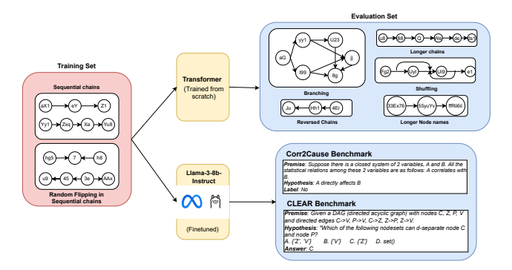
Figure 1 :Axiomatic Trainingfor imparting causal reasoning to language models. Given an axiom, we construct a training dataset comprising <premise, hypothesis, conclusion> triplets based on simple chain-like graphs of 3-6 nodes. A transformer model trained from scratch on such instances generalizes to much more complex graphs, including longer causal chains with >6 nodes, branched networks with higher average in-degree and out-degree, complete reversals, shuffled statements, and longer node names. Moreover, when an existing model such as Llama-3-8B-Instruct model is trained on the same dataset, it leads to significant (up to 20 percentage point (p.p.)) improvement in accuracy on causal reasoning benchmarks such as CLEAR and Corr2Cause.
원문 · CC BY 4.0 · Vashishtha, Aniket, Kumar, Abhinav, Pandey, Atharva, Reddy, Abbavaram Gowtham, Ahuja, Kabir, Balasubramanian, Vineeth N, Sharma, Amit · Teaching Transformers Causal Reasoning through Axiomatic Training · 원문 그림 인용 · 원본 PDF 2쪽에서 그림 영역을 추출했습니다.분포 외 합성 그래프에서의 일반화 평가
학습 후 모델은 길이 7에서 15의 사슬, 긴 노드 이름, 완전히 역전된 사슬, 셔플된 문장, 분기 그래프 등 학습에 없던 조건에서 평가됩니다. 분기 평가에는 Erdos-Renyi 그래프가 쓰이며, 분기 인자는 간선 수를 노드 수로 나눈 값으로 정의됩니다. 학습 데이터의 분기 인자는 1 이하로 제한되어 있습니다. 결합 평가 MultiEvalSLR에서는 RoPE로 학습한 모델이 대다수 노드 길이에서 Gemini Pro와 Phi-3를 능가한다고 보고됩니다. GPT-4가 가장 높은 성능을 보이지만, 67M 모델은 10억 규모의 모델과 비교될 만한 결과를 보입니다. 분기 인자 1.4의 d-분리 실험에서는 RoPE 모델이 사슬 결과와 달리 분기 복잡도가 커질수록 무작위 기준에 가까워진다고 보고됩니다.
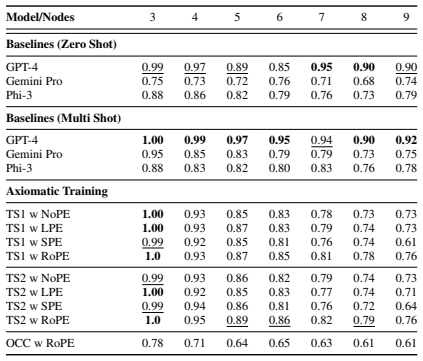
Table 1 :Evaluation on MultiEvalSLR dataset.Accu- racy of axiomatically trained models with another baseline on the most complicated setups. For OCC we only report performance with RoPE encodings, which is the best per- forming setup for this dataset. See Sec 5.2 for details.Bold numbers denote the highest value on a test set, while the underlined ones denote the second best.
원문 · CC BY 4.0 · Vashishtha, Aniket, Kumar, Abhinav, Pandey, Atharva, Reddy, Abbavaram Gowtham, Ahuja, Kabir, Balasubramanian, Vineeth N, Sharma, Amit · Teaching Transformers Causal Reasoning through Axiomatic Training · 원문 그림 인용 · 원본 PDF 7쪽에서 그림 영역을 추출했습니다.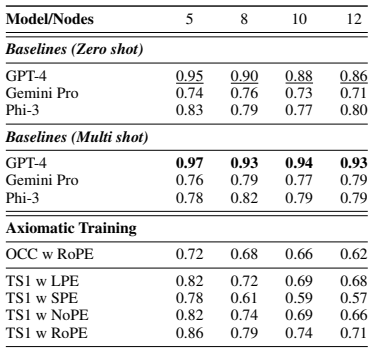
Table 2 :Evaluation with branching factor 1.4.Accuracy of axiomatically trained models with LM baselines on the causal graphs with branching factor 1.4.
원문 · CC BY 4.0 · Vashishtha, Aniket, Kumar, Abhinav, Pandey, Atharva, Reddy, Abbavaram Gowtham, Ahuja, Kabir, Balasubramanian, Vineeth N, Sharma, Amit · Teaching Transformers Causal Reasoning through Axiomatic Training · 원문 그림 인용 · 원본 PDF 7쪽에서 그림 영역을 추출했습니다.데이터 다양성과 위치 인코딩의 역할
절제 결과는 데이터 구성과 위치 인코딩이 일반화에 영향을 준다는 점을 보여 줍니다. 선형 사슬만으로 학습한 OCC 설정은 더 긴 사슬에는 일반화하지만, 다른 DAG 구조에는 일반화하지 못한다고 보고됩니다. 무작위 뒤집기를 포함한 TS1과 TS2 설정은 여러 시나리오에 걸쳐 일반화합니다. 위치 인코딩 비교에서는 위치 인코딩을 제거한 NoPE가 긴 사슬과 복잡한 구조에서 좋은 결과를 보입니다. 다만 이 결과는 해당 실험 설정에서의 관찰이며, RoPE가 모든 조건에서 우월하다는 결론은 아닙니다.
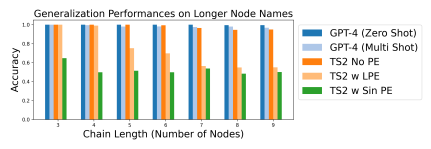
Figure 2 : Evaluating generalization on causal sequences (with- out random flipping) with longer node names (than the ones used in sequences in train set). TS-2 training set with no positional encoding leads to the best performance. Refer table A5 for complete results.
원문 · CC BY 4.0 · Vashishtha, Aniket, Kumar, Abhinav, Pandey, Atharva, Reddy, Abbavaram Gowtham, Ahuja, Kabir, Balasubramanian, Vineeth N, Sharma, Amit · Teaching Transformers Causal Reasoning through Axiomatic Training · 원문 그림 인용 · 원본 PDF 8쪽에서 그림 영역을 추출했습니다.Llama-3-8B-Instruct의 자연어 벤치마크 평가
같은 축공리 데이터로 Llama-3-8B-Instruct를 지도 fine-tuning(LoRA, rank 64, alpha 16)합니다. 미세조정한 모델은 Corr2Cause에서 제로샷으로 평가되며, 클래스 불균형 때문에 F1 점수를 사용합니다. 보고에 따르면 F1은 기준 Llama 모델보다 거의 20 p.p. 높아지며 GPT-4를 능가합니다. CLEAR의 d-분리 Yes/No 문항에서는 표 5에 정확도가 60.0에서 70.0으로 보고되고, 객관식 문항에서는 33.0에서 50.0으로 보고됩니다. 본문에는 Yes/No가 30에서 70퍼센트로 늘었다고 써 있어 기준 수치 표기가 다르므로, 표 값을 기준으로 읽어야 합니다.
이 평가는 합성 데이터만으로 학습하고 벤치마크 자체로는 학습하지 않은 설정입니다.
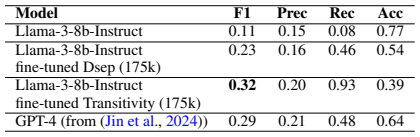
Table 4 :Evaluation on the Corr2Cause Task from (Jin et al., 2024).We fine-tune Llama-3-8B on our transitivity and d-separation datasets and evaluate on the Corr2Cause dataset in a zero-shot setting. We observe a significant increase in performance (over 20 p.p. improvement in F1 score compared to the base Llama model).
원문 · CC BY 4.0 · Vashishtha, Aniket, Kumar, Abhinav, Pandey, Atharva, Reddy, Abbavaram Gowtham, Ahuja, Kabir, Balasubramanian, Vineeth N, Sharma, Amit · Teaching Transformers Causal Reasoning through Axiomatic Training · 원문 그림 인용 · 원본 PDF 9쪽에서 그림 영역을 추출했습니다.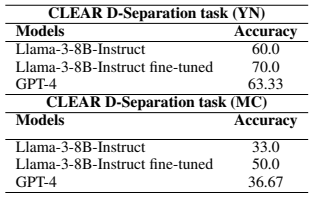
Table 5 :Evaluation on CLEAR dataset (Chen et al., 2024)We fine-tune the LMs on our d-separation dataset and evaluate on the CLEAR dataset. We observe a significant increase in performance compared to the baseline, which highlights the efficacy of axiomatic training.
원문 · CC BY 4.0 · Vashishtha, Aniket, Kumar, Abhinav, Pandey, Atharva, Reddy, Abbavaram Gowtham, Ahuja, Kabir, Balasubramanian, Vineeth N, Sharma, Amit · Teaching Transformers Causal Reasoning through Axiomatic Training · 원문 그림 인용 · 원본 PDF 9쪽에서 그림 영역을 추출했습니다.적용 범위와 가정
이 결과는 전제와 가설이 합성 그래프로 제한된 설정에서 얻어진 것입니다. 연구는 관측되지 않은 교란 변수가 없다고 가정합니다. 또한 분기 평가의 RoPE 결과는 복잡도가 커질수록 약해지며, OCC 모델은 구조 일반화에 실패합니다. 자연어 벤치마크의 개선은 Llama-3-8B-Instruct에 대한 결과이며, 다른 모델이나 다른 과제로 일반화되었다는 증거는 이 논문의 범위를 벗어납니다.
논문 정보
- 저자
- Vashishtha, Aniket, Kumar, Abhinav, Pandey, Atharva, Reddy, Abbavaram Gowtham, Ahuja, Kabir, Balasubramanian, Vineeth N, Sharma, Amit
- 학회·저널
- arXiv · 프리프린트
- 최초 공개일
- 2024년 7월 10일
- 등록일
- 2026년 10월 30일
- 수정일
- 2025년 10월 24일
- 버전
- v3
- arXiv
- 2407.07612
- 원문 이용 조건
- CC BY 4.0
- 제공 범위
- 논문 정보, 해설, 허용된 원문 그림
AI 해설은 논문 원문과 별개의 설명이며 오류가 있을 수 있습니다. 원문과 그림은 각 출처의 이용 조건과 따로 표시된 권리를 따릅니다.
초록
For text-based AI systems to interact in the real world, causal reasoning is an essential skill. Since active interventions are costly, we study to what extent a system can learn causal reasoning from symbolic demonstrations of causal axioms. Specifically, we present an axiomatic training method where the system learns from multiple demonstrations of a causal axiom (or rule), rather than incorporating the axiom as an inductive bias or inferring it from data values. A key question is whether the system would learn to generalize from the axiom demonstrations to more complex scenarios. Our results, based on applying axiomatic training to learn the transitivity axiom and d-separation rule, indicate that such generalization is possible. To avoid data contamination issues, we start with a 67 million parameter transformer model and train it from scratch. On both tasks, we find that a model trained on linear causal chains (along with some noisy variations) can generalize well to complex graphs, including longer causal chains, causal chains with reversed order, and graphs with branching.To handle diverse text inputs, the same method is extended to finetune language models. Finetuning Llama-3-8B-Instruct model on our axiomatic data leads to significant gains on causal benchmarks such as Corr2Cause and CLEAR, in some cases providing state-of-the-art performance surpassing GPT-4.
원문 인용
Vashishtha, Aniket, Kumar, Abhinav, Pandey, Atharva, Reddy, Abbavaram Gowtham, Ahuja, Kabir, Balasubramanian, Vineeth N, Sharma, Amit (2024). Teaching Transformers Causal Reasoning through Axiomatic Training. arXiv:2407.07612v3. https://arxiv.org/abs/2407.07612v3
BibTeX
@misc{aniket2024teaching,
  title = {{Teaching Transformers Causal Reasoning through Axiomatic Training}},
  author = {Vashishtha, Aniket and Kumar, Abhinav and Pandey, Atharva and Reddy, Abbavaram Gowtham and Ahuja, Kabir and Balasubramanian, Vineeth N and Sharma, Amit},
  year = {2024},
  eprint = {2407.07612},
  archivePrefix = {arXiv},
  url = {https://arxiv.org/abs/2407.07612v3}
}