논문 해설
CURE: Simulation-Augmented Auto-Tuning in Robotics
CURE: 로보틱스에서의 시뮬레이션 보강 자동 튜닝
- 연구 문제 로봇의 설정 옵션은 서로 복잡하게 상호작용하여 설정 공간이 지수적으로 커지므로, 기존 데이터 효율적 최적화는 예산 소진 뒤에야 수렴하고 환경 간 전이가 어렵습니다.
- 연구 방법 CURE는 시뮬레이션에서 학습한 인과 모델로 평균 인과 효과가 큰 설정 옵션만 남긴 뒤, 대상 플랫폼에서 축소된 공간을 EHVI 기반 베이지안 최적화로 탐색합니다.
- 주요 결과 내비게이션 실험에서 CURE는 MOBO 대비 2배 성능 향상과 4.6배 효율 향상을 보고했습니다. 배포 변화가 커질수록 이점이 커진다는 결과도 보고되었습니다.
로봇 설정 최적화의 어려움
로봇은 locomotion, 내비게이션, 조작 등 여러 하위 시스템으로 구성되며 각 구성 요소에는 설정 옵션이 많이 있습니다. 옵션들은 소프트웨어와 하드웨어를 가로질러 서로 복잡하게 상호작용하므로 설정 공간은 지수적으로 커집니다. 원문은 100개 옵션이 각각 10개 값을 가지는 경우 10^100개의 설정이 생긴다고 예로 듭니다. 베이지안 최적화 같은 데이터 효율적 방법은 이를 자동화하는 데 쓰이지만, 예산이 거의 소진된 뒤에야 수렴하는 경우가 많고 환경이나 플랫폼이 바뀌면 전이되지 않는다는 문제가 있습니다.
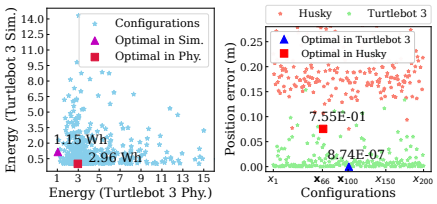
Fig. 2 : Non-transferability of optimal configurations across different environments/platforms: (a) optimal configuration for Turtlebot 3 in simulation differs from its physical counterpart; and (b) optimal configuration for Turtlebot 3 is not suitable in Husky.
원문 · CC BY 4.0 · Md Abir Hossen, Sonam Kharade, Jason M. O'Kane, Bradley Schmerl, David Garlan, Pooyan Jamshidi · CURE: Simulation-Augmented Auto-Tuning in Robotics · 원문 그림 인용 · 원본 PDF 3쪽에서 그림 영역을 추출했습니다.이 논문은 이 문제를 해결하기 위해 CURE를 제안합니다. CURE는 저비용 소스 환경에서 학습한 인과 모델로 인과적으로 관련된 옵션만 남겨 탐색 공간을 줄이고, 그 축소된 공간에서 대상 플랫폼의 최적화를 수행합니다.
CURE의 두 단계 구조
CURE는 1단계에서 소스 환경의 무작위 설정과 성능 측정으로 인과 구조를 학습합니다. 구조 학습은 Fisher의 z 검정으로 독립인 변수 쌍 사이의 간선을 제거하고 PAG를 만든 뒤, LatentSearch로 부분 방향 간선을 엔트로피 기준에 따라 해결하는 방식으로 진행됩니다. 원문은 이 결과를 ADMG 형태의 인과 모델이라고 설명합니다.
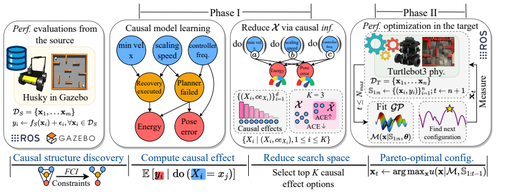
Fig. 3 : CURE overview.
원문 · CC BY 4.0 · Md Abir Hossen, Sonam Kharade, Jason M. O'Kane, Bradley Schmerl, David Garlan, Pooyan Jamshidi · CURE: Simulation-Augmented Auto-Tuning in Robotics · 원문 그림 인용 · 원본 PDF 4쪽에서 그림 영역을 추출했습니다.학습된 모델에서 각 설정 옵션의 평균 인과 효과(ACE)를 개입으로 계산하여 옵션을 순위화하고, 상위 K개 옵션만 남겨 탐색 공간을 줄입니다. 2단계에서는 대상 플랫폼에서 축소된 공간에 Sobol 초기 설계를 측정하고, GP 대리 모델을 적합한 뒤 EHVI를 최대화하는 설정을 다음 실험으로 선택합니다. 원문은 이를 예산이 소진될 때까지 반복한다고 설명합니다.

원문 그림 TABLE VI: ACE values of the configuration options.
원문 · CC BY 4.0 · Md Abir Hossen, Sonam Kharade, Jason M. O'Kane, Bradley Schmerl, David Garlan, Pooyan Jamshidi · CURE: Simulation-Augmented Auto-Tuning in Robotics · 원문 그림 인용 · 원본 PDF 15쪽에서 그림 영역을 추출했습니다.내비게이션 과제 검증
내비게이션 실험에서 CURE는 Husky를 Gazebo에서 실행한 데이터로 인과 모델을 학습하고, MOBO 및 RidgeCV-MOBO와 비교되었습니다. 목적 지표는 에너지와 위치 오차였으며, 예산은 200회 반복으로 설정되었습니다. 저자들은 CURE가 MOBO보다 2배 높은 성능 향상과 4.6배의 효율 향상을 보였다고 보고합니다. 이 수치는 Husky 시뮬레이션에서 Turtlebot 3 물리 로봇으로 전이하는 설정에서 나온 것입니다.
효율 지표 η는 성공한 과제 수의 합을 반복 수로 정규화한 값입니다. 원문은 RidgeCV-MOBO가 핵심 옵션을 식별하지 못해 성능이 낮았다고 해석합니다.
배포 변화 심각도에 따른 전이성
전이성 실험은 Sim-to-real 설정과 Sim-to-real 및 플랫폼 변화 설정으로 나뉩니다. Sim-to-real 설정에서는 Turtlebot 3 시뮬레이션의 1000회 미션 데이터로 학습한 인과 모델을 실물 Turtlebot 3에 적용했습니다. 플랫폼 변화 설정에서는 Husky 시뮬레이션에서 학습한 모델을 Turtlebot 3 실물에 적용했습니다.
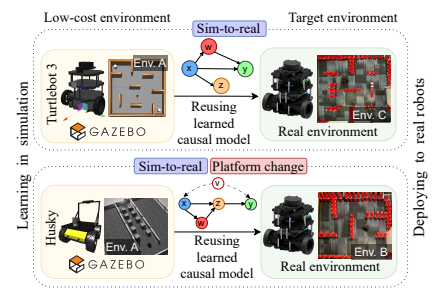
Fig. 1 : Sim-to-real: applying the knowledge of the learned causal model using Turtlebot 3 in simulation to the Turtlebot 3 physical robot. Sim-to-real & Platform change: transferring the causal model learned using Husky in simulation to the Turtlebot 3 physical robot.
원문 · CC BY 4.0 · Md Abir Hossen, Sonam Kharade, Jason M. O'Kane, Bradley Schmerl, David Garlan, Pooyan Jamshidi · CURE: Simulation-Augmented Auto-Tuning in Robotics · 원문 그림 인용 · 원본 PDF 1쪽에서 그림 영역을 추출했습니다.원문은 낮은 심각도에서 MOBO 대비 hypervolume 1.5배, 높은 심각도에서 2배를 보고하며, 효율은 각각 2.2배와 4.6배라고 밝힙니다. 이는 두 설정의 비교 결과이며, 심각도가 커질수록 CURE의 상대 이점이 커진다는 관찰로 읽습니다.
인과 모델의 한계와 적용 범위
인과 발견은 NP-hard이므로 학습된 인과 모델이 실제 인과 구조와 다를 수 있습니다. 또한 소스 플랫폼의 전체 인과 그래프를 그대로 재사용하면 플랫폼 차이 때문에 편향이 생길 수 있어, 대상 플랫폼에서 새로운 인과 연결을 찾는 과정이 필요하다고 원문은 설명합니다. 원문에서 Husky와 Turtlebot 3의 인접행렬은 상당히 겹치지만, 서로 다른 간선도 존재합니다.
CURE는 소스 환경의 개입 비용이 낮고 대상 환경의 개입 비용이 높으며 샘플링 예산이 작다고 가정합니다. 조작 과제 결과와 다른 로봇 조합에 대한 일반화는 이 논문의 범위를 벗어나므로, 결과는 보고된 로봇과 과제 조건에서 읽어야 합니다.
논문 정보
- 저자
- Md Abir Hossen, Sonam Kharade, Jason M. O'Kane, Bradley Schmerl, David Garlan, Pooyan Jamshidi
- 학회·저널
- arXiv · 프리프린트
- 최초 공개일
- 2024년 2월 8일
- 등록일
- 2026년 11월 6일
- 수정일
- 2025년 2월 25일
- 버전
- v3
- arXiv
- 2402.05399
- 분류
- cs.RO · cs.AI
- 원문 이용 조건
- CC BY 4.0
- 제공 범위
- 논문 정보, 해설, 허용된 원문 그림
AI 해설은 논문 원문과 별개의 설명이며 오류가 있을 수 있습니다. 원문과 그림은 각 출처의 이용 조건과 따로 표시된 권리를 따릅니다.
초록
Robotic systems are typically composed of various subsystems, such as localization and navigation, each encompassing numerous configurable components (e.g., selecting different planning algorithms). Once an algorithm has been selected for a component, its associated configuration options must be set to the appropriate values. Configuration options across the system stack interact non-trivially. Finding optimal configurations for highly configurable robots to achieve desired performance poses a significant challenge due to the interactions between configuration options across software and hardware that result in an exponentially large and complex configuration space. These challenges are further compounded by the need for transferability between different environments and robotic platforms. Data efficient optimization algorithms (e.g., Bayesian optimization) have been increasingly employed to automate the tuning of configurable parameters in cyber-physical systems. However, such optimization algorithms converge at later stages, often after exhausting the allocated budget (e.g., optimization steps, allotted time) and lacking transferability. This paper proposes CURE -- a method that identifies causally relevant configuration options, enabling the optimization process to operate in a reduced search space, thereby enabling faster optimization of robot performance. CURE abstracts the causal relationships between various configuration options and robot performance objectives by learning a causal model in the source (a low-cost environment such as the Gazebo simulator) and applying the learned knowledge to perform optimization in the target (e.g., Turtlebot 3 physical robot). We demonstrate the effectiveness and transferability of CURE by conducting experiments that involve varying degrees of deployment changes in both physical robots and simulation.
원문 인용
Md Abir Hossen, Sonam Kharade, Jason M. O'Kane, Bradley Schmerl, David Garlan, Pooyan Jamshidi (2024). CURE: Simulation-Augmented Auto-Tuning in Robotics. arXiv:2402.05399v3. https://arxiv.org/abs/2402.05399v3
BibTeX
@misc{hossen2024cure,
  title = {{CURE: Simulation-Augmented Auto-Tuning in Robotics}},
  author = {Md Abir Hossen and Sonam Kharade and Jason M. O'Kane and Bradley Schmerl and David Garlan and Pooyan Jamshidi},
  year = {2024},
  eprint = {2402.05399},
  archivePrefix = {arXiv},
  url = {https://arxiv.org/abs/2402.05399v3}
}