논문 해설
Small Heads, Strong Decisions: A Controlled Study of Typed-Decision Models
작은 헤드, 강한 결정: Typed-Decision 모델에 관한 통제 실험 연구
- 연구 문제 여러 typed-decision 모델이 readout, 백본, 데이터, 레시피를 함께 바꿔 발표되어 어떤 설계 선택이 성능에 영향을 주는지 분리하기 어렵습니다.
- 연구 방법 readout만 바꾸고 백본과 학습 조건을 고정한 통제 비교를 수행하며, 헤드 대신 백본 크기를 바꾸는 실험을 함께 진행합니다.
- 주요 결과 Qwen3-0.6B에서 다섯 readout은 in-domain 81.3%에서 82.0% 사이였고, 코사인 헤드와 joint schema head의 차이는 −0.10점이었습니다.
문제 설정
typed-decision 모델은 상태 텍스트를 읽고 여러 질문의 선택지마다 확률을 내는 모델입니다. 공개된 모델들은 readout, 프롬프트 방식, 백본, 학습 데이터, 학습 레시피를 함께 바꾸어 발표되었기 때문에 어떤 설계 선택이 성능에 실제로 영향을 주는지 발표 수치만으로는 가릴 수 없습니다. 이 논문은 이 공백을 줄이기 위해 readout과 프롬프트 방식만 바꾸고 나머지를 고정한 통제 비교를 설계했습니다. 같은 백본, 같은 15개 공개 영어 학습 소스, 같은 레시피와 헤드별 학습률 탐색, 같은 시드를 사용했습니다. 이어서 헤드를 고정한 채 백본의 크기와 체크포인트 종류를 바꾸어 백본의 영향을 따로 확인했습니다.
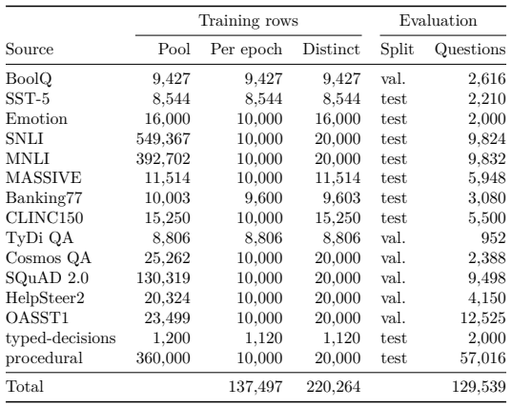
Table 2 : The 15 training sources. “Pool” is the number of training rows available, “per epoch” how many each epoch draws (at most 10,000), and “distinct” how many different rows the two epochs use. Evaluation is on the test split where one exists, otherwise on the validation rows not used for calibration.
원문 · CC BY 4.0 · Ritvik Rastogi · Small Heads, Strong Decisions: A Controlled Study of Typed-Decision Models · 원문 그림 인용 · 원본 PDF 11쪽에서 그림 영역을 추출했습니다.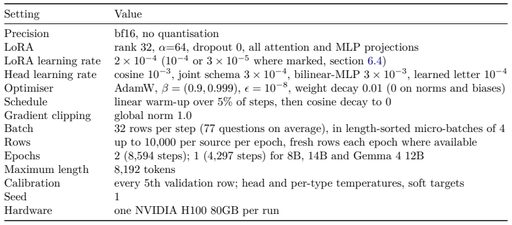
Table 10 : Training settings shared by every run, and the per-head learning rates.
원문 · CC BY 4.0 · Ritvik Rastogi · Small Heads, Strong Decisions: A Controlled Study of Typed-Decision Models · 원문 그림 인용 · 원본 PDF 21쪽에서 그림 영역을 추출했습니다.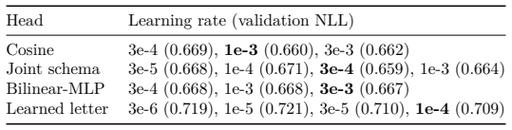
Table 11 : Head learning-rate sweep: calibrated NLL on the pooled validation (calibration) rows, on a cheap protocol (2,000 rows per source, one epoch, Qwen3-0.6B). Bold marks the chosen rate. The LM letter readout has no head parameters and is not swept.
원문 · CC BY 4.0 · Ritvik Rastogi · Small Heads, Strong Decisions: A Controlled Study of Typed-Decision Models · 원문 그림 인용 · 원본 PDF 22쪽에서 그림 영역을 추출했습니다.조인트 프롬프트와 코사인 헤드
주요 비교에서는 상태, 모든 질문, 선택지를 하나의 채팅 프롬프트에 넣는 조인트 프롬프트를 사용했습니다. 백본은 한 번의 순전파로 최종 은닉 상태를 만들고, 각 readout은 필요한 위치의 은닉 상태만 읽습니다. 제안된 코사인 헤드는 질문 구간의 마지막 토큰과 각 선택지 JSON의 마지막 토큰을 골라, 두 벡터를 각각 W=256차원으로 사영한 뒤 RMS 정규화합니다. 선택지 점수는 학습 가능한 스케일 s = min(e^θ, 100)을 곱한 코사인 유사도입니다. 같은 질문 안의 선택지끼리만 비교하므로 질문 사이의 상호작용은 백본 내부에서만 일어납니다. 학습은 질문마다 정답 분포와 예측 분포 사이의 soft cross-entropy를 쓰고 질문 수로 평균합니다.
LoRA 어댑터와 헤드를 AdamW로 함께 학습하며, 백본 가중치는 고정합니다. 이 보정은 예측된 선택지의 순서를 바꾸지 않습니다.
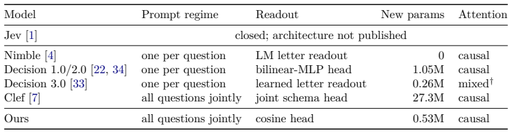
Table 1 : Typed-decision architectures. “New params” counts the readout’s new parameters in our port at hidden sizeH=1024(Qwen3-0.6B), excluding LoRA adapters.
원문 · CC BY 4.0 · Ritvik Rastogi · Small Heads, Strong Decisions: A Controlled Study of Typed-Decision Models · 원문 그림 인용 · 원본 PDF 3쪽에서 그림 영역을 추출했습니다.다섯 readout의 정확도 비교
Qwen3-0.6B 백본에서 다섯 readout은 in-domain 정확도 81.3%에서 82.0% 사이에 모였습니다. 차이는 −0.10점이며 95% 구간은 [−0.33, +0.13]이었습니다. 이 구간은 테스트 세트에서 같은 질문을 쌍으로 리샘플링한 값이며 시드 잡음은 포함하지 않습니다. 따라서 두 헤드의 차이는 non-inferiority 기준인 ±1점 안에 있다고 판단했습니다. 헤드 파라미터 수는 joint schema head의 27.3M개에 비해 코사인 헤드가 약 52배 적었습니다. held-out 5개 소스에서는 상황이 달랐습니다. 이 차이는 주로 AG News와 DBpedia에서 나타났습니다.
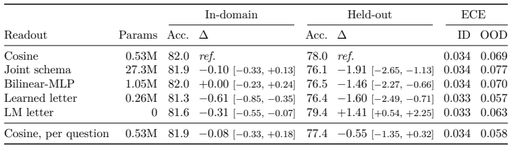
Table 3 : Every readout on Qwen3-0.6B. The cosine head pools both the question and each option by their last token (other poolings: table 6). Accuracy (%) is the unweighted mean over the 15 in-domain sources and over the 5 held-out sources.∆is the paired difference from the cosine head on the same questions, with a 95% bootstrap interval that resamples whole rows (test-set noise only, not seed noise). ECE is after calibration, averaged over sources. All rows use the joint prompt except the last, which gives every question its own prompt with the same cosine head and pooling.
원문 · CC BY 4.0 · Ritvik Rastogi · Small Heads, Strong Decisions: A Controlled Study of Typed-Decision Models · 원문 그림 인용 · 원본 PDF 13쪽에서 그림 영역을 추출했습니다.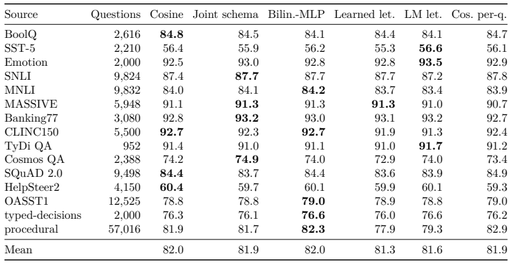
Table 12 : In-domain accuracy (%) by source on Qwen3-0.6B. “Questions” counts each source’s final evaluation questions (its test split, or the validation rows not used for calibration). Bold marks the best joint-prompt readout.
원문 · CC BY 4.0 · Ritvik Rastogi · Small Heads, Strong Decisions: A Controlled Study of Typed-Decision Models · 원문 그림 인용 · 원본 PDF 22쪽에서 그림 영역을 추출했습니다.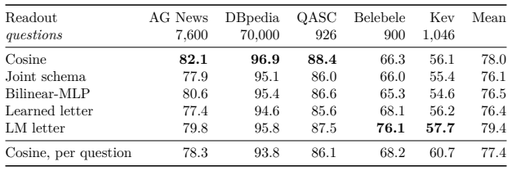
Table 13 : Held-out accuracy (%) by source on Qwen3-0.6B. Bold marks the best joint-prompt readout. The second row gives each source’s number of questions.
원문 · CC BY 4.0 · Ritvik Rastogi · Small Heads, Strong Decisions: A Controlled Study of Typed-Decision Models · 원문 그림 인용 · 원본 PDF 22쪽에서 그림 영역을 추출했습니다.질문을 한 프롬프트에 묶는 비용
질문마다 프롬프트를 따로 만드는 방식은 같은 상태 텍스트를 질문 수만큼 다시 인코딩합니다. 이 논문은 질문을 한 프롬프트에 묶어도 정확도가 줄지 않으면서 비용이 줄어든다는 점을 확인했습니다. 저자들이 밝힌 바로는 한 프롬프트 방식이 질문별 프롬프트 방식보다 추론이 1.6배, 학습이 2.1에서 2.5배 빨랐습니다. 이 비용 수치는 각 readout의 원래 설계 프롬프트 방식에 따라 측정한 값이므로, 프롬프트 방식만 분리한 효과와는 구분해서 읽어야 합니다.
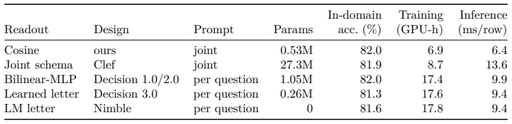
Table 4 : Accuracy and cost of the five readouts on Qwen3-0.6B. Each readout’s cost is charged in its design’s prompt regime: one joint prompt per row, or one sequence per question. Training is the GPU-hours of one run (8,594 steps of 32 rows) on one idle H100, from the median step time. Inference is the average time per row (one text with all its questions, 2.5 on average) with the GPU kept full by length-sorted batches of up to 32k tokens.
원문 · CC BY 4.0 · Ritvik Rastogi · Small Heads, Strong Decisions: A Controlled Study of Typed-Decision Models · 원문 그림 인용 · 원본 PDF 14쪽에서 그림 영역을 추출했습니다.백본 크기가 가장 큰 변수
헤드를 코사인 헤드로 고정하고 백본을 바꾸었을 때 변화가 가장 컸습니다. Qwen3-0.6B에서 Qwen3-4B로 바꾸자 in-domain 정확도는 82.0%에서 85.9%로 올랐고, held-out 정확도는 78.0%에서 88.9%로 올랐습니다. 이는 in-domain 약 4점, held-out 약 11점 증가에 해당합니다. 같은 4B 아키텍처의 post-training 변형도 비교했습니다. 하이브리드 thinking 체크포인트, Instruct-2507, Thinking-2507, Base의 in-domain 정확도는 모두 85.9%로 같았습니다. held-out에서는 Instruct가 +0.53점, Thinking이 +0.09점, Base가 +0.35점 차이를 보였고, 모두 ±1점 동등성 범위 안에 있었습니다.
따라서 이 실험에서 post-training 변형은 백본 크기만큼 큰 영향을 주지 않았습니다.
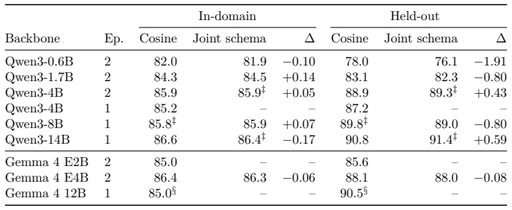
Table 7 : Scaling the backbone. Accuracy (%) of the cosine head (last-token question and option pooling) and the joint schema head;∆is joint schema minus cosine, paired on the same questions. Backbones of 8B and above, and the bridge row for Qwen3-4B, train for one epoch instead of two. ‡LoRA learning rate10−4 and§3× 10⁻⁵ instead of2× 10−4, after the default diverged (section 6.4).
원문 · CC BY 4.0 · Ritvik Rastogi · Small Heads, Strong Decisions: A Controlled Study of Typed-Decision Models · 원문 그림 인용 · 원본 PDF 16쪽에서 그림 영역을 추출했습니다.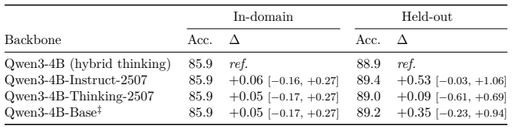
Table 9 : Four post-training variants of the same 4B architecture, cosine head, two epochs.∆is the paired difference from the hybrid-thinking checkpoint, with a 95% row-bootstrap interval.‡LoRA learning rate10−4 (section 6.4).
원문 · CC BY 4.0 · Ritvik Rastogi · Small Heads, Strong Decisions: A Controlled Study of Typed-Decision Models · 원문 그림 인용 · 원본 PDF 17쪽에서 그림 영역을 추출했습니다.양방향 어텐션의 손실
코사인 헤드에서 causal 어텐션과 bidirectional 어텐션을 비교했습니다. 질문과 선택지의 풀링을 마지막 토큰 또는 구간 평균으로 바꾸는 네 가지 조합을 모두 봤습니다. 모든 풀링 조합에서 bidirectional 어텐션은 in-domain 정확도를 약 3.5에서 6.0점, held-out 정확도를 5.4에서 11.8점 낮췄습니다. 질문 풀링을 마지막 토큰에서 평균으로 바꾸면 bidirectional held-out 정확도가 회복되었지만, causal 설정의 수준까지는 돌아가지 않았습니다. 이 결과는 학습 레시피 아래에서 나온 것이며, 더 긴 학습이나 더 큰 적응 용량이 이 격차를 줄일 수 있는지는 확인하지 않았습니다.
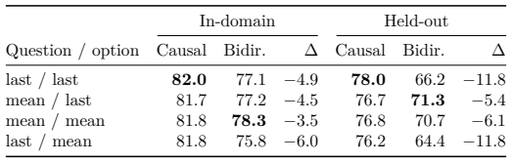
Table 6 : Pooling and attention direction in the Qwen3-0.6B cosine head. Accuracy (%), averaged equally over the 15 in-domain or five held-out sources;∆is bidirectional minus causal, in percentage points. Bold marks the highest value in each accuracy column. All models use rank-32 LoRA for two epochs. Causal results retain the original measurements; last/mean is an additional configuration. Differences are computed from the displayed means.
원문 · CC BY 4.0 · Ritvik Rastogi · Small Heads, Strong Decisions: A Controlled Study of Typed-Decision Models · 원문 그림 인용 · 원본 PDF 15쪽에서 그림 영역을 추출했습니다.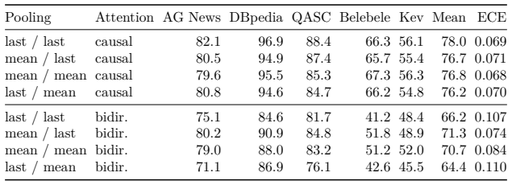
Table 14 : Held-out accuracy (%) and mean ECE after calibration for the pooling–attention ablation. Pooling is question / option; means weight sources equally. Per-source accuracies are rounded to one decimal. Calibration leaves the predicted option and hence accuracy unchanged.
원문 · CC BY 4.0 · Ritvik Rastogi · Small Heads, Strong Decisions: A Controlled Study of Typed-Decision Models · 원문 그림 인용 · 원본 PDF 23쪽에서 그림 영역을 추출했습니다.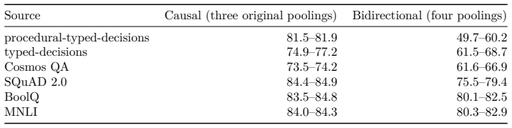
Table 15 : Selected in-domain sources with substantial bidirectional accuracy reductions. Ranges are observed accuracy (%), not confidence intervals. The causal column covers the original last/last, mean/last and mean/mean configurations; the bidirectional column covers all four. Ranges alone do not identify matched-pooling differences.
원문 · CC BY 4.0 · Ritvik Rastogi · Small Heads, Strong Decisions: A Controlled Study of Typed-Decision Models · 원문 그림 인용 · 원본 PDF 24쪽에서 그림 영역을 추출했습니다.Belebele 우위와 학습 안정성
LM letter readout이 held-out에서 앞선 이유는 대부분 Belebele에서 나타났습니다. Belebele에서 LM letter readout은 코사인 헤드보다 9.8점 높았습니다. 답변 코드를 바꾸어 평가하면 정확도가 달라졌습니다. 대문자 코드에서 76.1%였던 값은 숫자 단어 72.3%, 소문자 67.4%, 기호 59.3%로 떨어졌습니다. 따라서 이 우위는 readout 자체보다 사전학습된 언어 모델이 답변 코드에 가진 사전 확률과 연결되어 보입니다. 학습 안정성도 한계로 남습니다. 기본 LoRA 학습률 2×10⁻⁴에서 Qwen3-4B와 Qwen3-14B의 joint schema head, Qwen3-8B와 Qwen3-4B-Base의 코사인 헤드 실행이 발산했습니다.
이 네 실행은 10−4 학습률에서 정상적으로 학습되었습니다.
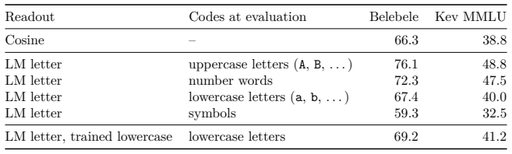
Table 5 : Where the LM letter readout’s held-out advantage comes from: the answer codes. Accuracy (%) of the Qwen3-0.6B checkpoints, all trained with uppercase codes, when the codes are swapped at evaluation only. Belebele has 900 questions; Kev’s MMLU subset has 80. The last row is a separate model trained with lowercase codes, scored by the main evaluation (where the uppercase-trained model scores 76.1). Paired against the cosine head on Belebele: uppercasep=2×10⁻¹⁰, number wordsp=1.3×10⁻⁵, lowercasep=0.28, symbolsp=3×10⁻⁴ (worse).
원문 · CC BY 4.0 · Ritvik Rastogi · Small Heads, Strong Decisions: A Controlled Study of Typed-Decision Models · 원문 그림 인용 · 원본 PDF 15쪽에서 그림 영역을 추출했습니다.논문 정보
- 저자
- Ritvik Rastogi
- 학회·저널
- arXiv · 프리프린트
- 최초 공개일
- 2026년 11월 11일
- 등록일
- 2026년 11월 13일
- 수정일
- 2026년 11월 11일
- 버전
- v1
- arXiv
- 2611.15592
- 분류
- cs.AI
- 원문 이용 조건
- CC BY 4.0
- 제공 범위
- 논문 정보, 해설, 허용된 원문 그림
AI 해설은 논문 원문과 별개의 설명이며 오류가 있을 수 있습니다. 원문과 그림은 각 출처의 이용 조건과 따로 표시된 권리를 따릅니다.
초록
In September 2026, TypeSafe announced Jev as the first model in its System One category: unstructured state goes in, and typed, calibrated decisions that software can use directly come out. Jev's architecture and training data are unpublished, but many open typed-decision models have followed, including Nimble, the Decision 1.0--3.0 family and Clef. They answer structured questions about a piece of text, such as a yes/no check, a choice among labelled options or a graded score, by reading the text with a language model and scoring the options with a small readout. Each pairs a different readout with a different backbone, training mix and recipe, so it is unclear which design choices matter. We re-implement five readouts and train all of them under one protocol: the same backbone, the same 15 public English training sources, the same recipe with a per-head learning-rate sweep, and the same seed. Our experiments demonstrate that: The complexity of the head does not affect accuracy: on Qwen3-0.6B every readout reaches 81.3--82.0\% in-domain accuracy, and a 0.5M-parameter cosine head, which scores each option by its cosine similarity to the question, matches the 27M-parameter joint schema head adapted from Clef in-domain at half its inference time. Reading all of a text's questions from one prompt also matches one prompt per question in accuracy, with 1.6 times faster inference and 2.1--2.5 times faster training on one H100. The backbone's size matters more than either choice: moving from Qwen3-0.6B to Qwen3-4B adds 4 points in-domain and 11 points on held-out sources, while the base, instruct and thinking checkpoints of the same model tie. We recommend spending effort on the backbone and keeping the head minimal.
원문 인용
Ritvik Rastogi (2026). Small Heads, Strong Decisions: A Controlled Study of Typed-Decision Models. arXiv:2611.15592v1. https://arxiv.org/abs/2611.15592v1
BibTeX
@misc{rastogi2026small,
  title = {{Small Heads, Strong Decisions: A Controlled Study of Typed-Decision Models}},
  author = {Ritvik Rastogi},
  year = {2026},
  eprint = {2611.15592},
  archivePrefix = {arXiv},
  url = {https://arxiv.org/abs/2611.15592v1}
}