논문 해설
Q-OIL: Optimistic Exploration in Learning from Human Interventions
Q-OIL: 인간 개입으로부터 학습하는 낙관적 탐색
- 연구 문제 실제 사람의 개입은 로봇 학습에 유용하지만, 기존 합성 사람 모델은 실제 개입의 시점과 교정 행동을 충분히 반영하지 못합니다.
- 연구 방법 개입 시점을 최근 진행도로 모델링하는 PAM과, 개입 보너스를 탐색에만 쓰고 과제 TD 목표와 분리하는 Q-OIL을 제안합니다.
- 주요 결과 PAM 기반 평가는 실제 사용자 알고리즘 순위와 ρ=1.0의 상관을 보였고, Q-OIL은 시뮬레이션과 실제 로봇 과제에서 비교 기준보다 높은 성공률을 보고했습니다.
실제 사용자 개입과 시뮬레이션 가정의 차이
로봇이 실제 세계에 배치되면 실수가 불가피하며, 사람의 개입은 로봇이 행동을 개선하는 유용한 피드백이 됩니다. 그러나 실제 사람을 대상으로 한 실험은 느리고 비용이 많이 들어서, 알고리즘 개발은 보통 합성 사람 모델에 의존합니다. 이 논문은 기존 합성 모델이 가정한 개입 방식이 실제 참가자의 개입 데이터와 맞지 않는다고 지적합니다. 파일럿 연구에서 8명의 참가자가 3개의 시뮬레이션 조작 과제를 감독했고, 그 결과 24회 실행과 약 200k 전이가 수집되었습니다.
분석의 첫 번째 결과는 개입이 순간적인 행동 최적성이 아니라 진행도 정체에 반응해 일어난다는 점입니다. 기존 Markov 모델은 현재 상태와 행동의 최적성만으로 개입 시점을 정하지만, 이 연구에서는 최근 k 단계의 가치 변화 V*(st)-V*(st-k)가 개입 패턴을 더 잘 나타냅니다.
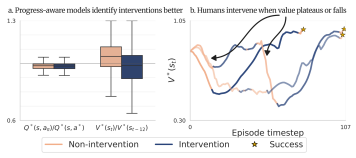
Figure 2 :(a) Progress separates interventions better than instantaneous values. (b) Qualitatively, humans in- tervene when value plateaus or declines.
원문 · CC BY 4.0 · Pranav Teegavarapu, Sriyash Poddar, Rico Qi, Cleah Winston, Krisha Khandelwal, Aykut Onyol, Natasha Jaques, Abhishek Gupta · Q-OIL: Optimistic Exploration in Learning from Human Interventions · 원문 그림 인용 · 원본 PDF 4쪽에서 그림 영역을 추출했습니다.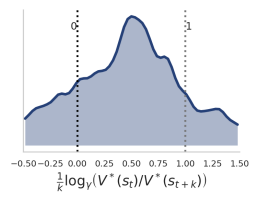
Figure 13 :Human intervention segments often make limited value-based progress.
원문 · CC BY 4.0 · Pranav Teegavarapu, Sriyash Poddar, Rico Qi, Cleah Winston, Krisha Khandelwal, Aykut Onyol, Natasha Jaques, Abhishek Gupta · Q-OIL: Optimistic Exploration in Learning from Human Interventions · 원문 그림 인용 · 원본 PDF 17쪽에서 그림 영역을 추출했습니다.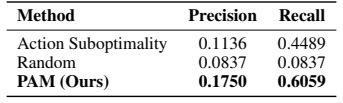
Table 1 : Intervention prediction on held-out human data.
원문 · CC BY 4.0 · Pranav Teegavarapu, Sriyash Poddar, Rico Qi, Cleah Winston, Krisha Khandelwal, Aykut Onyol, Natasha Jaques, Abhishek Gupta · Q-OIL: Optimistic Exploration in Learning from Human Interventions · 원문 그림 인용 · 원본 PDF 21쪽에서 그림 영역을 추출했습니다.진행도 기반 개입 모델과 분리된 Critic
연구의 핵심 기술적 변경은 두 가지입니다. 첫째, 개입 게이트 g를 최근 k 단계 진행도로 정의하는 진행도 인식 모델 PAM으로 바꿉니다. V*(st)-V*(st-k)가 δ보다 작으면 개입 확률은 α이고, 그 밖에는 β입니다. k와 δ는 실제 사람 데이터에서 격자 탐색으로 정했습니다.
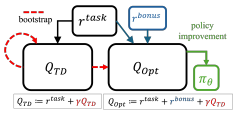
Figure 5 :Overview ofQ-OIL
원문 · CC BY 4.0 · Pranav Teegavarapu, Sriyash Poddar, Rico Qi, Cleah Winston, Krisha Khandelwal, Aykut Onyol, Natasha Jaques, Abhishek Gupta · Q-OIL: Optimistic Exploration in Learning from Human Interventions · 원문 그림 인용 · 원본 PDF 5쪽에서 그림 영역을 추출했습니다.둘째, Q-OIL은 개입 전이에 낙관적 보너스 b를 더하되 Critic을 두 개로 분리합니다. 과제 보상만 쓰는 TD Critic이 Bellman 목표를 제공하고, 보너스를 더한 낙관적 Critic이 탐색과 정책 개선을 담당합니다. 이렇게 하면 보너스가 개입 이전 상태로 역전파되는 것을 막을 수 있습니다. 정책은 낙관적 Critic을 최대화하는 방향으로 갱신되고, 개입 행동에는 행동 복제 정규화가 추가됩니다.
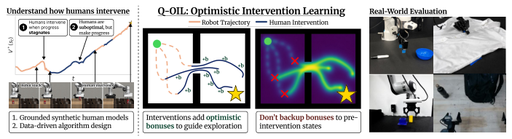
Figure 1 :Overview ofQ-OIL. Real-user data shows that humans intervene when robot progress stalls and provide suboptimal corrections.Q-OILtreats interventions as optimistic exploration bonuses while preventing bonuses from propagating to non-intervention states for faster real-world learning.
원문 · CC BY 4.0 · Pranav Teegavarapu, Sriyash Poddar, Rico Qi, Cleah Winston, Krisha Khandelwal, Aykut Onyol, Natasha Jaques, Abhishek Gupta · Q-OIL: Optimistic Exploration in Learning from Human Interventions · 원문 그림 인용 · 원본 PDF 2쪽에서 그림 영역을 추출했습니다.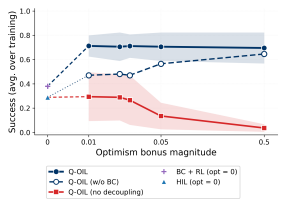
Figure 10 :Q-OILw/o decoupling degrades with higher bonus due to over-optimism.
원문 · CC BY 4.0 · Pranav Teegavarapu, Sriyash Poddar, Rico Qi, Cleah Winston, Krisha Khandelwal, Aykut Onyol, Natasha Jaques, Abhishek Gupta · Q-OIL: Optimistic Exploration in Learning from Human Interventions · 원문 그림 인용 · 원본 PDF 9쪽에서 그림 영역을 추출했습니다.시뮬레이션과 실제 사용자 순위 대조
PAM은 실제 사용자 평가와 알고리즘 순위의 일치도를 검증하는 데 사용되었습니다. 여섯 학습 알고리즘을 PAM, 행동 비최적성 기반 모델, 무작위 모델로 평가하고 실제 사용자 순위와 Spearman 상관을 비교했습니다. PAM 기반 순위는 실제 사용자 순위와 ρ=1.0의 상관을 보였습니다.
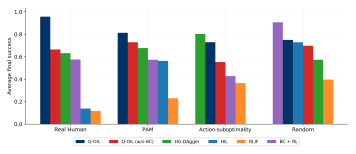
Figure 17 :Rankings of algorithms under real hu- man evaluation and three simulated intervention mod- els, based on final success rate.
원문 · CC BY 4.0 · Pranav Teegavarapu, Sriyash Poddar, Rico Qi, Cleah Winston, Krisha Khandelwal, Aykut Onyol, Natasha Jaques, Abhishek Gupta · Q-OIL: Optimistic Exploration in Learning from Human Interventions · 원문 그림 인용 · 원본 PDF 21쪽에서 그림 영역을 추출했습니다.이 결과는 알고리즘 순위의 일치에 관한 것이며, 절대 성공률이 같다는 뜻은 아닙니다. 또한 참가자 수와 과제 수가 제한되어 있으므로, 이 상관은 해당 과제와 참가자 집단에서 관찰된 결과로 읽어야 합니다.
시뮬레이션과 실제 로봇 결과
Robomimic 시뮬레이션에서 PAM 개입 모델을 사용했을 때 Q-OIL은 HIL, HG-DAgger, SIRIUS, PVP, RLIF, BC+RL 등 비교 기준보다 적은 상호작용으로 높은 성공률에 도달했습니다. 실제 사용자 개입 실험에서는 네 명의 참가자가 두 과제에서 여섯 방법을 평가했습니다.
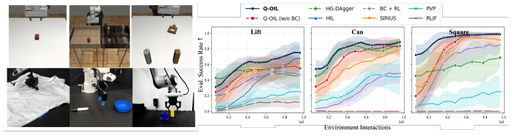
Figure 6 :Left:Evaluation tasks in simulation and on the Franka robot.Right:On Robomimic with the progress-aware human model (PAM),Q-OILimproves success rate and learning efficiency over baselines.
원문 · CC BY 4.0 · Pranav Teegavarapu, Sriyash Poddar, Rico Qi, Cleah Winston, Krisha Khandelwal, Aykut Onyol, Natasha Jaques, Abhishek Gupta · Q-OIL: Optimistic Exploration in Learning from Human Interventions · 원문 그림 인용 · 원본 PDF 7쪽에서 그림 영역을 추출했습니다.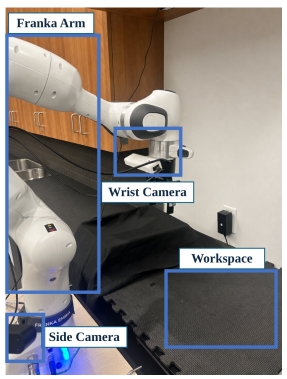
Figure 16 :Real-world robot setup. The policy receives RGB observations from a wrist-mounted camera and, optionally, a side-view camera. The human supervisor monitors the robot during online training and provides interventions using a Space- Mouse.
원문 · CC BY 4.0 · Pranav Teegavarapu, Sriyash Poddar, Rico Qi, Cleah Winston, Krisha Khandelwal, Aykut Onyol, Natasha Jaques, Abhishek Gupta · Q-OIL: Optimistic Exploration in Learning from Human Interventions · 원문 그림 인용 · 원본 PDF 19쪽에서 그림 영역을 추출했습니다.이 결과는 해당 과제와 평가 횟수에 한정됩니다.
적용 범위와 남은 질문
저자들은 인간 연구가 8명의 사용자와 시뮬레이션 과제 24회 실행으로 제한되어 있어, 더 다양한 실제 참가자 집단을 대표하지 않는다고 밝힙니다. 또한 평가는 탁상형 조작 과제에 한정되며, 비정형 환경과 긴 과제에서의 개입 패턴은 아직 확인되지 않았습니다.
개입 보너스는 학습 중 개입 전이에 가중치를 주는 방식이므로, 함수 근사를 통해 주변 전이로 퍼질 수 있습니다. 저자들은 이를 의미 공간이나 언어 기반 개입으로 확장하는 것을 향후 과제로 제시합니다.
논문 정보
- 저자
- Pranav Teegavarapu, Sriyash Poddar, Rico Qi, Cleah Winston, Krisha Khandelwal, Aykut Onyol, Natasha Jaques, Abhishek Gupta
- 학회·저널
- arXiv · 프리프린트
- 최초 공개일
- 2026년 11월 5일
- 등록일
- 2026년 11월 9일
- 수정일
- 2026년 11월 5일
- 버전
- v1
- arXiv
- 2611.08576
- 분류
- cs.RO · cs.AI
- 원문 이용 조건
- CC BY 4.0
- 제공 범위
- 논문 정보, 해설, 허용된 원문 그림
AI 해설은 논문 원문과 별개의 설명이며 오류가 있을 수 있습니다. 원문과 그림은 각 출처의 이용 조건과 따로 표시된 권리를 따릅니다.
초록
As robots are deployed in the real world, they will inevitably make mistakes. Human interventions provide valuable feedback for improving their behavior, enabling them to adapt online to new scenarios. However, studying human-in-the-loop robot learning is difficult: real-world experiments are slow and expensive, so most algorithm development relies on simulated human models. We show that common human modeling assumptions do not match how real people intervene in practice. Through analyzing intervention data from human participants, we find that humans tend to intervene when agent progress stalls, and that their corrective actions are often suboptimal. Motivated by these findings, we introduce a progress-based model of human intervention that achieves higher rank correlation with real-user algorithm rankings, enabling realistic algorithm benchmarking and development in simulation. Building on these insights, we propose Q-OIL, a method that adds optimistic bonuses to intervention transitions in reinforcement learning and softly guides exploration toward human corrections. We find that decoupled critics are critical for stability because they prevent the bonuses from backing up to pre-intervention states. As a result, Q-OIL learns more efficiently than competitive baselines, achieving 10-50% higher success in simulation and on real robots, and improving pretrained VLAs on two bimanual manipulation tasks. As we ground both evaluation and algorithms in realistic human behavior, this work provides a practical path toward scalable robot learning from interventions.
원문 인용
Pranav Teegavarapu, Sriyash Poddar, Rico Qi, Cleah Winston, Krisha Khandelwal, Aykut Onyol, Natasha Jaques, Abhishek Gupta (2026). Q-OIL: Optimistic Exploration in Learning from Human Interventions. arXiv:2611.08576v1. https://arxiv.org/abs/2611.08576v1
BibTeX
@misc{teegavarapu2026optimistic,
  title = {{Q-OIL: Optimistic Exploration in Learning from Human Interventions}},
  author = {Pranav Teegavarapu and Sriyash Poddar and Rico Qi and Cleah Winston and Krisha Khandelwal and Aykut Onyol and Natasha Jaques and Abhishek Gupta},
  year = {2026},
  eprint = {2611.08576},
  archivePrefix = {arXiv},
  url = {https://arxiv.org/abs/2611.08576v1}
}