논문 해설
Shortcut-Resistant CAM Distillation for Long-Tailed Recognition
꼬리가 긴 분포 인식을 위한 숏컷에 강한 CAM 증류
- 연구 문제 장기 꼬리 분포에서 tail 클래스는 샘플 수가 적어 배경이나 질감 같은 shortcut 단서에 쉽게 의존합니다.
- 연구 방법 SRCD는 head 클래스 CAM 후보를 에너지 기반 가중치로 합쳐 teacher를 만들고, tail CAM을 이 teacher에 distill합니다.
- 주요 결과 CIFAR100-LT IR=100에서 BCL 결합 시 Top-1 accuracy가 51.76에서 53.64로 보고되며, 여러 기준 방법과 벤치마크에서 Tail 분할 개선이 보고됩니다.
꼬리 클래스에서 shortcut이 강해지는 문제
장기 꼬리 분포의 데이터에서는 소수의 head 클래스가 많은 샘플을 가지고, 대부분의 클래스는 적은 샘플만 가집니다. 이 논문은 tail 클래스의 샘플 수가 적을 때 배경이나 질감처럼 객체가 아닌 단서가 쉽게 학습되는 shortcut 문제에 주목합니다. 저자들은 tail 샘플들이 비슷한 환경에서 수집되는 경향이 있어 이런 단서가 학습 데이터 안에서 안정적으로 보인다고 설명합니다. 이 현상은 선행 연구에서 제기된 shortcut 학습의 일반적 가설을 장기 꼬리 상황으로 확장한 것이며, 이 논문은 그 가설을 CAM 공간에서 진단합니다.
CAM 공간에서 head 클래스 증거를 distill하는 SRCD
SRCD는 tail 샘플마다 예측 확률이 높은 상위 K개 head 클래스를 골라 head-proxy CAM 후보를 계산합니다. 각 후보의 공간적 연속성은 4-neighbor grid Laplacian 기반 에너지 E_h로, 증거의 집중도는 정규화된 Hoyer형 희소성 점수 E_n으로 측정됩니다. 이 두 값을 U=-E_h+E_n으로 묶고, softmax 가중치로 후보들을 합쳐 teacher CAM을 만듭니다. 그 뒤 tail 클래스 CAM을 stop-gradient된 teacher에 L2 거리로 맞추는 손실을 기본 분류 손실에 더합니다. 저자들은 tail 손실 가중치 γ_y를 n_thres/n_y로 두어 샘플 수가 적은 클래스일수록 강한 정규화를 주도록 설계했습니다.
이 방법은 특정 분류 손실에 묶이지 않으며, 저자들이 제시한 설정에서는 후반 학습 단계에서만 활성화됩니다.
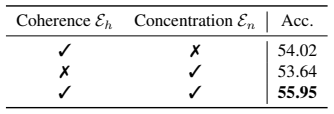
Table 3 .Ablation study on the teacher-weighting cues Eh and En in SRCD, evaluated on ImageNet-LT with the FCC.
원문 · CC BY 4.0 · Wenhai Wan, Teng Zhang, Shao-Yuan Li, Xinrui Wang, Qiang-Sheng Hua, Songcan Chen · Shortcut-Resistant CAM Distillation for Long-Tailed Recognition · 원문 그림 인용 · 원본 PDF 8쪽에서 그림 영역을 추출했습니다.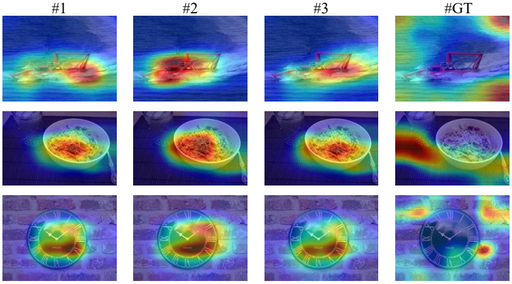
Figure 6 .CAM visualizations on multiple tail-class examples. For each example (row), the first three columns show head-proxy CAM candidates, and the last column shows the tail ground-truth class CAM. High-quality proxies tend to capture object-centric evidence consistent with the ground truth, while low-quality ones highlight scattered or background-dominated regions.
원문 · CC BY 4.0 · Wenhai Wan, Teng Zhang, Shao-Yuan Li, Xinrui Wang, Qiang-Sheng Hua, Songcan Chen · Shortcut-Resistant CAM Distillation for Long-Tailed Recognition · 원문 그림 인용 · 원본 PDF 31쪽에서 그림 영역을 추출했습니다.Teacher 가중치와 distillation의 수축 분석
논문은 shortcut 의존도를 Ω_sc 영역에 할당된 정규화 CAM 질량 A_sc로 정의합니다. Theorem 4.1은 teacher 가중치가 엔트로피 정규화 효용 최대화 문제의 유일한 해로서 softmax로 주어진다고 주장합니다. Theorem 4.2는 L2 distillation의 gradient flow가 A_sc를 e^{-2t} 비율로 teacher의 A_sc 값에 수렴시킨다고 보입니다. 따라서 teacher가 객체 중심적이면 tail CAM의 shortcut 질량이 줄어든다는 것이 이론적 해석입니다. 다만 이 결론은 Ω_sc 영역 분할이라는 분석적 가정과 gradient flow 설정 아래에서 성립하며, 실제 학습에서의 완전한 보장으로 읽어서는 안 됩니다.
CIFAR-LT와 대규모 벤치마크에서의 검증
실험은 scratch 학습과 CLIP ViT-B/16 기반 foundation model fine-tuning의 두 설정으로 나뉩니다. CIFAR100-LT IR=100에서 BCL은 Top-1 accuracy 51.76에서 SRCD 결합 후 53.64로 보고됩니다. ImageNet-LT와 iNaturalist에서는 Head, Med, Tail, All 분할을 함께 보고하며, 저자들은 Medium과 Tail에서 개선이 더 크게 나타난다고 설명합니다. Places-LT에서도 같은 분할로 평가하며, 여러 기준 방법에 SRCD를 결합한 결과를 비교합니다. 이 결과들은 각 기준 방법의 설정을 고정한 채 SRCD만 추가한 비교이며, 기준 방법이 달라지면 개선 폭도 달라집니다.
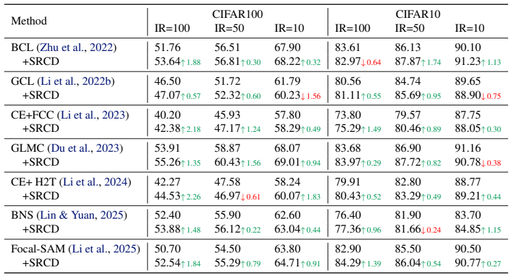
Table 1 .Training-from-scratch results on CIFAR-10-LT and CIFAR-100-LT under imbalance ratios IR ∈ {100,50,10} (Top-1 accuracy, %). +SRCD denotes integrating SRCD into each baseline; superscripts show absolute changes (↑/↓for gain/drop).
원문 · CC BY 4.0 · Wenhai Wan, Teng Zhang, Shao-Yuan Li, Xinrui Wang, Qiang-Sheng Hua, Songcan Chen · Shortcut-Resistant CAM Distillation for Long-Tailed Recognition · 원문 그림 인용 · 원본 PDF 7쪽에서 그림 영역을 추출했습니다.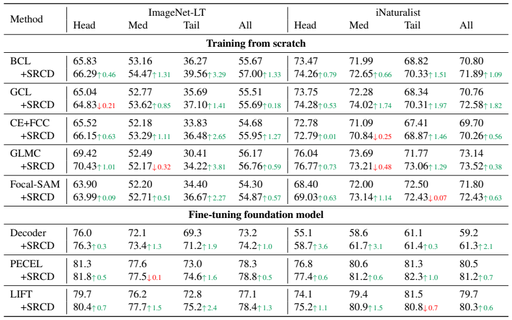
Table 2 .Results on ImageNet-LT and iNaturalist, reporting Top-1 accuracy (%) on Head/Med/Tail splits and All. The upper block is training from scratch, and the lower block is fine-tuning foundation models. +SRCD denotes integrating SRCD into each baseline; superscripts show absolute changes (↑/↓for gain/drop).
원문 · CC BY 4.0 · Wenhai Wan, Teng Zhang, Shao-Yuan Li, Xinrui Wang, Qiang-Sheng Hua, Songcan Chen · Shortcut-Resistant CAM Distillation for Long-Tailed Recognition · 원문 그림 인용 · 원본 PDF 8쪽에서 그림 영역을 추출했습니다.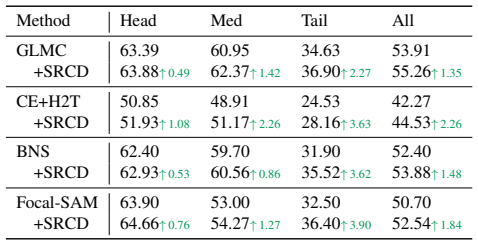
Table 6 .Split-wise results on CIFAR100-LT under IR=100, reporting Top-1 accuracy (%) on Head/Med/Tail splits and All. +SRCD denotes integrating SRCD into each baseline; superscripts show absolute changes (↑/↓for gain/drop).
원문 · CC BY 4.0 · Wenhai Wan, Teng Zhang, Shao-Yuan Li, Xinrui Wang, Qiang-Sheng Hua, Songcan Chen · Shortcut-Resistant CAM Distillation for Long-Tailed Recognition · 원문 그림 인용 · 원본 PDF 26쪽에서 그림 영역을 추출했습니다.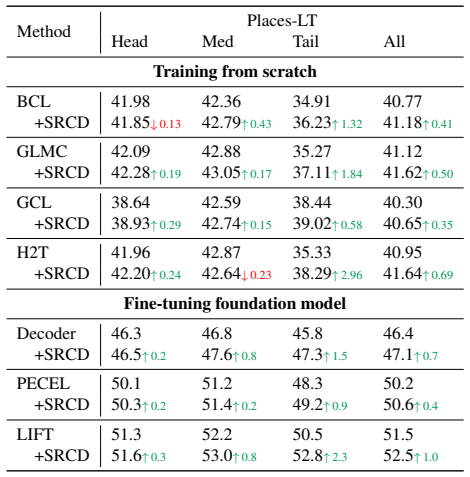
Table 8 .Results on Places-LT, reporting Top-1 accuracy (%) on Head/Med/Tail splits and All. The upper block is training from scratch, and the lower block is fine-tuning foundation models. +SRCD denotes integrating SRCD into each baseline; superscripts show absolute changes (↑/↓for gain/drop).
원문 · CC BY 4.0 · Wenhai Wan, Teng Zhang, Shao-Yuan Li, Xinrui Wang, Qiang-Sheng Hua, Songcan Chen · Shortcut-Resistant CAM Distillation for Long-Tailed Recognition · 원문 그림 인용 · 원본 PDF 27쪽에서 그림 영역을 추출했습니다.의미 불일치 tail 샘플과 마스크 기반 분석
저자들은 선택된 head proxy가 목표 tail 클래스와 분류학적으로 무관한 부분집합에서도 실험합니다. 이 부분집합은 BCL을 기준으로 선택된 tail 샘플의 32.13%이며, 정확도는 BCL 67.25에서 SRCD 결합 후 69.88로 보고됩니다. 이는 proxy가 정확히 같은 의미일 때만 효과가 나타난다는 해석에 대한 시험입니다. 또한 VOC 2012의 단일 레이블 long-tailed 부분집합에서 LIFT를 기준선으로 FG/BG Ratio를 측정했습니다. LIFT의 FG/BG Ratio 0.85는 SRCD 결합 후 1.56으로 보고되며, 정확도는 78.37에서 83.16으로 함께 나타납니다. 이 분석은 전경 마스크 기준의 증거 분포를 측정한 것이며, 전체 데이터셋에서의 일반적 보증으로 읽지 않습니다.
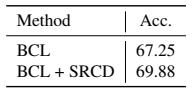
Table 4 .Accuracy (%) on the semantically mismatched subset of iNaturalist tail samples, where the selected head proxies are taxonomically unrelated to the target tail classes.
원문 · CC BY 4.0 · Wenhai Wan, Teng Zhang, Shao-Yuan Li, Xinrui Wang, Qiang-Sheng Hua, Songcan Chen · Shortcut-Resistant CAM Distillation for Long-Tailed Recognition · 원문 그림 인용 · 원본 PDF 16쪽에서 그림 영역을 추출했습니다.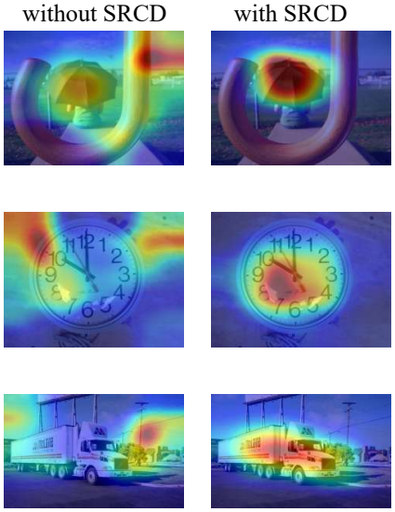
Figure 7 .Effect of SRCD on CAM localization across multiple examples. Left: without SRCD. Right: with SRCD. SRCD promotes more object-centric and spatially coherent activations while reducing background/context responses, indicating stronger shortcut resistance.
원문 · CC BY 4.0 · Wenhai Wan, Teng Zhang, Shao-Yuan Li, Xinrui Wang, Qiang-Sheng Hua, Songcan Chen · Shortcut-Resistant CAM Distillation for Long-Tailed Recognition · 원문 그림 인용 · 원본 PDF 32쪽에서 그림 영역을 추출했습니다.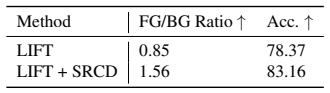
Table 11 .Mask-based shortcut analysis on the long-tailed VOC 2012 subset. FG/BG Ratio measures the CAM evidence mass inside the foreground mask relative to the background region. A larger ratio indicates weaker shortcut reliance.
원문 · CC BY 4.0 · Wenhai Wan, Teng Zhang, Shao-Yuan Li, Xinrui Wang, Qiang-Sheng Hua, Songcan Chen · Shortcut-Resistant CAM Distillation for Long-Tailed Recognition · 원문 그림 인용 · 원본 PDF 33쪽에서 그림 영역을 추출했습니다.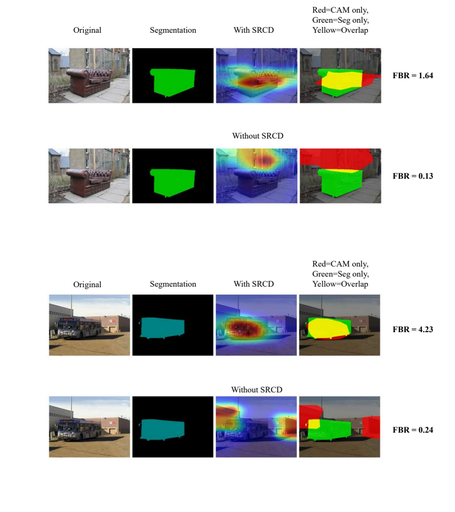
Figure 8 .CAM visualizations on the long-tailed VOC 2012 subset. Compared with the baseline, SRCD shifts attention from background or shortcut regions toward foreground object regions, which is consistent with the mask-based FG/BG analysis.
원문 · CC BY 4.0 · Wenhai Wan, Teng Zhang, Shao-Yuan Li, Xinrui Wang, Qiang-Sheng Hua, Songcan Chen · Shortcut-Resistant CAM Distillation for Long-Tailed Recognition · 원문 그림 인용 · 원본 PDF 34쪽에서 그림 영역을 추출했습니다.CAM 진단과 방법의 한계
CAM 유사도 진단은 balanced 모델의 CAM을 기준으로 하지만, 그 기준이 ground-truth 설명이라는 보장은 없습니다. 저자들은 낮은 유사도가 shortcut 학습 외에도 클래스 혼동, 최적화 잡음, 다른 지역 최솟값에서 생길 수 있다고 밝힙니다. E_h와 E_n도 큰 객체나 얇은 구조를 잘못 벌점할 수 있으며, 미세 분류에서는 기준을 더 조정해야 한다고 설명합니다. 또한 SRCD 실험은 주로 제시된 백본과 설정에서 수행되었으므로, 다른 아키텍처나 과제에서의 효과는 원문 범위를 넘어서는 질문으로 남습니다.
논문 정보
- 저자
- Wenhai Wan, Teng Zhang, Shao-Yuan Li, Xinrui Wang, Qiang-Sheng Hua, Songcan Chen
- 학회·저널
- arXiv · 프리프린트
- 최초 공개일
- 2026년 10월 21일
- 등록일
- 2026년 10월 29일
- 수정일
- 2026년 10월 21일
- 버전
- v1
- arXiv
- 2610.29508
- 분류
- cs.LG
- 원문 이용 조건
- CC BY 4.0
- 제공 범위
- 논문 정보, 해설, 허용된 원문 그림
AI 해설은 논문 원문과 별개의 설명이며 오류가 있을 수 있습니다. 원문과 그림은 각 출처의 이용 조건과 따로 표시된 권리를 따릅니다.
초록
Real-world datasets often follow a long-tailed distribution, making generalization to tail classes difficult. We revisit this problem through the lens of shortcut learning, where models prefer the easiest predictive cues (e.g., background or textures) over object-centric semantics, especially under scarce and biased supervision. We find that this tendency is amplified for tail classes: limited examples often share similar contexts, making non-semantic signals highly correlated and thus tempting shortcuts, whereas head classes with diverse appearances and environments encourage more stable object-focused representations. Motivated by this observation, we propose Shortcut-Resistant CAM Distillation (SRCD), a plug-and-play framework that transfers object-focused explanations from head to tail classes. SRCD operates in the Class Activation Map (CAM) space, where a CAM provides a class-specific spatial evidence map for a prediction. SRCD aggregates CAMs from a small set of head-class candidates into a shortcut-resistant teacher using an energy-model weighting based on coherence and concentration, and distills it to the tail-class CAM. We provide a theoretical analysis that quantifies shortcut reliance as shortcut-region evidence mass in CAM space and shows that SRCD suppresses tail shortcuts. Extensive experiments on long-tailed benchmarks consistently improve strong baselines. The code is available at https://github.com/Haifeng3/SRCD.
원문 인용
Wenhai Wan, Teng Zhang, Shao-Yuan Li, Xinrui Wang, Qiang-Sheng Hua, Songcan Chen (2026). Shortcut-Resistant CAM Distillation for Long-Tailed Recognition. arXiv:2610.29508v1. https://arxiv.org/abs/2610.29508v1
BibTeX
@misc{wan2026shortcut,
  title = {{Shortcut-Resistant CAM Distillation for Long-Tailed Recognition}},
  author = {Wenhai Wan and Teng Zhang and Shao-Yuan Li and Xinrui Wang and Qiang-Sheng Hua and Songcan Chen},
  year = {2026},
  eprint = {2610.29508},
  archivePrefix = {arXiv},
  url = {https://arxiv.org/abs/2610.29508v1}
}