논문 해설
AdjointFlow: Accelerating Scientific Inverse Problems with Physics-Based Transport
AdjointFlow: 물리 기반 수송으로 과학 역문제 가속하기
- 연구 문제 과학적 역문제의 복원은 비볼록 최적화와 반복 PDE 해법 비용 때문에 어렵고, 기존 가우시안 출발 생성 모델은 집중된 사후분포에서 속도장이 불안정해질 수 있습니다.
- 연구 방법 AdjointFlow는 확률적 보간에서 가우시안 참조 대신 수반 기반 물리 초기값 a(y)에 집중된 참조 분포를 쓰고, 잡음 bridge를 분리한 잡음 없는 속도장과 목표 예측 파라미터화를 결합합니다.
- 주요 결과 실험된 여러 역문제에서 AdjointFlow는 조건부 확산 기준선보다 정확도와 추론 속도 측면에서 유리하다고 보고되며, 추론 시점 RED-Flow 정제는 데이터 일관성을 추가로 높입니다.
역문제와 기존 생성 모델의 한계
과학적 역문제는 간접 측정값 y로부터 매질의 속성 m을 복원하는 문제이며, 순방향 물리 모델이 비선형이어서 최적화 landscape에 spurious local minima가 많습니다. 기존 PDE 제약 최적화는 반복마다 순방향 및 수반 PDE 해를 필요로 하여 해상도가 커질수록 비용이 급증합니다.
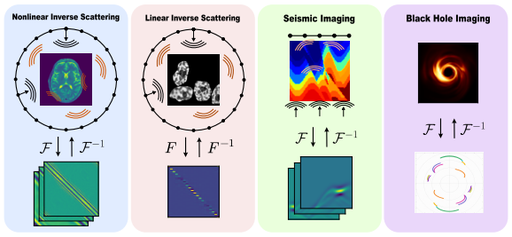
Figure 2 : Diagram of the different settings and modalities of inverse problems we consider. Top: a diagram of the data acquisition setting, including a representative example of the parameters𝑚 represented by the wavespeed (in the case of scattering problems) or brightness (in the case of black holes). Bottom: an example of the measurement data used for the reconstruction. Note that the full aperture scattering is measured in the frequency domain, while the geophysical scattering is measured in the time domain.
원문 · CC BY 4.0 · Ethan Hanold, Nicholas M. Boffi, Qin Li, Leonardo Zepeda-Núñez · AdjointFlow: Accelerating Scientific Inverse Problems with Physics-Based Transport · 원문 그림 인용 · 원본 PDF 4쪽에서 그림 영역을 추출했습니다.확산 모델과 같은 생성 모델은 이 비용을 오프라인 학습으로 옮길 수 있지만, 대부분 독립적인 가우시안 참조 분포에서 출발합니다. 측정이 정보적이어서 사후분포가 집중되면 이 가우시안에서 목표 분포로 가는 수송 속도장이 끝점 근처에서 정칙성을 잃을 수 있습니다. AdjointFlow는 이 두 가지 문제, 즉 물리 정보를 버리는 가우시안 초기화와 집중된 끝점에서의 속도장 불안정성을 함께 다룹니다.
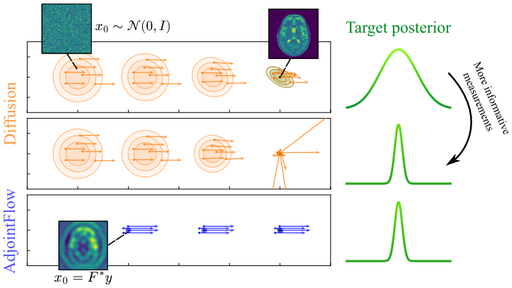
Figure 1 :Overview.Traditional diffusion-based approaches start from uninformative Gaussian noise and can suffer from ill-conditioned transport fields when the target posterior becomes concentrated, such as when more informative measurements are acquired. Conversely, AdjointFlowstartsfromadata-dependentinitialization–forexample,oneconstructedfromtheadjoint 𝐹∗𝑦 asshownabove–reducingtransport distancerelativetoGaussiannoiseandproducingfavorablelearningconditionsforthesolver. AdjointFlowfurtherleveragesanoise-freevelocity which remains regular near concentrated endpoints.
원문 · CC BY 4.0 · Ethan Hanold, Nicholas M. Boffi, Qin Li, Leonardo Zepeda-Núñez · AdjointFlow: Accelerating Scientific Inverse Problems with Physics-Based Transport · 원문 그림 인용 · 원본 PDF 2쪽에서 그림 영역을 추출했습니다.물리 기반 초기화와 잡음 없는 속도장
AdjointFlow의 첫 번째 구성요소는 독립 가우시안 대신 측정값으로부터 만든 물리 기반 초기값 a(y)를 확률적 보간의 참조 분포로 쓰는 것입니다. 선형 또는 선형화 가능한 경우 a(y)는 수반 연산 F*y로 주어지며, 단일 점에 집중된 끝점 δ_{a(y)}를 사용합니다.
두 번째 구성요소는 표준 확률적 보간 속도 b_t에서 잡음 bridge 항을 분리한 잡음 없는 속도 v_t입니다. 원문은 b_t = v_t + γ̇_t D_t로 분해하며, 끝점이 집중될 때 표준 속도의 Lipschitz 상수가 발산할 수 있음을 보이고, v_t는 deterministic 초기값과 잡음 증강 학습 조건에서 공간적으로 정칙함을 보입니다.
세 번째로 목표 예측 파라미터화에서는 v_t(x;y)=√α̇_t a(y)+√β̇_t m̂_t(x;y) 형태를 사용해 네트워크가 목표 재구성 자체를 예측하도록 합니다. 추론은 a(y)에서 출발해 학습된 ODE를 적분하며, 실험에서는 전진 오일러 8단계를 기본으로 사용합니다.
수송 거리 분석의 적용 범위
제안서의 명제는 선형 순방향 연산자 F와 평균 0 참조 분포에 대해, 물리 기반 평행이동된 참조 분포 ρ_0^adj가 목표 사후분포 ρ_1까지의 W2 거리를 줄이는 조건을 다룹니다. 원문의 명제 3.1은 ‖F*F−I‖_op < 1이고 F*y ≠ 0일 때 ρ_0^adj의 거리가 더 작다고 밝힙니다.
이 결과는 가우시안 끝점과 특정 조건에 한정되므로 모든 역문제에 대한 일반 보장으로 읽지 않습니다. 원문은 실제 데이터셋에서 δ_{a(y)}의 거리가 가우시안보다 작다고 보고합니다.
비선형 및 선형 역산란과 영상화 결과
비선형 역산란 벤치마크에서 AdjointFlow는 Shepp–Logan, 3–5–10h Triangles, 10h Overlapping Squares 데이터셋의 RRMSE와 Sinkhorn divergence를 기존 CDM과 비교합니다. Brain Scans에서 AdjointFlow는 RRMSE 3.421을 보고하며 EquiNet CDM의 5.661보다 낮습니다.
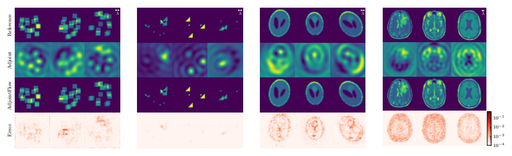
Figure 4 : Qualitative results on nonlinear inverse scattering for (a)10h Overlapping Squares, (b)3–5–10h Triangles, (c)Shepp–Logan, and (d)Brain Scans. Within each panel, columns show distinct test examples; rows show, from top to bottom, the ground-truth perturbation, the adjoint-based initialization, the AdjointFlow reconstruction, and its absolute reconstruction error. The wavelength marker corresponds to 8 points per wavelength (PPW) in (a)–(c) and 5 PPW in (d).
원문 · CC BY 4.0 · Ethan Hanold, Nicholas M. Boffi, Qin Li, Leonardo Zepeda-Núñez · AdjointFlow: Accelerating Scientific Inverse Problems with Physics-Based Transport · 원문 그림 인용 · 원본 PDF 13쪽에서 그림 영역을 추출했습니다.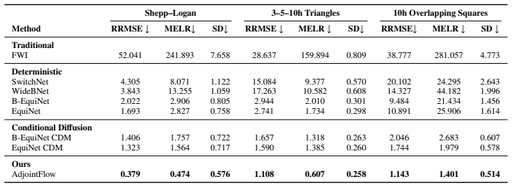
Table 1 : We compare performance on three synthetic datasets (Shepp–Logan, 3–5–10h Triangles, 10h Overlapping Squares) using RRMSE (%), MELR(×10−2), and Sinkhorn divergence (SD) metrics (see Appendix D for definitions, bold indicates best performance for a given metric). All Sinkhorn divergence values, including those of the baselines, are recomputed using an updated library version and therefore differ from those reported in [29]. We find that AdjointFlow outperforms all models, including conditional diffusion, across the board.
원문 · CC BY 4.0 · Ethan Hanold, Nicholas M. Boffi, Qin Li, Leonardo Zepeda-Núñez · AdjointFlow: Accelerating Scientific Inverse Problems with Physics-Based Transport · 원문 그림 인용 · 원본 PDF 14쪽에서 그림 영역을 추출했습니다.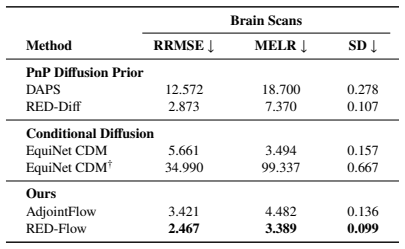
Table 2 : We compare AdjointFlow and RED-Flow to PnP-DP and CDM baselines for nonlinear inverse scattering on theBrain Scansdataset, with bold indicating the best performance on each metric. We report RRMSE as a percentage and MELR×10−2. EquiNet CDM results are obtained from a model we trained using the pipeline from [29]. CDM† indicates that we evaluate the diffusion model at the same number of function evaluations as AdjointFlow (namely, 8 sampling steps), thus demonstrating the advantage of AdjointFlow when compute is limited.
원문 · CC BY 4.0 · Ethan Hanold, Nicholas M. Boffi, Qin Li, Leonardo Zepeda-Núñez · AdjointFlow: Accelerating Scientific Inverse Problems with Physics-Based Transport · 원문 그림 인용 · 원본 PDF 14쪽에서 그림 영역을 추출했습니다.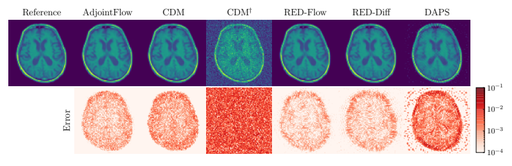
Figure 5 : Qualitative comparison of reconstructions on theBrain Scansdataset for nonlinear inverse scattering. For CDM†, we evaluate the diffusion model at the same number of NFE (number of function evaluations) as AdjointFlow (namely, we fix 8 sampling steps). AdjointFlow clearly performs far better in this iso-compute comparison, demonstrating its superior efficiency.
원문 · CC BY 4.0 · Ethan Hanold, Nicholas M. Boffi, Qin Li, Leonardo Zepeda-Núñez · AdjointFlow: Accelerating Scientific Inverse Problems with Physics-Based Transport · 원문 그림 인용 · 원본 PDF 15쪽에서 그림 영역을 추출했습니다.선형 역산란에서는 RED-Flow가 PSNR에서 강한 우위를 보이고 AdjointFlow는 PnP 계열과 경쟁력을 보입니다.
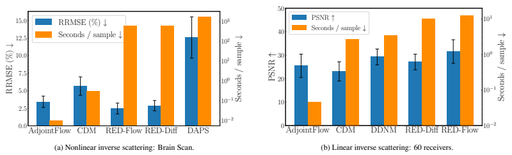
Figure 6 : Comparison of the efficiency–accuracy tradeoff for nonlinear and linear inverse scattering. All timings were measured on the same NVIDIA RTX A6000 GPU. (a) AdjointFlow achieves a strong balance between performance and efficiency, while RED-Diff and RED-Flow offer small accuracy improvements at substantially greater inference cost; the seconds-per-sample axis uses a logarithmic scale. (b) AdjointFlow achieves competitive accuracy at the lowest cost, though the efficiency gain is smaller than in the nonlinear problem.
원문 · CC BY 4.0 · Ethan Hanold, Nicholas M. Boffi, Qin Li, Leonardo Zepeda-Núñez · AdjointFlow: Accelerating Scientific Inverse Problems with Physics-Based Transport · 원문 그림 인용 · 원본 PDF 16쪽에서 그림 영역을 추출했습니다.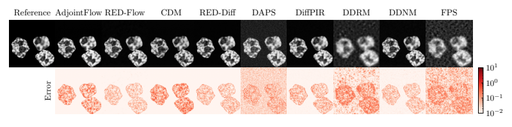
Figure 7 : Qualitative comparisons of reconstructions from AdjointFlow and diffusion baselines on linear inverse scattering with 60 receivers.
원문 · CC BY 4.0 · Ethan Hanold, Nicholas M. Boffi, Qin Li, Leonardo Zepeda-Núñez · AdjointFlow: Accelerating Scientific Inverse Problems with Physics-Based Transport · 원문 그림 인용 · 원본 PDF 16쪽에서 그림 영역을 추출했습니다.절제 실험과 초기화의 역할
절제 실험은 주로 비선형 역산란 설정에서 샘플링 방식, 잡음 bridge, 참조 분포, 목표 예측 파라미터화를 비교합니다. 원문은 이 데이터셋에서 저주파 수반 초기값이 세부 구조를 충분히 담지 못했을 가능성을 제시합니다.

Table 6 : Comparison of reference distribution and model parameterization on the four nonlinear inverse scattering datasets, with mean and standard deviation of RRMSE across the test set shown. We fix the number of sampling steps at 8 for all models. Without TP, we find that a coupledinterpolantdoesnotmeaningfullyimproveresultsonthesedatasets,demonstratingthepracticalnecessityoftheDD-TPparameterization. Bold indicates the best result on each dataset.
원문 · CC BY 4.0 · Ethan Hanold, Nicholas M. Boffi, Qin Li, Leonardo Zepeda-Núñez · AdjointFlow: Accelerating Scientific Inverse Problems with Physics-Based Transport · 원문 그림 인용 · 원본 PDF 24쪽에서 그림 영역을 추출했습니다.선형 역산란의 초기화 절제에서는 상수, 학습 평균, 수반 연산, 정규화 역연산을 비교합니다. 데이터 의존 초기화가 모든 지표에서 우세했고, 정규화 역연산이 가장 높은 PSNR과 가장 작은 측정 오차를 보였습니다. 다만 상수 초기화보다 평균 초기화가 더 나은 결과는 수송 거리만으로 성능을 완전히 설명하지 못함을 보여 줍니다.
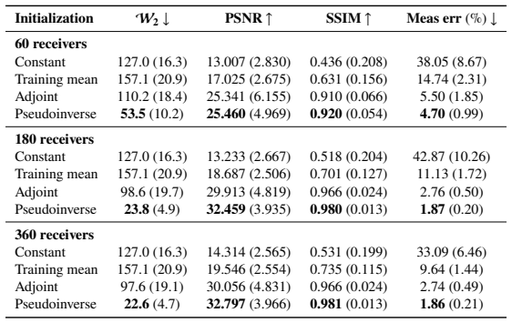
Table 7 : We present the results of AdjointFlow for linear inverse scattering with four choices of initialization𝑎(𝑦) , three different levels of measurement sparsity, and noise level𝜎𝑦 =10−4 following [40] (bold result indicates best for each receiver count). All models share the architecture and training procedure of Section 4.2 and differ only in𝑎(𝑦) ; the pseudoinverse corresponds to AdjointFlow in Table 3. Within each block, the first two initializations are data-independent and the last two are data-dependent.W2 is the empirical transport distance W2(𝛿 𝑎(𝑦), 𝛿𝑚)=∥𝑎(𝑦)−𝑚∥ 2 between singular endpoints (Appendix E.3), averaged over the test set.
원문 · CC BY 4.0 · Ethan Hanold, Nicholas M. Boffi, Qin Li, Leonardo Zepeda-Núñez · AdjointFlow: Accelerating Scientific Inverse Problems with Physics-Based Transport · 원문 그림 인용 · 원본 PDF 24쪽에서 그림 영역을 추출했습니다.적용 범위와 한계
저자들은 AdjointFlow의 이점이 초기화가 정보적일 때 가장 크다고 밝힙니다. 어드조인트가 없거나 부정확하거나 목표와 약하게 상관된 설정에서는 이점이 줄어들 수 있으며, 원문은 이를 해결하려면 추가 검증이 필요하다고 설명합니다.
또한 최상의 변형은 특이 초기 분포와 잡음 없는 속도 학습을 사용하므로 표준 확률적 보간 이론의 일반 가정 밖에 있습니다. 실험 데이터는 대부분 합성 또는 준합성이며, 실제 측정 잡음, 모델 불일치, 고위험 응용에서의 검증은 아직 충분히 다루지 않았습니다.
논문 정보
- 저자
- Ethan Hanold, Nicholas M. Boffi, Qin Li, Leonardo Zepeda-Núñez
- 학회·저널
- arXiv · 프리프린트
- 최초 공개일
- 2026년 11월 10일
- 등록일
- 2026년 11월 11일
- 수정일
- 2026년 11월 10일
- 버전
- v1
- arXiv
- 2611.13389
- 분류
- cs.LG
- 원문 이용 조건
- CC BY 4.0
- 제공 범위
- 논문 정보, 해설, 허용된 원문 그림
AI 해설은 논문 원문과 별개의 설명이며 오류가 있을 수 있습니다. 원문과 그림은 각 출처의 이용 조건과 따로 표시된 권리를 따릅니다.
초록
Inverse problems are ubiquitous across scientific applications ranging from seismic imaging to astrophysics to nondestructive testing, yet classical solvers often struggle with nonconvexity and repeated evaluations of expensive physical models. Diffusion models can amortize this computation offline, but largely data-driven conditional models underutilize known physics and suffer from ill-conditioned transport maps when the target distribution is concentrated. Plug-and-play (PnP) methods explicitly leverage the physical model to guide a learned prior, improving data consistency but reintroducing costly iterative computations. We instead propose AdjointFlow, a framework built on stochastic interpolants that injects the known physics into the generative transport itself. We design a data-dependent, adjoint-based initialization to reduce transport distance to the target, modify the transport velocity to remain regular as the endpoint distributions concentrate, and parameterize the network to build the initialization directly into the learned velocity. Together, these enable accurate reconstruction at substantially lower cost than generative models starting from Gaussian noise. Experiments on inverse scattering, seismic imaging, and black hole imaging show that AdjointFlow consistently produces more accurate reconstructions than conditional diffusion models while being up to five orders of magnitude faster at inference than PnP methods. Optional inference-time refinement that queries the physical model can further improve data consistency, matching or exceeding the accuracy of PnP methods without retraining.
원문 인용
Ethan Hanold, Nicholas M. Boffi, Qin Li, Leonardo Zepeda-Núñez (2026). AdjointFlow: Accelerating Scientific Inverse Problems with Physics-Based Transport. arXiv:2611.13389v1. https://arxiv.org/abs/2611.13389v1
BibTeX
@misc{hanold2026adjointflow,
  title = {{AdjointFlow: Accelerating Scientific Inverse Problems with Physics-Based Transport}},
  author = {Ethan Hanold and Nicholas M. Boffi and Qin Li and Leonardo Zepeda-Núñez},
  year = {2026},
  eprint = {2611.13389},
  archivePrefix = {arXiv},
  url = {https://arxiv.org/abs/2611.13389v1}
}