논문 해설
Design and Validation of a Robotic Knee Exoskeleton with Musculoskeletal Simulation-Derived Biological Torque Control
근골격 시뮬레이션에서 도출한 생체 토크 제어를 적용한 로봇 무릎 외골격의 설계 및 검증
- 연구 문제 시뮬레이션만으로 만든 무릎 생체 토크 제어기를 기기별 데이터 수집 없이 실제 외골격에 옮길 수 있는지가 문제입니다.
- 연구 방법 공개 생체역학 스쿼트 데이터를 근육 구동 모방 정책으로 재현하고, 그 시뮬레이션 무릎 모멘트를 온보드 IMU와 엔코더 신호만 쓰는 시간 합성곱 추정기로 증류하여 기기에 배포합니다.
- 주요 결과 7명의 건강한 참여자에서 스쿼트 시 보조는 최대 생체 무릎 신전 모멘트를 21.5%, 최대 내측광근 활성도를 26.7% 낮췄습니다(p < 0.05). 내측 비복근 활성도 차이는 유의하지 않았습니다.
데이터 수집 없이 기기를 옮길 수 있는 제어기가 필요한 이유
생체 토크 제어(biological torque control)는 온보드 센서로 사용자의 관절 모멘트를 추정하고 그 추정치를 비례하여 보조하는 방식으로, 보행과 경사 보행에서 대사 비용을 줄이는 결과가 보고되었습니다. 그러나 추정기는 대상 기기에서 기록한 대규모 데이터로 학습되며 그 기기의 센싱 구성에 과적합되는 경향이 있습니다. 따라서 새 하드웨어에 제어기를 배포할 때마다 기기 위에서 데이터를 다시 수집하고 라벨링해야 하며, 이는 시간이 많이 들고 값비싼 실험실 장비를 요구합니다. 또한 이 제어기들은 대개 같은 연구 그룹이 만든 맞춤 하드웨어에서 개발·검증되어 다른 연구 그룹에서 재현하기 어렵습니다.
공개 연구 자원도 이 문제를 완전히 해결하지 못합니다. 개방형 프로젝트는 기구, 임베디드 소프트웨어, 학습된 제어기를 개별적으로 공개해 왔지만, 이 구성 요소들은 함께 동작하도록 설계되지 않았으므로 조립된 기기 위에서 여전히 새 데이터를 수집해야 합니다. 이 논문은 하드웨어에서 시뮬레이션 기반 배포 제어기까지 전체 파이프라인을 다른 그룹이 재현할 수 있게 하는 것을 목표로 합니다.
근육 구동 모방 정책에서 온보드 추정기로 이어지는 학습 과정
제안 방법은 두 단계로 구성됩니다. 첫 단계에서 근육 구동 모방 정책(muscle-driven imitation policy)은 공개 생체역학 데이터셋의 참조 스쿼트 운동학을 시상면 근골격 모델에서 재현하도록 학습됩니다. 모델은 7자유도, 한쪽 하지의 9개 근육, 요추 액추에이터를 갖고, SCONE과 Hyfydy 물리 엔진에서 구현됩니다. 정책은 DeepMimic 틀을 따르며 soft actor–critic으로 학습되고, 관절·근육 상태, 발 접촉, 앞으로의 참조 운동학을 관찰하여 근육 여기와 요추 목표 각도를 출력합니다.
보상은 관절 좌표, 관절 속도, 골반 기준 발 위치의 추적 항과 평균 제곱 근육 활성화, 단계 간 근육 여기 및 정규화된 요추 토크 변화에 대한 벌점 항을 결합합니다. 가중치는 w_p = 0.60, w_v = 0.15, w_e = 0.25, w_a = w_u = 2.0으로 주어졌습니다. 이 보상은 생리적으로 그럴듯한 근육 조정과 추정기 학습에 쓰일 부드러운 관절 모멘트를 유도하기 위해 설계되었습니다.
두 번째 단계에서는 정책 롤아웃에서 얻은 무릎 근육 모멘트를 목표로, 온보드 센서와 동등한 신호만 입력받는 시간 합성곱 네트워크(temporal convolutional network)를 학습합니다. 입력은 허벅지와 정강이의 시상면 각속도와 무릎 각도이며, 100 Hz마다 95샘플(0.95 s) 창을 현재 시점의 무릎 모멘트 추정치로 매핑합니다. 네트워크는 인과적 확장 합성곱으로 과거와 현재 샘플에만 의존하므로 실시간 배포가 가능합니다. 학습 중에는 자이로스코프 채널에 가우시안 잡음을, 무릎 각도에 오프셋을 더해 센서 잡음과 보정 오차에 노출시킵니다.
배포 단계에서 추정기 출력은 보조 토크 명령 τ_cmd(t) = k·τ̂_knee(t−Δt)로 계산됩니다. 여기서 k는 보조 이득, Δt는 보조 지연입니다. 이득과 지연은 참여자별 익숙해지기 과정에서 조정되며, 명령 토크는 스톡 모터 드라이버의 출력 한계인 18 Nm로 제한됩니다.
스쿼트 실험에서 보조 조건과 비보조 조건의 비교
검증은 7명의 건강한 젊은 남성 참여자에서 수행되었습니다. 무릎 모멘트는 OpenSim에서 참여자별로 조정된 수정 Rajagopal 모델을 사용해 역동역학으로 계산했고, 외골격 시행에서는 기기 질량 3.5 kg을 골반, 허벅지, 정강이에 나누어 반영했습니다. 보조 시행에서는 보조 토크 명령을 역동역학 무릎 모멘트에서 뺀 값을 생체 무릎 모멘트로 사용했습니다.
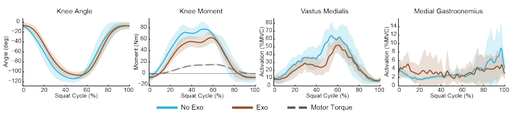
Fig. 4 .Group-averaged knee kinematics, kinetics, and muscle activation during squatting.(a) Knee angle, (b) biological knee extension moment with commanded torque, (c) vastus medialis activation, and (d) medial gastrocnemius activation over the normalized squat cycle. Solid curves represent group means across participants, and shaded regions represent±1 standard deviation. Blue and brown indicate squatting without (No Exo) and with (Exo) the exoskeleton, respectively, and the dashed gray curve indicates the commanded torque with the exoskeleton. Muscle activation is expressed as a percentage of each participant’s maximum voluntary contraction (%MVC).
원문 · CC BY 4.0 · Rajiv V. Joshi, Jimin An, Ilseung Park, Dawit Lee, Inseung Kang · Design and Validation of a Robotic Knee Exoskeleton with Musculoskeletal Simulation-Derived Biological Torque Control · 원문 그림 인용 · 원본 PDF 5쪽에서 그림 영역을 추출했습니다.근활성은 내측광근과 내측 비복근에서 측정되었으며, 각 근육의 MVC 기준값에 대한 백분율(%MVC)로 정규화되었습니다. 각 참여자의 평균 스쿼트 주기에서 생체 무릎 신전 모멘트의 최댓값과 내측광근·내측 비복근의 최대 활성도를 추출하고 보조 조건과 비교하기 위해 양측 쌍체 t-검정을 사용했습니다. 유의수준은 p < 0.05로 정의되었습니다.
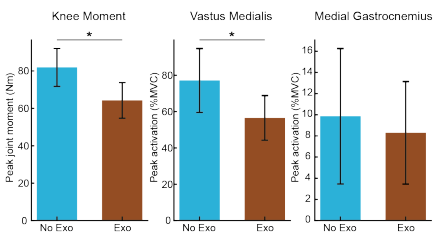
Fig. 5 .Peak biological knee extension moment and muscle activation with and without the exoskeleton.(a) Peak biological knee extension moment, (b) peak vastus medialis activation, and (c) peak medial gastroc- nemius activation without (No Exo) and with (Exo) the exoskeleton. Bars represent group means, and error bars represent±1 standard deviation across participants. Asterisks indicate a significant difference between conditions (p <0.05, pairedt-test).
원문 · CC BY 4.0 · Rajiv V. Joshi, Jimin An, Ilseung Park, Dawit Lee, Inseung Kang · Design and Validation of a Robotic Knee Exoskeleton with Musculoskeletal Simulation-Derived Biological Torque Control · 원문 그림 인용 · 원본 PDF 5쪽에서 그림 영역을 추출했습니다.스쿼트 한 과제와 토크 상한이 남긴 적용 범위
이 결과는 스쿼트 한 과제에서 얻은 것입니다. 보행이나 sit-to-stand로 추정기를 재학습하여 옮기는 경우가 성립하는지는 이 연구에서 확인되지 않았습니다. 생체 무릎 모멘트는 측정된 토크가 아니라 명령 토크를 빼서 계산되었으므로, 전달 손실이나 인터페이스 손실이 있으면 추정 보조 기여가 과대평가될 수 있습니다. 비보조 조건만 있는 무보조 착용 대조군이 없어서, 보고된 감소량에는 기기를 착용하는 비용과 고정된 조건 순서에 따른 피로나 학습 효과가 섞일 수 있습니다.
또한 명령 토크는 스톡 모터 드라이버의 18 Nm 한계로 제한되었고, 참여자는 모두 건강한 젊은 성인이었습니다. 따라서 더 높은 보조 수준이나 임상 집단으로의 확장은 이 실험에서 검증되지 않았습니다. 저자들은 이 기기와 학습 파이프라인이 데이터셋과 제어기를 비교하는 공유 테스트베드가 될 수 있다고 제안하지만, 이는 향후 검증이 필요한 제안입니다.
논문 정보
- 저자
- Rajiv V. Joshi, Jimin An, Ilseung Park, Dawit Lee, Inseung Kang
- 학회·저널
- arXiv · 프리프린트
- 최초 공개일
- 2026년 10월 30일
- 등록일
- 2026년 11월 7일
- 수정일
- 2026년 10월 30일
- 버전
- v1
- arXiv
- 2610.41981
- 분류
- cs.RO
- 원문 이용 조건
- CC BY 4.0
- 제공 범위
- 논문 정보, 해설, 허용된 원문 그림
AI 해설은 논문 원문과 별개의 설명이며 오류가 있을 수 있습니다. 원문과 그림은 각 출처의 이용 조건과 따로 표시된 권리를 따릅니다.
초록
Data-driven controllers have enabled lower-limb robotic exoskeletons to adapt assistance to the user across many tasks. A leading example is biological torque control, which estimates the user's own joint moment from onboard sensors and assists in proportion to that estimate. However, its estimators are trained on data recorded with the target device, so deploying the controller on new hardware requires collecting new data. Existing open-source efforts release hardware, software, or controllers separately, so this data collection must still be repeated on the assembled device. Here, we present an open-source knee exoskeleton, built from off-the-shelf components and widely available fabrication tools, with a biological torque controller derived entirely from simulation. A muscle-driven imitation policy reproduces squatting motions from an open biomechanics dataset, and the resulting knee moments are distilled into an estimator that uses only onboard sensors, so no training data are recorded on the device. In seven able-bodied participants, assistance reduced peak biological knee extension moment by 21.5% and peak vastus medialis activation by 26.7% during squatting, relative to squatting without the exoskeleton (p<0.05). Our results demonstrate that a biological torque controller derived from simulation can transfer to physical hardware without device-specific data collection. Because the hardware and training pipeline are released together, research groups can train and compare knee exoskeleton controllers on shared hardware without additional data collection overhead.
원문 인용
Rajiv V. Joshi, Jimin An, Ilseung Park, Dawit Lee, Inseung Kang (2026). Design and Validation of a Robotic Knee Exoskeleton with Musculoskeletal Simulation-Derived Biological Torque Control. arXiv:2610.41981v1. https://arxiv.org/abs/2610.41981v1
BibTeX
@misc{joshi2026design,
  title = {{Design and Validation of a Robotic Knee Exoskeleton with Musculoskeletal Simulation-Derived Biological Torque Control}},
  author = {Rajiv V. Joshi and Jimin An and Ilseung Park and Dawit Lee and Inseung Kang},
  year = {2026},
  eprint = {2610.41981},
  archivePrefix = {arXiv},
  url = {https://arxiv.org/abs/2610.41981v1}
}