논문 해설
Accelerating Clinical Evidence Synthesis with Large Language Models
대규모 언어 모델을 활용한 임상 근거 종합 가속화
- 연구 문제 체계적 문헌고찰은 문헌의 빠른 증가 때문에 검색, 스크리닝, 데이터 추출, 근거 종합을 효율적으로 수행하기 어렵습니다.
- 연구 방법 TrialMind는 PICO 입력에서 검색식을 만들고 eligibility 기준으로 연구를 순위화하며 필드 기반 추출과 코드 기반 결과 표준화를 수행하는 LLM 파이프라인입니다.
- 주요 결과 검색 재현율은 전체 평균 0.782로 GPT-4 기준선 0.073과 인간 기준선 0.187보다 높게 보고되었고, 스크리닝과 추출에서도 기준선 대비 개선이 보고되었습니다.
체계적 문헌고찰의 병목
체계적 문헌고찰은 임상 근거를 종합하는 핵심 절차이지만, 문헌이 빠르게 늘면서 연구를 찾고 선별하고 요약하고 갱신하는 일이 점점 어려워집니다. 원문은 한 체계적 문헌고찰에 평균 다섯 명의 전문가와 67.3주가 필요하다는 분석을 인용하며 이 부담을 설명합니다. 저자들은 LLM이 검색식 생성, PICO 추출, 스크리닝, 요약 같은 개별 단계에는 쓰였지만 전체 과정을 끝까지 다룬 연구는 드물다고 지적합니다. 이 논문은 검색부터 근거 종합까지 전 과정을 대상으로 TrialMind라는 파이프라인과 TrialReviewBench라는 벤치마크를 제시합니다.
TrialMind의 단계별 구조
TrialMind는 PICO 요소를 입력으로 받아 검색식을 만들고, eligibility 기준을 생성해 연구를 스크리닝하며, 필드 설명에 따라 데이터를 추출하고, 추출 결과를 바탕으로 근거를 종합하는 단계로 구성됩니다. 검색 단계에서는 초기 Boolean 검색식으로 PubMed에서 초록을 가져온 뒤 이 초록을 RAG의 맥락으로 사용하고, CoT로 용어를 정제합니다. 스크리닝에서는 기준별로 −1, 0, 1의 예측값을 만들고 이를 합산해 연구의 관련도 점수로 사용합니다. 사용자는 기준을 수정하거나 집계 방식을 바꿀 수 있습니다. 결과 추출은 관련 내용 식별, 수치 추출, Python 코드를 이용한 표준화의 순서로 진행됩니다.
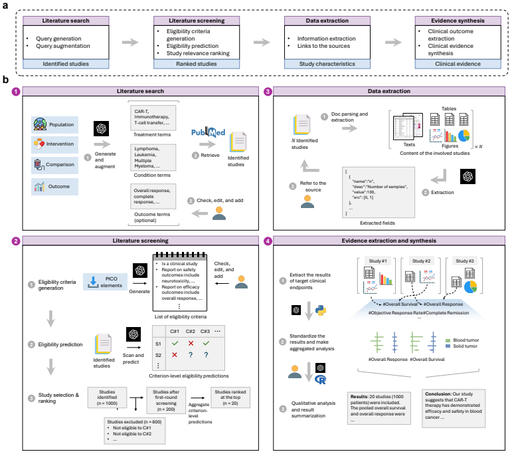
Figure 1 : The overview of TrialMind pipeline. a , it has four main steps: literature search, literature screening, data extraction, and evidence synthesis. b, (1) Utilizing input PICO elements, TrialMind generates key terms to construct Boolean queries for retrieving studies from literature databases. (2) TrialMind formulates eligibility criteria, which users can edit to provide context for LLMs during eligibility predictions. Users can then select studies based on these predictions and rank their relevance by aggregating them. (3) TrialMind processes the descriptions of target data fields to extract and output the required information as structured data. (4) TrialMind extracts findings from the studies and collaborates with users to synthesize the clinical evidence.
원문 · CC BY 4.0 · Zifeng Wang, Lang Cao, Benjamin Danek, Qiao Jin, Zhiyong Lu, Jimeng Sun · Accelerating Clinical Evidence Synthesis with Large Language Models · 원문 그림 인용 · 원본 PDF 3쪽에서 그림 영역을 추출했습니다.검색 재현율 평가
검색 실험은 TrialReviewBench의 100개 체계적 문헌고찰에서 포함 연구를 PubMed 검색으로 얼마나 찾는지를 Recall로 측정합니다. 비교 대상은 GPT-4 기준선과 PICO 용어를 UMLS로 확장한 인간 기준선입니다. 전체 평균 Recall은 TrialMind 0.782, GPT-4 0.073, 인간 0.187로 보고됩니다. 주제별로는 Immunotherapy에서 TrialMind 0.797, GPT-4 0.094, 인간 0.154이며, 식별된 연구 수 N은 TrialMind 22,084, GPT-4 27, 인간 958입니다. 이 수치는 검색 재현율을 중심으로 한 결과이며 스크리닝과 추출의 성능을 직접 나타내지는 않습니다.
스크리닝 순위 평가
스크리닝 실험에서는 각 리뷰마다 목표 연구와 다른 검색 결과를 섞어 2,000개 후보 집합을 만들고 Recall@20과 Recall@50으로 순위를 평가합니다. 비교 대상은 MPNet, MedCPT, Random입니다. 보고된 Recall@20은 Hormone Therapy 0.431, Hyperthermia 0.518, Immunotherapy 0.567, Radiation/Chemotherapy 0.416이며, 최선의 기준선 대비 배수는 1.3에서 2.6 사이입니다. 기준별 영향은 leave-one-out 방식의 ∆Recall@200으로 분석되며, 값이 0인 기준이 가장 자주 관찰되었다고 원문은 보고합니다.
데이터 추출과 결과 추출
데이터 추출 평가는 Table 1에서 가져온 1,334개 목표 데이터 포인트를 사용하며, 정확도 Accuracy로 측정합니다. TrialMind는 전체 Immunotherapy 주제에서 ACC 0.78을 보고하며, 연구 설계 필드는 0.95, 결과 필드는 0.42로 나타납니다. 결과 추출은 GPT-4와 Sonnet을 단순 프롬프트로 비교하며, 인간이 후처리한 기준선과도 비교합니다. Immunotherapy에서 TrialMind는 0.70, GPT-4는 0.54로 보고됩니다. 결과 추출의 오류는 부정확 추출, 추출 실패, 데이터 없음, 환각으로 분류되었습니다.
적용 범위와 한계
원문은 LLM이 어느 단계에서도 오류를 낼 수 있어 사람의 검토가 필요하다고 밝힙니다. 데이터셋 규모는 인간 라벨링 비용 때문에 제한되었고, 연구 범위는 PubMed Central의 공개 자료에 한정되었습니다. 또한 GPT-4 중심 실험이므로 다른 LLM에 대한 적용성은 추가 검증이 필요합니다. 비용과 처리 시간도 실제 운영의 병목이 될 수 있다고 원문은 지적합니다.
논문 정보
- 저자
- Zifeng Wang, Lang Cao, Benjamin Danek, Qiao Jin, Zhiyong Lu, Jimeng Sun
- 학회·저널
- arXiv · 프리프린트
- 최초 공개일
- 2024년 6월 25일
- 등록일
- 2026년 11월 6일
- 수정일
- 2024년 10월 28일
- 버전
- v2
- arXiv
- 2406.17755
- 분류
- cs.CL
- 원문 이용 조건
- CC BY 4.0
- 제공 범위
- 논문 정보, 해설, 허용된 원문 그림
AI 해설은 논문 원문과 별개의 설명이며 오류가 있을 수 있습니다. 원문과 그림은 각 출처의 이용 조건과 따로 표시된 권리를 따릅니다.
초록
Synthesizing clinical evidence largely relies on systematic reviews of clinical trials and retrospective analyses from medical literature. However, the rapid expansion of publications presents challenges in efficiently identifying, summarizing, and updating clinical evidence. Here, we introduce TrialMind, a generative artificial intelligence (AI) pipeline for facilitating human-AI collaboration in three crucial tasks for evidence synthesis: study search, screening, and data extraction. To assess its performance, we chose published systematic reviews to build the benchmark dataset, named TrialReviewBench, which contains 100 systematic reviews and the associated 2,220 clinical studies. Our results show that TrialMind excels across all three tasks. In study search, it generates diverse and comprehensive search queries to achieve high recall rates (Ours 0.711-0.834 v.s. Human baseline 0.138-0.232). For study screening, TrialMind surpasses traditional embedding-based methods by 30% to 160%. In data extraction, it outperforms a GPT-4 baseline by 29.6% to 61.5%. We further conducted user studies to confirm its practical utility. Compared to manual efforts, human-AI collaboration using TrialMind yielded a 71.4% recall lift and 44.2% time savings in study screening and a 23.5% accuracy lift and 63.4% time savings in data extraction. Additionally, when comparing synthesized clinical evidence presented in forest plots, medical experts favored TrialMind's outputs over GPT-4's outputs in 62.5% to 100% of cases. These findings show the promise of LLM-based approaches like TrialMind to accelerate clinical evidence synthesis via streamlining study search, screening, and data extraction from medical literature, with exceptional performance improvement when working with human experts.
원문 인용
Zifeng Wang, Lang Cao, Benjamin Danek, Qiao Jin, Zhiyong Lu, Jimeng Sun (2024). Accelerating Clinical Evidence Synthesis with Large Language Models. arXiv:2406.17755v2. https://arxiv.org/abs/2406.17755v2
BibTeX
@misc{wang2024accelerating,
  title = {{Accelerating Clinical Evidence Synthesis with Large Language Models}},
  author = {Zifeng Wang and Lang Cao and Benjamin Danek and Qiao Jin and Zhiyong Lu and Jimeng Sun},
  year = {2024},
  eprint = {2406.17755},
  archivePrefix = {arXiv},
  url = {https://arxiv.org/abs/2406.17755v2}
}