논문 해설
HiBerNAC: Hierarchical Brain-inspired Robotic Neural Agent Collective for Disentangling Complex Manipulation
HiBerNAC: 복잡한 조작의 분리를 위한 계층적 뇌 영감 로봇 신경 에이전트 집단
- 연구 문제 복잡한 장기 조작 과제에서 기존 VLA 기반 로봇 시스템은 지속적 문맥 기억, 다중 에이전트 조정, 실시간 대응을 충분히 다루지 못합니다.
- 연구 방법 HiBerNAC은 심의적 다중 에이전트 계획과 약 100Hz의 반응형 VLA 제어를 비동기 파이프라인으로 연결합니다.
- 주요 결과 시뮬레이션에서 다중모달 과제 성공률 48.5%와 장기 과제 실행 시간 23% 감소를 보고하며, Semantic 과제의 우위는 통계적으로 유의하지 않습니다.
복잡한 조작 과제의 어려움
로봇이 긴 시간에 걸친 복잡한 조작 과제를 수행하려면 지속적인 문맥 기억, 불확실성 아래의 다중 에이전트 조정, 가변적인 장기 계획이 필요합니다. 원문은 기존 VLA 모델이 이런 조건에서 장기 과제와 실시간 대응을 충분히 다루지 못한다고 지적합니다. HiBerNAC은 이 문제를 신경 조직의 원리를 설계 은유로 삼아 다룹니다. 원문은 생물학적 영역 명칭이 생물물리적 동등성이나 신경과학적 검증을 뜻하지 않는다고 분명히 밝힙니다.
심의 경로와 반응 경로를 나눈 구조
HiBerNAC은 약 1×10⁻² Hz로 동작하는 다중 에이전트 신경 구조에서 고수준 계획을 맡습니다. 이 구조에는 Prefrontal Planner, 에피소드 기억을 저장하는 Hippocampus Module, 실행을 감시하는 Inspection Agent가 포함됩니다. 비동기 파이프라인은 DBHTN 계획기로 계획을 상태와 전이로 이루어진 행동 순서로 분해하고, 상태 검토를 약 1×10⁻¹ Hz로 수행합니다. 반응형 VLA 분기는 100Hz 수준의 저수준 제어를 맡으며 파이프라인과 양방향으로 정보를 주고받습니다. 이 구조는 계획 경로와 반응 경로를 한 시스템 안에서 연결하는 것이 핵심입니다.
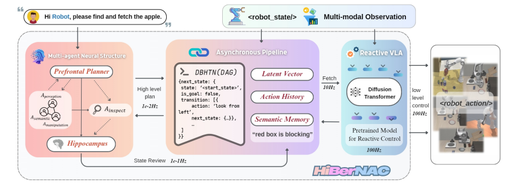
Figure 3 :Overall framework ofHiBerNAC. Three main core modules: Left. A multi-agent neural structure for high-level planning based on language input; Middle. An asynchronous hierarchical task pipeline for neural agent collective; and Right. A reactive VLA model for real-time robotic manipulation execution.
원문 · CC BY 4.0 · Heng Zhang, Hongjun Wu, Pengsong Zhang, Jin Wang, Cong Wang · HiBerNAC: Hierarchical Brain-inspired Robotic Neural Agent Collective for Disentangling Complex Manipulation · 원문 그림 인용 · 원본 PDF 5쪽에서 그림 영역을 추출했습니다.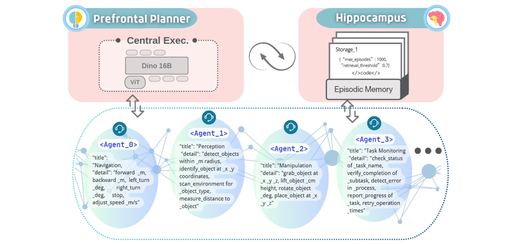
Figure 4 :Multi-agent Neural Architecture: A collective of neural agents designed for scalable and adaptive operation across variable task horizons and complexity levels, achieved through dynamic agent specialization.
원문 · CC BY 4.0 · Heng Zhang, Hongjun Wu, Pengsong Zhang, Jin Wang, Cong Wang · HiBerNAC: Hierarchical Brain-inspired Robotic Neural Agent Collective for Disentangling Complex Manipulation · 원문 그림 인용 · 원본 PDF 7쪽에서 그림 영역을 추출했습니다.기준 VLA 모델과의 시뮬레이션 비교
평가는 MuJoCo 기반 시뮬레이션에서 수행되었으며, DP-VLA, OpenVLA, Octo, RDT를 공개 체크포인트로 기본 설정에서 평가했습니다. 원문은 기준선에 과제별 fine-tuning을 하지 않았다고 밝히고, 그 결과가 최적으로 미세조정된 기준선보다 낫다는 뜻은 아니라고 명시합니다. 과제는 여덟 범주로 구성되며 성공률과 표준편차로 비교합니다. 이 결과는 해당 시뮬레이션 환경과 기본 설정 기준선에서 얻은 것입니다.
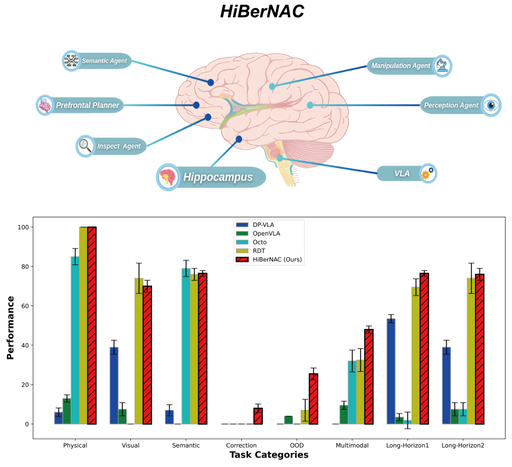
Figure 2 :Evaluation of Performances in comparison with SOTA VLA models
원문 · CC BY 4.0 · Heng Zhang, Hongjun Wu, Pengsong Zhang, Jin Wang, Cong Wang · HiBerNAC: Hierarchical Brain-inspired Robotic Neural Agent Collective for Disentangling Complex Manipulation · 원문 그림 인용 · 원본 PDF 4쪽에서 그림 영역을 추출했습니다.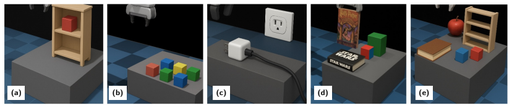
Figure 6 :Evaluation cases in simulation. Example tasks such as (a).grab cube from cabinet, (b). grab the blue cube, (c). plug the right charger, (d) grab the Harry Potter book, (e). find and fetch the apple
원문 · CC BY 4.0 · Heng Zhang, Hongjun Wu, Pengsong Zhang, Jin Wang, Cong Wang · HiBerNAC: Hierarchical Brain-inspired Robotic Neural Agent Collective for Disentangling Complex Manipulation · 원문 그림 인용 · 원본 PDF 12쪽에서 그림 영역을 추출했습니다.다중모달과 장기 과제의 결과
다중모달 과제에서 HiBerNAC은 48.5%의 성공률을 보였고, 가장 강한 기준선 RDT의 32%보다 16.5 퍼센트포인트 높습니다. 원문의 표 1 대비 요약에서는 다중모달 과제 결과가 48%로 기록되어 있으므로, 이 두 값은 서로 다른 집계 표현으로 읽어야 합니다. 장기 과제의 평균 실행 시간은 기준 모델 대비 23% 줄었다고 보고됩니다. 다만 Semantic 과제에서 HiBerNAC과 Octo 또는 RDT의 차이는 p=0.71로 유의하지 않으므로 해당 우위를 주장하지 않습니다.
시뮬레이션 범위와 남은 과제
원문은 보고된 모든 정량 결과가 MuJoCo 기반 시뮬레이션에서 얻은 것이며 실제 로봇 실험은 수행하지 않았다고 밝힙니다. 따라서 실제 세계의 견고성은 이 결과만으로 확인되지 않습니다. 또한 현재 구현은 이중 RTX 3090 환경에서 측정되었고, 원문은 이 구성이 자원이 제한된 로봇 플랫폼에 바로 배포되기 어렵다고 설명합니다. 원문이 제시한 경량화와 엣지 배포 방향은 향후 과제로 제시된 것입니다.
논문 정보
- 저자
- Heng Zhang, Hongjun Wu, Pengsong Zhang, Jin Wang, Cong Wang
- 학회·저널
- arXiv · 프리프린트
- 최초 공개일
- 2025년 6월 9일
- 등록일
- 2026년 11월 6일
- 수정일
- 2026년 9월 18일
- 버전
- v3
- arXiv
- 2506.08296
- 분류
- cs.RO
- 원문 이용 조건
- CC BY 4.0
- 제공 범위
- 논문 정보, 해설, 허용된 원문 그림
AI 해설은 논문 원문과 별개의 설명이며 오류가 있을 수 있습니다. 원문과 그림은 각 출처의 이용 조건과 따로 표시된 권리를 따릅니다.
초록
Recent advances in multimodal vision-language-action (VLA) models have revolutionized traditional robot learning, enabling systems to interpret vision, language, and action in unified frameworks for complex task planning. However, mastering complex manipulation tasks remains an open challenge, constrained by limitations in persistent contextual memory, multi-agent coordination under uncertainty, and dynamic long-horizon planning across variable sequences. To address this challenge, we propose \textbf{HiBerNAC}, a \textbf{Hi}erarchical \textbf{B}rain-\textbf{e}mulated \textbf{r}obotic \textbf{N}eural \textbf{A}gent \textbf{C}ollective, inspired by breakthroughs in neuroscience, particularly in neural circuit mechanisms and hierarchical decision-making. Our framework combines: (1) multimodal VLA planning and reasoning with (2) neuro-inspired reflection and multi-agent mechanisms, specifically designed for complex robotic manipulation tasks. By leveraging neuro-inspired functional modules with decentralized multi-agent collaboration, our approach enables robust and enhanced real-time execution of complex manipulation tasks. In addition, the agentic system exhibits scalable collective intelligence via dynamic agent specialization, adapting its coordination strategy to variable task horizons and complexity. Through extensive experiments on complex manipulation tasks compared with state-of-the-art VLA models, we demonstrate that \textbf{HiBerNAC} reduces average long-horizon task completion time by 23\%, and achieves non-zero success rates (12\textendash 31\%) on multi-path tasks where prior state-of-the-art VLA models consistently fail. These results provide indicative evidence for bridging biological cognition and robotic learning mechanisms.
원문 인용
Heng Zhang, Hongjun Wu, Pengsong Zhang, Jin Wang, Cong Wang (2025). HiBerNAC: Hierarchical Brain-inspired Robotic Neural Agent Collective for Disentangling Complex Manipulation. arXiv:2506.08296v3. https://arxiv.org/abs/2506.08296v3
BibTeX
@misc{zhang2025hibernac,
  title = {{HiBerNAC: Hierarchical Brain-inspired Robotic Neural Agent Collective for Disentangling Complex Manipulation}},
  author = {Heng Zhang and Hongjun Wu and Pengsong Zhang and Jin Wang and Cong Wang},
  year = {2025},
  eprint = {2506.08296},
  archivePrefix = {arXiv},
  url = {https://arxiv.org/abs/2506.08296v3}
}