논문 해설
Understanding Contextual Bias in Agricultural CNNs Through Hidden-Neuron Concept Induction
Hidden-Neuron Concept Induction을 통한 농업 CNN의 맥락 편향 이해
- 연구 문제 CNN이 배경 중심 패치로 분류하는 현상은 정확도로만 확인되었고, 은닉 뉴런이 무엇을 표현하는지는 불분명했습니다.
- 연구 방법 은닉층 활성화를 UDAT 기술자 기반 OWL 지식그래프와 CELOE 개념 유도로 연결하고, 보류 이미지에서 검정했습니다.
패치 기반 편향 탐지의 한계
CNN은 대상 물체가 거의 없는 배경 중심 패치로도 분류에 성공할 수 있습니다. 이전 연구는 이 현상을 분류 정확도로 확인했지만, 은닉 뉴런이 그 패치에서 무엇을 표현하는지는 설명하지 못했습니다. 이 논문은 이 공백을 메우기 위해 패치의 시각 특성과 은닉 뉴런 활성화를 같은 틀에서 연결합니다.
연구 질문은 네 가지입니다. 어느 깊이의 층에서 의미 해석 가능한 표현이 나타나는지, 어떤 공간 패치 위치가 일관되게 검증되는지, 어떤 이미지 기술자 계열이 가장 잘 특징짓는지, 그리고 검증된 개념의 출현이 문맥 편향 정도와 어떻게 연결되는지입니다.
뉴런과 기술자를 개념 유도로 잇는 파이프라인
각 데이터셋과 패치 위치의 이미지를 CNN에 통과시키고, 세 깊이의 은닉층에서 채널별 GAP 활성화를 얻습니다. 각 채널은 하나의 뉴런으로 취급됩니다.
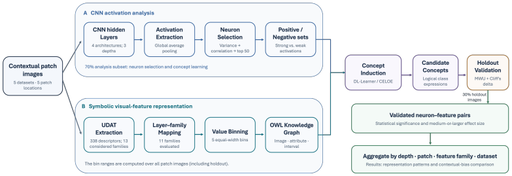
Figure 1 : Overview of the neuro-symbolic analysis pipeline for interpreting CNN hidden-neuron acti- vations from contextual image patches.
원문 · CC BY 4.0 · Abhilekha Dalal, Avishek Das, Samatha Ereshi Akkamahadevi · Understanding Contextual Bias in Agricultural CNNs Through Hidden-Neuron Concept Induction · 원문 그림 인용 · 원본 PDF 9쪽에서 그림 영역을 추출했습니다.
Table 3 : Hidden layers selected to represent mid, mid-deep, and deep stages of each CNN architecture
원문 · CC BY 4.0 · Abhilekha Dalal, Avishek Das, Samatha Ereshi Akkamahadevi · Understanding Contextual Bias in Agricultural CNNs Through Hidden-Neuron Concept Induction · 원문 그림 인용 · 원본 PDF 10쪽에서 그림 영역을 추출했습니다.UDAT의 원본 이미지 기술자는 구간 빈으로 이산화되고, 이미지와 빈은 OWL 지식그래프로 표현됩니다. 긍정 예시는 최대 활성화의 80% 이상인 이미지이고, 부정 예시는 최대 활성화의 20% 이하이면서 0이 아닌 이미지입니다. 그 사이의 이미지와 활성화가 0인 이미지는 제외합니다. DL-Learner의 CELOE가 이 예시와 배경지식으로 클래스 표현식을 찾고, 실행당 60초 제한 아래 최고 정확도 표현식 하나를 검증 단계로 넘깁니다.
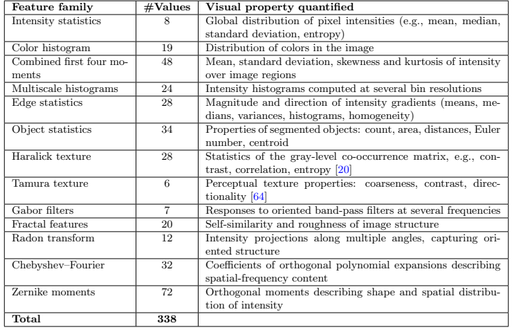
Table 1 : UDAT feature families considered in this study, the number of numerical descriptors associated with each family, and the visual properties they quantify.
원문 · CC BY 4.0 · Abhilekha Dalal, Avishek Das, Samatha Ereshi Akkamahadevi · Understanding Contextual Bias in Agricultural CNNs Through Hidden-Neuron Concept Induction · 원문 그림 인용 · 원본 PDF 8쪽에서 그림 영역을 추출했습니다.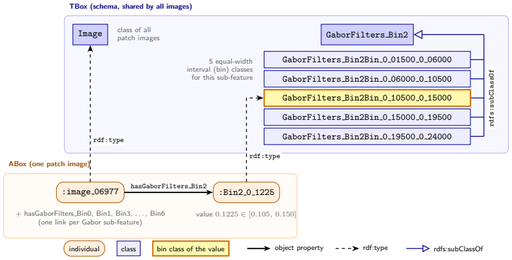
Figure 2 : Ontology pattern for one patch image and one UDAT sub-feature (Gabor filters, sub- feature Bin2). The patch individual is linked by hasGaborFilters Bin2 to a value individual (value 0.1225), which is typed with the interval class for [0.105,0.150]; the five equal-width interval classes are subclasses of the sub-feature class GaborFilters Bin2. The same pattern is repeated for each of the seven Gabor sub-features.
원문 · CC BY 4.0 · Abhilekha Dalal, Avishek Das, Samatha Ereshi Akkamahadevi · Understanding Contextual Bias in Agricultural CNNs Through Hidden-Neuron Concept Induction · 원문 그림 인용 · 원본 PDF 13쪽에서 그림 영역을 추출했습니다.보류 이미지에서의 검증 기준
개념을 만족하는 이미지는 긍정군, 나머지는 부정군이 되며 두 군에 각각 최소 3개 이미지가 있어야 검정합니다. 단측 Mann-Whitney U 검정으로 긍정군의 활성화가 더 큰지 보고, Cliff's delta의 절댓값이 0.330 이상이며 p가 0.05 미만인 쌍만 검증된 것으로 판정합니다.
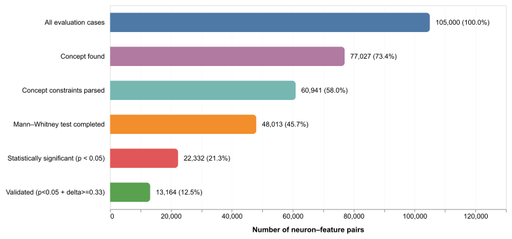
Figure 3 : Progressive reduction of neuron-feature evaluation cases. Percentages indicate the proportion retained relative to the initial 105,000 evaluation cases.
원문 · CC BY 4.0 · Abhilekha Dalal, Avishek Das, Samatha Ereshi Akkamahadevi · Understanding Contextual Bias in Agricultural CNNs Through Hidden-Neuron Concept Induction · 원문 그림 인용 · 원본 PDF 15쪽에서 그림 영역을 추출했습니다.검증률은 검정을 완료한 쌍 중 검증된 쌍의 비율입니다. 깊이별 평균은 25개 데이터셋-패치 구성의 검증률을 같은 가중치로 평균합니다. 따라서 전체 풀링 비율과 구성별 평균은 구분해서 읽어야 합니다.
깊이에 따른 검증률 변화
검증률은 Mid 층에서 평균 40.21%, Mid-deep 층에서 26.91%, Deep 층에서 11.99%를 기록했습니다. 대부분의 구성에서 Mid 층의 검증률이 가장 높고 Deep 층이 가장 낮았습니다. Sugarcane은 Mid 층에서 bottom-left 패치가 61.8%였고, WeedCrop의 center 패치는 Mid 52.4%에서 Deep 29.1%로 떨어졌습니다.
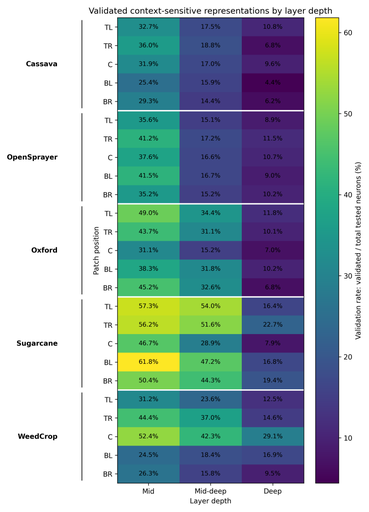
Figure 4 : Validation rates of context-sensitive neuron-feature pairs across different layers for each dataset-patch configuration.
원문 · CC BY 4.0 · Abhilekha Dalal, Avishek Das, Samatha Ereshi Akkamahadevi · Understanding Contextual Bias in Agricultural CNNs Through Hidden-Neuron Concept Induction · 원문 그림 인용 · 원본 PDF 17쪽에서 그림 영역을 추출했습니다.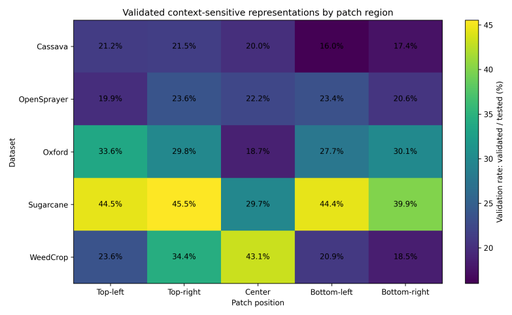
Figure 5 : Dataset-wise validation rates of context-sensitive neuron-feature representations across the five predefined spatial patch locations.
원문 · CC BY 4.0 · Abhilekha Dalal, Avishek Das, Samatha Ereshi Akkamahadevi · Understanding Contextual Bias in Agricultural CNNs Through Hidden-Neuron Concept Induction · 원문 그림 인용 · 원본 PDF 18쪽에서 그림 영역을 추출했습니다.저자들은 문맥 시각 특성이 중간 단계의 계층적 특징 형성 과정에서 가장 뚜렷하게 인코딩된다고 해석합니다. 다만 Edge와 Gabor는 Mid 층에서만 검사되었으므로 이 깊이 패턴과 특징 계열 효과를 분리하지 못합니다.
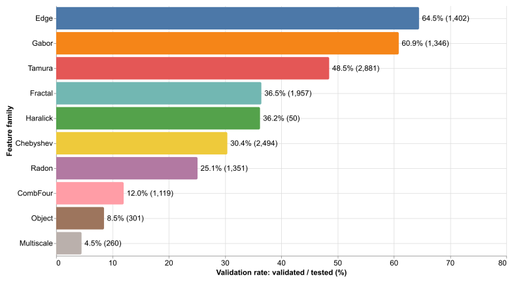
Figure 6 : Overall validation outcomes for the analyzed UDAT feature families.
원문 · CC BY 4.0 · Abhilekha Dalal, Avishek Das, Samatha Ereshi Akkamahadevi · Understanding Contextual Bias in Agricultural CNNs Through Hidden-Neuron Concept Induction · 원문 그림 인용 · 원본 PDF 19쪽에서 그림 영역을 추출했습니다.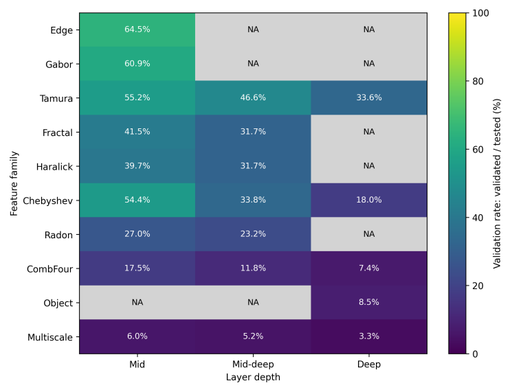
Figure 9 : Validation rates of neuron-feature pairs across feature families and CNN layer depths.
원문 · CC BY 4.0 · Abhilekha Dalal, Avishek Das, Samatha Ereshi Akkamahadevi · Understanding Contextual Bias in Agricultural CNNs Through Hidden-Neuron Concept Induction · 원문 그림 인용 · 원본 PDF 22쪽에서 그림 영역을 추출했습니다.문맥 편향과 검증률의 관계
Sugarcane은 중간 수준의 문맥 편향을 보였지만 검증률은 40.55%로 가장 높았습니다. 반대로 높은 편향의 Cassava는 19.23%, OpenSprayer는 21.97%였습니다. WeedCrop은 높은 편향에서 29.03%를 기록했고, 낮은 편향의 Oxford는 27.95%를 기록했습니다.
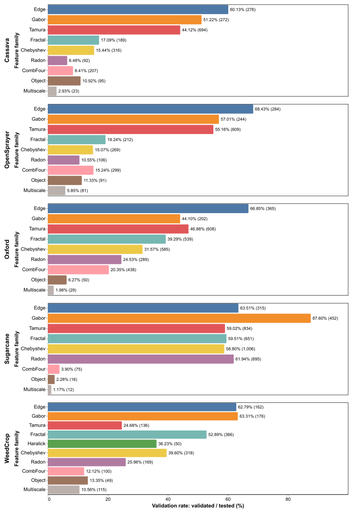
Figure 7 : Feature-family validation rates grouped by dataset across the analyzed patch locations, architectures, and layer depths.
원문 · CC BY 4.0 · Abhilekha Dalal, Avishek Das, Samatha Ereshi Akkamahadevi · Understanding Contextual Bias in Agricultural CNNs Through Hidden-Neuron Concept Induction · 원문 그림 인용 · 원본 PDF 20쪽에서 그림 영역을 추출했습니다.이 결과는 행동적 문맥 의존성과 은닉 뉴런의 의미 개념 출현이 서로 다른 측면을 잡는다는 저자들의 해석을 뒷받침합니다. 이 비교는 다섯 데이터셋의 패치 분석에 한정된 것입니다.
남은 제약
Zernike moments는 CELOE가 모든 뉴런에 대해 Thing만 반환해서 검증 가능한 개념을 만들지 못했습니다. 특징 계열은 LLM 기반 평가로 층에 배정되었고 모든 층에 교차하지 않았습니다.
또한 이 분석은 특징과 분류 결정 사이의 인과를 확정하지 않습니다. 해당 관계는 특징 개입 실험으로 따로 확인해야 합니다.
논문 정보
- 저자
- Abhilekha Dalal, Avishek Das, Samatha Ereshi Akkamahadevi
- 학회·저널
- arXiv · 프리프린트
- 최초 공개일
- 2026년 11월 13일
- 등록일
- 2026년 11월 16일
- 수정일
- 2026년 11월 13일
- 버전
- v1
- arXiv
- 2611.18530
- 분류
- cs.CV · cs.LG
- 원문 이용 조건
- CC BY 4.0
- 제공 범위
- 논문 정보, 해설, 허용된 원문 그림
AI 해설은 논문 원문과 별개의 설명이며 오류가 있을 수 있습니다. 원문과 그림은 각 출처의 이용 조건과 따로 표시된 권리를 따릅니다.
초록
Convolutional Neural Networks (CNNs) can classify images using background-dominated patches that contain little or none of the target object, showing that they exploit contextual information. Previous studies detected this behavior through classification accuracy but say little about what CNN hidden layers represent. We investigate whether Concept Induction can reveal interpretable visual properties associated with hidden-neuron activations on contextual image patches. Using five agricultural datasets with high, moderate, and low contextual bias, we analyze four CNN architectures at three network depths and five patch locations. Quantitative image descriptors of each patch are encoded in a knowledge graph and used as background knowledge for Concept Induction, which derives logical expressions characterizing neuron activation. These expressions are tested on held-out images using the Mann-Whitney U test and Cliff's delta. Of 48,013 tested neuron-feature pairs, 13,164 (27.4%) were validated. Validation was most frequent at intermediate depths (mean 40.2% at mid layers versus 12.0% at deep layers), and no patch location dominated across datasets. Among the tested descriptors, edge, Gabor, and Tamura texture features had the highest validation rates. Stronger contextual bias did not correspond to higher neuron-feature validation rates: moderately biased Sugarcane had the highest rate (40.5%) and highly biased Cassava the lowest (19.2%). These results suggest that behavioral context dependence and the semantic interpretability of hidden neurons capture different aspects of CNN behavior, and that Concept Induction can complement patch-based bias detection.
원문 인용
Abhilekha Dalal, Avishek Das, Samatha Ereshi Akkamahadevi (2026). Understanding Contextual Bias in Agricultural CNNs Through Hidden-Neuron Concept Induction. arXiv:2611.18530v1. https://arxiv.org/abs/2611.18530v1
BibTeX
@misc{dalal2026understanding,
  title = {{Understanding Contextual Bias in Agricultural CNNs Through Hidden-Neuron Concept Induction}},
  author = {Abhilekha Dalal and Avishek Das and Samatha Ereshi Akkamahadevi},
  year = {2026},
  eprint = {2611.18530},
  archivePrefix = {arXiv},
  url = {https://arxiv.org/abs/2611.18530v1}
}