논문 해설
Where to Approximate in Neurosymbolic Inference?
뉴로심볼릭 추론에서 어디를 근사할 것인가?
- 연구 문제 신경기호 추론의 가중 모델 계수 계산은 정확히 하기 어려워 근사가 필요하지만, 어느 단계에서 근사해야 하는지 체계적으로 알려지지 않았습니다.
- 연구 방법 컴파일, 곱셈·재압축, 독립 축소의 세 단계 파이프라인을 정의하고, 텐서 트레인 기반 APRICOT 전략으로 인수를 근사하고 TT 곱을 재압축합니다.
- 주요 결과 스도쿠 절제 실험과 여러 과제의 추론·학습 실험에서 의존성을 보존하는 TT 재압축 방법은 독립 근사보다 WMC 추정을 크게 개선하고, 보조 변수가 있는 과제에서 학습도 개선합니다.
스도쿠 같은 제약에서 WMC 계산이 어려운 이유
신경기호 시스템은 신경망이 예측한 이산 개념의 확률이 기호 제약을 만족할 확률, 즉 가중 모델 계수(WMC)를 계산해야 합니다. 이 계산은 일반적으로 #P-hard이며, 9×9 스도쿠 같은 큰 제약은 기존 정확 컴파일러로 다루기 어렵습니다. 그래서 많은 방법이 근사 계산을 사용하지만, 근사를 어느 단계에 넣어야 하는지에 대한 체계적 기준은 아직 정리되지 않았습니다. 이 논문은 이 공백을 다루기 위해 근사가 들어갈 수 있는 세 단계를 하나의 파이프라인으로 묶습니다. 첫 단계는 각 인수를 컴파일하는 단계이고, 둘째 단계는 인수들을 곱하거나 재압축하는 단계이며, 셋째 단계는 남은 회로들을 독립 가정으로 결합하는 단계입니다.
APRICOT 파이프라인의 텐서 트레인 근사
APRICOT는 세 단계 파이프라인의 첫 두 단계를 텐서 트레인(TT) 분해로 구현합니다. 제약 인수는 밀집 텐서로 만든 뒤 TT-SVD로 근사되며, 여러 TT는 같은 변수 순서에서 아다마르 곱으로 정확히 곱할 수 있습니다. 이때 랭크는 두 TT 랭크의 곱으로 커지므로, TT-ROUND 같은 재압축 방법으로 최대 랭크를 제한할 수 있습니다. 마지막 단계에서 남은 K개의 회로는 WMC를 개별로 계산한 뒤 독립 가정으로 곱합니다. 따라서 정확 곱, 재압축 곱, 독립 축소의 조합이 기존 방법들을 포괄하는 설계 공간을 이룹니다.
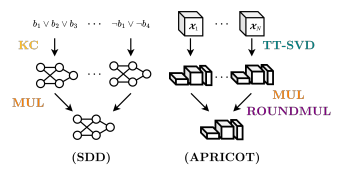
Figure 1 :Where can we approximatewhen compiling structured-decomposable circuits? We unify bottom-up approaches in a three-step pipeline:(Step I)compiles each factor ϕj into an exact or relaxedcircuit,(Step II)multiplies the resulting N circuits down to K exactlyor usingrecom- pression strategies, and(Step III)combines any K >1 remaining circuits with anindependence (fuzzy) approximation. Existing methods correspond to specific combinations of exact or approximate operations, but the framework also allows for new TT-based APRICOT strategies yet to be explored.
원문 · CC BY 4.0 · Samy Badreddine, Emile van Krieken, Luciano Serafini, Antonio Vergari · Where to Approximate in Neurosymbolic Inference? · 원문 그림 인용 · 원본 PDF 2쪽에서 그림 영역을 추출했습니다.
Figure 2 : Closed algebra over TTs. TTs (a) canapproximate discrete functionsunder an error crite- rion and (b) are closed under severalexact operationsincluding multiplications. As multiplications involve Kronecker products ⊗ of the cores resulting in an exponential increase in rank, algebraic recompression strategies (c) canapproximate the result of the operations.
원문 · CC BY 4.0 · Samy Badreddine, Emile van Krieken, Luciano Serafini, Antonio Vergari · Where to Approximate in Neurosymbolic Inference? · 원문 그림 인용 · 원본 PDF 5쪽에서 그림 영역을 추출했습니다.스도쿠 컴파일 설정에 대한 절제 실험
스도쿠 6×6과 9×9 보드에서 곱셈 방식과 TT-SVD 초기 랭크를 바꾸어 컴파일 시간과 모델 계수의 로그 오차를 비교합니다. 참조값은 보드별 모델 수이며, 4×4에서는 정확 SDD와 적절한 TT 설정이 모두 수치 정밀도 안에서 정확한 계수를 회복합니다. 원문은 독립 근사가 설정에 따라 예측하기 어려운 결과를 보이며, 정확 곱을 먼저 수행하면 충실도가 크게 개선된다고 보고합니다. 또한 재압축 곱은 가장 강한 정확도를 제공하지만, 제한된 랭크 예산에서 너무 많은 곱을 시도하면 표현력 한계 때문에 성능이 떨어질 수 있습니다.
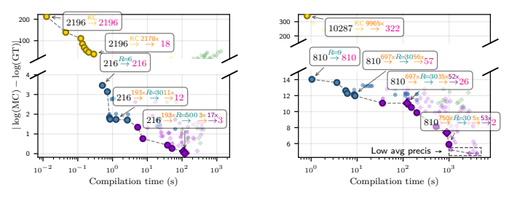
Figure 3 : Pareto front of absolute log inference error vs. compilation time for Sudoku 6x6 (left) and 9x9 (right). SDD pipelines are in yellow . APRICOT pipelines are in blue when they do not use recompressions, in violet when they use SVD-based recompressions (TT-ROUND and HATT ) and in green for interpolation-based strategies (TCI and RSI ).
원문 · CC BY 4.0 · Samy Badreddine, Emile van Krieken, Luciano Serafini, Antonio Vergari · Where to Approximate in Neurosymbolic Inference? · 원문 그림 인용 · 원본 PDF 8쪽에서 그림 영역을 추출했습니다.
Table 1 : Ablation of the multiplication schedule and maximum TT rank on Sudoku 6×6 . All pipelines use TT-ROUNDand reduce the 216 initial factors to five before fuzzy reduction.
원문 · CC BY 4.0 · Samy Badreddine, Emile van Krieken, Luciano Serafini, Antonio Vergari · Where to Approximate in Neurosymbolic Inference? · 원문 그림 인용 · 원본 PDF 26쪽에서 그림 영역을 추출했습니다.가중 추론과 학습에서 근사 방법 비교
MNISTAdd, MNISTMul, CLEVR-Diff, CLEVR-CountDiff에서 정확 SDD 컴파일은 어려운 설정에서 실패하지만, 완전 TT 축소인 APRICOT C는 독립 근사보다 훨씬 정확한 추정을 보고합니다. 학습 실험에서는 독립 축소가 시각 스도쿠와 CLEVR-Diff에서는 경쟁력 있지만, 보조 기호 변수가 있는 산술과 CLEVR-CountDiff에서는 의존성을 보존하는 방법이 개념과 출력 정확도를 크게 개선합니다. 다만 일부 설정에서 실행 간 분산이 크고 최적화가 수렴하지 않은 경우도 있습니다.
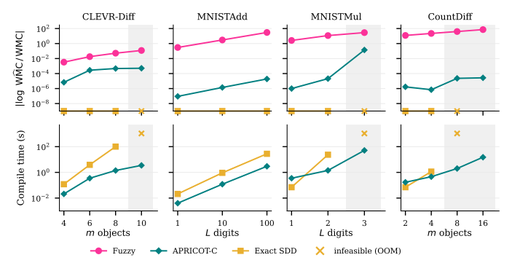
Figure 4 : Median absolute log WMC error and compilation time across tasks and problem sizes. Exact SDD compilation becomes infeasible on harder problems. Full TT reduction (APRICOT C) can scale further while producing estimates orders of magnitude more accurate than fuzzy.
원문 · CC BY 4.0 · Samy Badreddine, Emile van Krieken, Luciano Serafini, Antonio Vergari · Where to Approximate in Neurosymbolic Inference? · 원문 그림 인용 · 원본 PDF 9쪽에서 그림 영역을 추출했습니다.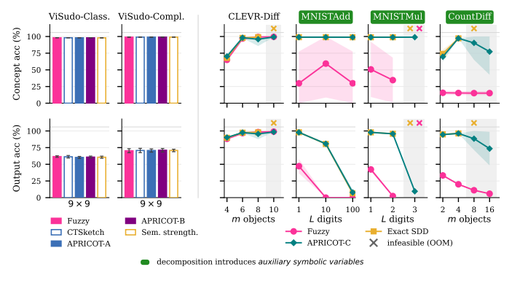
Figure 5 : Concept and output accuracy across tasks and problem sizes. APRICOT matches exact compilation when the latter is feasible, and outperforms fuzzy in larger regimes.
원문 · CC BY 4.0 · Samy Badreddine, Emile van Krieken, Luciano Serafini, Antonio Vergari · Where to Approximate in Neurosymbolic Inference? · 원문 그림 인용 · 원본 PDF 10쪽에서 그림 영역을 추출했습니다.적용 범위와 한계
저자들은 TCI와 RSI를 포함한 대부분의 텐서 트레인 분해와 재압축이 희소 불리언 텐서에 맞춰 설계되지 않았다고 밝힙니다. 따라서 이 방법의 효율을 희소 제약 전반으로 일반화하려면 별도의 연구가 필요합니다. 또한 스케줄과 랭크 선택은 과제마다 달라지며, 결과는 특정 벤치마크와 설정에서 얻은 것입니다.
논문 정보
- 저자
- Samy Badreddine, Emile van Krieken, Luciano Serafini, Antonio Vergari
- 학회·저널
- arXiv · 프리프린트
- 최초 공개일
- 2026년 11월 10일
- 등록일
- 2026년 11월 11일
- 수정일
- 2026년 11월 10일
- 버전
- v1
- arXiv
- 2611.13862
- 분류
- cs.LG
- 원문 이용 조건
- CC BY 4.0
- 제공 범위
- 논문 정보, 해설, 허용된 원문 그림
AI 해설은 논문 원문과 별개의 설명이며 오류가 있을 수 있습니다. 원문과 그림은 각 출처의 이용 조건과 따로 표시된 권리를 따릅니다.
초록
Probabilistic neurosymbolic methods rely on weighted model counting (WMC) to combine neural predictors with symbolic constraints. Exact WMC is #P-hard and typically scales poorly, so many methods resort to approximations. By unifying existing approaches under a three-step bottom-up approximate compilation pipeline, we study where approximation budget is best allocated. Inspired by tensor networks, we instantiate two steps with tensor train decompositions and derive new pipelines that exactly multiply approximated factors and recompress their products via SVD- or interpolation-based schemes. Across six tasks in Sudoku, arithmetic reasoning, and scene understanding, and across increasing problem sizes, our pipelines produce WMC estimates orders-of-magnitude more accurate than prior methods. This translates into stronger downstream learning on tasks where reasoning relies on tight interactions between symbolic factors, where cruder approximations ignore these dependencies. Our pipelines open novel design space for effective approximate compilation of challenging probabilistic reasoning tasks.
원문 인용
Samy Badreddine, Emile van Krieken, Luciano Serafini, Antonio Vergari (2026). Where to Approximate in Neurosymbolic Inference?. arXiv:2611.13862v1. https://arxiv.org/abs/2611.13862v1
BibTeX
@misc{badreddine2026where,
  title = {{Where to Approximate in Neurosymbolic Inference?}},
  author = {Samy Badreddine and Emile van Krieken and Luciano Serafini and Antonio Vergari},
  year = {2026},
  eprint = {2611.13862},
  archivePrefix = {arXiv},
  url = {https://arxiv.org/abs/2611.13862v1}
}