논문 해설
Can Mechanistic Interpretability Help Explain LLM Agent Failures? A Case Study on Web Element Hallucination
기계적 해석 가능성은 LLM 에이전트의 실패를 설명하는 데 도움이 될까? 웹 요소 환각에 대한 사례 연구
- 연구 문제 기존 MI 도구는 웹 에이전트의 환각 행동을 충분히 설명하지 못합니다.
- 연구 방법 Qwen2.5-7B-Instruct의 활성값에서 선형 프로브를 학습하고 프로브 방향으로 스티어링합니다.
웹 에이전트 환각을 MI로 설명하기 어려운 이유
웹 에이전트는 실제 웹페이지에 없는 행동을 만들어 내는 환각을 보입니다. 이 논문은 기계적 해석 가능성(MI) 도구가 이런 에이전트 실패를 얼마나 설명할 수 있는지 사례 연구로 살펴봅니다. 저자들은 MI가 모델 단위 분석에 맞춰 설계되었기 때문에, 긴 궤적과 여러 에이전트 구성요소에 걸친 실패를 다루기 어렵다고 봅니다. 그래서 이 글은 회로 탐색과 특징 식별이라는 두 방향에서 기존 가정이 어디서 깨지는지를 따라갑니다.
선택자 값 위치에서 프로브 학습과 스티어링
분석 대상은 Online-Mind2Web의 웹 궤적에서 생성된 행동을 Qwen2.5-7B-Instruct가 고르는 상황입니다. 행동 목록에 없는 행동을 환각으로 정의하고, 프롬프트 끝, 선택자 시작, 선택자 값 시작 위치의 잔차 스트림 활성값으로 층별 선형 프로브를 학습했습니다. 스티어링은 프로브 가중치로 만든 방향 벡터를 활성값에 더해 출력을 바꾸는 개입입니다.
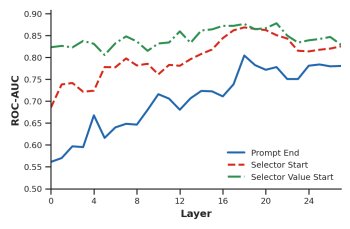
Figure 4 : Per-layer AUC of linear probes trained to predict hallucination at different positions.
원문 · CC BY 4.0 · Mohamed Aghzal, Mor Geva, Gregory J. Stein, Ziyu Yao · Can Mechanistic Interpretability Help Explain LLM Agent Failures? A Case Study on Web Element Hallucination · 원문 그림 인용 · 원본 PDF 7쪽에서 그림 영역을 추출했습니다.프로브 예측과 스티어링 교정 결과
이 수치는 Qwen2.5-7B-Instruct와 Online-Mind2Web의 설정에서 나온 결과입니다.
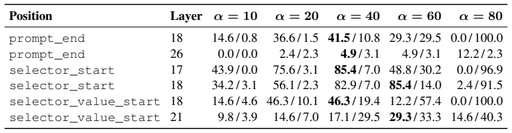
Table 5 : Fix and break rates for probe-based steering across (position, layer) configurations. Each cell shows fix / break %. Bold marks the best fix rate for each configuration.
원문 · CC BY 4.0 · Mohamed Aghzal, Mor Geva, Gregory J. Stein, Ziyu Yao · Can Mechanistic Interpretability Help Explain LLM Agent Failures? A Case Study on Web Element Hallucination · 원문 그림 인용 · 원본 PDF 20쪽에서 그림 영역을 추출했습니다.형식 변화에 취약한 프로브 방향
같은 스티어링 벡터를 번호 목록 형식의 OOD 프롬프트에 적용하면 교정율이 크게 떨어집니다. 저자들은 이 결과를 학습된 방향이 환각 방향만이 아니라 행동 형식과 얽혀 있다는 근거로 해석합니다.
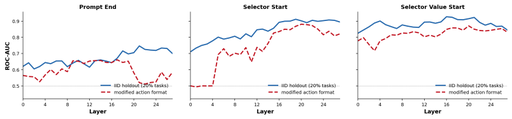
Figure 6 : Per-layer ROC-AUC of probes trained to predict hallucination after modifying the action format.
원문 · CC BY 4.0 · Mohamed Aghzal, Mor Geva, Gregory J. Stein, Ziyu Yao · Can Mechanistic Interpretability Help Explain LLM Agent Failures? A Case Study on Web Element Hallucination · 원문 그림 인용 · 원본 PDF 8쪽에서 그림 영역을 추출했습니다.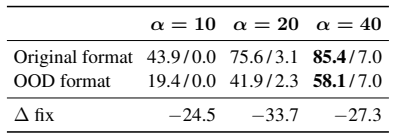
Table 6 : Fix and break rates for selector_start L17 steering on the original JSON format vs. the OOD numbered-list format. The same steering vector is used in both conditions.
원문 · CC BY 4.0 · Mohamed Aghzal, Mor Geva, Gregory J. Stein, Ziyu Yao · Can Mechanistic Interpretability Help Explain LLM Agent Failures? A Case Study on Web Element Hallucination · 원문 그림 인용 · 원본 PDF 18쪽에서 그림 영역을 추출했습니다.논문 정보
- 저자
- Mohamed Aghzal, Mor Geva, Gregory J. Stein, Ziyu Yao
- 학회·저널
- arXiv · 프리프린트
- 최초 공개일
- 2026년 11월 13일
- 등록일
- 2026년 11월 16일
- 수정일
- 2026년 11월 13일
- 버전
- v1
- arXiv
- 2611.18514
- 분류
- cs.AI · cs.CL
- 원문 이용 조건
- CC BY 4.0
- 제공 범위
- 논문 정보, 해설, 허용된 원문 그림
AI 해설은 논문 원문과 별개의 설명이며 오류가 있을 수 있습니다. 원문과 그림은 각 출처의 이용 조건과 따로 표시된 권리를 따릅니다.
초록
Mechanistic Interpretability (MI) has made significant progress in explaining the internal computations of Large Language Models (LLMs); however, these advances have yet to demonstrate comparable success in explaining the decision-making processes of LLM-based agents. This paper examines the challenges MI tools face when applied to realistic agentic failures. We focus on one such failure: web agents hallucinating actions that are not available on a website. We apply a series of mechanistic analyzes to Qwen2.5-7B-Instruct as it interacts with live websites. We find that a linear probe trained on the last prompt token can predict hallucinations before generation begins (0.80 AUC) and steering along a probe direction corrects 85\% of hallucinations, but disrupts 7\% of valid actions. However, these results only provide a partial explanation of why the agent hallucinates. The probe direction is sensitive to prompt formatting, losing much of its steering effect after a minor change to how actions are represented. Additionally, circuit identification can be difficult as the computation is distributed across multiple components and positions, and the information the agent relies on varies across examples. We discuss how these observations challenge the assumptions underlying standard MI methods for circuit discovery and feature identification, and outline future directions for making these methods better suited to explain failures in LLM-based agents.
원문 인용
Mohamed Aghzal, Mor Geva, Gregory J. Stein, Ziyu Yao (2026). Can Mechanistic Interpretability Help Explain LLM Agent Failures? A Case Study on Web Element Hallucination. arXiv:2611.18514v1. https://arxiv.org/abs/2611.18514v1
BibTeX
@misc{aghzal2026mechanistic,
  title = {{Can Mechanistic Interpretability Help Explain LLM Agent Failures? A Case Study on Web Element Hallucination}},
  author = {Mohamed Aghzal and Mor Geva and Gregory J. Stein and Ziyu Yao},
  year = {2026},
  eprint = {2611.18514},
  archivePrefix = {arXiv},
  url = {https://arxiv.org/abs/2611.18514v1}
}