논문 해설
Talk2Data: A Natural Language Interface for Exploratory Visual Analysis via Question Decomposition
Talk2Data: 질문 분해를 통한 탐색적 시각 분석을 위한 자연어 인터페이스
- 연구 문제 복잡한 질문을 여러 단순 질문으로 나누어 표 데이터의 탐색적 시각 분석을 지원하는 문제를 다룹니다.
- 연구 방법 딥러닝 기반 질문 분해 모델로 복잡한 질문을 두 개의 하위 질문으로 나누고, 빔 탐색으로 데이터 사실을 추출해 주석 차트로 답합니다.
- 주요 결과 사용자 연구에서 복잡한 질문의 정확도는 Talk2Data가 M=87.6%, 기준선이 M=67.5%로 보고되었습니다.
복잡한 질문이 기존 자연어 인터페이스에서 어려운 이유
기존 자연어 인터페이스는 하나의 구체적인 질문에서 하나의 시각화를 생성하는 데 초점을 맞춰 왔습니다. 그러나 탐색적 데이터 분석에서는 여러 데이터 질의와 시각화가 필요한 복잡한 질문이 자주 등장하며, 이런 질문은 기존 기법으로 쉽게 해결되지 않습니다. 논문은 이 간극을 메우기 위해 복잡한 질문을 여러 단순 질문으로 분해하는 Talk2Data를 제안합니다.
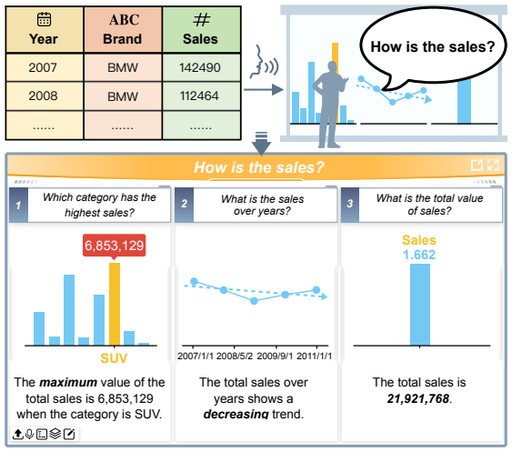
Fig. 1 . The user asks the system a question about car sales. The system decomposes this complex question into three simple questions and answers with a set of annotated charts.
원문 · CC BY 4.0 · Yi Guo, Danqing Shi, Mingjuan Guo, Yanqiu Wu, Qing Chen, Nan Cao · Talk2Data: A Natural Language Interface for Exploratory Visual Analysis via Question Decomposition · 원문 그림 인용 · 원본 PDF 2쪽에서 그림 영역을 추출했습니다.복잡한 질문은 여러 데이터 차원을 동시에 다루고, 문맥과 세부 정보를 명시하지 않은 채 던져지는 경우가 많습니다. 따라서 시스템은 흐린 질문에서 문맥 정보와 세부 사항을 추출하고, 그 결과를 순서대로 정리해 서술하기 쉬운 형태로 보여 주어야 합니다. 이 논문은 이 세 가지 어려움을 함께 다룹니다.
질문 분해 모델과 사실 탐색의 구조
Talk2Data는 입력 스프레드시트와 질문을 전처리하여 질문 단어와 열의 데이터 유형 표지를 함께 담은 시퀀스를 만듭니다. 이후 분해 모델이 이 복잡한 질문을 정확히 두 개의 하위 질문으로 나누며, 각 하위 질문은 단순 질문이거나 다시 분해할 복잡한 질문일 수 있습니다.
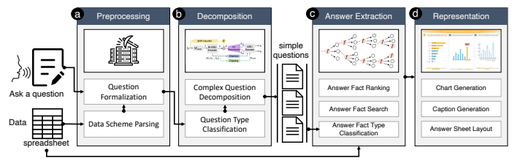
Fig. 2 . The architecture design of Talk2Data consists of four major modules: (a) data preprocessing, (b) question decomposition, (c) answer fact extraction, and (d) visual representation.
원문 · CC BY 4.0 · Yi Guo, Danqing Shi, Mingjuan Guo, Yanqiu Wu, Qing Chen, Nan Cao · Talk2Data: A Natural Language Interface for Exploratory Visual Analysis via Question Decomposition · 원문 그림 인용 · 원본 PDF 4쪽에서 그림 영역을 추출했습니다.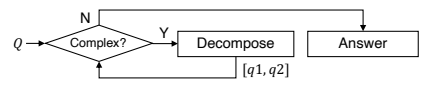
Fig. 3 . The running pipeline of the decomposition algorithm.
원문 · CC BY 4.0 · Yi Guo, Danqing Shi, Mingjuan Guo, Yanqiu Wu, Qing Chen, Nan Cao · Talk2Data: A Natural Language Interface for Exploratory Visual Analysis via Question Decomposition · 원문 그림 인용 · 원본 PDF 7쪽에서 그림 영역을 추출했습니다.분해 모델은 고전적인 시퀀스-투-시퀀스 구조를 확장한 것입니다. 질문 유형을 분류하는 BERT 기반 조건 벡터를 두고, 인코딩 벡터와 조건 벡터를 결합한 값을 완전연결 계층으로 두 개의 은닉 벡터로 변환합니다. 디코더는 어텐션으로 입력 질문의 관련 단어를 참조하며, 복사 메커니즘은 학습 때 보지 못한 열 이름이나 질문 단어를 직접 복사하도록 확률을 조정합니다.
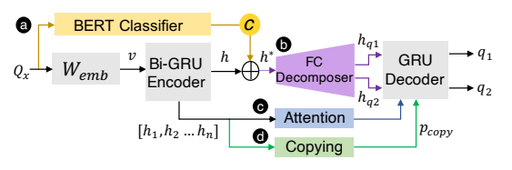
Fig. 4 . Schematic diagrams of the decomposition model. It consists of four major improvements: (a) question classifier, (b) decomposition layer, (c) attention mechanism, and (d) copying mechanism.
원문 · CC BY 4.0 · Yi Guo, Danqing Shi, Mingjuan Guo, Yanqiu Wu, Qing Chen, Nan Cao · Talk2Data: A Natural Language Interface for Exploratory Visual Analysis via Question Decomposition · 원문 그림 인용 · 원본 PDF 7쪽에서 그림 영역을 추출했습니다.분해된 단순 질문에 대해서는 사실 유형을 BERT 분류기로 정한 뒤 빔 탐색으로 부분공간, 분해 기준, 측정값, 초점을 채웁니다. 각 사실은 사실 유형, 부분공간, 분해 기준, 측정값, 초점의 5-튜플로 정의되며, 상위 k개 사실이 답변으로 선택됩니다.
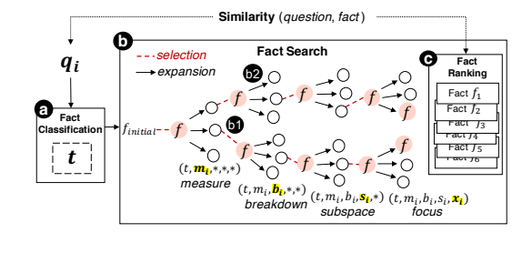
Fig. 5 . The pipeline of answer fact extraction. It consists of three components: (a) type classification, (b) searching, and (c) ranking.
원문 · CC BY 4.0 · Yi Guo, Danqing Shi, Mingjuan Guo, Yanqiu Wu, Qing Chen, Nan Cao · Talk2Data: A Natural Language Interface for Exploratory Visual Analysis via Question Decomposition · 원문 그림 인용 · 원본 PDF 11쪽에서 그림 영역을 추출했습니다.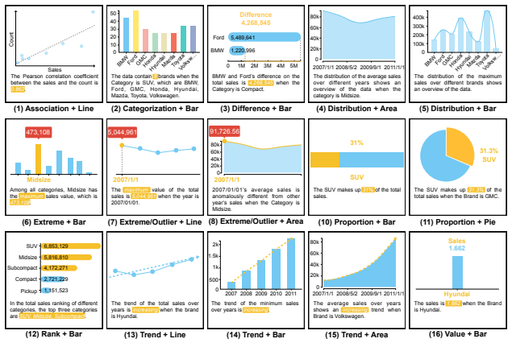
Fig. 7 . The gallery of annotated charts designed for narrating the data content organized in 10 types of data facts. Each chart consists of a statistical diagram, annotations, and an automatically generated caption.
원문 · CC BY 4.0 · Yi Guo, Danqing Shi, Mingjuan Guo, Yanqiu Wu, Qing Chen, Nan Cao · Talk2Data: A Natural Language Interface for Exploratory Visual Analysis via Question Decomposition · 원문 그림 인용 · 원본 PDF 14쪽에서 그림 영역을 추출했습니다.분해 모델의 학습 코퍼스와 손실
분해 모델은 표 기반 질문 분해 코퍼스로 학습되었으며, 이 코퍼스는 7,096개의 복잡한 질문과 14,192개의 단순 질문 쌍으로 구성됩니다. 모델 학습에는 정답 문장의 단어 단위 음의 로그 우도 손실이 사용되며, 이 손실은 정답 단어의 확률을 최대화하는 방향으로 작동합니다.
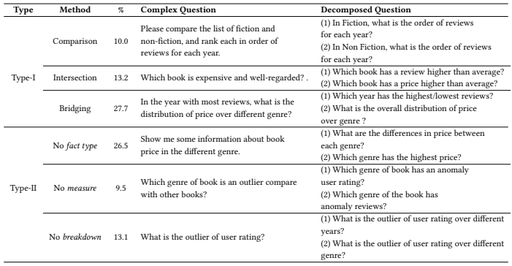
Table 1 . Examples of complex questions and the corresponding decomposed simple questions. % shows the proportions of the questions generated by the different methods.
원문 · CC BY 4.0 · Yi Guo, Danqing Shi, Mingjuan Guo, Yanqiu Wu, Qing Chen, Nan Cao · Talk2Data: A Natural Language Interface for Exploratory Visual Analysis via Question Decomposition · 원문 그림 인용 · 원본 PDF 9쪽에서 그림 영역을 추출했습니다.코퍼스 품질 확인을 위해 기계 생성 질문과 바꿔 쓴 질문의 의미 유사도 S_s를 Sentence-BERT의 코사인 유사도로, 텍스트 유사도 S_t를 Levenshtein 거리로 계산하고 S = S_s − S_t 값으로 그대로 복사한 질문이나 의미가 바뀐 질문을 걸러 냈습니다.
분해 모델의 구성 요소별 비교와 사용자 연구
분해 모델의 구성 요소를 줄인 변형을 BLEU와 METEOR로 비교한 결과, 문장 재작성 기준선의 METEOR는 22.12였습니다. Decomposer 단독은 BLEU 23.88, METEOR 24.02였고, 분류기를 추가하면 BLEU 25.23, METEOR 25.73이 되었습니다. 어텐션을 더한 경우는 BLEU 25.56, METEOR 26.09였고, 복사 메커니즘까지 포함한 전체 모델은 BLEU 26.22, METEOR 27.55였습니다. 이 결과는 학습 코퍼스의 테스트 분할에서 얻은 것입니다.
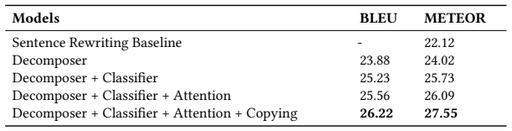
Table 2 . Performance Evaluation of the Decomposition Model
원문 · CC BY 4.0 · Yi Guo, Danqing Shi, Mingjuan Guo, Yanqiu Wu, Qing Chen, Nan Cao · Talk2Data: A Natural Language Interface for Exploratory Visual Analysis via Question Decomposition · 원문 그림 인용 · 원본 PDF 17쪽에서 그림 영역을 추출했습니다.사용자 연구는 20명의 참가자가 Talk2Data와 NL4DV 및 Vega-Lite 기반 기준선을 비교한 대응 설계로 진행되었습니다. 복잡한 질문의 정확도는 Talk2Data가 M=87.6%, SD=0.17, 기준선이 M=67.5%, SD=0.28이었고, 대응표본 t 검정에서 t(19)=4.08, p<0.01로 보고되었습니다. 단순 질문에서는 두 시스템의 정확도가 비슷했습니다.
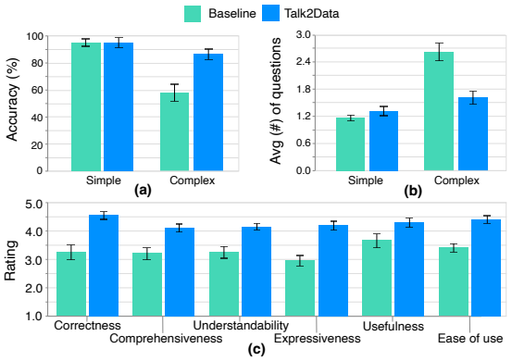
Fig. 9 . The results of the user study: (a) the accuracy, (b) the averaged number of questions to finish each of the tasks, and (c) the ratings from different criteria based on a 5-point Likert scale, where 5 is the best and 1 is the worst.
원문 · CC BY 4.0 · Yi Guo, Danqing Shi, Mingjuan Guo, Yanqiu Wu, Qing Chen, Nan Cao · Talk2Data: A Natural Language Interface for Exploratory Visual Analysis via Question Decomposition · 원문 그림 인용 · 원본 PDF 18쪽에서 그림 영역을 추출했습니다.확장성, 정확도, 도메인 일반화의 한계
현재 구현은 수만 개 행을 가진 큰 데이터셋을 처리하기 어려우며, 원문은 답변 추출 알고리즘이 주요 병목이라고 밝힙니다. 또한 학습 코퍼스가 26개의 표 데이터에서 생성되어 주로 마케팅 도메인에 치우쳐 있으므로, 다른 도메인의 질문에서는 분해 품질이 낮아질 수 있다고 원문은 설명합니다. 이 점은 논문이 다른 도메인에서 검증했다는 뜻이 아니라 향후 보완이 필요한 범위입니다.
논문 정보
- 저자
- Yi Guo, Danqing Shi, Mingjuan Guo, Yanqiu Wu, Qing Chen, Nan Cao
- 학회·저널
- arXiv · 프리프린트
- 최초 공개일
- 2021년 7월 30일
- 등록일
- 2026년 11월 6일
- 수정일
- 2023년 5월 16일
- 버전
- v3
- arXiv
- 2107.14420
- 분류
- cs.HC
- 원문 이용 조건
- CC BY 4.0
- 제공 범위
- 논문 정보, 해설, 허용된 원문 그림
AI 해설은 논문 원문과 별개의 설명이며 오류가 있을 수 있습니다. 원문과 그림은 각 출처의 이용 조건과 따로 표시된 권리를 따릅니다.
초록
Through a natural language interface (NLI) for exploratory visual analysis, users can directly "ask" analytical questions about the given tabular data. This process greatly improves user experience and lowers the technical barriers of data analysis. Existing techniques focus on generating a visualization from a concrete question. However, complex questions, requiring multiple data queries and visualizations to answer, are frequently asked in data exploration and analysis, which cannot be easily solved with the existing techniques. To address this issue, in this paper, we introduce Talk2Data, a natural language interface for exploratory visual analysis that supports answering complex questions. It leverages an advanced deep-learning model to resolve complex questions into a series of simple questions that could gradually elaborate on the users' requirements. To present answers, we design a set of annotated and captioned visualizations to represent the answers in a form that supports interpretation and narration. We conducted an ablation study and a controlled user study to evaluate Talk2Data's effectiveness and usefulness.
원문 인용
Yi Guo, Danqing Shi, Mingjuan Guo, Yanqiu Wu, Qing Chen, Nan Cao (2021). Talk2Data: A Natural Language Interface for Exploratory Visual Analysis via Question Decomposition. arXiv:2107.14420v3. https://arxiv.org/abs/2107.14420v3
BibTeX
@misc{guo2021talk2data,
  title = {{Talk2Data: A Natural Language Interface for Exploratory Visual Analysis via Question Decomposition}},
  author = {Yi Guo and Danqing Shi and Mingjuan Guo and Yanqiu Wu and Qing Chen and Nan Cao},
  year = {2021},
  eprint = {2107.14420},
  archivePrefix = {arXiv},
  url = {https://arxiv.org/abs/2107.14420v3}
}