논문 해설
Polybasic Speculative Decoding Through a Theoretical Perspective
이론적 관점에서 본 다항(polybasic) speculative decoding
- 연구 문제 기존 speculative decoding은 초안 모델과 타깃 모델의 이중 구조에 머물러 수락 길이와 추론 시간을 설명하는 이론적 근거가 부족합니다.
- 연구 방법 여러 모델을 체인으로 연결하고 전방 계산 횟수와 수락 길이로 전체 추론 시간을 표현하며, 새 모델 삽입과 샘플링 안정성에 대한 조건을 제시합니다.
- 주요 결과 Vicuna-7B에서 평균 3.16×, 최대 4.43×의 속도 향상과 평균 수락 길이 약 9~10 토큰을 보고합니다. 삽입 조건을 만족한 사례에서는 속도가 향상되었고 만족하지 않은 사례에서는 떨어졌습니다.
기존 이중 구조의 한계
대규모 언어 모델의 추론 지연은 실제 배포에서 큰 병목입니다. speculative decoding은 작은 초안 모델이 후보 토큰을 제안하고 큰 타깃 모델이 이를 검증하여 출력 분포를 유지하면서 속도를 높이는 기법입니다. 그러나 기존 방식은 초안 모델과 타깃 모델의 두 모델로 구성되는 이중 구조에 머물러 있으며, 이 구조에서 수락 길이를 결정하는 이론적 근거가 부족합니다. 이 논문은 이 공백을 다루기 위해 여러 모델을 체인으로 연결하는 폴리베이직 speculative decoding 프레임워크를 제안합니다.
폴리베이직 체인과 수락 길이
이 방법은 모델 집합 M={M1, ..., Mn}을 사용합니다. M1은 분포를 재현할 타깃 모델이고 M2부터 Mn은 점점 낮은 용량의 드래프터입니다. 각 단계에서 Mn이 K개의 토큰 블록을 제안하면 Mn-1, Mn-2, ..., M1 순서로 검증합니다. 모델 Mi의 기대 수락 길이는 Li로 정의되며, 모델 Mi가 수행하는 전방 계산 횟수 Fi와 단일 전방 계산 비용 Ti를 이용해 전체 추론 시간 T는 T=sum_i Fi·Ti로 표현됩니다. 논문은 이 비용 모델을 바탕으로 n-모델 체계의 최적 추론 시간을 식 (3)으로 제시합니다.
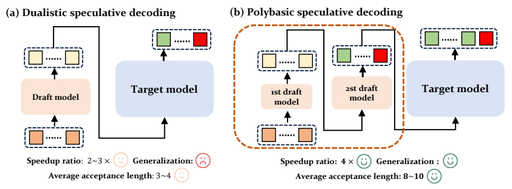
Figure 1 . Comparison of speculative decoding frameworks. (a) Traditional dualistic approach with a single draft model. (b) Our polybasic framework with multiple draft models achieves superior performance (4× speedup and 8-10 tokens acceptance length) while maintaining good generalization ability. The framework demonstrates significant improvements over the dualistic baseline.
원문 · CC BY 4.0 · Wang, Ruilin, Li, Huixia, Ma, Yuexiao, Zheng, Xiawu, Chao, Fei, Xiao, Xuefeng, Ji, Rongrong · Polybasic Speculative Decoding Through a Theoretical Perspective · 원문 그림 인용 · 원본 PDF 3쪽에서 그림 영역을 추출했습니다.모델 삽입 조건
새 모델을 두 모델 사이에 넣었을 때 추론 시간이 줄어드는지는 Theorem 3.2의 모델 삽입 효율 조건으로 판단합니다. 이 조건은 새 모델의 전방 계산 비용 Tnew가 해당 위치의 기존 비용에 비해 충분히 작고, 삽입으로 얻는 수락 길이 증가가 그 비용을 상쇄해야 한다는 형태입니다. 논문은 이를 세 모델 경우에 대해 차분 식으로 전개하여 증명하며, 여러 모델에 대해서는 삽입 지점 앞뒤의 모델을 복합 모델로 묶어 같은 조건으로 환원한다고 설명합니다.
샘플링 안정성 정리
논문은 speculative sampling을 사용할 때 수락 길이의 분산이 어떻게 결정되는지 Theorem 3.3으로 제시합니다. 수락 확률 pi=1-α를 가정하고 절단된 기하 분포의 기댓값과 이차 적률을 계산하여 분산 식을 도출합니다. 이 결과는 speculative sampling이 다중 모델 체인에서 수락 길이의 변동을 줄이는 근거로 사용됩니다. 다만 이는 제시된 확률 모형에서의 분산 식이며, 실제 분산 감소 효과는 아래 절제 실험에서 따로 확인됩니다.
삽입 정리의 실험 검증
Table 1의 세 사례는 삽입 조건이 실제 속도 변화와 맞는지 검증합니다. Case 1은 Vicuna-7B 타깃과 EAGLE2 기준 드래프터 사이에 Vicuna-1B를 넣은 경우로, Tnew/Ti가 0.80이고 수락 길이 개선 항이 0.117이어서 조건을 만족하지 않습니다. 이 경우 속도는 2.61×에서 1.08×로 떨어졌습니다. Case 2는 양자화된 Vicuna-7B(W4A16)를 넣은 경우로, Tnew/Ti가 0.318이고 개선 항이 0.330이어서 조건을 만족하며 속도는 2.61×에서 3.48×로 올랐습니다. Case 3은 CS Drafting 설정에서 FLAN-T5-base를 FLAN-T5-XXL과 FLAN-T5-small 사이에 넣은 재현 실험이며, Tnew/Ti가 0.403, 개선 항이 0.461로 조건을 만족하고 속도는 3.19×에서 3.88×로 올랐습니다.
이 세 결과는 같은 모델 계열이 아니라 서로 다른 기준선과 설정에서 얻은 것입니다.

Table 1 .Theoretical Validation via Model Insertion
원문 · CC BY 4.0 · Wang, Ruilin, Li, Huixia, Ma, Yuexiao, Zheng, Xiawu, Chao, Fei, Xiao, Xuefeng, Ji, Rongrong · Polybasic Speculative Decoding Through a Theoretical Perspective · 원문 그림 인용 · 원본 PDF 7쪽에서 그림 영역을 추출했습니다.다중 과제와 모델에서의 속도 향상
SpecBench의 여러 과제에서 폴리베이직 시스템의 속도 향상과 평균 수락 길이를 측정했습니다. 속도 향상은 표준 자기회귀 디코딩 대비 실제 디코딩 시간의 비율이며, 평균 수락 길이는 최종 모델이 forward pass마다 연속으로 수락한 토큰 수의 평균입니다. Vicuna-7B는 평균 3.16×, 수학 추론에서 최대 4.43×의 속도 향상을 보였다고 보고됩니다. 한편 Table 2의 Vicuna-7B 전체 평균 행은 3.48×와 평균 수락 길이 9.88을 보여 주며, 본문 평균 3.16×와 표의 전체 평균은 서로 다른 집계로 읽어야 합니다. LLaMA2-Chat 7B, LLaMA3-8B, Qwen2-7B에서도 최대 속도 향상이 보고되었으며, 요약 과제의 속도는 2.95×에서 3.41×로 상대적으로 낮았습니다.
이 결과는 배치 크기 1 설정에서 얻은 것입니다.
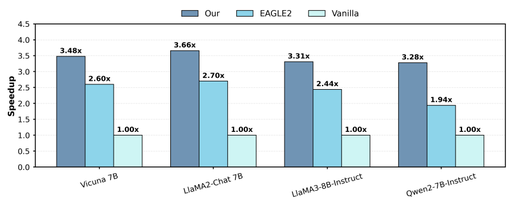
Figure 2 . Speedup ratios for Vicuna-7B, LLaMA2-Chat 7B, LLaMA3-8B-Instruct and Qwen2-7B-Instruct on SpecBench.Our polybasic system consistently achieves the highest speedups (3.16×–3.66×), surpassing EAGLE2 and vanilla baselines.
원문 · CC BY 4.0 · Wang, Ruilin, Li, Huixia, Ma, Yuexiao, Zheng, Xiawu, Chao, Fei, Xiao, Xuefeng, Ji, Rongrong · Polybasic Speculative Decoding Through a Theoretical Perspective · 원문 그림 인용 · 원본 PDF 8쪽에서 그림 영역을 추출했습니다.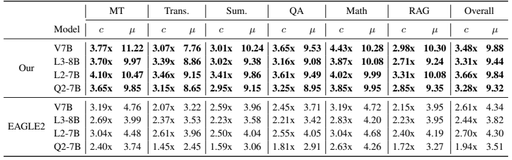
Table 2 . Average acceptance length (µ) and speedup ratio (c) on different tasks. V7B: Vicuna-7B, L3-8B: LLaMA3-8B-Instruct, L2-7B: LLaMA2-Chat-7B, Q2-7B: Qwen2-7B-Instruct.
원문 · CC BY 4.0 · Wang, Ruilin, Li, Huixia, Ma, Yuexiao, Zheng, Xiawu, Chao, Fei, Xiao, Xuefeng, Ji, Rongrong · Polybasic Speculative Decoding Through a Theoretical Perspective · 원문 그림 인용 · 원본 PDF 8쪽에서 그림 영역을 추출했습니다.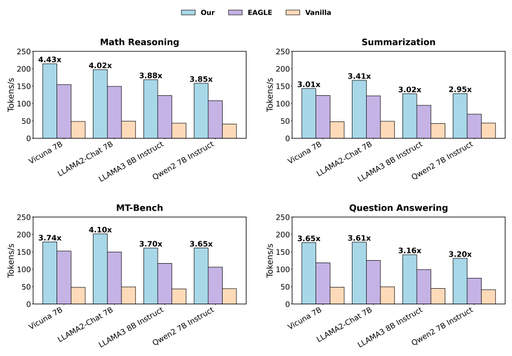
Figure 3 . Speedup by task.Our method excels in math tasks, reaching 4.43× with Vicuna-7B, while also maintaining strong accelerations in translation, QA, and multi-turn conversation.
원문 · CC BY 4.0 · Wang, Ruilin, Li, Huixia, Ma, Yuexiao, Zheng, Xiawu, Chao, Fei, Xiao, Xuefeng, Ji, Rongrong · Polybasic Speculative Decoding Through a Theoretical Perspective · 원문 그림 인용 · 원본 PDF 9쪽에서 그림 영역을 추출했습니다.대형 모델 확장과 한계
Vicuna-13B와 LLaMA-70B에서도 EAGLE 기준선과 비교했습니다. Vicuna-13B는 2.69×의 속도 향상과 8.62의 수락 길이를 보였고 EAGLE2의 2.30×보다 높았습니다. LLaMA-70B는 2.92×로 기준선 2.46×보다 높았습니다. 저자들은 대형 모델에서 검증 비용이 커져 드래프팅 이득을 일부 상쇄하므로 절대 속도 향상이 7B 모델보다 낮다고 해석합니다. 네 개 이상의 모델로 구성된 시스템은 현재 적합한 기성 모델을 찾기 어렵다고 설명하며, 제시된 삽입 효율 조건은 충분 조건이고 필요 조건이 아니라고 명시합니다. 긴 문맥에서는 모델별 KV 캐시가 커져 추가 오버헤드가 커질 수 있다고 논의됩니다.
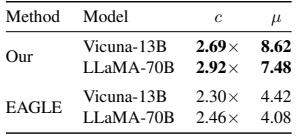
Table 3 . Speedup Ratios and Acceptance Lengths on Larger Mod- els
원문 · CC BY 4.0 · Wang, Ruilin, Li, Huixia, Ma, Yuexiao, Zheng, Xiawu, Chao, Fei, Xiao, Xuefeng, Ji, Rongrong · Polybasic Speculative Decoding Through a Theoretical Perspective · 원문 그림 인용 · 원본 PDF 8쪽에서 그림 영역을 추출했습니다.speculative sampling과 그리디 검증의 분산 비교
절제 실험은 세 모델 설정에서 50개의 질의를 실행해 수락 길이 분포를 기록하고, speculative sampling과 그리디 검증을 비교합니다. 결과는 그림 4의 분산으로 제시되며, speculative sampling이 그리디 검증보다 수락 길이의 분산이 작게 나타났다고 보고됩니다. 이 실험은 샘플링 안정성 정리와 같은 방향의 관찰이지만, 50개 질의와 한 설정에서 얻은 결과이므로 모든 과제에 대한 보편적 증명으로 읽지 않아야 합니다.
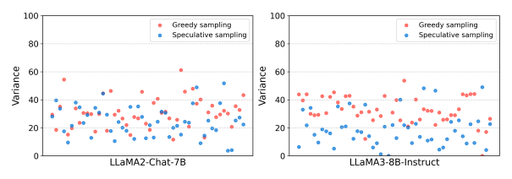
Figure 4 . Variance of acceptance length.Speculative sampling (blue) exhibits noticeably lower variance compared to greedy sampling (orange), aligning with our theoretical stability analysis.
원문 · CC BY 4.0 · Wang, Ruilin, Li, Huixia, Ma, Yuexiao, Zheng, Xiawu, Chao, Fei, Xiao, Xuefeng, Ji, Rongrong · Polybasic Speculative Decoding Through a Theoretical Perspective · 원문 그림 인용 · 원본 PDF 9쪽에서 그림 영역을 추출했습니다.논문 정보
- 저자
- Wang, Ruilin, Li, Huixia, Ma, Yuexiao, Zheng, Xiawu, Chao, Fei, Xiao, Xuefeng, Ji, Rongrong
- 학회·저널
- arXiv · 프리프린트
- 최초 공개일
- 2025년 10월 30일
- 등록일
- 2026년 10월 30일
- 수정일
- 2025년 10월 30일
- 버전
- v1
- arXiv
- 2510.26527
- 원문 이용 조건
- CC BY 4.0
- 제공 범위
- 논문 정보, 해설, 허용된 원문 그림
AI 해설은 논문 원문과 별개의 설명이며 오류가 있을 수 있습니다. 원문과 그림은 각 출처의 이용 조건과 따로 표시된 권리를 따릅니다.
초록
Inference latency stands as a critical bottleneck in the large-scale deployment of Large Language Models (LLMs). Speculative decoding methods have recently shown promise in accelerating inference without compromising the output distribution. However, existing work typically relies on a dualistic draft-verify framework and lacks rigorous theoretical grounding. In this paper, we introduce a novel \emph{polybasic} speculative decoding framework, underpinned by a comprehensive theoretical analysis. Specifically, we prove a fundamental theorem that characterizes the optimal inference time for multi-model speculative decoding systems, shedding light on how to extend beyond the dualistic approach to a more general polybasic paradigm. Through our theoretical investigation of multi-model token generation, we expose and optimize the interplay between model capabilities, acceptance lengths, and overall computational cost. Our framework supports both standalone implementation and integration with existing speculative techniques, leading to accelerated performance in practice. Experimental results across multiple model families demonstrate that our approach yields speedup ratios ranging from $3.31\times$ to $4.01\times$ for LLaMA2-Chat 7B, up to $3.87 \times$ for LLaMA3-8B, up to $4.43 \times$ for Vicuna-7B and up to $3.85 \times$ for Qwen2-7B -- all while preserving the original output distribution. We release our theoretical proofs and implementation code to facilitate further investigation into polybasic speculative decoding.
원문 인용
Wang, Ruilin, Li, Huixia, Ma, Yuexiao, Zheng, Xiawu, Chao, Fei, Xiao, Xuefeng, Ji, Rongrong (2025). Polybasic Speculative Decoding Through a Theoretical Perspective. arXiv:2510.26527v1. https://arxiv.org/abs/2510.26527v1
BibTeX
@misc{ruilin2025polybasic,
  title = {{Polybasic Speculative Decoding Through a Theoretical Perspective}},
  author = {Wang, Ruilin and Li, Huixia and Ma, Yuexiao and Zheng, Xiawu and Chao, Fei and Xiao, Xuefeng and Ji, Rongrong},
  year = {2025},
  eprint = {2510.26527},
  archivePrefix = {arXiv},
  url = {https://arxiv.org/abs/2510.26527v1}
}