논문 해설
Interpretable and Explainable Machine Learning for Materials Science and Chemistry
재료 과학 및 화학을 위한 해석 가능하고 설명 가능한 머신러닝
- 연구 문제 재료과학과 화학의 머신러닝은 예측 성능을 넘어 모델을 이해하고 과학적 통찰을 얻을 수 있어야 하며, 이 논문은 해석가능성과 설명가능성 기법을 정리합니다.
- 연구 방법 논문은 해석가능성, 완전성, 정확성의 절충 관계를 정의하고 내재적·외재적 해석, SHAP, 심층 학습의 살리언스와 어텐션 같은 기법을 재료과학 사례와 함께 설명합니다.
- 주요 결과 SHAP 분석은 페로브스카이트 태양전지 캡핑층 사례에서 상위 극성 표면적과 H-bond donor를 열화 시작 시간 예측의 주요 특성으로 보고합니다.
과학적 머신러닝에서 해석가능성이 필요한 이유
재료과학과 화학에서 머신러닝은 예측 성능을 넘어 과학적 통찰을 줄 수 있어야 합니다. 원문은 모델의 예측과 내부 작동이 사람이 이해할 수 있는 수준의 설명을 제공해야 모델의 한계를 찾고, 예측에 대한 신뢰를 쌓고, 과학적 발견으로 이어질 상관관계를 드러낼 수 있다고 강조합니다. 이 논문은 이러한 해석가능성과 설명가능성 기법을 재료과학과 화학 사례에 맞춰 정리합니다.
논문은 해석가능성을 모델이 설명을 제공해 사람이 작동을 이해할 수 있는 성질로 두고, 설명가능성은 해석가능성에 완전성이 더해진 개념으로 봅니다. 완전성은 설명이 실제 모델의 작동을 얼마나 정확히 반영하는지를 뜻합니다. 과학적 응용에서는 여기에 물리적·화학적 관점의 정확성이라는 세 번째 차원이 더해집니다.
해석 방식의 구분과 설명의 범위
원문은 해석을 모델 자체를 조사하는 내재적 해석과 입력에 대한 모델의 반응을 조사하는 외재적 해석으로 나눕니다. 내재적 해석은 구성에 따라 특정 알고리즘에 한정되며 주로 전역 설명을 제공합니다. 선형 회귀가 대표적인 예입니다. 외재적 해석은 주로 모델에 독립적이거나 귀납적 편향을 활용하며, 입력을 바꿔 보는 방식으로 국소 설명을 제공하는 경우가 많습니다.
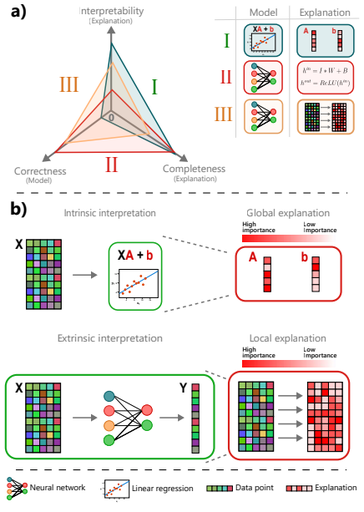
FIG. 1 . Key concepts a) Any explanation of a machine learning model has some inherent trade-offs to it. In partic- ular, any explanation should balance completeness, i.e. how well the given explanation approximates the operating mech- anisms of the actual model and interpretability, i.e. how well can a human subject understand the given explanation. In models that approximate real-world phenomena, we argue that a third dimension exists: correctness i.e. how correct a given explanation from the physical or chemical points of view. In the text, we explain the various trade-offs in more detail in examples I, II and III. b) Illustration of local/global explanations and intrinsic/extrinsic interpretability. In I) a linear model is a intrinsic interpretable model. By construc- tion, the vector coefficients A and b can be interpreted di- rectly, as represented by the color scale. In the same way, a linear model can be explained globally as both A and b are applied to all inputs X and have constant contributions for each input. II) A neural network requires extrinsic expla- nations. Due to its non-linear nature, interpretations of the model require observing the inputs along with the outputs. In the same way, a neural network model is better explained using local explanations: each input interacts in a different way with the model to generate specific outputs.
원문 · CC BY 4.0 · Felipe Oviedo, Juan Lavista Ferres, Tonio Buonassisi, Keith Butler · Interpretable and Explainable Machine Learning for Materials Science and Chemistry · 원문 그림 인용 · 원본 PDF 2쪽에서 그림 영역을 추출했습니다.심층 학습 모델은 수백만 개의 학습 파라미터와 비선형 변환을 사용하므로 구조를 직접 살펴보는 방식만으로는 작동을 이해하기 어렵다고 원문은 설명합니다. 따라서 심층 학습의 해석은 외재적 방법에서 얻어집니다. 원문은 고전 모델의 많은 외재적 방법도 심층 학습에 적용될 수 있다고 덧붙입니다.
SHAP 해석과 페로브스카이트 캡핑층 사례
SHAP 값은 모델 출력을 국소 선형 설명 모델로 근사하여 각 특성이 출력에 주는 국소 효과를 계수로 나타내는 방법입니다. 이 계수들을 합산하면 전역 특성 기여도를 얻을 수 있다고 원문은 설명합니다.
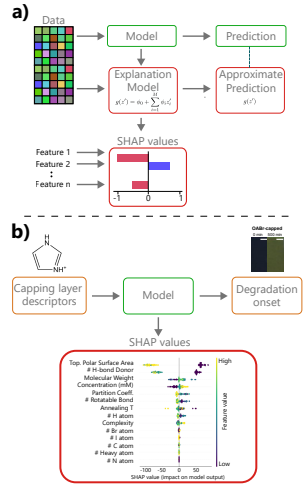
FIG. 2 . Interpretability with SHAP values (a) SHAP values are a generalization of various black-box explainability methods. SHAP values work by approximating the output of a model with a local linear explanation model. The coef- ficients of this explanation model quantify the local effect of each feature on the output. The coefficients can be aggre- gated to get global feature contributions. (b) Case study of SHAP analysis in material science [23]. A model is built to relate the physio-chemical descriptors of a capping layer of lead halide perovskite solar cells. Then, a machine learning model is trained to predict the onset time of degradation of the solar cells under ambient conditions. SHAP analysis al- lows to identify the dominant descriptors in the model, shown in the figures as a distribution of local SHAP values. Top po- lar surface area and H-bond donor have the most significant impact the output’s prediction and are demonstrated to have dominant importance by additional experimentation.
원문 · CC BY 4.0 · Felipe Oviedo, Juan Lavista Ferres, Tonio Buonassisi, Keith Butler · Interpretable and Explainable Machine Learning for Materials Science and Chemistry · 원문 그림 인용 · 원본 PDF 5쪽에서 그림 영역을 추출했습니다.원문의 사례에서는 연구자들이 할로젠화 납 페로브스카이트 태양전지 캡페이어의 물리화학적 기술자를 입력으로 삼고, 대기 조건에서 열화 시작 시간을 예측하는 머신러닝 모델을 학습했습니다. 이후 SHAP 분석으로 모델의 지배적인 기술자를 찾았고, 상위 극성 표면적과 H-bond donor가 예측에 가장 큰 영향을 주는 것으로 나타났습니다. 원문은 이 두 특성이 추가 실험으로도 중요성이 확인되었다고 보고합니다.
what-if 분석의 한계
부분 의존 그림은 한 특성을 바꿀 때 출력이 어떻게 변하는지를 다른 특성의 효과를 주변화하여 보여 줍니다. 원문은 이 방식이 교란 관계를 놓칠 수 있다고 지적합니다. 예를 들어 평균 원자량이 높아질 때 밀도가 높은 물질에서는 유전 응답이 커지고 다공성 물질에서는 줄어든다면, 이 두 효과가 부분 의존 그림에서 상쇄될 수 있습니다.
개별 조건부 기대 그림은 부분 의존 그림과 가깝지만 이러한 상호작용을 드러내도록 설계되었습니다. 원문은 SHAP 분석에도 한계가 있다고 설명합니다. 샘플링 과정이 상관된 특성의 비현실적 조합을 만들 수 있고, 특성 간 인과 방향을 나타내지 않기 때문입니다.
해석가능성과 인과성의 차이
원문은 해석가능성이 인과성과 같은 것이 아니라고 설명합니다. 머신러닝 모델이 물리 현상을 대략 근사하더라도 예측 변수의 영향력을 보여 줄 뿐이며, 그 자체로 인과 설명이 되지는 않습니다. 따라서 저자들은 물리적 통찰을 얻기 위해서는 해석 기법을 후속 실험이나 명시적 인과 모델링으로 보완해야 한다고 주장합니다.
이 관점에서 머신러닝 해석은 과학적 가설을 만들고 모델 예측을 이해하는 유용한 도구로 제시되며, 생성된 가설은 별도의 확인이 필요합니다.
논문 정보
- 저자
- Felipe Oviedo, Juan Lavista Ferres, Tonio Buonassisi, Keith Butler
- 학회·저널
- arXiv · 프리프린트
- 최초 공개일
- 2021년 11월 1일
- 등록일
- 2026년 11월 6일
- 수정일
- 2021년 11월 3일
- 버전
- v2
- arXiv
- 2111.01037
- DOI
- 10.1021/accountsmr.1c00244
- 분류
- cond-mat.mtrl-sci · cs.LG
- 원문 이용 조건
- CC BY 4.0
- 제공 범위
- 논문 정보, 해설, 허용된 원문 그림
AI 해설은 논문 원문과 별개의 설명이며 오류가 있을 수 있습니다. 원문과 그림은 각 출처의 이용 조건과 따로 표시된 권리를 따릅니다.
초록
While the uptake of data-driven approaches for materials science and chemistry is at an exciting, early stage, to realise the true potential of machine learning models for successful scientific discovery, they must have qualities beyond purely predictive power. The predictions and inner workings of models should provide a certain degree of explainability by human experts, permitting the identification of potential model issues or limitations, building trust on model predictions and unveiling unexpected correlations that may lead to scientific insights. In this work, we summarize applications of interpretability and explainability techniques for materials science and chemistry and discuss how these techniques can improve the outcome of scientific studies. We discuss various challenges for interpretable machine learning in materials science and, more broadly, in scientific settings. In particular, we emphasize the risks of inferring causation or reaching generalization by purely interpreting machine learning models and the need of uncertainty estimates for model explanations. Finally, we showcase a number of exciting developments in other fields that could benefit interpretability in material science and chemistry problems.
원문 인용
Felipe Oviedo, Juan Lavista Ferres, Tonio Buonassisi, Keith Butler (2021). Interpretable and Explainable Machine Learning for Materials Science and Chemistry. arXiv:2111.01037v2. https://doi.org/10.1021/accountsmr.1c00244
BibTeX
@article{oviedo2021interpretable,
  title = {{Interpretable and Explainable Machine Learning for Materials Science and Chemistry}},
  author = {Felipe Oviedo and Juan Lavista Ferres and Tonio Buonassisi and Keith Butler},
  year = {2021},
  eprint = {2111.01037},
  archivePrefix = {arXiv},
  doi = {10.1021/accountsmr.1c00244},
  url = {https://arxiv.org/abs/2111.01037v2}
}