논문 해설
FICE: Text-Conditioned Fashion Image Editing With Guided GAN Inversion
FICE: 가이드 GAN 인버전을 활용한 텍스트 조건 패션 이미지 편집
- 연구 문제 텍스트 설명만으로 패션 이미지를 편집하면서 포즈와 정체성을 보존하기는 어렵습니다.
- 연구 방법 FICE는 E4e 초기화, CLIP 의미 손실, DensePose 포즈 손실, 잠재 코드 정규화와 이미지·머리 영역 손실을 결합한 제약 GAN 역변환 뒤 이미지 스티칭을 수행합니다.
- 주요 결과 실험에서 FICE는 평가한 지표 전체에서 비교 기준보다 높은 평균을 보였으며, 특히 정체성 유사도와 포즈 보존에서 차이가 컸습니다.
텍스트로 패션 이미지를 편집하는 문제
기존 가상 피팅(Virtual Try-On) 방법은 목표 의상의 예시 이미지를 먼저 골라야 합니다. 이 논문은 예시 이미지 없이 자연어 설명만으로 입력 인물 이미지의 의상을 바꾸는 문제를 다룹니다. 텍스트 기반 편집은 예시 이미지가 필요 없고 다양한 시각 개념을 자연어로 표현할 수 있다는 장점이 있습니다. 그러나 기존 언어 기반 편집 방법은 풍부한 속성 주석이 필요하거나 단순한 설명만 처리할 수 있습니다.
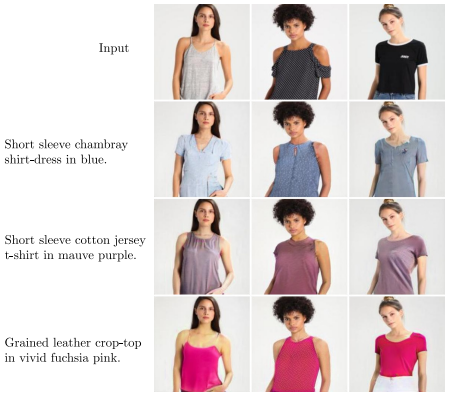
Fig. 1 : Fashion–image editing with language–based inputs. In this paper, we propose FICE (Fashion Image CLIP Editing), a text–conditioned image editing model, capable of handling a wide variety of text inputs with the goal of manipulating fashion images toward the desired target appearance.
원문 · CC BY 4.0 · Martin Pernuš, Clinton Fookes, Vitomir Štruc, Simon Dobrišek · FICE: Text-Conditioned Fashion Image Editing With Guided GAN Inversion · 원문 그림 인용 · 원본 PDF 1쪽에서 그림 영역을 추출했습니다.GAN 역변환(GAN inversion) 기반의 기존 텍스트 편집 방법을 패션 도메인에 그대로 적용하면 정체성 정보와 포즈가 크게 손상될 수 있고, 이는 재구성과 편집 가능성 사이의 상충 관계에서 비롯됩니다. 따라서 이 연구는 포즈와 정체성을 보존하면서 의상 의미를 텍스트로 바꾸는 편집 절차를 설계하는 데 초점을 둡니다.
제약 조건을 둔 GAN 역변환 절차
FICE는 세 단계로 작동합니다. 먼저 초기화 단계에서 인코더 E(E4e)가 입력 이미지 I에 대응하는 초기 잠재 코드 w를 계산하고, DensePose와 분할 마스크를 함께 구합니다. 다음으로 제약 GAN 역변환 단계에서 잠재 코드 w를 사전 학습된 StyleGANv2 생성기 G에 넣어 중간 이미지 Ig=G(w)를 만들고, 이를 기준으로 목적 함수 L을 최소화하여 w*를 구합니다. 마지막 이미지 스티칭 단계에서는 최적화된 이미지 I*g와 원본 I를 머리 영역 마스크로 합성하여 최종 출력 If를 얻습니다.
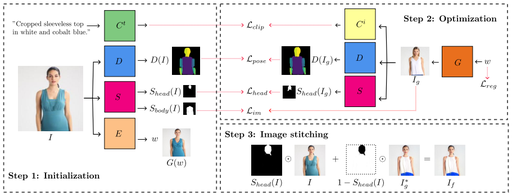
Fig. 2 : High-level overview of the proposed FICE editing model . The model uses a constrained GAN inversion procedure over the latent space of the pretrained StyleGANv2 model G to incorporate the semantics expressed in the provided text description into the output image Ig. Here, the optimization–based GAN inversion is performed by enforcing: (i) the presence of semantic content (determined by the image–text association model C), (ii) pose preservation (ensured by the pose parser D), (iii) image consistency (through the segmentation model S), and (iv) latent code regularization. An image stitching step is also incorporated into FICE to improve the image fidelity and further enhance the model’s identity preservation capabilities.
원문 · CC BY 4.0 · Martin Pernuš, Clinton Fookes, Vitomir Štruc, Simon Dobrišek · FICE: Text-Conditioned Fashion Image Editing With Guided GAN Inversion · 원문 그림 인용 · 원본 PDF 4쪽에서 그림 영역을 추출했습니다.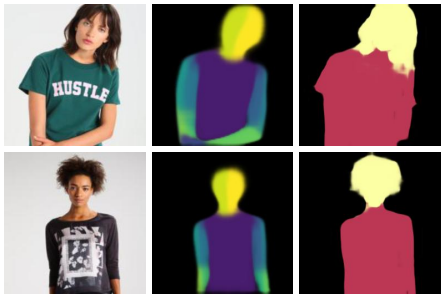
Fig. 3 : Sample images parsed withD andS. The DensePose modelD generates a parsed body representation consisting of 24 body parts in a clothing agnostic manner. The segmentation modelS, on the other hand, parses the input image into three classes: head (with hair), body (with clothing) and background.
원문 · CC BY 4.0 · Martin Pernuš, Clinton Fookes, Vitomir Štruc, Simon Dobrišek · FICE: Text-Conditioned Fashion Image Editing With Guided GAN Inversion · 원문 그림 인용 · 원본 PDF 5쪽에서 그림 영역을 추출했습니다.목적 함수는 CLIP 기반 의미 손실 Lclip=1−cos(Ci(Ig),Ct(t)), 포즈 보존 손실 Lpose, 잠재 코드 정규화 손실 Lreg, 이미지 손실 Lim과 머리 영역 손실 Lhead의 가중합입니다. Lclip은 생성 이미지와 텍스트 임베딩 사이의 각도 차이를 줄여 텍스트 의미를 반영합니다. Lpose는 DensePose 예측의 차이를 줄이고, Lreg는 가장 거친 잠재 코드와 나머지 계층 잠재 코드 사이의 거리를 줄입니다. 원문은 가중치를 λclip=1, λim=30, λpose=10, λhead=1, λreg=1로 설명하며, 최적화는 500회 반복으로 고정되었습니다.
실험 구성과 비교 기준
FICE의 생성기는 VITON 학습 분할로 학습되었고, 평가에는 VITON 공식 테스트 세트의 첫 120장이 사용되었습니다. 텍스트는 Fashion-Gen의 상의 카테고리에서 CLIP 매칭 점수가 높은 120개 문장을 골랐으며, 테스트 이미지와 텍스트를 모두 조합하여 120×120=14,400개 조합을 만들었습니다. 분할 모델 S는 DeepFashion의 일부 이미지로 학습되었습니다.

원문 그림 TABLE I: Overview of the fashion datasets used in the paper. Three different datasets are selected for the experiments and used to train and test various components of FICE.
원문 · CC BY 4.0 · Martin Pernuš, Clinton Fookes, Vitomir Štruc, Simon Dobrišek · FICE: Text-Conditioned Fashion Image Editing With Guided GAN Inversion · 원문 그림 인용 · 원본 PDF 6쪽에서 그림 영역을 추출했습니다.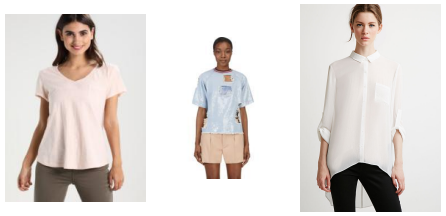
Fig. 4 : Sample images from the experimental datasets. We train and test FICE with fashion images from the VITON, Fashion-Gen and DeepFashion datasets.
원문 · CC BY 4.0 · Martin Pernuš, Clinton Fookes, Vitomir Štruc, Simon Dobrišek · FICE: Text-Conditioned Fashion Image Editing With Guided GAN Inversion · 원문 그림 인용 · 원본 PDF 7쪽에서 그림 영역을 추출했습니다.비교 기준은 StyleCLIP의 전역 편집을 결합한 GAN 역변환 방법들입니다. 비교 대상은 pSp, E4e, 두 가지 ReStyle, HyperStyle이며, StyleCLIP의 (α,β) 조합은 각 방법마다 의미 관련성 점수를 가장 높이는 값으로 선택되었습니다. 평가 지표는 CLIP 유사도 기반의 의미 관련성, DensePose 기반 IoU, ArcFace 기반 정체성 유사도, FID입니다.
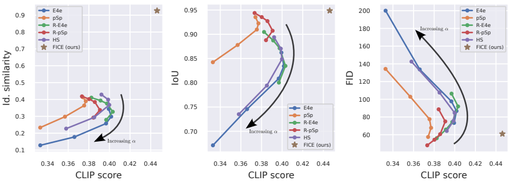
Fig. 9 : Fine-grained comparison across multiple hyperparameter values. For the StyleCLIP based models, we consider the β value of the best-performing (α,β ) combination and α∈{ 3.0, 4.0, 5.0, 7.5, 10.0}. Increasing α generally increases the semantic–relevance score, but above a certain point degrades the results.
원문 · CC BY 4.0 · Martin Pernuš, Clinton Fookes, Vitomir Štruc, Simon Dobrišek · FICE: Text-Conditioned Fashion Image Editing With Guided GAN Inversion · 원문 그림 인용 · 원본 PDF 11쪽에서 그림 영역을 추출했습니다.비교 결과와 절제 실험
비교 실험에서 FICE는 평가한 모든 지표에서 경쟁 방법보다 높은 평균을 보였다고 원문은 보고합니다. 표 II에서 FICE의 의미 관련성은 0.446, 정체성 유사도는 0.926, IoU는 0.949, FID는 60.96입니다. 같은 표에서 가장 높은 의미 관련성을 보인 기준은 e4e의 0.402이며, 정체성 유사도가 가장 높은 기준은 pSp로 0.390입니다. 이 점수들은 각 방법의 최고 의미 관련성 설정에서 얻은 값이며 StyleCLIP 설정의 적용 범위 안에서 읽어야 합니다.
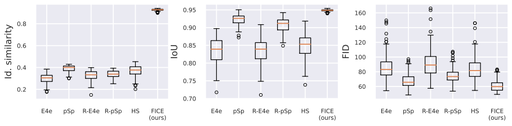
Fig. 8 : Boxplots of different performance indicators for the tested editing models. The competing models were tested with hyperparameter settings that resulted in the highest semantic–relevance score to ensure a fair comparison. Results are reported in terms of variation over the text descriptions. The individual scores are obtained by averaging over all images for a given text description. We observe that FICE performs best across all performance indices, while ensuring the most consistent results.
원문 · CC BY 4.0 · Martin Pernuš, Clinton Fookes, Vitomir Štruc, Simon Dobrišek · FICE: Text-Conditioned Fashion Image Editing With Guided GAN Inversion · 원문 그림 인용 · 원본 PDF 11쪽에서 그림 영역을 추출했습니다.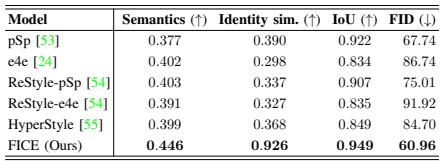
원문 그림 TABLE II: Quantitative comparison. FICE is compared to several competing techniques and across four difference performance indicators. The arrows denote whether higher or lower scores imply better performance.
원문 · CC BY 4.0 · Martin Pernuš, Clinton Fookes, Vitomir Štruc, Simon Dobrišek · FICE: Text-Conditioned Fashion Image Editing With Guided GAN Inversion · 원문 그림 인용 · 원본 PDF 12쪽에서 그림 영역을 추출했습니다.절제 실험에서는 잠재 공간과 초기화를 바꾸어 비교했습니다. 표 III에서 W+ 공간과 E4e 초기화를 함께 쓴 FICE의 의미 관련성은 0.446으로, 평균 초기화와 W 공간을 쓴 경우 0.422보다 높습니다. 손실 절제에서는 의미 항만 쓴 경우 정체성 유사도가 0.819로 낮았으며, 합성 항을 추가하자 0.924로 높아졌습니다. 포즈 보존 항을 추가한 완전한 FICE는 IoU를 0.884에서 0.949로 높였습니다. 다만 포즈 항은 의미 관련성을 0.450에서 0.446으로 조금 낮춥니다.
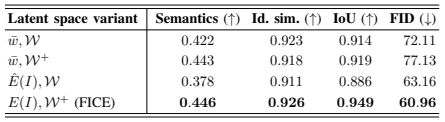
원문 그림 TABLE III: Ablation study w.r.t. latent spaces. We analyze the choice of the latent space (vanilla W and extendedW +) as well as the procedure for initializing the latent code w.
원문 · CC BY 4.0 · Martin Pernuš, Clinton Fookes, Vitomir Štruc, Simon Dobrišek · FICE: Text-Conditioned Fashion Image Editing With Guided GAN Inversion · 원문 그림 인용 · 원본 PDF 12쪽에서 그림 영역을 추출했습니다.처리 시간과 텍스트 의미의 한계
저자들이 밝힌 한계는 두 가지입니다. 첫째, CLIP이 처리할 수 있는 텍스트 길이는 byte-pair encoding 기준 76개 토큰으로 제한됩니다. 둘째, FICE는 기울기 기반 최적화를 사용하므로 20장씩 묶어 처리하더라도 RTX 3090에서 이미지당 평균 약 16초가 걸린다고 보고됩니다. 같은 문단은 인코더 기반 방법이 잠재 코드를 1초 미만에 얻을 수 있다고 비교합니다.
또한 긴 텍스트나 옷에 그려진 물체·로고에 대한 세부 묘사는 제대로 생성하지 못하는 경우가 있다고 원문은 보고합니다. 그림 12의 해골 그래픽, 번개 무늬, 대성당 로고 예시가 이를 보여줍니다. 소매 길이도 일부 사례에서 어려움을 보였습니다. 저자들은 이를 제한된 GAN 합성 능력과 CLIP의 지식 한계의 결합으로 추정하고, 패션 텍스트-이미지 데이터로 CLIP을 미세 조정하는 방안을 제안합니다.
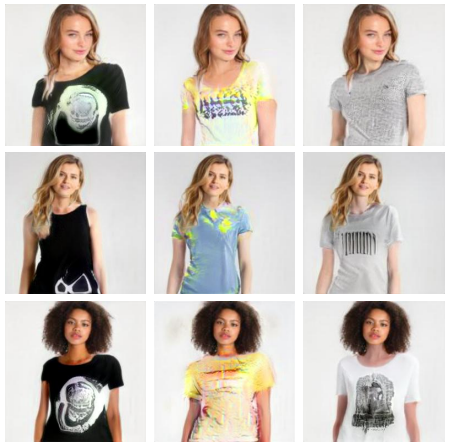
Fig. 12 : Illustration of FICE limitations. When presented with text descriptions involving objects and specific logos to be shown on the garment, the model is only capable of generating approximate results. In the presented examples, the model fails to produce a convincing skull graphic (left column), a lightning bolt (middle column) or a cathedral (right column).
원문 · CC BY 4.0 · Martin Pernuš, Clinton Fookes, Vitomir Štruc, Simon Dobrišek · FICE: Text-Conditioned Fashion Image Editing With Guided GAN Inversion · 원문 그림 인용 · 원본 PDF 13쪽에서 그림 영역을 추출했습니다.논문 정보
- 저자
- Martin Pernuš, Clinton Fookes, Vitomir Štruc, Simon Dobrišek
- 학회·저널
- arXiv · 프리프린트
- 최초 공개일
- 2023년 1월 5일
- 등록일
- 2026년 11월 6일
- 수정일
- 2023년 1월 5일
- 버전
- v1
- arXiv
- 2301.02110
- 분류
- cs.CV · cs.AI · cs.LG
- 원문 이용 조건
- CC BY 4.0
- 제공 범위
- 논문 정보, 해설, 허용된 원문 그림
AI 해설은 논문 원문과 별개의 설명이며 오류가 있을 수 있습니다. 원문과 그림은 각 출처의 이용 조건과 따로 표시된 권리를 따릅니다.
초록
Fashion-image editing represents a challenging computer vision task, where the goal is to incorporate selected apparel into a given input image. Most existing techniques, known as Virtual Try-On methods, deal with this task by first selecting an example image of the desired apparel and then transferring the clothing onto the target person. Conversely, in this paper, we consider editing fashion images with text descriptions. Such an approach has several advantages over example-based virtual try-on techniques, e.g.: (i) it does not require an image of the target fashion item, and (ii) it allows the expression of a wide variety of visual concepts through the use of natural language. Existing image-editing methods that work with language inputs are heavily constrained by their requirement for training sets with rich attribute annotations or they are only able to handle simple text descriptions. We address these constraints by proposing a novel text-conditioned editing model, called FICE (Fashion Image CLIP Editing), capable of handling a wide variety of diverse text descriptions to guide the editing procedure. Specifically with FICE, we augment the common GAN inversion process by including semantic, pose-related, and image-level constraints when generating images. We leverage the capabilities of the CLIP model to enforce the semantics, due to its impressive image-text association capabilities. We furthermore propose a latent-code regularization technique that provides the means to better control the fidelity of the synthesized images. We validate FICE through rigorous experiments on a combination of VITON images and Fashion-Gen text descriptions and in comparison with several state-of-the-art text-conditioned image editing approaches. Experimental results demonstrate FICE generates highly realistic fashion images and leads to stronger editing performance than existing competing approaches.
원문 인용
Martin Pernuš, Clinton Fookes, Vitomir Štruc, Simon Dobrišek (2023). FICE: Text-Conditioned Fashion Image Editing With Guided GAN Inversion. arXiv:2301.02110v1. https://arxiv.org/abs/2301.02110v1
BibTeX
@misc{pernu2023fice,
  title = {{FICE: Text-Conditioned Fashion Image Editing With Guided GAN Inversion}},
  author = {Martin Pernuš and Clinton Fookes and Vitomir Štruc and Simon Dobrišek},
  year = {2023},
  eprint = {2301.02110},
  archivePrefix = {arXiv},
  url = {https://arxiv.org/abs/2301.02110v1}
}