논문 해설
Calibrated Multi-Preference Optimization for Aligning Diffusion Models
확산 모델 정렬을 위한 보정된 다중 선호 최적화
- 연구 문제 사람 주석 선호 데이터 없이 확산 모델을 정렬하려면 보상 값을 그대로 쓸 때 과최적화가 생기고, 여러 보상이 충돌하는 상황을 다루기 어렵습니다.
- 연구 방법 CaPO는 샘플 간 쌍별 승률 평균으로 보상을 calibration하고, 선택된 쌍의 차이를 회귀 손실로 맞춥니다. 다중 보상에서는 Pareto frontier 기반으로 쌍을 선택합니다.
- 주요 결과 원문 실험에서 CaPO는 단일 보상 설정에서 DPO와 IPO보다 높은 승률을 보였고, 다중 보상에서는 FRS가 SUM보다 일관되게 높은 결과를 보고합니다.
사람 선호 데이터 없이 확산 모델을 정렬하는 문제
텍스트-이미지 확산 모델을 사람의 선호에 맞추는 Direct Preference Optimization 계열 방법은 사람이 주석한 쌍별 선호 데이터에 크게 의존합니다. 원문은 이 데이터 수집 비용이 확장성을 제한한다고 짚습니다. 보상 모델을 사용하면 사람 주석 없이 선호 신호를 얻을 수 있지만, 보상 값을 그대로 최적화하면 보상이 잘 보정되지 않았을 때 과최적화와 reward hacking이 생길 위험이 있습니다.
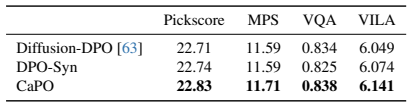
Table 4 .Comparison with Diffusion-DPO [ 63].We compare CaPO with Diffusion-DPO, which is trained on human annotated preference dataset Pick-a-pic [28]. For fair comparison, we train CaPO with same prompts from Pick-a-pic, but trained with gen- erated images from SDXL. Also, we use Pickscore [28], which is trained on Pick-a-pic dataset. We also train DPO for our synthetic dataset, denoted as DPO-Syn. We report Pickscore, MPS, VQAs- core, and VILA score by generating images from Parti prompts.
원문 · CC BY 4.0 · Kyungmin Lee, Xiaohang Li, Qifei Wang, Junfeng He, Junjie Ke, Ming-Hsuan Yang, Irfan Essa, Jinwoo Shin, Feng Yang, Yinxiao Li · Calibrated Multi-Preference Optimization for Aligning Diffusion Models · 원문 그림 인용 · 원본 PDF 8쪽에서 그림 영역을 추출했습니다.또한 기존 방법은 주로 쌍별 선호 분포만 고려하며, 여러 보상이 서로 일관되지 않을 때 다중 선호 상황을 다루기 어렵다고 원문은 설명합니다. 이 연구는 사전 학습된 모델이 생성한 샘플과 여러 보상 모델의 점수만으로 이 두 문제를 함께 다룹니다.
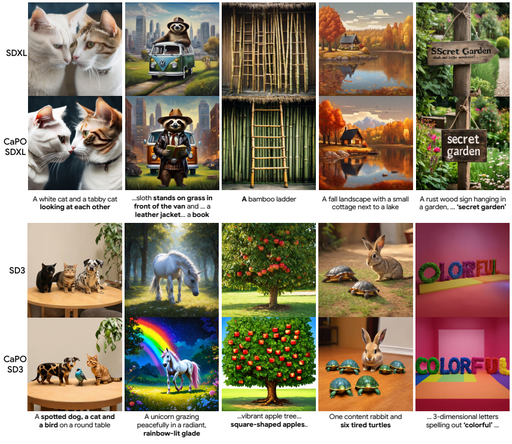
Figure 1 . Calibrated Preference Optimization (CaPO) improves the performance of diffusion models by optimizing the model with diverse reward signals. The top and bottom groups are using SDXL and SD3-medium, respectively. For each group, the first row is from base model and the second row is applying CaPO to the base model. CaPO tends to generate images of higher quality (e.g., image aestheticism, text rendering), and better prompt alignment (e.g., compositional generation), without using any human preference dataset.
원문 · CC BY 4.0 · Kyungmin Lee, Xiaohang Li, Qifei Wang, Junfeng He, Junjie Ke, Ming-Hsuan Yang, Irfan Essa, Jinwoo Shin, Feng Yang, Yinxiao Li · Calibrated Multi-Preference Optimization for Aligning Diffusion Models · 원문 그림 인용 · 원본 PDF 2쪽에서 그림 영역을 추출했습니다.Calibrated reward와 CaPO 손실
CaPO는 보상 값을 직접 쓰지 않고, 같은 프롬프트에서 생성된 N개 샘플 사이의 쌍별 승률을 평균한 calibrated reward로 바꿉니다. 원문 식 (7)은 샘플 i의 calibrated reward를 다른 N-1개 샘플 j에 대한 시그모이드 승률의 평균으로 정의합니다. 원문은 N이 충분히 크면 이 값이 기대 승률 P(x ≻ p_ref|c)에 근사한다고 명시합니다.
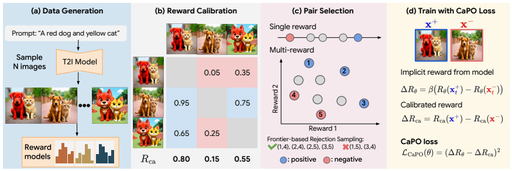
Figure 2 .Overview. (a) We generate N images using pretrained T2I diffusion model using the prompt dataset, and infer the scores from reward models. (b) Then, we calibrate the rewards by making pairwise comparison between images. For each image, we compute the win-rates between other N−1 images using Eq. (2), and average them to obtain calibrated reward Rca (see Sec. 4.2). (c) We select pair by choosing the best-of-N and worst-of-N when using single reward. For multi-reward, we use non-dominated sorting algorithm to select upper Pareto set as positives, and lower Pareto set as negatives. The accepted and rejected pairs are also listed using proposed rejection sampling method. (d) Lastly, during training, we select a pair from (c), and compute CaPO loss (i.e., Eq. (8)), which perform regression task to match the difference in calibrated rewards,i.e.,∆R ca by the difference of implicit reward model∆R θ.
원문 · CC BY 4.0 · Kyungmin Lee, Xiaohang Li, Qifei Wang, Junfeng He, Junjie Ke, Ming-Hsuan Yang, Irfan Essa, Jinwoo Shin, Feng Yang, Yinxiao Li · Calibrated Multi-Preference Optimization for Aligning Diffusion Models · 원문 그림 인용 · 원본 PDF 3쪽에서 그림 영역을 추출했습니다.학습 목적은 선택된 쌍의 calibrated reward 차이를 확산 모델의 암묵 보상 차이에 맞추는 회귀 손실입니다. 원문 식 (8)은 두 calibrated reward 차이와 β 배 된 모델 쪽 차이의 차이를 제곱하는 형태입니다. 원문은 이 손실이 IPO의 특수한 일반화로 설명되며, 목표 차이를 고정 1로 두지 않고 쌍마다 동적으로 정한다고 말합니다.
Frontier 기반 쌍 선택
단일 보상에서는 가장 높은 점수의 샘플을 양성으로, 가장 낮은 점수의 샘플을 음성으로 고르는 방식이 자연스럽습니다. 여러 보상에서는 가중합을 쓰는 방법이 가중치 선택에 휴리스틱이 필요하다는 문제가 있습니다.
원문이 제안하는 frontier 기반 rejection sampling은 비지배 정렬 알고리즘으로 상위 Pareto 집합을 양성 집합 X+(c), 하위 집합을 음성 집합 X−(c)로 구성합니다. 한 샘플이 다른 샘플을 지배한다는 것은 모든 보상 j에서 calibrated reward가 크거나 같다는 조건으로 정의됩니다. 이후 양성과 음성 집합에서 각각 샘플을 뽑아 쌍을 만들고, 여러 보상의 calibrated reward 평균을 최적화 목표로 삼아 CaPO 손실로 갱신합니다.
단일 및 다중 보상 실험 설정
단일 보상 실험은 MPS, VQAscore, VILA를 각각 학습 보상으로 사용하고, 최고와 최저 샘플 쌍을 선택해 DPO와 IPO와 비교합니다. 평가는 SDXL에는 Parti 프롬프트를, SD3-M에는 DPG-bench 프롬프트를 사용하며 기본 모델 대비 승률을 보고합니다.
다중 보상 실험에서는 MPS, VQAscore, VILA를 함께 사용합니다. 비교군은 보상 합산 방식(SUM)과 단일 보상으로 학습한 모델을 가중 병합하는 model soup(SOUP)이며, 제안 방법은 frontier 기반 rejection sampling(FRS)입니다. 원문은 SOUP에서 단일 보상 모델을 구면 선형 보간으로 병합하고 세 모델에 균등 가중치를 준다고 설명합니다.
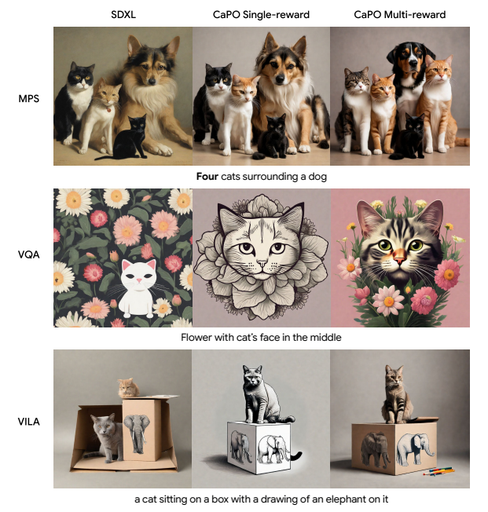
Figure 7 .Effect of multi-reward CaPO. We demonstrate the qualitative comparison between CaPO with single-reward with each MPS, VQAscore, and VILA, and CaPO with multi-reward on SDXL. We see that optimizing with single-reward improves upon the base model, yet multi-reward CaPO shows the best overall improvement. For example, while using VQAscore alone improves the image-text alignment, the image aesthetics are significantly improved when using multi-reward. Also, when using VILA score, the image aesthetics improve, but it often lose the image-text alignment (e.g., the image becomes drawing style, while only the elephant should be in a drawing style).
원문 · CC BY 4.0 · Kyungmin Lee, Xiaohang Li, Qifei Wang, Junfeng He, Junjie Ke, Ming-Hsuan Yang, Irfan Essa, Jinwoo Shin, Feng Yang, Yinxiao Li · Calibrated Multi-Preference Optimization for Aligning Diffusion Models · 원문 그림 인용 · 원본 PDF 16쪽에서 그림 영역을 추출했습니다.주요 비교 결과와 적용 범위
단일 보상 실험에서 원문 Tab. 1은 각 보상으로 미세조정한 설정에서 CaPO가 DPO와 IPO보다 기본 모델 대비 승률이 높다고 보고합니다. 원문은 VILA로 학습했을 때 DPO가 VQAscore에서 크게 떨어지는 반면 CaPO는 VILA 점수에서 DPO와 비슷하거나 더 높다고 설명합니다.
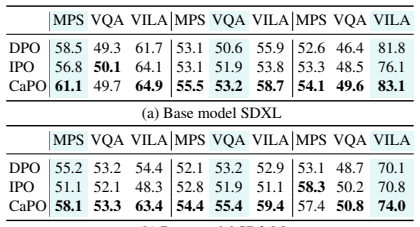
Table 1 . Single reward results. We report the win-rate (%) over base model by using automatic evaluation with each reward model. We use Parti prompts [69] and DPG-bench prompts [20] to generate images for each SDXL, and SD3-M models, respectively. We highlight the column to indicate the rewards used for fine-tuning.
원문 · CC BY 4.0 · Kyungmin Lee, Xiaohang Li, Qifei Wang, Junfeng He, Junjie Ke, Ming-Hsuan Yang, Irfan Essa, Jinwoo Shin, Feng Yang, Yinxiao Li · Calibrated Multi-Preference Optimization for Aligning Diffusion Models · 원문 그림 인용 · 원본 PDF 5쪽에서 그림 영역을 추출했습니다.다중 보상 실험인 Tab. 2에서는 FRS가 SUM보다 DPO와 IPO 목적 함수 모두에서 일관되게 높다고 보고됩니다. CaPO와 FRS를 함께 쓴 설정은 SOUP보다 높은 승률과 평균 점수를 보입니다. 다만 이 비교는 SDXL과 SD3-M, 각 설정의 승률과 평균 점수 지표에 대한 것입니다.
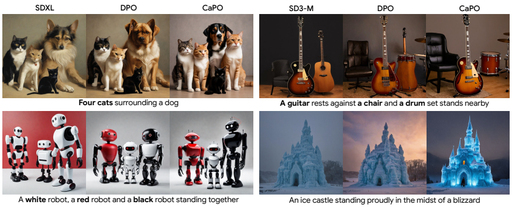
Figure 3 .Qualitative comparison. We present qualitative comparison of using multiple rewards using our frontier rejection sampling method when fine-tuning with CaPO objective.
원문 · CC BY 4.0 · Kyungmin Lee, Xiaohang Li, Qifei Wang, Junfeng He, Junjie Ke, Ming-Hsuan Yang, Irfan Essa, Jinwoo Shin, Feng Yang, Yinxiao Li · Calibrated Multi-Preference Optimization for Aligning Diffusion Models · 원문 그림 인용 · 원본 PDF 6쪽에서 그림 영역을 추출했습니다.한계와 확인되지 않은 범위
원문은 CaPO가 오프라인으로 생성한 데이터에 기반하므로 수렴이 느릴 수 있다고 밝히며, 온라인 학습으로의 확장을 향후 과제로 남깁니다. 또한 SDXL처럼 기반 모델의 능력에 묶인 개선, 예를 들어 텍스트 렌더링 향상은 어렵다고 설명합니다.
벤치마크 비교에서 SDXL과 SD3-M은 더 큰 최신 모델들과 직접 같은 조건이 아니며, 원문도 그 비교가 공정하지 않다고 명시합니다. 따라서 결과는 제시된 프롬프트, 보상 모델, 비교군 안에서 읽어야 합니다.
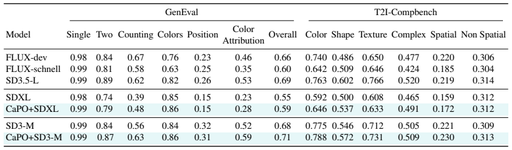
Table 3 .T2I Benchmarks evaluation.We compare the benchmark results of CaPO-SDXL and CaPO-SD3-M on text-to-image benchmarks, e.g., GenEval [16] and T2I-Compbench [21], with various open-source state-of-the-art models (e.g., Flux-dev [29], and Flux-schnell [29], and SE3.5-L [11]). We observe that with CaPO, the majority of evaluation metrics for SDXL and SD3-M show improvement. For comparison, we also include the most recent three image generation models, which are 3×larger compared to SDXL and SD3-M.
원문 · CC BY 4.0 · Kyungmin Lee, Xiaohang Li, Qifei Wang, Junfeng He, Junjie Ke, Ming-Hsuan Yang, Irfan Essa, Jinwoo Shin, Feng Yang, Yinxiao Li · Calibrated Multi-Preference Optimization for Aligning Diffusion Models · 원문 그림 인용 · 원본 PDF 7쪽에서 그림 영역을 추출했습니다.논문 정보
- 저자
- Kyungmin Lee, Xiaohang Li, Qifei Wang, Junfeng He, Junjie Ke, Ming-Hsuan Yang, Irfan Essa, Jinwoo Shin, Feng Yang, Yinxiao Li
- 학회·저널
- arXiv · 프리프린트
- 최초 공개일
- 2025년 2월 4일
- 등록일
- 2026년 11월 5일
- 수정일
- 2025년 9월 26일
- 버전
- v3
- arXiv
- 2502.02588
- 분류
- cs.CV
- 원문 이용 조건
- CC BY 4.0
- 제공 범위
- 논문 정보, 해설, 허용된 원문 그림
AI 해설은 논문 원문과 별개의 설명이며 오류가 있을 수 있습니다. 원문과 그림은 각 출처의 이용 조건과 따로 표시된 권리를 따릅니다.
초록
Aligning text-to-image (T2I) diffusion models with preference optimization is valuable for human-annotated datasets, but the heavy cost of manual data collection limits scalability. Using reward models offers an alternative, however, current preference optimization methods fall short in exploiting the rich information, as they only consider pairwise preference distribution. Furthermore, they lack generalization to multi-preference scenarios and struggle to handle inconsistencies between rewards. To address this, we present Calibrated Preference Optimization (CaPO), a novel method to align T2I diffusion models by incorporating the general preference from multiple reward models without human annotated data. The core of our approach involves a reward calibration method to approximate the general preference by computing the expected win-rate against the samples generated by the pretrained models. Additionally, we propose a frontier-based pair selection method that effectively manages the multi-preference distribution by selecting pairs from Pareto frontiers. Finally, we use regression loss to fine-tune diffusion models to match the difference between calibrated rewards of a selected pair. Experimental results show that CaPO consistently outperforms prior methods, such as Direct Preference Optimization (DPO), in both single and multi-reward settings validated by evaluation on T2I benchmarks, including GenEval and T2I-Compbench.
원문 인용
Kyungmin Lee, Xiaohang Li, Qifei Wang, Junfeng He, Junjie Ke, Ming-Hsuan Yang, Irfan Essa, Jinwoo Shin, Feng Yang, Yinxiao Li (2025). Calibrated Multi-Preference Optimization for Aligning Diffusion Models. arXiv:2502.02588v3. https://arxiv.org/abs/2502.02588v3
BibTeX
@misc{lee2025calibrated,
  title = {{Calibrated Multi-Preference Optimization for Aligning Diffusion Models}},
  author = {Kyungmin Lee and Xiaohang Li and Qifei Wang and Junfeng He and Junjie Ke and Ming-Hsuan Yang and Irfan Essa and Jinwoo Shin and Feng Yang and Yinxiao Li},
  year = {2025},
  eprint = {2502.02588},
  archivePrefix = {arXiv},
  url = {https://arxiv.org/abs/2502.02588v3}
}