논문 해설
The Optimal Rate Constant of Heavy-Ball Momentum on Smooth Strongly Convex Functions
매끄럽고 강볼록한 함수에서 헤비볼 모멘텀의 최적 비율 상수
- 연구 문제 상수 파라미터 heavy-ball이 smooth strongly convex 함수에서 달성할 수 있는 최악 수렴률 상수를 구하는 문제입니다.
- 연구 방법 하한은 감쇠 나선을 구성하고, 상한은 명시적 튜닝과 Lyapunov 함수로 증명합니다.
문제 설정: 상수 파라미터 heavy-ball의 최적 수렴률
Heavy-ball 방법은 상수 스텝 크기와 상수 모멘텀 파라미터로 이차함수에서는 경사하강법을 가속하지만, smooth strongly convex 함수 클래스 F_{μ,L}에서는 어떤 튜닝도 가속을 보장하지 못한다는 것이 알려져 있습니다. 본 논문은 조건수 κ=L/μ에 대해 최적 튜닝의 최악 수렴률을 1−c(κ)/κ로 쓰고, 이때 c(κ)가 얼마나 커질 수 있는지를 묻습니다. 원문은 경사하강법의 하한 c(κ)≥2κ/(κ+1)과 비가속성이 주는 c(κ)의 유계성을 함께 제시하며, 정확한 극한이 열린 문제였다고 밝힙니다.
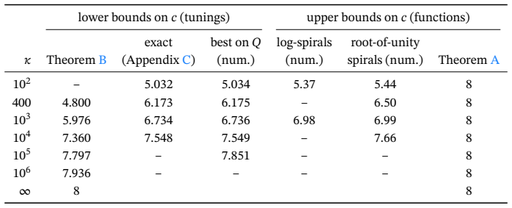
Table 2 :Bounds on𝑐(𝜅) =𝜅(1−𝜌 ⋆(𝜅)) for𝑑≥2 . Lower bounds on𝑐 come from tunings, and upper boundsfromfunctionsthatsloweverytuningdown.Lowerboundsareroundeddownandupperbounds up.Thecolumnsmarked“num.”arefloatingpoint.
원문 · CC BY 4.0 · Marcos Hernanz · The Optimal Rate Constant of Heavy-Ball Momentum on Smooth Strongly Convex Functions · 원문 그림 인용 · 원본 PDF 24쪽에서 그림 영역을 추출했습니다.하한과 상한 증명의 구조
하한 정리는 어떤 튜닝이든 d≥2에서 ρ≥1−8/κ가 성립함을 보입니다. 튜닝이 이차함수에서 1−8/κ보다 빠르면, 그 튜닝은 두 변수 함수 위에서 감쇠하는 나선 x_t=r^t e^{2πit/K}을 따르도록 구성됩니다. 상한 정리는 κ≥400에서 명시적 튜닝을 제시하며, 그 수렴률이 1−(8−64/√κ)/κ임을 Lyapunov 함수로 보입니다.
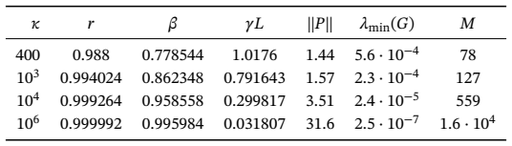
Table3 :ThetuningandtheconstantofTheoremBatsamplevaluesof𝜅,rounded,with𝑀roundedup.
원문 · CC BY 4.0 · Marcos Hernanz · The Optimal Rate Constant of Heavy-Ball Momentum on Smooth Strongly Convex Functions · 원문 그림 인용 · 원본 PDF 32쪽에서 그림 영역을 추출했습니다.적용 범위와 남은 질문
결과는 상수 파라미터와 정확한 그래디언트에 대한 최악의 경우 진술입니다. 원문은 변수 파라미터, 재시작, 그래디언트를 다른 점에서 평가하는 방법은 다루지 않으며, 확률적 신경망 학습에 직접 적용되는 결과가 아니라고 밝힙니다. 또한 유한 κ에서의 최적 튜닝, 두 번째 차수 항, 한 차원에서의 상수는 아직 열린 질문으로 남아 있습니다.
논문 정보
- 저자
- Marcos Hernanz
- 학회·저널
- arXiv · 프리프린트
- 최초 공개일
- 2026년 11월 9일
- 등록일
- 2026년 11월 10일
- 수정일
- 2026년 11월 9일
- 버전
- v1
- arXiv
- 2611.12310
- 분류
- cs.LG · math.OC
- 원문 이용 조건
- CC BY 4.0
- 제공 범위
- 논문 정보, 해설, 허용된 원문 그림
AI 해설은 논문 원문과 별개의 설명이며 오류가 있을 수 있습니다. 원문과 그림은 각 출처의 이용 조건과 따로 표시된 권리를 따릅니다.
초록
The heavy-ball method with a constant step size and a constant momentum parameter accelerates gradient descent on quadratics, but no choice of the two parameters does so on the class of smooth strongly convex functions. We determine how much faster than gradient descent it can be made on this class. Writing the best worst-case rate over all tunings as $1-c(κ)/κ$, where $κ$ is the condition number, we prove that $c(κ)$ tends to $8$ in every dimension of two or more. The lower bound on the rate holds for every tuning, because a tuning that is faster than $1-8/κ$ on quadratics follows a slowly decaying spiral on some function of two variables. The matching upper bound comes from an explicit tuning, with nearly the momentum of Polyak's tuning and a step size about $\sqrtκ/8$ times smaller, and from a Lyapunov function whose positivity is verified in exact arithmetic. Optimally tuned heavy-ball is therefore asymptotically four times faster than gradient descent on this class.
원문 인용
Marcos Hernanz (2026). The Optimal Rate Constant of Heavy-Ball Momentum on Smooth Strongly Convex Functions. arXiv:2611.12310v1. https://arxiv.org/abs/2611.12310v1
BibTeX
@misc{hernanz2026optimal,
  title = {{The Optimal Rate Constant of Heavy-Ball Momentum on Smooth Strongly Convex Functions}},
  author = {Marcos Hernanz},
  year = {2026},
  eprint = {2611.12310},
  archivePrefix = {arXiv},
  url = {https://arxiv.org/abs/2611.12310v1}
}