논문 해설
PROB: Probabilistic Objectness for Open World Object Detection
PROB: 개방형 세계 객체 탐지를 위한 확률적 객체성
- 연구 문제 오픈 월드 객체 검출은 알려진 객체를 검출하면서 라벨 없는 미지 객체를 찾아야 하지만, 미지 객체 재현율이 낮다는 문제가 있습니다.
- 연구 방법 PROB는 deformable DETR의 query embedding에 확률적 objectness 헤드를 추가하고, 분포 추정과 매칭 query의 likelihood 최대화를 교대로 수행합니다.
- 주요 결과 PROB는 M-OWODB Task 1에서 U-Recall 19.4를 보고해 OW-DETR의 7.5보다 높고, 절제 실험에서는 objectness likelihood 최대화가 알려진 객체 mAP 유지에 기여하는 것으로 나타납니다.
미지 객체 검출의 어려움
오픈 월드 객체 검출(OWOD)은 학습된 알려진 객체를 검출하면서, 학습 때 라벨이 없던 미지 객체도 찾아내고 나중에 점진적으로 학습해야 하는 과제입니다. 표준 객체 검출에서는 어떤 객체 제안이 라벨된 객체와 겹치지 않으면 배경으로 분류되므로, 미지 객체가 배경으로 잘못 예측됩니다. 기존 OWOD 방법들은 미지 객체의 감독 신호가 없다는 문제를 pseudo-labeling으로 메우려 했지만, 미지 객체 재현율은 여전히 낮은 수준이라고 보고됩니다. 이 논문은 미지 객체와 배경을 직접 구분하는 대신 일반적인 objectness를 확률 모델로 학습하는 방향을 제안합니다.
확률적 objectness의 학습과 추론
PROB는 deformable DETR의 query embedding에 objectness 헤드를 추가합니다. objectness 확률 ftobj(q)는 query embedding 분포를 클래스에 무관한 다변량 가우시안으로 두고, 그 가능도 exp(−dM(q)²)로 계산됩니다. 여기서 dM은 Mahalanobis 거리입니다. 학습은 두 단계를 교대로 수행합니다. 첫째, 전체 query embedding의 평균 µ와 공분산 Σ를 지수 이동 평균으로 추정합니다. 둘째, 매칭된 query의 squared Mahalanobis 거리를 줄이는 손실 Lo를 최소화합니다. 추론에서는 분류 확률 ftcls(q)에 objectness 확률을 곱해 최종 클래스 확률을 만듭니다.
이 방식은 분류 헤드가 미지 객체를 따로 식별하지 않아도 된다는 점이 핵심입니다.
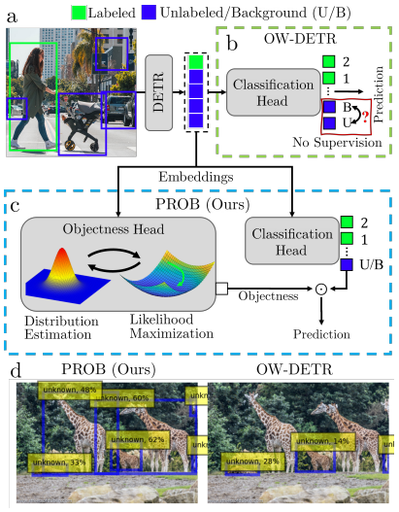
Figure 1 . Comparison of PROB with other open world object de- tectors. (a) Query embeddings (each representing a single pre- diction) are extracted from an image via the deformable DETR model. (b) other open-world detectors attempt to directly distin- guish between unlabeled ‘hidden’ objects and background without supervision (red). (c) PROB’s scheme of probabilistic objectness training and revised inference, which performs alternation opti- mization of (i) Embeddings distribution estimation and (ii) maxi- mizing the likelihood of embeddings that represent known objects. (d) Qualitative example of the improved unknown object detection capability of PROB the MS-COCO test set.
원문 · CC BY 4.0 · Orr Zohar, Kuan-Chieh Wang, Serena Yeung · PROB: Probabilistic Objectness for Open World Object Detection · 원문 그림 인용 · 원본 PDF 1쪽에서 그림 영역을 추출했습니다.objectness 기반 exemplar 선택
증분 학습에서는 이전 객체를 잊지 않도록 소수의 exemplar를 보관합니다. PROB는 무작위로 고르는 대신 매칭된 query의 objectness 점수가 낮은 인스턴스와 높은 인스턴스를 클래스별 상위·하위 25개씩 선택합니다. 낮은 objectness 인스턴스는 학습하기 어려운 사례로, 높은 objectness 인스턴스는 대표적인 사례로 해석됩니다. 선택 후에는 exemplar replay로 추가 미세조정을 수행합니다. 이 선택 방식은 추가 라벨을 요구하지 않는 점에서 능동 학습과 다릅니다.
OWOD 벤치마크 결과
M-OWODB의 Task 1에서 PROB의 U-Recall은 19.4이고 OW-DETR은 7.5입니다. 알려진 객체 mAP는 PROB가 OW-DETR보다 여러 태스크에서 높게 보고됩니다. S-OWODB에서도 PROB는 U-Recall과 알려진 객체 mAP에서 OW-DETR을 능가합니다. 이 결과는 MS-COCO, PASCAL VOC 등 해당 벤치마크와 OW-DETR 같은 비교 기준선에서 얻은 것입니다. 미지 객체 혼동을 나타내는 A-OSE는 Task 1에서 PROB가 5195, OW-DETR이 10240으로 보고됩니다.
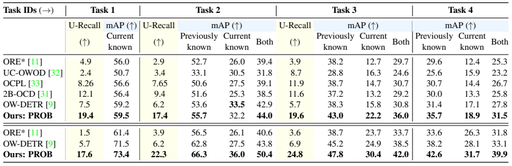
Table 1 . State-of-the-art comparison for OWOD on M-OWODB (top) and S-OWODB (bottom). The comparison is shown in terms of unknown class recall (U-Recall) and known class mAP@0.5 (for previously, currently, and all known objects). For a fair comparison in the OWOD setting, we compare with the recently introduced ORE [11] not employing EBUI (EBUI relies on a held-out set of unknown images, violating the OWOD objective, as shown in [9, 36]). PROB outperforms all existing OWOD models across all tasks both in terms of U-Recall and known mAP, indicating our models improved unknown and known detection capabilities. The smaller drops in mAP between “Previously known” and “Current known” from the previous task exemplify that the exemplar selection improved our models’ incremental learning performance. Note that since all 80 classes are known in Task 4, U-Recall is not computed. Only ORE and OW-DETR are compared in S-OWODB, as other methods have not reported results on this benchmark. See Sec. 5.1 for more details.
원문 · CC BY 4.0 · Orr Zohar, Kuan-Chieh Wang, Serena Yeung · PROB: Probabilistic Objectness for Open World Object Detection · 원문 그림 인용 · 원본 PDF 6쪽에서 그림 영역을 추출했습니다.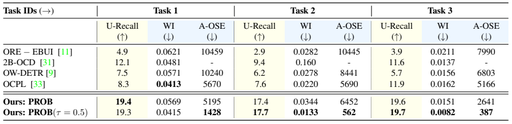
Table 4 . Uknown Object Confusion on M-OWODB.The comparison is shown in terms of wilderness impact (WI), absolute open set error (A-OSE) and unknown class recall (U-Recall). The unknown recall (U-Recall) metric quantifies a model’s ability to retrieve the unknown object instances. PROB achieves improved WI, A-OSE and U-Recall over OW-DETR across tasks, thereby indicating less confusion in detecting unknown instances as known classes with higher unknown instance detection capabilities. See Sec. A.1 for additional details.
원문 · CC BY 4.0 · Orr Zohar, Kuan-Chieh Wang, Serena Yeung · PROB: Probabilistic Objectness for Open World Object Detection · 원문 그림 인용 · 원본 PDF 12쪽에서 그림 영역을 추출했습니다.절제 실험과 objectness 최대화의 역할
PROB-Obj는 objectness likelihood 최대화를 제거한 변형입니다. 이 변형은 U-Recall을 약간 높이지만 알려진 객체 mAP를 크게 낮춥니다. 저자들은 likelihood 최대화가 없으면 objectness 예측이 임의적이 되어 배경 query를 억제하지 못하고, 그 결과 알려진 객체 예측 일부가 억제된다고 해석합니다. PROB-IL은 active exemplar selection을 제거한 변형이며, 주로 미지 객체 재현율에서 이득이 줄어드는 것으로 보고됩니다. 두 절제 결과는 각 구성요소의 유지가 성능에 기여한다는 근거로 읽어야 하며, 모든 조건에서 항상 같은 효과를 보장하지는 않습니다.
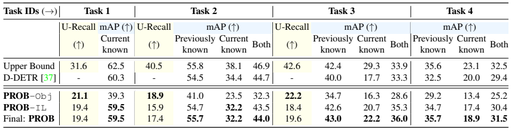
Table 2 . Impact of progressively integrating our contributions into the baseline. The comparison is shown in terms of known class average precision (mAP) and unknown class recall (U-Recall) on M-OWODB. All models shown include a finetuning step to mitigate catastrophic forgetting. PROB-Obj is our model without objectness likelihood maximization. PROB-IL is our model without active exemplar selection. For context, we also include the performance of deformable DETR and an upper bound (D-DETR trained with ground- truth unknown class annotations) as reported by Gupta et al. [9]. As all classes are known in Task 4, U-Recall is not computed.
원문 · CC BY 4.0 · Orr Zohar, Kuan-Chieh Wang, Serena Yeung · PROB: Probabilistic Objectness for Open World Object Detection · 원문 그림 인용 · 원본 PDF 6쪽에서 그림 영역을 추출했습니다.PASCAL VOC 증분 학습 결과
PASCAL VOC 2007에서 10+10, 15+5, 19+1의 세 설정으로 증분 객체 검출을 평가합니다. 각 설정은 처음 학습한 클래스 수와 추가 도입 클래스 수가 다릅니다. 최종 mAP는 PROB가 66.5, 70.1, 72.6이며 OW-DETR은 65.7, 69.4, 70.2로 보고됩니다. 19+1 설정에서 PROB의 새 클래스 mAP는 48.5로 낮게 보고되므로, 최종 mAP의 향상이 모든 하위 지표에서 일관되지 않습니다.
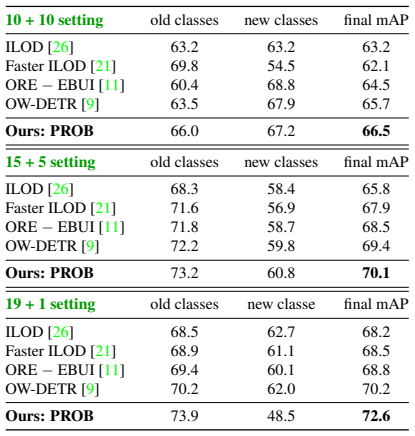
Table 3 . State-of-the-art comparison for incremental object de- tection (iOD) on PASCAL VOC. The comparison is shown in terms of new, old, and overall mAP. In each setting, the model is first trained on 10, 15 or 19 classes, and then the additional 10, 5, and 1 class(es) are introduced. PROB achieves favorable perfor- mance in comparison to existing approaches in all three settings. See Sec. 5.3 for additional details.
원문 · CC BY 4.0 · Orr Zohar, Kuan-Chieh Wang, Serena Yeung · PROB: Probabilistic Objectness for Open World Object Detection · 원문 그림 인용 · 원본 PDF 8쪽에서 그림 영역을 추출했습니다.적용 범위와 한계
저자들은 objectness temperature가 추론 시에만 적용되는 하이퍼파라미터이며 기본값을 1.3으로 두었다고 밝힙니다. 이 값은 온도 스윕 실험에서 U-Recall과 mAP, 그리고 A-OSE와 WI 사이의 절충으로 설명됩니다. 공분산은 채널 독립 가정 Σ=I·σ로 단순화할 수 있으며, 저자들은 이 가정이 성능 변화를 만들지 않았다고 보고합니다. 또한 미지 객체를 검출하고 exemplar를 저장하는 과정은 개인정보나 민감 정보를 포함할 수 있어 별도의 검토가 필요하다고 제시됩니다.
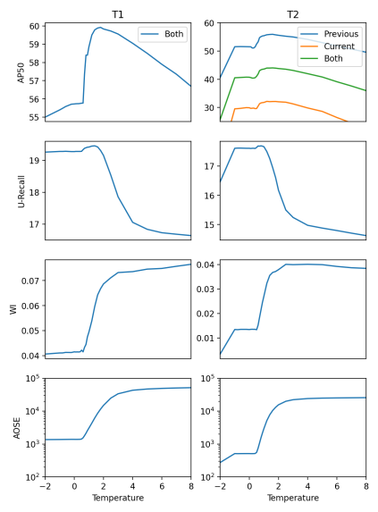
Figure 5 . Objectness Temperature Sweep Experiment. Effect of objectness temperature on model performance for Task 1 and Task 2. WI and A-OSE monotonically increase with objectness temperature, while U-Recall and AP50 peak at an objectness tem- perature of 1.0-1.6. See Sec. A.3 for additional details.
원문 · CC BY 4.0 · Orr Zohar, Kuan-Chieh Wang, Serena Yeung · PROB: Probabilistic Objectness for Open World Object Detection · 원문 그림 인용 · 원본 PDF 11쪽에서 그림 영역을 추출했습니다.논문 정보
- 저자
- Orr Zohar, Kuan-Chieh Wang, Serena Yeung
- 학회·저널
- arXiv · 프리프린트
- 최초 공개일
- 2022년 12월 2일
- 등록일
- 2026년 11월 5일
- 수정일
- 2022년 12월 2일
- 버전
- v1
- arXiv
- 2212.01424
- 분류
- cs.CV · cs.AI · cs.LG
- 원문 이용 조건
- CC BY 4.0
- 제공 범위
- 논문 정보, 해설, 허용된 원문 그림
AI 해설은 논문 원문과 별개의 설명이며 오류가 있을 수 있습니다. 원문과 그림은 각 출처의 이용 조건과 따로 표시된 권리를 따릅니다.
초록
Open World Object Detection (OWOD) is a new and challenging computer vision task that bridges the gap between classic object detection (OD) benchmarks and object detection in the real world. In addition to detecting and classifying seen/labeled objects, OWOD algorithms are expected to detect novel/unknown objects - which can be classified and incrementally learned. In standard OD, object proposals not overlapping with a labeled object are automatically classified as background. Therefore, simply applying OD methods to OWOD fails as unknown objects would be predicted as background. The challenge of detecting unknown objects stems from the lack of supervision in distinguishing unknown objects and background object proposals. Previous OWOD methods have attempted to overcome this issue by generating supervision using pseudo-labeling - however, unknown object detection has remained low. Probabilistic/generative models may provide a solution for this challenge. Herein, we introduce a novel probabilistic framework for objectness estimation, where we alternate between probability distribution estimation and objectness likelihood maximization of known objects in the embedded feature space - ultimately allowing us to estimate the objectness probability of different proposals. The resulting Probabilistic Objectness transformer-based open-world detector, PROB, integrates our framework into traditional object detection models, adapting them for the open-world setting. Comprehensive experiments on OWOD benchmarks show that PROB outperforms all existing OWOD methods in both unknown object detection ($\sim 2\times$ unknown recall) and known object detection ($\sim 10\%$ mAP). Our code will be made available upon publication at https://github.com/orrzohar/PROB.
원문 인용
Orr Zohar, Kuan-Chieh Wang, Serena Yeung (2022). PROB: Probabilistic Objectness for Open World Object Detection. arXiv:2212.01424v1. https://arxiv.org/abs/2212.01424v1
BibTeX
@misc{zohar2022prob,
  title = {{PROB: Probabilistic Objectness for Open World Object Detection}},
  author = {Orr Zohar and Kuan-Chieh Wang and Serena Yeung},
  year = {2022},
  eprint = {2212.01424},
  archivePrefix = {arXiv},
  url = {https://arxiv.org/abs/2212.01424v1}
}