논문 해설
VJEPA: Variational Joint Embedding Predictive Architectures as Probabilistic World Models
VJEPA: 확률적 세계 모델로서의 변분 결합 임베딩 예측 아키텍처
- 연구 문제 기존 JEPA는 결정론적 회귀 목적을 사용해 예측의 확률적 의미와 불확실성 표현이 충분히 정식화되지 않았습니다.
- 연구 방법 VJEPA는 미래 잠재 표현의 예측 분포를 변분 목적으로 학습하고, BJEPA는 동역학 전문가와 사전 전문가를 Product of Experts로 결합합니다.
- 주요 결과 Noisy TV 선형 시스템의 scale 8.0 테스트 결과에서 JEPA 계열은 신호 복원을 유지했고 VAE는 낮아졌습니다.
기존 JEPA의 확률적 의미 공백
JEPA는 관측을 재구성하지 않고 표현 공간에서 미래나 누락된 표현을 예측하는 자기지도 학습 구조입니다. 그러나 원문에 따르면 기존 JEPA 계열 세계 모델은 결정론적 회귀 목적을 사용하므로, 예측 표현이 담는 불확실성과 확률적 의미가 형식적으로 다뤄지지 않습니다. 이 논문은 이 공백을 메우기 위해 확률적 예측 모델로 JEPA를 재구성하는 질문에서 출발합니다.
VJEPA의 변분 목적과 BJEPA의 사후 융합
VJEPA는 목표 표현에 대한 예측 분포 p_ϕ(Z_T | Z_C, ξ_T)를 학습하며, 목표 인코더가 만드는 분포와 예측 분포 사이의 음의 로그우도와 KL 정규화를 합한 목적을 최소화합니다. 원문은 예측 분포를 고정 분산 가우시안으로 두면 기존 JEPA의 제곱 손실과 같아진다고 설명합니다. BJEPA는 학습된 우도 전문가와 사전 전문가를 Product of Experts로 곱하고 정규화하여 사후 예측을 만들며, 사전을 균일하게 두면 VJEPA로 환원된다고 설명합니다.
예측 충분성과 제어 조건
원문은 잠재 표현이 최적 제어의 충분 정보 상태가 되려면 실제 예측 충분 상태가 존재하고, 표현 인코더가 그 분포를 표현할 만큼 충분히 표현력이 있으며, 예측 모델 족이 올바르게 설정되어야 한다고 명시합니다. 따라서 VJEPA가 이 성질을 보장한다고 읽기보다, 이러한 가정 아래에서 충분성이 따른다는 조건부 논증으로 읽어야 합니다. 또한 붕괴 회피는 목적함수 구조에 근거한 정리로 제시되며, 그 전제는 목표의 다양성과 조건화의 비자명성입니다.
Noisy TV 선형 시스템에서의 잡음 불변성 검증
실험은 관측 차원 20, 실제 상태 차원 4의 선형-가우시안 환경에서 방해 신호의 척도를 0부터 8까지 바꾸며 수행됩니다. 척도 8.0에서 SNR은 약 -2.2 dB입니다. 신호 복원 성능은 선형 프로브의 R2로 측정됩니다. 생성 기반 VAE와 AR은 방해 신호가 커질수록 신호 복원이 낮아지고, JEPA 계열은 높은 신호 복원을 유지한다고 보고됩니다.
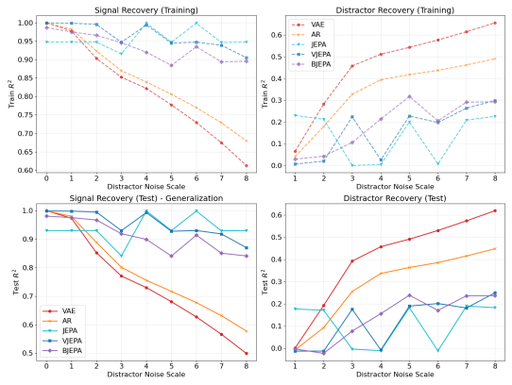
Figure 3 :Performance metrics across noise scales. T op Row:Training setR 2.Bottom Row:Test setR 2 (Generalization). The generative models (V AE, AR) degrade linearly as noise increases, tracking the distractor (Bottom Right). The JEPA-based models (Blue/Cyan/Purple) maintain high signal recovery (Bottom Left) even at high noise scales, demonstrating invariance to nuisance variability.
원문 · CC BY 4.0 · Yongchao Huang · VJEPA: Variational Joint Embedding Predictive Architectures as Probabilistic World Models · 원문 그림 인용 · 원본 PDF 42쪽에서 그림 영역을 추출했습니다.테스트 신호 복원 결과와 해석 범위
척도 8.0에서 VAE의 테스트 신호 R2는 0.499이고 잡음 R2는 0.620으로 보고됩니다. 같은 척도에서 JEPA의 테스트 신호 R2는 0.930, BJEPA는 0.841이며, 이 결과는 원문에서 JEPA 계열의 잡음 불변성을 뒷받침하는 근거로 제시됩니다. 다만 이 결과는 하나의 선형 장난감 환경과 제시된 척도 범위에서 얻은 것이며, 다른 데이터셋이나 실제 영상 과제로 일반화되었다고 볼 근거는 제공되지 않았습니다.
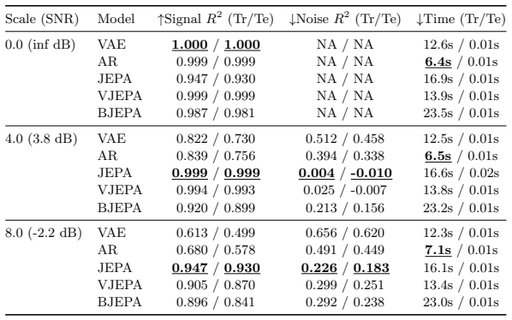
Table 4 : Performance metrics (R2) across models at representative noise scales.T rdenotes training set,T edenotes test set. Full table is listed in Appendix.J.
원문 · CC BY 4.0 · Yongchao Huang · VJEPA: Variational Joint Embedding Predictive Architectures as Probabilistic World Models · 원문 그림 인용 · 원본 PDF 42쪽에서 그림 영역을 추출했습니다.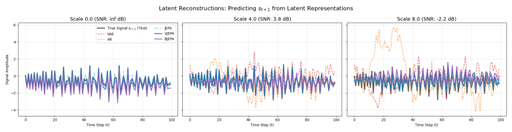
Figure 4 :Latent Reconstructions at varying noise scales.Atσ= 8.0 (Right), the V AE and AR reconstructions (dashed lines) track the high-frequency noise. In contrast, BJEPA and VJEPA (solid lines) successfully filter the noise and track the underlying true signal (black line).
원문 · CC BY 4.0 · Yongchao Huang · VJEPA: Variational Joint Embedding Predictive Architectures as Probabilistic World Models · 원문 그림 인용 · 원본 PDF 43쪽에서 그림 영역을 추출했습니다.단봉 예측 분포의 한계
저자는 현재 구현의 예측 분포가 단봉 가우시안이므로, 다중 모드 분기 환경에서 서로 다른 모드를 평균하여 흐린 믿음을 만들 수 있다고 제한합니다. 또한 실험에서 확률적 VJEPA가 결정론적 JEPA보다 정점 정확도에서 약간 낮거나 더 세밀한 하이퍼파라미터 조정을 요구했다고 밝힙니다. 이 한계는 저자가 보고한 범위에 한정되며, 다른 과제에서의 실패는 원문에서 확인되지 않습니다.
논문 정보
- 저자
- Yongchao Huang
- 학회·저널
- arXiv · 프리프린트
- 최초 공개일
- 2026년 1월 20일
- 등록일
- 2026년 10월 30일
- 수정일
- 2026년 1월 20일
- 버전
- v1
- arXiv
- 2601.14354
- 분류
- cs.LG
- 원문 이용 조건
- CC BY 4.0
- 제공 범위
- 논문 정보, 해설, 허용된 원문 그림
AI 해설은 논문 원문과 별개의 설명이며 오류가 있을 수 있습니다. 원문과 그림은 각 출처의 이용 조건과 따로 표시된 권리를 따릅니다.
초록
Joint Embedding Predictive Architectures (JEPA) offer a scalable paradigm for self-supervised learning by predicting latent representations rather than reconstructing high-entropy observations. However, existing formulations rely on \textit{deterministic} regression objectives, which mask probabilistic semantics and limit its applicability in stochastic control. In this work, we introduce \emph{Variational JEPA (VJEPA)}, a \textit{probabilistic} generalization that learns a predictive distribution over future latent states via a variational objective. We show that VJEPA unifies representation learning with Predictive State Representations (PSRs) and Bayesian filtering, establishing that sequential modeling does not require autoregressive observation likelihoods. Theoretically, we prove that VJEPA representations can serve as sufficient information states for optimal control without pixel reconstruction, while providing formal guarantees for collapse avoidance. We further propose \emph{Bayesian JEPA (BJEPA)}, an extension that factorizes the predictive belief into a learned dynamics expert and a modular prior expert, enabling zero-shot task transfer and constraint (e.g. goal, physics) satisfaction via a Product of Experts. Empirically, through a noisy environment experiment, we demonstrate that VJEPA and BJEPA successfully filter out high-variance nuisance distractors that cause representation collapse in generative baselines. By enabling principled uncertainty estimation (e.g. constructing credible intervals via sampling) while remaining likelihood-free regarding observations, VJEPA provides a foundational framework for scalable, robust, uncertainty-aware planning in high-dimensional, noisy environments.
원문 인용
Yongchao Huang (2026). VJEPA: Variational Joint Embedding Predictive Architectures as Probabilistic World Models. arXiv:2601.14354v1. https://arxiv.org/abs/2601.14354v1
BibTeX
@misc{huang2026vjepa,
  title = {{VJEPA: Variational Joint Embedding Predictive Architectures as Probabilistic World Models}},
  author = {Yongchao Huang},
  year = {2026},
  eprint = {2601.14354},
  archivePrefix = {arXiv},
  url = {https://arxiv.org/abs/2601.14354v1}
}