논문 해설
LM6-CastBench: A Geometry-Aware Simulation Dataset for Transient Thermal Prediction in LM6 Sand Casting
LM6-CastBench: LM6 사형 주조의 과도 열 예측을 위한 형상 인식 시뮬레이션 데이터셋
- 연구 문제 알루미늄 사형주조의 과도 열장을 기하와 공정 조건을 넘어 재현 가능하게 학습·비교할 공개 데이터와 벤치마크가 부족합니다.
- 연구 방법 세 기하 계열 각 10개 변형과 450개 기하-공정 사례를 만들고, 점별 MLP와 3D U-Net을 기하 수준 분할에서 비교합니다.
- 주요 결과 U-Net은 세 기하 모두에서 MLP보다 MAE와 P95 오차를 낮추며, 차이는 플랜지와 스텝 블록에서 특히 큽니다. 대신 U-Net의 추론 시간은 더 깁니다.
열장 예측이 필요한 이유와 기존 데이터의 한계
알루미늄 사형주조에서 응고 중 과도 열장은 공정 조건과 냉각 거동을 결핍 가능성이 있는 영역과 연결합니다. 그러나 여러 기하 구조와 공정 조건에서 이 열 문제를 반복해서 풀면 계산 비용이 크게 늘어납니다. 그래서 학습 기반 대리 모델이 빠른 예측 수단으로 주목받습니다.
기존 머신러닝 연구는 연구마다 따로 만든 시뮬레이션 데이터베이스에 의존해 재현 가능한 기하 수준 벤치마크를 만들기 어렵습니다. 예를 들어 2차원 기하 구조의 이미지형 온도장을 쓰거나, 고정된 주조 구성에서 주입 온도만 바꾸는 연구가 있습니다. 이 연구는 3차원 기하 구조와 공정 변화를 함께 체계적으로 통제하면서 메시와 과도 장을 계속 연결해 두는 데이터셋이 필요하다고 봅니다.
이 논문의 범위는 응고 중 과도 온도장을 전도 지배 가정 아래 예측하는 것입니다. 용융 금속의 충전이나 결함을 직접 시뮬레이션하지는 않습니다.
LM6-CastBench의 구축 과정과 기하·공정 설계
LM6-CastBench는 브레이크 레버, 플랜지, 스텝 블록이라는 세 기하 계열을 각각 10개 변형으로 만듭니다. 각 변형의 설계 변수는 Latin Hypercube Sampling으로 설계 공간에서 샘플링되어 STEP 모델로 내보내집니다. 이 샘플링은 전체 요인 설계 대신 설계 공간을 고르게 덮는 방식이며, 계열 내부의 관계는 유지됩니다.
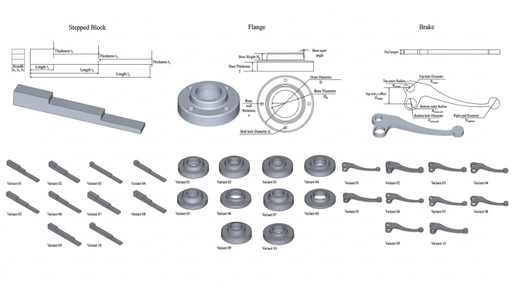
Figure 4 : CAD Parametrization details
원문 · CC BY 4.0 · Suhani Kolhatkar, Anand Khandekar · LM6-CastBench: A Geometry-Aware Simulation Dataset for Transient Thermal Prediction in LM6 Sand Casting · 원문 그림 인용 · 원본 PDF 6쪽에서 그림 영역을 추출했습니다.각 변형은 독립적으로 1차 사면체 메시가 만들어지며, 구멍·필렛·곡면 주변에서 국부 세분화가 적용됩니다. 기하 변형을 공통 기본 메시에서 변형하지 않으므로 원래 기하의 차이가 메시에 남습니다. 공정 조건은 5개 주입 온도와 3개 주형 온도의 격자 조합으로, 모든 기하 변형에 같은 방식으로 적용됩니다. 그 결과 3×10×15 = 450개 사례가 만들어집니다.
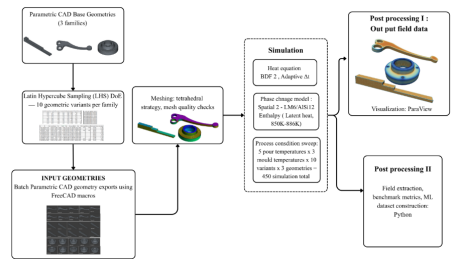
Figure 1 : End-to-end workflow for generating LM6-CastBench.
원문 · CC BY 4.0 · Suhani Kolhatkar, Anand Khandekar · LM6-CastBench: A Geometry-Aware Simulation Dataset for Transient Thermal Prediction in LM6 Sand Casting · 원문 그림 인용 · 원본 PDF 2쪽에서 그림 영역을 추출했습니다.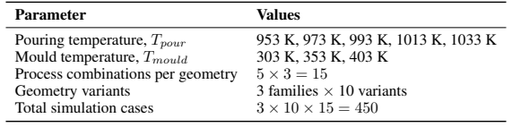
Table 6 : Process-condition design of LM6-CastBench.
원문 · CC BY 4.0 · Suhani Kolhatkar, Anand Khandekar · LM6-CastBench: A Geometry-Aware Simulation Dataset for Transient Thermal Prediction in LM6 Sand Casting · 원문 그림 인용 · 원본 PDF 8쪽에서 그림 영역을 추출했습니다.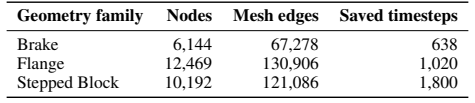
Table 12 : Mesh statistics for one representative variant per geometry family.
원문 · CC BY 4.0 · Suhani Kolhatkar, Anand Khandekar · LM6-CastBench: A Geometry-Aware Simulation Dataset for Transient Thermal Prediction in LM6 Sand Casting · 원문 그림 인용 · 원본 PDF 10쪽에서 그림 영역을 추출했습니다.각 사례에는 절점 좌표, 메시 연결성, 부호거리 값, 공정 파라미터, 시간별 절점 온도가 함께 보존됩니다. 데이터는 기하 변형 단위로 학습·검증·테스트에 8/1/1개씩 나뉘며, 같은 물리적 기하의 시간 단계가 학습과 테스트에 함께 들어가지 않도록 설계되었습니다. 저자들은 테스트 기하가 3개뿐이라 통계적으로 충분한 평가가 아니라 데이터셋 활용성을 보여 주는 예시라고 해석합니다.
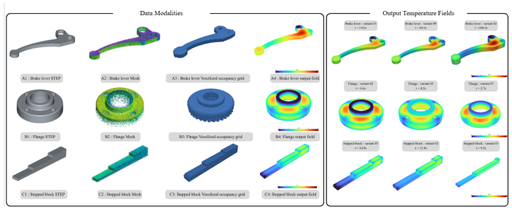
Figure 2 : Geometry, spatial representations, and transient thermal fields in LM6-CastBench.
원문 · CC BY 4.0 · Suhani Kolhatkar, Anand Khandekar · LM6-CastBench: A Geometry-Aware Simulation Dataset for Transient Thermal Prediction in LM6 Sand Casting · 원문 그림 인용 · 원본 PDF 3쪽에서 그림 영역을 추출했습니다.엔탈피 기반 열 해석의 작동 방식
열 해석은 Elmer FEM에서 수행되며, 응고 중 상변화를 엔탈피 기반 공식으로 다룹니다. 지배 방정식은 밀도, 유효 비열, 온도 의존 열전도도로 표현된 에너지 식이며, 주형과의 경계는 온도 의존 대류형 경계 조건으로 놓입니다. 이 열전달 계수는 주변 온도 353 K를 기준으로 사용됩니다.
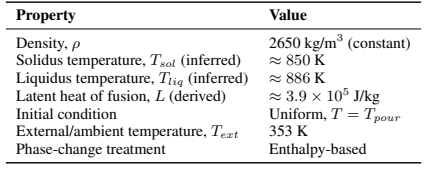
Table 7 : General material and boundary-condition properties of LM6 used in the simulations.
원문 · CC BY 4.0 · Suhani Kolhatkar, Anand Khandekar · LM6-CastBench: A Geometry-Aware Simulation Dataset for Transient Thermal Prediction in LM6 Sand Casting · 원문 그림 인용 · 원본 PDF 9쪽에서 그림 영역을 추출했습니다.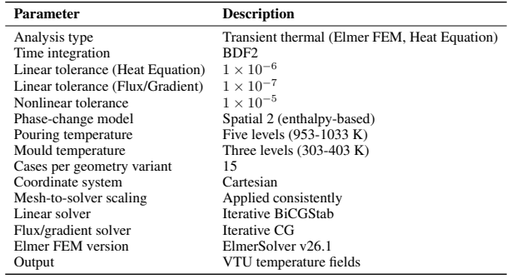
Table 11 : Summary of numerical and process settings.
원문 · CC BY 4.0 · Suhani Kolhatkar, Anand Khandekar · LM6-CastBench: A Geometry-Aware Simulation Dataset for Transient Thermal Prediction in LM6 Sand Casting · 원문 그림 인용 · 원본 PDF 10쪽에서 그림 영역을 추출했습니다.원문은 이 값들이 .sif 파일의 명시적 독립 키워드가 아니라 엔탈피 곡선에서 추론·도출된 값이라고 밝힙니다. 따라서 이 값들은 시뮬레이션 설정 자체가 아니라 곡선에서 얻은 참고 값으로 읽어야 합니다.
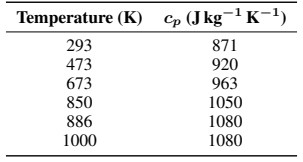
Table 8 : Specific heat cp(T) of LM6, from the Elmer .sif solver input file (piecewise-linear between listed points).
원문 · CC BY 4.0 · Suhani Kolhatkar, Anand Khandekar · LM6-CastBench: A Geometry-Aware Simulation Dataset for Transient Thermal Prediction in LM6 Sand Casting · 원문 그림 인용 · 원본 PDF 9쪽에서 그림 영역을 추출했습니다.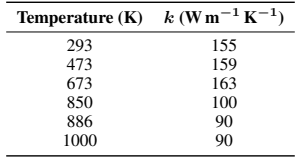
Table 9 : Thermal conductivity k(T) of LM6, from the Elmer .sif solver input file (piecewise-linear between listed points).
원문 · CC BY 4.0 · Suhani Kolhatkar, Anand Khandekar · LM6-CastBench: A Geometry-Aware Simulation Dataset for Transient Thermal Prediction in LM6 Sand Casting · 원문 그림 인용 · 원본 PDF 9쪽에서 그림 영역을 추출했습니다.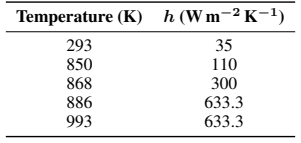
Table 10 : Convective boundary coefficienth(T) , from the Elmer .sif solver input file (piecewise- linear between listed points).
원문 · CC BY 4.0 · Suhani Kolhatkar, Anand Khandekar · LM6-CastBench: A Geometry-Aware Simulation Dataset for Transient Thermal Prediction in LM6 Sand Casting · 원문 그림 인용 · 원본 PDF 10쪽에서 그림 영역을 추출했습니다.점별 MLP와 3D U-Net의 입력과 구조
두 모델은 같은 기하 수준 분할에서 비교됩니다. 점별 MLP는 좌표, 부호거리, 주입 온도, 주형 온도, 시간을 입력으로 받아 절점 온도를 예측합니다. 반면 3D U-Net은 기하 변형을 32×32×32 복셀 격자에 옮긴 뒤 점유, 부호거리, 공정 및 시간 채널을 입력받아 3차원 온도장을 예측하고, 그 결과를 다시 FEM 절점으로 되돌립니다.

Table 1 : Benchmark implementation details of the point-wise MLP and grid-based 3D U-Net.
원문 · CC BY 4.0 · Suhani Kolhatkar, Anand Khandekar · LM6-CastBench: A Geometry-Aware Simulation Dataset for Transient Thermal Prediction in LM6 Sand Casting · 원문 그림 인용 · 원본 PDF 3쪽에서 그림 영역을 추출했습니다.복셀화에서는 각 복셀이 가장 가까운 절점의 값을 받으며, 같은 복셀을 공유하는 절점은 같은 예측값을 받습니다. 이 때문에 U-Net에는 격자에서 생기는 양자화 한계가 있으며, 점별 MLP는 정확한 절점 위치에서 작동하므로 이 한계가 없습니다. 학습은 두 모델 모두 MSE 손실과 Adam으로 이루어지지만, U-Net은 기하 계열마다 따로 학습되며 구조와 하이퍼파라미터는 공유합니다.
기하 수준 분할에서의 오차와 추론 시간
U-Net은 세 기하 모두에서 MLP보다 온도장 오차가 낮습니다. 브레이크 기하에서 MAE는 MLP 8.38 K에서 U-Net 2.19 K로, 플랜지에서는 36.75 K에서 1.03 K로, 스텝 블록에서는 80.71 K에서 1.86 K로 보고됩니다. P95 오차도 같은 방향을 보입니다. 차이는 브레이크 기하보다 플랜지와 스텝 블록에서 훨씬 큽니다.
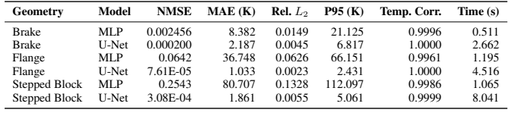
Table 2 : Quantitative temperature-field prediction performance of the MLP and U-Net on held-out geometry variants.
원문 · CC BY 4.0 · Suhani Kolhatkar, Anand Khandekar · LM6-CastBench: A Geometry-Aware Simulation Dataset for Transient Thermal Prediction in LM6 Sand Casting · 원문 그림 인용 · 원본 PDF 4쪽에서 그림 영역을 추출했습니다.추론 시간은 반대 방향으로 나타납니다. MLP는 0.51-1.20 s, U-Net은 2.66-8.04 s로 보고되어, 이 벤치마크에서는 계산 비용과 예측 정확도가 구분됩니다. 이 수치는 MAE와 P95 등 테스트 기하 평균에 근거하며, 최악·중앙값 사례의 시간별 오차는 부록 C에서 따로 확인됩니다.
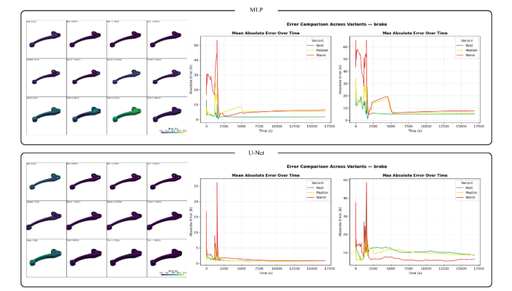
Figure 5 : Temporal error evolution and spatial error distributions for MLP and U-Net predictions on the brake-lever geometry.
원문 · CC BY 4.0 · Suhani Kolhatkar, Anand Khandekar · LM6-CastBench: A Geometry-Aware Simulation Dataset for Transient Thermal Prediction in LM6 Sand Casting · 원문 그림 인용 · 원본 PDF 12쪽에서 그림 영역을 추출했습니다.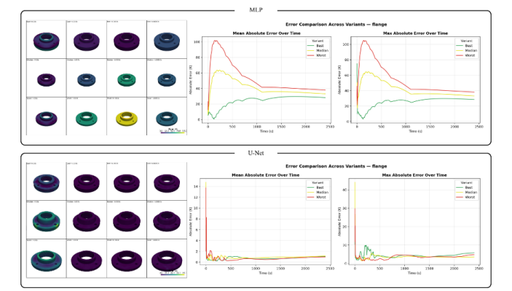
Figure 6 : Temporal error evolution and spatial error distributions for MLP and U-Net predictions on the flange geometry.
원문 · CC BY 4.0 · Suhani Kolhatkar, Anand Khandekar · LM6-CastBench: A Geometry-Aware Simulation Dataset for Transient Thermal Prediction in LM6 Sand Casting · 원문 그림 인용 · 원본 PDF 13쪽에서 그림 영역을 추출했습니다.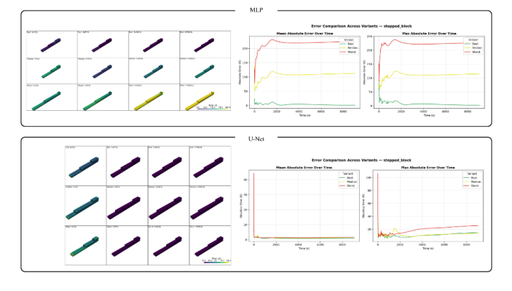
Figure 7 : Temporal error evolution and spatial error distributions for MLP and U-Net predictions on the stepped-block geometry.
원문 · CC BY 4.0 · Suhani Kolhatkar, Anand Khandekar · LM6-CastBench: A Geometry-Aware Simulation Dataset for Transient Thermal Prediction in LM6 Sand Casting · 원문 그림 인용 · 원본 PDF 13쪽에서 그림 영역을 추출했습니다.결과의 적용 범위와 남은 한계
이 벤치마크는 두 대리 모델만 비교하며 테스트 기하는 3개입니다. 따라서 U-Net이 MLP보다 낫다는 결과는 이 데이터셋과 이 두 구성에 대한 것입니다. 그래프 네트워크나 신경 연산자 등 다른 모델은 이 논문에서 평가되지 않았습니다.
데이터셋도 계열당 10개 변형과 두 공정 파라미터에 한정됩니다. 게이트와 라이저 시스템, 충전과 응고의 결합 물리는 포함되지 않았습니다. 부록 C의 최악·중앙값·최선 사례는 초기 과도 구간에서 큰 순간 오차를 보이며, 주 지표와 같은 방향의 추세를 보여 주는 보조 분석입니다.
논문 정보
- 저자
- Suhani Kolhatkar, Anand Khandekar
- 학회·저널
- arXiv · 프리프린트
- 최초 공개일
- 2026년 10월 31일
- 등록일
- 2026년 11월 7일
- 수정일
- 2026년 10월 31일
- 버전
- v1
- arXiv
- 2611.00619
- 분류
- cs.AI · cond-mat.mtrl-sci
- 원문 이용 조건
- CC BY 4.0
- 제공 범위
- 논문 정보, 해설, 허용된 원문 그림
AI 해설은 논문 원문과 별개의 설명이며 오류가 있을 수 있습니다. 원문과 그림은 각 출처의 이용 조건과 따로 표시된 권리를 따릅니다.
초록
Transient thermal fields during solidification connect casting process conditions and cooling behaviour to the formation of defect-prone regions in aluminum cast ings. Repeatedly solving this thermal problem across geometries and process conditions is computationally expensive, motivating data-driven surrogate models. However, existing machine-learning studies on casting thermal behaviour rely on study-specific simulation databases that do not support reproducible geometry-level benchmarking. We introduce LM6-CastBench, an open simulation dataset for geometry-aware learning of transient thermal fields in LM6 aluminum sand casting, combining three geometry families, ten variants per family, five pouring tempera tures, and three mould temperatures (450 geometry-process cases in total). Each case retains CAD geometry, unstructured mesh connectivity, spatial descriptors, process metadata, and time-resolved nodal temperatures. We benchmark a point wise MLP against a spatially structured U-Net under geometry-level data splits; the U-Net reduces temperature-field errors by a large margin, with the biggest gains on geometries with localized features and abrupt section changes. LM6-CastBench gives researchers a reproducible dataset and benchmark for geometry-aware surro gate modelling of casting thermal behaviour.
원문 인용
Suhani Kolhatkar, Anand Khandekar (2026). LM6-CastBench: A Geometry-Aware Simulation Dataset for Transient Thermal Prediction in LM6 Sand Casting. arXiv:2611.00619v1. https://arxiv.org/abs/2611.00619v1
BibTeX
@misc{kolhatkar2026castbench,
  title = {{LM6-CastBench: A Geometry-Aware Simulation Dataset for Transient Thermal Prediction in LM6 Sand Casting}},
  author = {Suhani Kolhatkar and Anand Khandekar},
  year = {2026},
  eprint = {2611.00619},
  archivePrefix = {arXiv},
  url = {https://arxiv.org/abs/2611.00619v1}
}