논문 해설
DeepSat V2: Feature Augmented Convolutional Neural Nets for Satellite Image Classification
DeepSat V2: 위성 영상 분류를 위한 특징 증강 합성곱 신경망
- 연구 문제 고해상도 위성영상 분류는 같은 토지피복 클래스 안의 변동성이 커서 어렵고, 라벨된 대규모 벤치마크도 부족했습니다.
- 연구 방법 CNN의 bottleneck 표현에 150개 후보 중 22개로 선택한 수작업 텍스처 특징을 feature fusion layer에서 결합하는 end-to-end 분류 구조입니다.
- 주요 결과 SAT-4에서 99.90%, SAT-6에서 99.84%의 정확도를 보고하며 가장 가까운 선행 기준인 triplet networks보다 높습니다.
고해상도 위성영상 분류의 어려움
위성영상 분류는 토지피복을 이해하고 구획하는 데 중요하지만, 같은 클래스 안에서도 나무, 초지, 나지, 수역 등의 변동성이 커서 어렵습니다. 원문은 고해상도 위성영상 분류 벤치마크가 부족했다는 점을 함께 제시하며, SAT-4와 SAT-6는 각각 500,000개와 405,000개의 라벨된 영상 패치를 제공하여 새로운 구조를 과적합 문제 없이 평가할 수 있는 자료로 소개됩니다. 이 논문은 픽셀 단위 segmentation이 아니라 영상 분류 문제로 범위를 제한합니다.
CNN과 수작업 특징의 융합 구조
DeepSat V2는 이전 DeepSAT의 DBN 기반 구조를 CNN 기반 구조로 확장합니다. 두 개의 합성곱층(각각 32, 64개 feature map, 3×3 kernel)과 ReLU, 2×2 최대 풀링, 드롭아웃 뒤에 수작업 텍스처 특징을 CNN bottleneck 표현과 연결하는 feature fusion layer가 놓입니다. 융합된 특징은 배치 정규화를 포함한 32개 뉴런의 완전연결층, 128개 뉴런의 완전연결층을 거쳐 Softmax 층으로 분류되며, 학습에는 Adadelta optimizer가 사용됩니다. 수작업 특징은 150개 후보에서 Distribution Separability Criterion 기준으로 22개를 선택해 사용합니다.
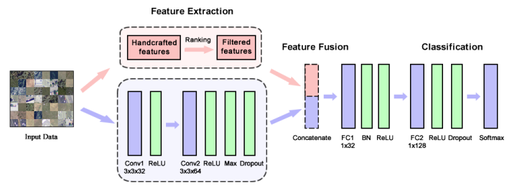
Figure 1 . Architecture of the DeepSat V2 classification framework.
원문 · CC BY 4.0 · Qun Liu, Saikat Basu, Sangram Ganguly, Supratik Mukhopadhyay, Robert DiBiano, Manohar Karki, Ramakrishna Nemani · DeepSat V2: Feature Augmented Convolutional Neural Nets for Satellite Image Classification · 원문 그림 인용 · 원본 PDF 4쪽에서 그림 영역을 추출했습니다.분포 분리도 기준과 특징 선택
논문은 분류 정확도 향상을 클래스 조건부 분포 사이의 분리도를 높이는 문제로 봅니다. Distribution Separability Criterion은 Ds를 평균 간 거리의 평균 ‖δmean‖을 표준편차의 평균 δσ로 나눈 값으로 정의하며, 이 값을 특징 공간에서 최대화하여 특징 순위를 얻습니다. Table 1은 SAT-6에 대한 특징 순위와 Ds 값을 보여 주고, 임계값 Ds = 0.3을 사용해 150개 특징을 22개로 줄였다고 보고합니다. Table 2에서는 원시 영상과 DeepSat 특징의 평균 간 거리와 표준편차 평균을 비교합니다.
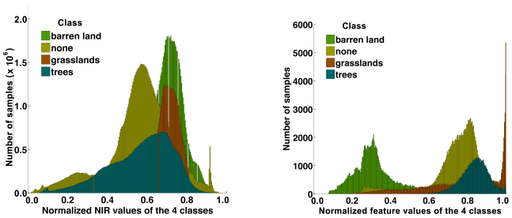
Figure 2 . Distributions of the raw NIR values for traditional deep learning algorithms and a sample hand- crafted DeepSat feature (Autocorrelation of Hue Color co-occurrence matrix Boyda et al. (2017)) for various classes in SAT-4 imagery.
원문 · CC BY 4.0 · Qun Liu, Saikat Basu, Sangram Ganguly, Supratik Mukhopadhyay, Robert DiBiano, Manohar Karki, Ramakrishna Nemani · DeepSat V2: Feature Augmented Convolutional Neural Nets for Satellite Image Classification · 원문 그림 인용 · 원본 PDF 6쪽에서 그림 영역을 추출했습니다.정확도 비교와 통계 검정
DeepSat V2는 SAT-4에서 99.90%, SAT-6에서 99.84%의 분류 정확도를 보고합니다. Table 3의 비교 기준 중 가장 가까운 선행 방법인 triplet networks보다 SAT-4에서 0.14%, SAT-6에서 0.13% 높습니다. 두 방법의 테스트 데이터가 같아서 McNemar’s test를 적용했고, SAT-4에서 χ2 = 138.01, SAT-6에서 χ2 = 103.01이며 두 경우 모두 자유도 1의 양측 p-value는 2.2×10⁻¹⁶보다 작다고 보고합니다. 이 검정은 triplet networks와의 비교에만 적용됩니다.
절제 실험과 학습 비용
원문은 완전연결 dense layer를 제거하면 분류 성능이 낮아진다고 보고합니다. 드롭아웃은 최대 풀링 뒤와 최종 단계 앞 설정에서 가장 좋은 정확도를 보였다고 기술됩니다. 평균 학습 시간은 두 데이터셋에서 약 1200초로 보고되며, 같은 문단에서 Zhong et al. 2017은 약 2400초로 제시됩니다. 이 비교는 저자들이 제시한 실험 조건에서의 학습 시간 비교이며 다른 하드웨어나 모든 설정에 일반화되지 않습니다.
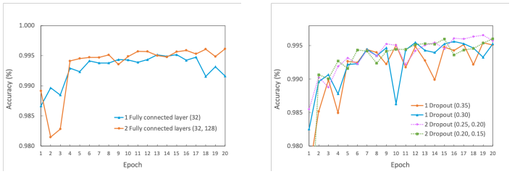
Figure 4 . Impact on the classification performance of our framework on the datasets. (a) Using different number of fully connected layers with values. (b) Using different number of dropout layers with values.
원문 · CC BY 4.0 · Qun Liu, Saikat Basu, Sangram Ganguly, Supratik Mukhopadhyay, Robert DiBiano, Manohar Karki, Ramakrishna Nemani · DeepSat V2: Feature Augmented Convolutional Neural Nets for Satellite Image Classification · 원문 그림 인용 · 원본 PDF 8쪽에서 그림 영역을 추출했습니다.적용 범위와 해석의 한계
이 논문은 고해상도 위성영상의 분류 문제에 범위를 제한하며, 픽셀 단위 segmentation 기법과 데이터셋은 다루지 않습니다. t-SNE 시각화는 학습된 표현과 결정 경계를 정성적으로 이해하기 위한 목적으로 사용되었습니다. 따라서 시각화 결과는 분포 분리도의 정량적 증명이 아니라 보조적 관찰로 읽어야 하며, 결과 수치는 SAT-4와 SAT-6에 한정됩니다.
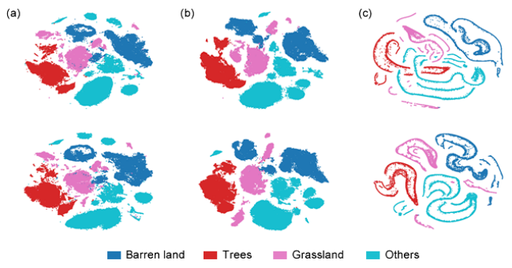
Figure 3 . Visualization of learned representations and decision boundaries for SAT-4 dataset. Top row, regu- lar CNN model which has no handcrafted features fused. Bottom, proposed framework which has handcrafted features fused. (a) Feature maps learned from the first dense layer. (b) Feature maps learned from the second dense layer. (c) Decision Boundaries.
원문 · CC BY 4.0 · Qun Liu, Saikat Basu, Sangram Ganguly, Supratik Mukhopadhyay, Robert DiBiano, Manohar Karki, Ramakrishna Nemani · DeepSat V2: Feature Augmented Convolutional Neural Nets for Satellite Image Classification · 원문 그림 인용 · 원본 PDF 7쪽에서 그림 영역을 추출했습니다.논문 정보
- 저자
- Qun Liu, Saikat Basu, Sangram Ganguly, Supratik Mukhopadhyay, Robert DiBiano, Manohar Karki, Ramakrishna Nemani
- 학회·저널
- arXiv · 프리프린트
- 최초 공개일
- 2019년 11월 15일
- 등록일
- 2026년 11월 6일
- 수정일
- 2019년 11월 15일
- 버전
- v1
- arXiv
- 1911.07747
- DOI
- 10.1080/2150704x.2019.1693071
- 분류
- cs.CV · cs.LG · eess.IV
- 원문 이용 조건
- CC BY 4.0
- 제공 범위
- 논문 정보, 해설, 허용된 원문 그림
AI 해설은 논문 원문과 별개의 설명이며 오류가 있을 수 있습니다. 원문과 그림은 각 출처의 이용 조건과 따로 표시된 권리를 따릅니다.
초록
Satellite image classification is a challenging problem that lies at the crossroads of remote sensing, computer vision, and machine learning. Due to the high variability inherent in satellite data, most of the current object classification approaches are not suitable for handling satellite datasets. The progress of satellite image analytics has also been inhibited by the lack of a single labeled high-resolution dataset with multiple class labels. In a preliminary version of this work, we introduced two new high resolution satellite imagery datasets (SAT-4 and SAT-6) and proposed DeepSat framework for classification based on "handcrafted" features and a deep belief network (DBN). The present paper is an extended version, we present an end-to-end framework leveraging an improved architecture that augments a convolutional neural network (CNN) with handcrafted features (instead of using DBN-based architecture) for classification. Our framework, having access to fused spatial information obtained from handcrafted features as well as CNN feature maps, have achieved accuracies of 99.90% and 99.84% respectively, on SAT-4 and SAT-6, surpassing all the other state-of-the-art results. A statistical analysis based on Distribution Separability Criterion substantiates the robustness of our approach in learning better representations for satellite imagery.
원문 인용
Qun Liu, Saikat Basu, Sangram Ganguly, Supratik Mukhopadhyay, Robert DiBiano, Manohar Karki, Ramakrishna Nemani (2019). DeepSat V2: Feature Augmented Convolutional Neural Nets for Satellite Image Classification. arXiv:1911.07747v1. https://doi.org/10.1080/2150704x.2019.1693071
BibTeX
@article{liu2019deepsat,
  title = {{DeepSat V2: Feature Augmented Convolutional Neural Nets for Satellite Image Classification}},
  author = {Qun Liu and Saikat Basu and Sangram Ganguly and Supratik Mukhopadhyay and Robert DiBiano and Manohar Karki and Ramakrishna Nemani},
  year = {2019},
  eprint = {1911.07747},
  archivePrefix = {arXiv},
  doi = {10.1080/2150704x.2019.1693071},
  url = {https://arxiv.org/abs/1911.07747v1}
}