논문 해설
TacMind: Benchmarking and Modeling Tactile Interaction States for Robotic Manipulation
TacMind: 로봇 조작을 위한 촉각 상호작용 상태의 벤치마킹과 모델링
- 연구 문제 기존 촉각 조작 연구는 과제별로 흩어져 있어 촉각 정보의 기여를 체계적으로 비교하기 어렵습니다. 이 논문은 촉각을 시간에 따라 변하는 상호작용 상태로 표현하고, 이를 평가할 벤치마크와 모델을 제안합니다.
- 연구 방법 TacMind-Bench의 세 평가 영역과 교란 설정 위에서, Tac-LeWM이 미래 촉각 임베딩을 예측하도록 촉각 상태를 학습하고 TacMind-0가 이 상태와 예측 촉각 반영을 사용해 행동을 생성합니다.
- 주요 결과 표준 28개 과제의 평가에서 TacMind-0는 InD 평균 32.3%, OOD 평균 20.7%를 보고하며, 촉각 상태와 예측 촉각 반영의 추가가 여러 영역에서 성공률 향상과 연관됩니다.
촉각을 상호작용 상태로 봐야 하는 이유
기존 촉각 조작 연구는 특정 과제 설정 안에서 개발되고 평가되는 경우가 많아, 촉각 정보가 서로 다른 상호작용 조건에서 어떻게 기여하는지 체계적으로 비교하기 어렵습니다. 촉각은 접촉 물리량과 국소 기하를 직접 알려 주지만, 조작 중에는 무엇이 접촉되고 있는지, 접촉이 어떻게 변하는지, 이후 행동이 그 접촉에 어떤 영향을 주는지까지 담고 있습니다. 이 논문은 촉각을 순간적인 보조 관측이 아니라 시간에 따라 변하는 상호작용 표현으로 다루겠다는 질문에서 출발합니다. 또한 정밀 접촉, 시각적으로 모호한 상황의 인식, 외부 움직임이 있는 동적 상호작용을 나누어 평가할 벤치마크가 필요하다고 설명합니다.
역할 기준으로 구성한 TacMind-Bench
TacMind-Bench는 과제를 물체 범주나 조작 기본 동작이 아니라 조작에서 촉각이 맡는 지배적 역할에 따라 구성합니다. 표준 suite는 28개 과제이고 확장 suite는 100개 과제이며, 두 suite는 정밀 접촉, 모호성 아래의 인식, 동적 상호작용이라는 세 평가 영역을 모두 포함합니다. 정밀 접촉 과제는 외부 구동 움직임 없이 삽입과 결합을 평가하고, 인식 과제는 부분 가림이나 낮은 시각 대비에서 촉각으로 상태를 구분하는 능력을 봅니다. 동적 과제는 목표나 원천이 움직이는 조건에서 조작을 수행합니다. 여기에 조명, 카메라 위치, 물체 크기의 12개 교란 설정을 직교하는 강건성 축으로 더합니다.
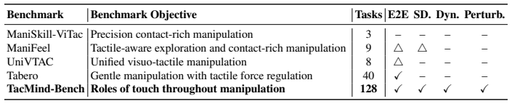
Table 1 : Comparison with representative tactile manipulation benchmarks.✓denotes an explicit benchmark design axis,△denotes partial coverage, and – denotes that the dimension is not explicitly evaluated.E2E denotes manipulation that includes object acquisition rather than only the terminal contact stage.SD.denotes State Disambiguation.Dyn.denotes externally driven source or target motion during execution.Perturb. denotes an orthogonal controlled robustness axis.
원문 · CC BY 4.0 · Jiaxin Shi, Zibin Wu, Yichi Zhang, Jianghua Duan, Siyu Zhu, Weihao Yuan · TacMind: Benchmarking and Modeling Tactile Interaction States for Robotic Manipulation · 원문 그림 인용 · 원본 PDF 4쪽에서 그림 영역을 추출했습니다.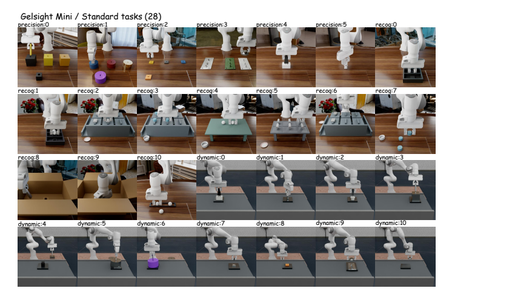
Figure 6 : The 28 standard tasks of TacMind-Bench (GelSight Mini).
원문 · CC BY 4.0 · Jiaxin Shi, Zibin Wu, Yichi Zhang, Jianghua Duan, Siyu Zhu, Weihao Yuan · TacMind: Benchmarking and Modeling Tactile Interaction States for Robotic Manipulation · 원문 그림 인용 · 원본 PDF 17쪽에서 그림 영역을 추출했습니다.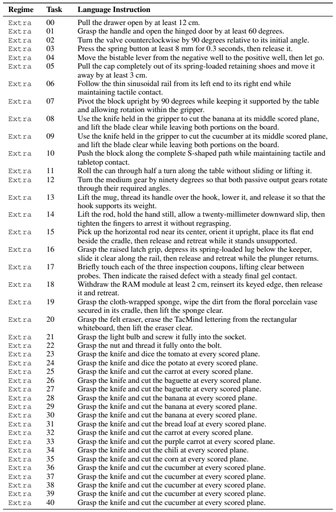
Table 7 : All 100 TacMind-Bench Extra tasks. Task IDs correspond to the zero-based IDs in the Extra task catalog.
원문 · CC BY 4.0 · Jiaxin Shi, Zibin Wu, Yichi Zhang, Jianghua Duan, Siyu Zhu, Weihao Yuan · TacMind: Benchmarking and Modeling Tactile Interaction States for Robotic Manipulation · 원문 그림 인용 · 원본 PDF 18쪽에서 그림 영역을 추출했습니다.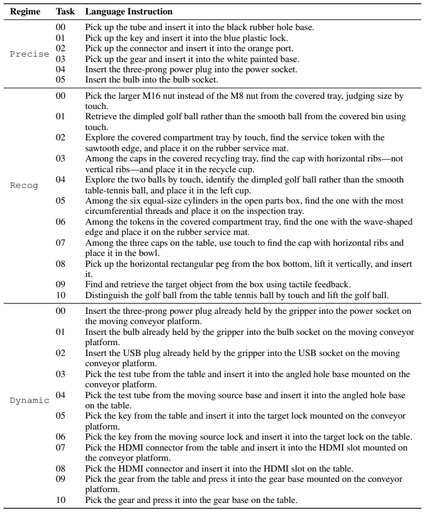
Table 6 : All 28 TacMind-Bench Standard tasks, grouped by evaluation regime. For theDynamicregime, the fixture is mounted on the moving conveyor platform unless stated otherwise.
원문 · CC BY 4.0 · Jiaxin Shi, Zibin Wu, Yichi Zhang, Jianghua Duan, Siyu Zhu, Weihao Yuan · TacMind: Benchmarking and Modeling Tactile Interaction States for Robotic Manipulation · 원문 그림 인용 · 원본 PDF 24쪽에서 그림 영역을 추출했습니다.Tac-LeWM의 촉각 상태 학습
Tac-LeWM은 미래 촉각 관측을 픽셀로 재구성하지 않고, 미래 촉각 임베딩을 예측하는 joint-embedding 예측 목표로 촉각 상태를 학습합니다. 입력 촉각 이력은 각 손가락의 촉각 RGB 영상과 마커 변형을 겹쳐 만든 표현이며, 좌우 손가락 관측은 하나의 촉각 토큰 열로 정리됩니다. 공간 위치는 전역 격자 대신 CTR(Canonical Tactile Rotary) 위치 임베딩으로 부호화하는데, 오른쪽 손가락의 x 좌표를 왼쪽과 같은 정준 좌표계로 옮긴 뒤 여덟 방향 투영을 회전 위치 부호화에 넣습니다. 시간 축에는 인과 주의와 KV 캐시를 사용하여 현재 상태가 과거 촉각 관측을 재사용하고 미래 관측에는 접근하지 않게 합니다.
현재 촉각 상태 z는 인코더의 전역 토큰으로 정의되며, 예측기는 이 상태와 행동 열, 보조 시각 특징을 받아 미래 촉각 임베딩을 예측합니다.
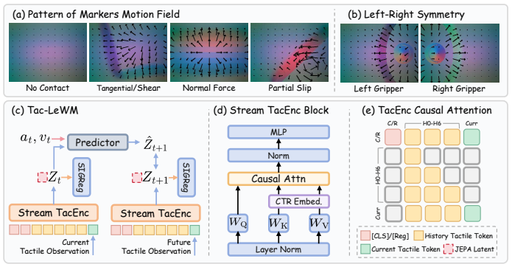
Figure 3 :Overview of Tac-LeWM. (a–b)Marker-motion directions vary with contact conditions, while the left and right fingertip sensors have mirrored spatial layouts. These properties motivate tactile-specific spatial encoding that accounts for directional deformation and cross-fingertip symmetry.(c)Tac-LeWM learns a pre- dictive tactile state by combining a streaming tactile encoder with an action-conditioned latent predictor trained to predict future tactile embeddings.(d)The streaming encoder reuses historical features through cached keys and values, enabling efficient online updates.(e)Causal attention integrates preceding tactile context while preventing access to future observations.
원문 · CC BY 4.0 · Jiaxin Shi, Zibin Wu, Yichi Zhang, Jianghua Duan, Siyu Zhu, Weihao Yuan · TacMind: Benchmarking and Modeling Tactile Interaction States for Robotic Manipulation · 원문 그림 인용 · 원본 PDF 5쪽에서 그림 영역을 추출했습니다.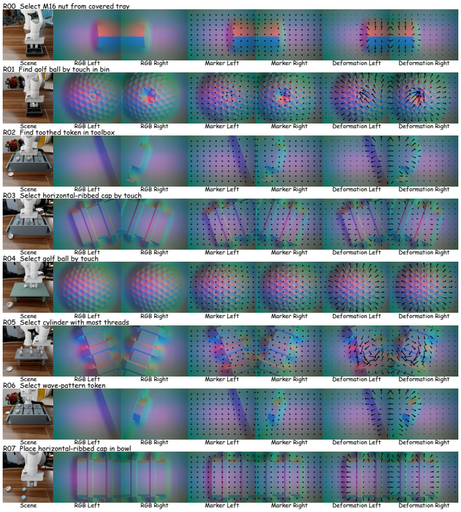
Figure 8 : Visualization of tactile information of Gelsight Mini.
원문 · CC BY 4.0 · Jiaxin Shi, Zibin Wu, Yichi Zhang, Jianghua Duan, Siyu Zhu, Weihao Yuan · TacMind: Benchmarking and Modeling Tactile Interaction States for Robotic Manipulation · 원문 그림 인용 · 원본 PDF 20쪽에서 그림 영역을 추출했습니다.TacMind-0의 행동 생성과 예측 촉각 반영
TacMind-0는 시각 관측, 언어 지시, 촉각 상태를 받아 초기 행동 청크를 생성합니다. 백본은 Gemma 3 시각-언어 모델이며, 행동 전문가는 flow matching으로 학습됩니다. 촉각 상태는 행동 전문가에 맞춘 촉각 조건 토큰으로 들어가고, 시간적 촉각 집계는 Tac-LeWM 인코더 안에서 이뤄집니다. 예측 촉각 반영은 초기 행동 제안 뒤에 Tac-LeWM 예측기로 그 제안에 대응하는 미래 촉각 잠재 상태를 만들고, 이를 행동 정제의 추가 조건으로 씁니다. 구현은 flow reversal로 초기 제안을 잠재 노이즈 쪽으로 되돌린 뒤, 예측된 촉각 상태를 포함한 조건으로 다시 전진시키는 방식입니다.
따라서 첫 번째 역방향 통과는 원래 조건을 쓰고, 두 번째 순방향 통과에서 예측 촉각 상태를 추가로 받습니다.
표준 과제에서 관측된 성공률
표준 28개 과제에서 TacMind-0는 Multi-Task 일반 정책 중 가장 높은 InD 평균 32.3%와 OOD 평균 20.7%를 보고합니다. 이 비교는 GelSight Mini 센서를 사용한 표준 과제, 과제당 하나의 InD 설정과 12개 OOD 교란 설정, 설정마다 20 에피소드라는 조건에서 얻은 결과입니다. 단일 과제 특화 정책인 ACT+Tactile과 비교하면 TacMind-0는 정밀 영역과 OOD 전체 평균에서 더 높은 값을 보고합니다. 이 결과는 해당 벤치마크 설정에서의 관찰이며, 다른 로봇이나 다른 센서 조건으로 일반화된 결론으로 읽으면 안 됩니다.
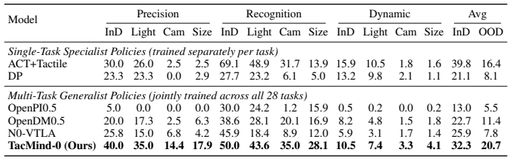
Table 2 :Performance on TacMind-Bench Standard (GelSight Mini).OOD performance is categorized into lighting, camera, and size perturbations.
원문 · CC BY 4.0 · Jiaxin Shi, Zibin Wu, Yichi Zhang, Jianghua Duan, Siyu Zhu, Weihao Yuan · TacMind: Benchmarking and Modeling Tactile Interaction States for Robotic Manipulation · 원문 그림 인용 · 원본 PDF 8쪽에서 그림 영역을 추출했습니다.절제 실험으로 본 촉각 상태와 예측 반영의 역할
절제 실험은 촉각 상태 추가와 예측 촉각 반영 사용 여부를 나누어 비교합니다. 촉각 상태를 추가하면 정밀 영역과 인식 영역의 성공률이 크게 올라가며, 예측 촉각 반영을 더하면 여러 영역에서 추가 향상이 보고됩니다. 특히 OOD 교란에서 예측 촉각 반영의 개선이 두드러집니다. 이 결과는 두 구성 요소가 각각 제거된 변형과 비교된 결과이며, 예측 반영이 항상 모든 조건에서 개선을 낳는다는 뜻은 아닙니다. 저자들은 이 결과를 촉각 상호작용 상태의 명시적 모델링과 예측 기반 정제가 강건성과 일반화에 도움이 된다는 해석으로 제시합니다.
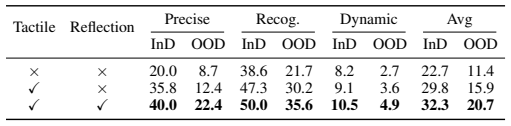
Table 3 :Ablation study of TacMind-0.We evaluate the contributions of streaming tactile features and predic- tive tactile reflection across different evaluation regimes and distributions.
원문 · CC BY 4.0 · Jiaxin Shi, Zibin Wu, Yichi Zhang, Jianghua Duan, Siyu Zhu, Weihao Yuan · TacMind: Benchmarking and Modeling Tactile Interaction States for Robotic Manipulation · 원문 그림 인용 · 원본 PDF 9쪽에서 그림 영역을 추출했습니다.Tac-LeWM 표현 품질과 시간 문맥
Tac-LeWM의 표현 품질은 재구성과 선형 프로브로 확인합니다. pre-training 후 현재 프레임 촉각 재구성은 PSNR 31.83 dB에서 34.42 dB로, SSIM은 0.875에서 0.914로 올라갑니다. 선형 프로브에서 고유감각, 그리퍼 상태, 행동, 촉각 패드 에너지에 대한 피어슨 상관은 각각 0.8981, 0.9053, 0.8976, 0.7968로 보고됩니다. 미래 촉각 재구성은 캐시 길이 k를 1에서 8로 늘릴 때 PSNR 27.34 dB에서 28.98 dB로 개선되며, 기억을 섞으면 27.90 dB, 오염시키면 24.18 dB로 떨어집니다. 스트리밍 캐시는 배치 크기 1에서 인코더 지연을 18.36 ms에서 10.33 ms로 줄입니다.
이 값들은 별도 재구성·프로브 실험의 결과이며, 행동 성공률의 직접 측정으로 읽지 않습니다.

Table 8 : Ablation study on Tac-LeWM: linear probing results.
원문 · CC BY 4.0 · Jiaxin Shi, Zibin Wu, Yichi Zhang, Jianghua Duan, Siyu Zhu, Weihao Yuan · TacMind: Benchmarking and Modeling Tactile Interaction States for Robotic Manipulation · 원문 그림 인용 · 원본 PDF 24쪽에서 그림 영역을 추출했습니다.
Table 9 : Ablation study on Tac-LeWM on TacMind-Bench Standard 28 tasks: current and future reconstruction results.
원문 · CC BY 4.0 · Jiaxin Shi, Zibin Wu, Yichi Zhang, Jianghua Duan, Siyu Zhu, Weihao Yuan · TacMind: Benchmarking and Modeling Tactile Interaction States for Robotic Manipulation · 원문 그림 인용 · 원본 PDF 25쪽에서 그림 영역을 추출했습니다.한계와 남은 질문
논문은 동적 상호작용 과제가 여전히 어렵다고 보고합니다. 또한 가속 결과는 행동 정책 전체의 폐루프 성공률이 아니라 행동 적분 모듈에 한정된 지연 측정이며, 학습된 체크포인트와 폐루프 과제 성공률 평가는 향후 과제로 남아 있습니다. 실세계 실험은 RealMan 로봇과 DM-Tac 센서의 여섯 과제로 한정되어 있어 표준 벤치마크 결과와 같은 범위로 확장할 수 없습니다. 현재 설명은 저자가 보고한 조건 안에서의 관찰이며, 다른 센서·로봇·과제에서의 성능은 이 논문만으로 확인되지 않습니다.
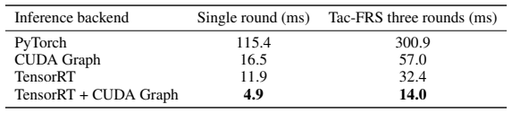
Table 10 : Action integration latency on an NVIDIA RTX 5090. Values are median latencies over 30 measure- ments.
원문 · CC BY 4.0 · Jiaxin Shi, Zibin Wu, Yichi Zhang, Jianghua Duan, Siyu Zhu, Weihao Yuan · TacMind: Benchmarking and Modeling Tactile Interaction States for Robotic Manipulation · 원문 그림 인용 · 원본 PDF 25쪽에서 그림 영역을 추출했습니다.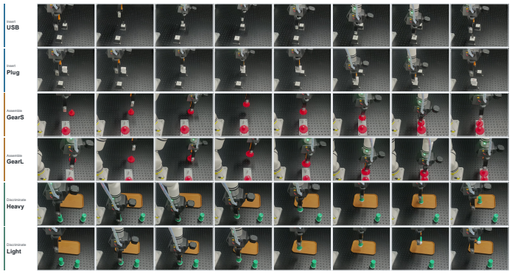
Figure 12 : Representative trajectories for the six real-world tasks. From top to bottom, the rows show USB in- sertion, plug insertion, small-gear assembly, large-gear assembly, heavy-bottle discrimination, and light-bottle discrimination. Each row contains eight frames arranged in chronological order from left to right.
원문 · CC BY 4.0 · Jiaxin Shi, Zibin Wu, Yichi Zhang, Jianghua Duan, Siyu Zhu, Weihao Yuan · TacMind: Benchmarking and Modeling Tactile Interaction States for Robotic Manipulation · 원문 그림 인용 · 원본 PDF 26쪽에서 그림 영역을 추출했습니다.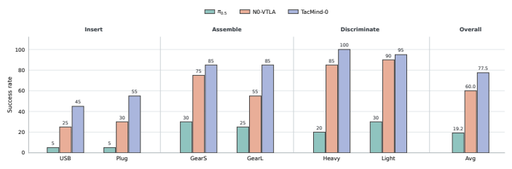
Figure 13 : Success rates on six real-world manipulation tasks. We compareπ 0.5, N0-VTLA, and TacMind-0 on two insertion tasks (USB and Plug), two assembly tasks (GearS and GearL), and two weight discrimination tasks (Heavy and Light). Each method is evaluated over 20 trials per task. The numbers above the bars denote success rates in percent, and Avg is the mean across the six tasks.
원문 · CC BY 4.0 · Jiaxin Shi, Zibin Wu, Yichi Zhang, Jianghua Duan, Siyu Zhu, Weihao Yuan · TacMind: Benchmarking and Modeling Tactile Interaction States for Robotic Manipulation · 원문 그림 인용 · 원본 PDF 26쪽에서 그림 영역을 추출했습니다.논문 정보
- 저자
- Jiaxin Shi, Zibin Wu, Yichi Zhang, Jianghua Duan, Siyu Zhu, Weihao Yuan
- 학회·저널
- arXiv · 프리프린트
- 최초 공개일
- 2026년 10월 30일
- 등록일
- 2026년 11월 7일
- 수정일
- 2026년 10월 30일
- 버전
- v1
- arXiv
- 2611.00455
- 분류
- cs.RO
- 원문 이용 조건
- CC BY 4.0
- 제공 범위
- 논문 정보, 해설, 허용된 원문 그림
AI 해설은 논문 원문과 별개의 설명이며 오류가 있을 수 있습니다. 원문과 그림은 각 출처의 이용 조건과 따로 표시된 권리를 따릅니다.
초록
Tactile sensing provides robots with direct observations of contact physics, local geometry, and interaction dynamics, making it a vital source of feedback for contact-rich manipulation. However, existing tactile manipulation studies are often developed and evaluated within specific task settings, making it difficult to systematically compare how tactile information contributes under different interaction conditions. In this work, we develop a benchmark in simulation comprising 128 tasks organized around three complementary evaluation regimes: Precise, Recognition, and Dynamic. The benchmark further includes controlled static and dynamic task variants and 12 perturbation settings for evaluating robustness under changes in visual and physical conditions. These settings motivate studying tactile information as a temporally evolving interaction representation rather than only as an instantaneous observation. We therefore propose an action-conditioned latent predictive world model that integrates tactile history and learns a tactile state through prediction of future tactile latents. Building on this representation, we design a model that conditions action generation on the learned tactile state and uses predicted future tactile information to refine candidate actions through predictive tactile reflection. Experiments on the proposed benchmark show consistent gains from incorporating tactile information across the evaluated regimes. Project Page: https://tacmind-bench.github.io/
원문 인용
Jiaxin Shi, Zibin Wu, Yichi Zhang, Jianghua Duan, Siyu Zhu, Weihao Yuan (2026). TacMind: Benchmarking and Modeling Tactile Interaction States for Robotic Manipulation. arXiv:2611.00455v1. https://arxiv.org/abs/2611.00455v1
BibTeX
@misc{shi2026tacmind,
  title = {{TacMind: Benchmarking and Modeling Tactile Interaction States for Robotic Manipulation}},
  author = {Jiaxin Shi and Zibin Wu and Yichi Zhang and Jianghua Duan and Siyu Zhu and Weihao Yuan},
  year = {2026},
  eprint = {2611.00455},
  archivePrefix = {arXiv},
  url = {https://arxiv.org/abs/2611.00455v1}
}