논문 해설
Learning Rate Scaling across LoRA Ranks and Transfer to Full Finetuning
LoRA 랭크 전반의 학습률 스케일링과 전체 fine-tuning으로의 전이
- 연구 문제 LoRA에서 최적 학습률은 랭크, 초기화, 승수에 따라 달라져 랭크를 바꿀 때마다 재튜닝이 필요합니다.
- 연구 방법 너비와 랭크가 함께 커지는 극한에서 LoRA 특징 증분을 분해하고, SignSGD 가정 아래 안정 특징 학습을 위한 학습률 규칙을 도출합니다.
- 주요 결과 Init[A]와 α=1에서는 학습률이 랭크에 따라 줄고, Init[B]와 α=1에서는 랭크에 불변인 η=Θ(n^-1) 규칙이 나오며 전체 fine-tuning과 정렬된다고 보고됩니다.
LoRA 랭크가 바뀔 때 학습률을 다시 맞춰야 하는 문제
LoRA는 pre-training 가중치 W⋆를 고정하고 저랭크 인자곱 αBA만 학습하는 대표적인 매개변수 효율적 fine-tuning 방법입니다. 그러나 업데이트 크기는 초기화 방식, 승수 α, 랭크 r, 학습률 η가 함께 결정하므로, 랭크를 바꾸면 기존에 최적이던 학습률이 쉽게 최적에서 벗어납니다. 이 논문은 너비 n과 랭크 r이 함께 커지는 극한에서 최적 학습률이 r에 따라 어떻게 변하는지를 묻고, 이를 전체 fine-tuning(FFT)으로 옮길 수 있는지 함께 검토합니다.
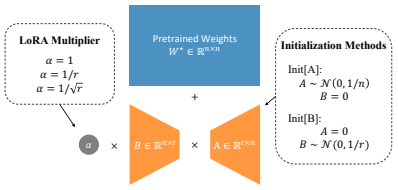
Figure 1 .LoRA finetuning with standard design choices.
원문 · CC BY 4.0 · Nan Chen, Soledad Villar, Soufiane Hayou · Learning Rate Scaling across LoRA Ranks and Transfer to Full Finetuning · 원문 그림 인용 · 원본 PDF 1쪽에서 그림 영역을 추출했습니다.Maximal-Update Adaptation의 특징 증분 분해와 학습률 규칙
이 논문은 LoRA 출력 특징 ZB=αBAZ의 한 단계 증분 ΔZB를 세 항 δ1, δ2, δ3로 나눕니다. δ1과 δ2는 한쪽 인자만 갱신되는 선형 업데이트이고 δ3는 A와 B가 함께 바뀌는 곱셈 업데이트입니다. 안정 특징 학습은 각 단계의 증분이 O(1)이면서 ΔZB=Θ(1)인 조건으로 정의됩니다. 분석은 층 입력과 역전파 신호가 Θ(1)이라는 가정과 Adam을 단순화한 SignSGD 업데이트 아래에서 수행됩니다.
Init[A]에서는 A가 무작위이고 B=0이며, 정리 4.3은 ΔZB가 max{Θ(ηαr), Θ(η²αrn)}임을 보입니다. 이로부터 α=r^-γ일 때 η=Θ(n^-1/2 r^-(1-γ)/2)가 필요합니다. 특히 α=1이면 학습률은 r^-1/2로 줄고, α=r^-1이면 랭크에 대해 대체로 불변인 학습률 규칙이 됩니다.
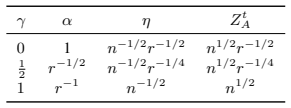
Table 1 . µA scaling rules from Corollary 4.4 for common choices ofα. Each cell shows the argument ofΘ(·).
원문 · CC BY 4.0 · Nan Chen, Soledad Villar, Soufiane Hayou · Learning Rate Scaling across LoRA Ranks and Transfer to Full Finetuning · 원문 그림 인용 · 원본 PDF 5쪽에서 그림 영역을 추출했습니다.Init[B]와 α=1에서는 ΔZB가 max{Θ(ηn), Θ(η²nr)}이고, 안정 특징 학습을 위해 η=Θ(n^-1)이 필요합니다. 이 규칙은 랭크에 독립입니다. 같은 SignSGD 가정에서 전체 fine-tuning 선형층도 η=Θ(n^-1)을 얻으므로, 저자들은 이 너비 스케일링의 일치를 학습률 전이의 필요 조건으로 해석합니다.
구성별 학습률 스윕으로 본 SFT 실험의 확인 범위
실험은 Llama-3.2-1B(Tulu-3), Qwen2.5-3B-Instruct(OpenThoughts-114k), RoBERTa-large(ANLI), ViT-Huge/14(ImageNet-1K), Qwen3-VL-2B-Instruct(LLaVA-Instruct-Mix)에서 수행되었습니다. 각 구성은 로그2 격자에서 학습률을 스윕하고 최종 훈련 손실의 EMA 평활값과 과제별 검증 지표로 최적값을 따로 고릅니다.
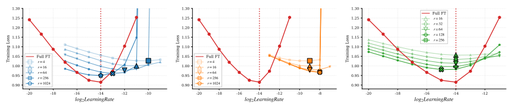
Figure 2 .Learning rate sweeps for three standard LoRA configurations on Llama-3.2-1B (Tulu3). Each panel plots final training loss (EMA-smoothed) versus log-scale learning rate log2(η) for multiple ranks (colored) and FFT (red). Large markers indicate the optimal learning rate for each rank; the dashed red line marks the optimal FFT learning rate. The y-axis is clipped for readability.
원문 · CC BY 4.0 · Nan Chen, Soledad Villar, Soufiane Hayou · Learning Rate Scaling across LoRA Ranks and Transfer to Full Finetuning · 원문 그림 인용 · 원본 PDF 2쪽에서 그림 영역을 추출했습니다.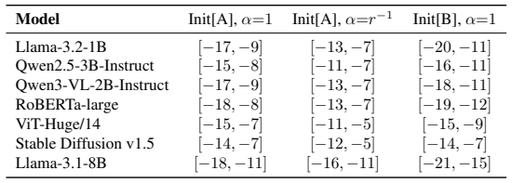
Table 6 .Learning rate sweep ranges (log 2 η) for each model and configuration.
원문 · CC BY 4.0 · Nan Chen, Soledad Villar, Soufiane Hayou · Learning Rate Scaling across LoRA Ranks and Transfer to Full Finetuning · 원문 그림 인용 · 원본 PDF 30쪽에서 그림 영역을 추출했습니다.Init[A]와 α=1의 경우, 기반 모델의 너비를 고정했을 때 최적 학습률이 랭크가 커지면 단조롭게 작아지는 경향이 보고됩니다. 이 결과는 η∝r^-1/2 예측과 대체로 맞지만, Qwen2.5-3B-Instruct에서는 r=16과 r=64가 같은 학습률에서 최소 손실을 보이는 등 격자 이산화에 따른 편차가 있습니다. Init[A]와 α=r^-1의 경우에는 랭크에 따른 최적 학습률이 대체로 좁은 범위 안에 있다고 보고됩니다. Init[B]와 α=1에서는 랭크별 최적값이 촘촘히 모이고, 저자들은 이를 전체 fine-tuning 최적값과의 정렬로 해석합니다. 다만 RoBERTa-large에서는 전체 fine-tuning이 약간 작은 학습률을 선호했고, 저자들은 이를 추가 분류 헤드의 영향으로 설명합니다.

Figure 3 .Learning rate sweeps for Init[A] with α= 1 across four models. Curves show final training loss (EMA-smoothed) versus log-scale learning rate (log2(η)). Large markers denote per-rank optima. The Y-axis is clipped for readability.
원문 · CC BY 4.0 · Nan Chen, Soledad Villar, Soufiane Hayou · Learning Rate Scaling across LoRA Ranks and Transfer to Full Finetuning · 원문 그림 인용 · 원본 PDF 6쪽에서 그림 영역을 추출했습니다.
Figure 4 .Learning rate sweeps for Init[A] with rank-dependent α=r −1 across four models. Curves show final training loss (EMA- smoothed) versus log-scale learning rate (log2(η)). Large markers denote per-rank optima. The Y-axis is clipped for readability.
원문 · CC BY 4.0 · Nan Chen, Soledad Villar, Soufiane Hayou · Learning Rate Scaling across LoRA Ranks and Transfer to Full Finetuning · 원문 그림 인용 · 원본 PDF 6쪽에서 그림 영역을 추출했습니다.
Figure 5 .Learning rate sweeps for Init[B] with α= 1 across four models. Curves show final training loss (EMA-smoothed) versus log-scale learning rate (log2(η)) for multiple ranks (green) and FFT (red). Large markers denote per-rank optima. The Y-axis is clipped for readability. The red vertical dashed line marks the optimal FFT learning rate.
원문 · CC BY 4.0 · Nan Chen, Soledad Villar, Soufiane Hayou · Learning Rate Scaling across LoRA Ranks and Transfer to Full Finetuning · 원문 그림 인용 · 원본 PDF 7쪽에서 그림 영역을 추출했습니다.RLVR과 확산 모델 실험에서 확인된 학습률 전이와 학습 시간
Llama-3.1-8B를 GSM8k에서 GRPO로 학습한 RLVR 실험에서도 Init[A]와 α=r^-1의 최적 학습률은 랭크에 대해 대체로 불변이고, Init[B]와 α=1의 최적 학습률은 전체 fine-tuning 최적값과 정렬된다고 보고됩니다. Init[A]와 α=1 결과는 부록에서 다룹니다.

Figure 6 .RLVR results on Llama-3.1-8B (GSM8k) with GRPO. (a)–(b) Learning rate sweeps plotting final training reward versuslog2(η). Large markers denote the best learning rate per rank; the red dashed line marks the FFT optimum. (c) Training time versus learning rate for FFT (red) and Init[B] with α=1 and r=256 (green). (d) Peak GPU memory breakdown for FFT (left) and LoRA with r=256 (right).
원문 · CC BY 4.0 · Nan Chen, Soledad Villar, Soufiane Hayou · Learning Rate Scaling across LoRA Ranks and Transfer to Full Finetuning · 원문 그림 인용 · 원본 PDF 7쪽에서 그림 영역을 추출했습니다.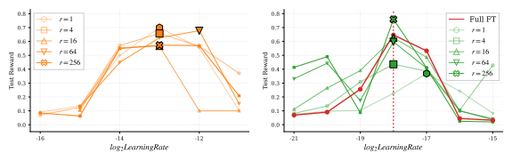
Figure 13 .RLVR results on Llama-3.1-8B (GSM8k) for (a) Init[A] with α=r −1 and (b) Init[B] with α= 1 . Curves show test reward versus log-scale learning ratelog 2(η). Large markers indicate the optimal learning rate for each rank.
원문 · CC BY 4.0 · Nan Chen, Soledad Villar, Soufiane Hayou · Learning Rate Scaling across LoRA Ranks and Transfer to Full Finetuning · 원문 그림 인용 · 원본 PDF 34쪽에서 그림 영역을 추출했습니다.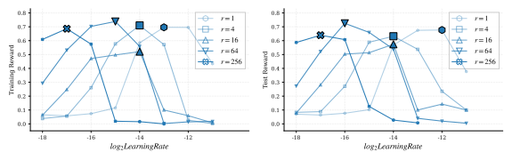
Figure 14 .RLVR results on Llama-3.1-8B (GSM8k) for Init[A] with α= 1 . (a) Training reward and (b) test reward versus log-scale learning ratelog 2(η). Large markers indicate the optimal learning rate for each rank.
원문 · CC BY 4.0 · Nan Chen, Soledad Villar, Soufiane Hayou · Learning Rate Scaling across LoRA Ranks and Transfer to Full Finetuning · 원문 그림 인용 · 원본 PDF 35쪽에서 그림 영역을 추출했습니다.RLVR에서는 학습률에 대한 민감도가 SFT보다 크게 나타납니다. Init[B] α=1, r=256에서 최적 학습률 η=2^-18과 준최적 η=2^-16을 비교하면, 준최적 학습률에서는 보상이 무너지고 완성 길이가 최대 길이에 머무르며 단계당 학습 시간이 길어집니다. 원문은 이 준최적 조건에서 시간이 3–5배 늘어난다고 보고합니다. 단, 완성 길이가 줄어드는 두 단계 패턴은 이 설정의 관찰이며 모든 RLVR 설정으로 일반화되지는 않습니다.
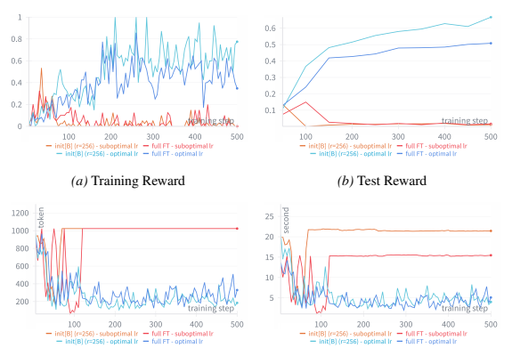
Figure 15 .Case study comparing optimal ( η= 2 −18) and suboptimal (η= 2 −16) learning rates for FFT and Init[B] (α= 1 and r= 256 ). (a) Training reward and (b) test reward show that suboptimal learning rates cause reward collapse, while optimal rates yield steady improvement. (c) Maximum completion length reveals the two-phase training pattern: under optimal learning rates, models transition from generating near-maximum-length sequences (∼1024 tokens) to concise solutions (∼200 tokens), whereas suboptimal rates cause models stuck in the exploratory phase with persistently long outputs. (d) Per-step training time directly reflects the completion length, with optimal learning rates achieving3–5×faster for each training step.
원문 · CC BY 4.0 · Nan Chen, Soledad Villar, Soufiane Hayou · Learning Rate Scaling across LoRA Ranks and Transfer to Full Finetuning · 원문 그림 인용 · 원본 PDF 36쪽에서 그림 영역을 추출했습니다.Stable Diffusion v1.5의 Naruto-BLIP-Captions 실험에서는 U-Net의 LoRA 학습률을 검증 FID로 고릅니다. Init[A]와 α=r^-1에서는 최적 학습률이 랭크에 대해 불변이고, Init[B]와 α=1에서는 FFT 최적값과 정렬된다고 보고됩니다.
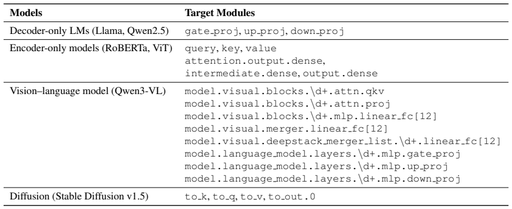
Table 3 .Implementation details of LoRA placement across different models, based on the PEFT package. For vision-language models, we use regular expressions to identify target modules. For the diffusion model, we apply LoRA only to the U-Net denoiser.
원문 · CC BY 4.0 · Nan Chen, Soledad Villar, Soufiane Hayou · Learning Rate Scaling across LoRA Ranks and Transfer to Full Finetuning · 원문 그림 인용 · 원본 PDF 27쪽에서 그림 영역을 추출했습니다.점근 이론의 한계와 전이 조건의 범위
저자들은 이론이 점근적이며, 유한한 너비와 랭크에서는 상수항과 저차항이 최적 학습률을 옮길 수 있다고 밝힙니다. 학습률 격자가 이산적이어서 평평한 손실 근처에서는 인접한 격자점의 우열이 잡음에 좌우될 수 있습니다. 또한 분석은 학습률 전이 조건의 필요 조건을 제시할 뿐이며, 충분 조건은 후속 연구로 남아 있습니다.
이 한계는 이론의 예측이 정확한 수치 일치를 뜻하지 않고 질적 경향을 확인하는 수준으로 해석되어야 함을 뜻합니다. 실험 결과도 주로 지정된 모델, 데이터, 랭크 격자에서 얻은 것이므로 다른 설정으로 넓히려면 별도 검증이 필요합니다.
논문 정보
- 저자
- Nan Chen, Soledad Villar, Soufiane Hayou
- 학회·저널
- arXiv · 프리프린트
- 최초 공개일
- 2026년 2월 5일
- 등록일
- 2026년 10월 30일
- 수정일
- 2026년 2월 5일
- 버전
- v1
- arXiv
- 2602.06204
- 분류
- cs.LG · cs.AI · cs.CL
- 원문 이용 조건
- CC BY 4.0
- 제공 범위
- 논문 정보, 해설, 허용된 원문 그림
AI 해설은 논문 원문과 별개의 설명이며 오류가 있을 수 있습니다. 원문과 그림은 각 출처의 이용 조건과 따로 표시된 권리를 따릅니다.
초록
Low-Rank Adaptation (LoRA) is a standard tool for parameter-efficient finetuning of large models. While it induces a small memory footprint, its training dynamics can be surprisingly complex as they depend on several hyperparameters such as initialization, adapter rank, and learning rate. In particular, it is unclear how the optimal learning rate scales with adapter rank, which forces practitioners to re-tune the learning rate whenever the rank is changed. In this paper, we introduce Maximal-Update Adaptation ($μ$A), a theoretical framework that characterizes how the "optimal" learning rate should scale with model width and adapter rank to produce stable, non-vanishing feature updates under standard configurations. $μ$A is inspired from the Maximal-Update Parametrization ($μ$P) in pretraining. Our analysis leverages techniques from hyperparameter transfer and reveals that the optimal learning rate exhibits different scaling patterns depending on initialization and LoRA scaling factor. Specifically, we identify two regimes: one where the optimal learning rate remains roughly invariant across ranks, and another where it scales inversely with rank. We further identify a configuration that allows learning rate transfer from LoRA to full finetuning, drastically reducing the cost of learning rate tuning for full finetuning. Experiments across language, vision, vision--language, image generation, and reinforcement learning tasks validate our scaling rules and show that learning rates tuned on LoRA transfer reliably to full finetuning.
원문 인용
Nan Chen, Soledad Villar, Soufiane Hayou (2026). Learning Rate Scaling across LoRA Ranks and Transfer to Full Finetuning. arXiv:2602.06204v1. https://arxiv.org/abs/2602.06204v1
BibTeX
@misc{chen2026learning,
  title = {{Learning Rate Scaling across LoRA Ranks and Transfer to Full Finetuning}},
  author = {Nan Chen and Soledad Villar and Soufiane Hayou},
  year = {2026},
  eprint = {2602.06204},
  archivePrefix = {arXiv},
  url = {https://arxiv.org/abs/2602.06204v1}
}