논문 해설
Discrete Diffusion Playground: A 2D Benchmark for Discrete Generative Models
Discrete Diffusion Playground: 이산 생성 모델을 위한 2D 벤치마크
- 연구 문제 이산 확산 모델의 생성 품질을 간접 지표가 아니라 알려진 2D 목표 분포와 직접 비교하는 진단용 벤치마크를 제시합니다.
- 연구 방법 연속 2D 분포를 격자 양자화와 이진 인코딩으로 토큰 시퀀스에 연결하고, 생성된 시퀀스를 다시 2D로 디코딩하여 KL 등 격자 지표와 샘플 기반 지표로 비교합니다.
- 주요 결과 Gaussian mixture와 회전 체커보드에서 AR은 KL 지표, 특히 reverse KL에서 masked diffusion 모델보다 강했으며, AR Reversed 실험은 이 우위가 단순한 비트 순서 효과만은 아님을 보여 줍니다.
이산 생성 모델의 평가 문제
이산 확산 모델은 언어나 생물 서열처럼 범주형 데이터를 생성하는 틀로 주목받고 있지만, 평가는 대개 우도 기반 지표, perplexity, 임베딩 거리, 하류 과제 성능, 정성적 검토 같은 간접 지표에 의존합니다. 이 지표들은 학습된 모델이 목표 분포의 기하, 덮개, 모드 구조를 실제로 포착했는지 드러내지 못할 수 있습니다. Discrete Diffusion Playground는 해석 가능한 2D 연속 분포를 정확한 격자 대응으로 이진 토큰 시퀀스에 연결합니다. 학습은 이산 시퀀스만으로 하되, 생성된 샘플을 다시 2D로 복호화해 알려진 정답 분포와 직접 비교할 수 있게 합니다. 이 설정은 고차원 응용 벤치마크를 대체하기보다 조건을 통제한 진단 도구로 제시됩니다.
데이터 구성과 격자 디코딩
구성은 네 단계입니다. 먼저 경계가 있는 연속 분포에서 점 (x, y)를 샘플링하고, 각 좌표를 격자 정수로 양자화합니다. 그다음 각 정수를 고정 길이 이진 문자열로 쓰고, 기본 레이아웃에서는 모든 x 비트 뒤에 모든 y 비트를 이어 붙입니다. 그림 1의 예시는 좌표당 8비트, 합계 16토큰입니다. 학습 모델은 이 이진 시퀀스만 보며, 유효한 시퀀스는 격자 위의 한 점으로 되돌아갑니다. 생성 후에는 같은 격자 대응으로 디코딩하여 격자 위의 질량 함수와 연속 공간 샘플을 얻습니다. 이 대응이 결정적이고 격자 위에서 전단사적이기 때문에 생성 샘플을 정답 분포와 같은 공간에서 비교할 수 있습니다. interleaved와 reversed 레이아웃은 같은 데이터 분포를 다른 귀납 구조로 제시하는 변형입니다.
KL과 MSE 지표의 역할
정확한 격자 지표에서 forward KL은 KL(Pt‖Pm)=Σ_i Pt(i) log(Pt(i)/Pm(i))로 정의되며, 정답 질량을 모델이 놓치는 경우를 민감하게 벌합니다. Reverse KL은 모델 질량이 낮은 밀도나 지지집합 밖에 놓이는 것을 벌하므로 가짜 샘플과 지지집합 누출을 드러냅니다. MSE는 셀 질량 차이의 제곱을 격자 셀 수 N으로 평균한 값으로, 전체 격자에 평균되기 때문에 질량이 잘못 놓인 소수의 중요한 셀의 오차를 과소평가할 수 있습니다. 저자들은 이 때문에 KL 계열을 주된 판단 근거로 두고 MSE는 보조 밀도 오차 진단으로 사용합니다. 샘플 기반 지표로는 energy distance가 함께 보고됩니다.
Gaussian mixture에서의 분포 충실도
Gaussian mixture 벤치마크에서 모델 크기를 늘리면 모든 방법의 지표가 작은 규모에서 중간 규모로 개선되었습니다. 그러나 AR은 가장 안정적인 낮은 KL 영역에 도달했고, masked diffusion 모델은 KL이 더 높고 변동이 컸습니다. 이 KL 차이가 가장 뚜렷했으며, AR은 forward KL과 reverse KL 모두에서 가장 강했습니다. MSE는 분리가 약해서 여러 masked diffusion 모델이 MSE에서는 경쟁력 있게 보였지만 KL은 여전히 나빴습니다. 이 결과는 10개 시드 평균과 SEM으로 보고되며, Gaussian mixture 실험에 한정됩니다.
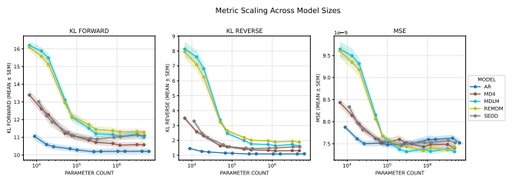
Figure 2 : Scaling on the Gaussian mixture benchmark for forward KL, reverse KL, and MSE. AR Reversed is analyzed separately. Lines show means over 10 independent seeds (0–9), and shaded regions indicate±one standard error of the mean (SEM).
원문 · CC BY 4.0 · Justin Shao, Sihyun Park, David Ryan Koes, Maria Chikina · Discrete Diffusion Playground: A 2D Benchmark for Discrete Generative Models · 원문 그림 인용 · 원본 PDF 6쪽에서 그림 영역을 추출했습니다.AR Reversed 순서 제어
AR의 이점이 coarse-to-fine 비트 순서에서만 나오는지 확인하기 위해 AR Reversed를 두었습니다. AR Reversed는 비트를 뒤집고 교차 배치해 좌표의 계층 구조를 흩뜨린 최악의 순서 제어입니다. 최종 성능 차이는 크지 않았고, reverse KL에서도 표준 AR에 가깝게 유지되었습니다. 학습 곡선에서는 in-order 모델이 초기에 forward KL과 reverse KL을 약간 낮게 보였으며, 저자들은 이를 작은 표본 효율 차이로 해석합니다. 저자들은 충분한 최적화에서 이 간격이 좁아진다고 보고하므로, AR의 우위가 단순한 유리한 비트 순서 때문만은 아니라고 해석합니다. 이 실험은 Gaussian mixture에 한정되며 두 순서 모두 10개 시드로 평가되었습니다.
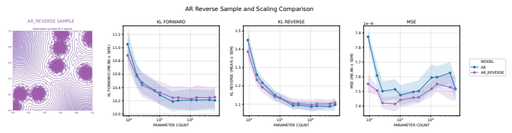
Figure 4 : AR Reversed ordering control on the Gaussian mixture benchmark. Left: representative samples. Right: scaling comparison with standard AR. Lines show means over 10 seeds (0–9), and shaded regions indicate±1 SEM.
원문 · CC BY 4.0 · Justin Shao, Sihyun Park, David Ryan Koes, Maria Chikina · Discrete Diffusion Playground: A 2D Benchmark for Discrete Generative Models · 원문 그림 인용 · 원본 PDF 8쪽에서 그림 영역을 추출했습니다.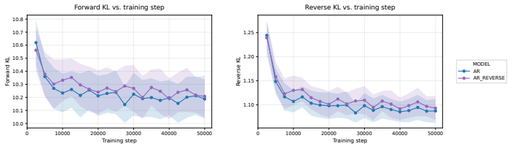
Figure 5 : Effect of sequence ordering on autoregressive training. AR and AR Reversed converge similarly. Lines show means over 10 seeds (0–9), and shaded regions indicate±1 SEM.
원문 · CC BY 4.0 · Justin Shao, Sihyun Park, David Ryan Koes, Maria Chikina · Discrete Diffusion Playground: A 2D Benchmark for Discrete Generative Models · 원문 그림 인용 · 원본 PDF 8쪽에서 그림 영역을 추출했습니다.적응적 공개 순서의 진단
adaptive top-k reveal sampling은 각 단계에서 현재 마스크된 모든 위치를 예측하고 가장 확신이 높은 위치를 먼저 공개하는 진단 절차입니다. 이를 통해 비트 위치별 공개 시간 분포를 얻어, masked diffusion 모델이 명시적인 자기회귀 인수분해 없이도 의미 있는 생성 순서를 복원하는지 볼 수 있습니다. 표준 레이아웃에서는 상위 좌표 비트가 하위 정제 비트보다 먼저 공개되는 경향이 있어 coarse-to-fine 전략과 맞습니다. interleaved 레이아웃에서는 짝을 이룬 x, y 비트가 비슷한 단계에 공개되고, reversed 레이아웃에서는 토큰 순서에 따라 패턴이 바뀝니다.
이 진단은 최종 분포 충실도 지표를 대체하지 않고 이를 보완합니다.
회전 4×4 체커보드의 지지집합 정합
매끄러운 GMM에서는 모드 사이의 질량이 드러나지 않을 수 있으므로, 회전 및 이동된 4×4 체커보드에서 지지집합 정합을 직접 검증했습니다. AR은 KL 지표, 특히 reverse KL에서 가장 좋았고, 이는 무효 영역에 놓이는 확률이 적다는 뜻으로 해석됩니다. masked diffusion 모델들은 모델 크기에 따라 일관되게 확장되지 않았으며, MD4, MDLM, ReMDM은 서로 가깝게 머물렀고 SEDD는 큰 규모에서 특히 악화되었습니다. 샘플에서 MD4, MDLM, ReMDM은 대략적 구조는 포착하지만 경계를 가로질러 흐리게 퍼지고 무효 영역에 질량을 둡니다. 회전 체커보드는 좌표 주변분포를 따로 맞추는 것만으로 풀 수 없으므로 결합 구조가 필요합니다.
이 결과는 4×4 체커보드 설정에 한정됩니다.
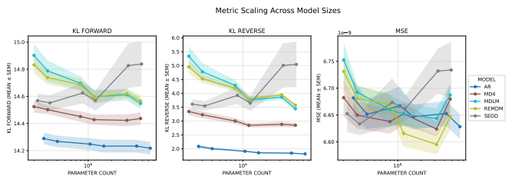
Figure 6 : Metric scaling on the rotated and shifted 4×4 checkerboard benchmark. Lines show means over 10 seeds (0–9), and shaded regions indicate±1 SEM.
원문 · CC BY 4.0 · Justin Shao, Sihyun Park, David Ryan Koes, Maria Chikina · Discrete Diffusion Playground: A 2D Benchmark for Discrete Generative Models · 원문 그림 인용 · 원본 PDF 9쪽에서 그림 영역을 추출했습니다.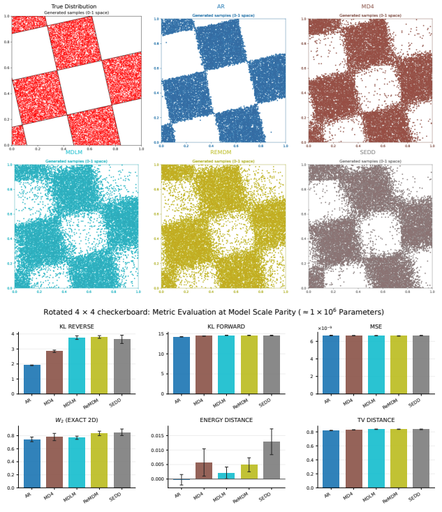
Figure 7 : Scale-parity comparison on the rotated and shifted 4×4 checkerboard benchmark. Top: representative generated samples at approximately matched model scale. Bottom: matched-scale metric comparison. Bars show means over 10 seeds (0–9), with error bars indicating±1 SEM.
원문 · CC BY 4.0 · Justin Shao, Sihyun Park, David Ryan Koes, Maria Chikina · Discrete Diffusion Playground: A 2D Benchmark for Discrete Generative Models · 원문 그림 인용 · 원본 PDF 10쪽에서 그림 영역을 추출했습니다.적용 범위와 한계
Playground는 진단용 벤치마크이며 고차원 응용 벤치마크를 대체하지 않는다고 저자들이 밝힙니다. 이진 시퀀스는 합성이고 자연어, 단백질 서열, 분자 그래프보다 더 구조적이므로, 이 결과가 실제 도메인 성능을 직접 보장하지는 않습니다. 실험은 2D 분포와 AR, MD4, MDLM, ReMDM, SEDD 등 특정 모델 구성에 한정되며, 그 밖의 조건으로 결론을 넓히면 안 됩니다. masked diffusion의 infilling 같은 강점은 이 설정에서 제거되어 있어 일반적인 우열 판단으로 읽으면 안 됩니다. Gray-code 실험은 주요 모델 순위가 대체로 유지됨을 보여 주지만, 모든 인코딩에서의 보장은 아닙니다.
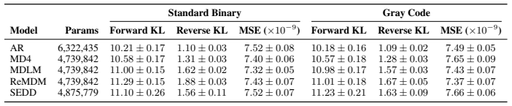
Table 1 : GMM results under standard binary and Gray-code encodings. Values are mean ± SEM over 10 independent seeds (0–9).
원문 · CC BY 4.0 · Justin Shao, Sihyun Park, David Ryan Koes, Maria Chikina · Discrete Diffusion Playground: A 2D Benchmark for Discrete Generative Models · 원문 그림 인용 · 원본 PDF 17쪽에서 그림 영역을 추출했습니다.논문 정보
- 저자
- Justin Shao, Sihyun Park, David Ryan Koes, Maria Chikina
- 학회·저널
- arXiv · 프리프린트
- 최초 공개일
- 2026년 11월 8일
- 등록일
- 2026년 11월 10일
- 수정일
- 2026년 11월 8일
- 버전
- v1
- arXiv
- 2611.11068
- 분류
- cs.LG
- 원문 이용 조건
- CC BY 4.0
- 제공 범위
- 논문 정보, 해설, 허용된 원문 그림
AI 해설은 논문 원문과 별개의 설명이며 오류가 있을 수 있습니다. 원문과 그림은 각 출처의 이용 조건과 따로 표시된 권리를 따릅니다.
초록
Discrete diffusion is a promising framework for categorical generative modeling, but current evaluation protocols often fail to reveal whether models have actually learned the target distribution. We introduce the Discrete Diffusion Playground, a diagnostic benchmark that converts known 2D continuous distributions into binary token sequences through an exact discretized bijection. This creates a rare setting in which models are trained on discrete sequences, but generated samples can be decoded back into 2D and compared directly against a known ground-truth distribution. The benchmark spans smooth Gaussian mixtures and tilted checkerboards with sharp boundaries, disconnected support, and coordinate-dependent structure, allowing it to expose failures that are invisible in standard proxy metrics. It supports exact grid divergences, Wasserstein distances, density visualizations, and nonparametric two-sample tests, providing both quantitative evaluation and interpretable failure diagnosis. Using this testbed, we show that masked diffusion models can learn meaningful adaptive reveal orders but remain less stable than autoregressive baselines on smooth targets and largely fail on tilted checkerboards, where autoregressive models preserve the target geometry. Control experiments with reversed and interleaved token orderings show that autoregressive performance is not explained by favorable bit order alone. The Playground provides a simple but stringent benchmark for stress-testing discrete generative models and for developing evaluation metrics that detect real distributional mismatch rather than proxy performance. Our code is available at https://github.com/shaojus/DiscreteDiffusionPlayground .
원문 인용
Justin Shao, Sihyun Park, David Ryan Koes, Maria Chikina (2026). Discrete Diffusion Playground: A 2D Benchmark for Discrete Generative Models. arXiv:2611.11068v1. https://arxiv.org/abs/2611.11068v1
BibTeX
@misc{shao2026discrete,
  title = {{Discrete Diffusion Playground: A 2D Benchmark for Discrete Generative Models}},
  author = {Justin Shao and Sihyun Park and David Ryan Koes and Maria Chikina},
  year = {2026},
  eprint = {2611.11068},
  archivePrefix = {arXiv},
  url = {https://arxiv.org/abs/2611.11068v1}
}