논문 해설
Quantiles, Not Points: Streaming Quantile Matching for Ordinal-Aware LLM-as-a-Judge Calibration
점이 아닌 분위수: 순서형 인식 LLM-as-a-Judge 보정을 위한 스트리밍 분위수 매칭
- 연구 문제 LLM 판단 점수는 사람 평점과 체계적으로 어긋나므로, 가중치를 고정한 판단자의 점수를 소량의 사람 앵커로 사후 보정하는 방법을 비교합니다.
- 연구 방법 판단 점수와 사람 점수의 경험적 분포를 스트리밍으로 맞추는 streaming quantile matching을 제안하고, 여러 보정 방법과 held-out 프로토콜에서 비교합니다.
- 주요 결과 SQM은 보고된 평가에서 가장 높은 전체 순위를 얻었고, 보정은 대부분 방법에서 원시 판단 대비 오차를 줄였습니다. 스트리밍 SQM은 full-batch 방식보다 적은 라벨로 좋은 held-out MAE에 도달했다고 보고됩니다.
사후 보정이 필요한 이유
LLM-as-a-judge 점수는 같은 평가 과제에서도 사람 점수와 분포가 어긋나는 경우가 많습니다. 이 논문은 판단 모델의 가중치를 고정한 채, 소량의 사람 라벨 앵커 집합으로 원시 점수를 사람 점수에 맞추는 사후 보정을 다룹니다. 이 설정에서는 판단 모델을 다시 학습하지 않으므로 같은 보정된 판단자를 여러 분석의 고정 측정 도구로 재사용할 수 있습니다. 저자들은 LLM 판단 점수를 분포에서 나온 순서형 평점으로 보고, 보정이 입력의 순서성과 판단 점수 및 사람 점수 분포를 함께 존중해야 한다고 주장합니다. 이 관점에서 고전적인 분위수 매칭을 LLM 판단 보정에 적용한 것이 streaming quantile matching(SQM)입니다.
SQM의 보정 사상과 분포 기반 변형
SQM은 판단 점수와 사람 점수의 경험적 CDF를 스트리밍 방식으로 유지하고, 판단 점수 j를 사람 점수 분포의 역CDF로 보내는 분위수 대응 사상으로 보정합니다. 원문 식은 \(g_\phi(j) = \hat{F}_H^{-1}(\hat{F}_J(j))\)이며, 여기서 \(\hat{F}_J\), \(\hat{F}_H\)는 지금까지 본 앵커에서 얻은 판단 점수와 사람 점수의 경험적 CDF입니다. 저자들은 이 사상이 1차원 최적 수송 문제의 닫힌 해이며, L1/EMD 비용 아래에서 평가 지표인 Earth Mover's distance와 같은 불일치를 줄인다고 설명합니다. 또한 예측 분포 변형은 각 예시의 전체 분포를 가중 질량으로 판단 분포에 누적하고, 지지점 각각을 같은 방식으로 보정한 뒤 원래 가중치를 유지합니다.
단일 점수는 가중치 1의 한 점 분포로 볼 수 있어 SQM의 일반화로 제시됩니다.
비교 기준 방법과 분포 정렬의 차이
논문은 미니배치 sliced Wasserstein OT, cross-entropy matching, Dawid–Skene EM, median scaling, isotonic regression, Platt scaling 등 여러 방법을 같은 held-out 프로토콜에서 비교합니다. 미니배치 sliced Wasserstein OT는 배치마다 정렬된 순서 통계량으로 1차원 수송 쌍을 만들고 이를 누적합니다. Cross-entropy matching은 쌍 데이터가 아니라 두 주변 분포의 히스토그램 사이 KL 발산으로 아핀 사상을 적합합니다. 저자들은 SQM이 같은 분포 정렬을 목표로 하더라도 모수 제약이 없는 분위수 대응을 사용하고, 목적이 평가 지표와 일치한다는 점에서 이들과 구분된다고 해석합니다.
held-out 평가 프로토콜과 지표
스트리밍과 배치 방식은 체크포인트마다 held-out 집합에서 다시 평가되고, full-batch 방식은 비보류 풀 전체로 한 번 적합된 뒤 한 번 평가됩니다. 주 지표는 held-out 평균 절대 오차이며, 스트리밍 중 누적 평균 오차는 초기 콜드 스타트 구간의 영향을 받으므로 선호하지 않습니다. 분포 형태는 1-Wasserstein 거리(Earth Mover's Distance)로 평가하고, 정확 일치율도 보고합니다. 저자들은 KL 발산보다 EMD가 점수의 순서 거리를 반영한다고 설명합니다.
보정 효과와 SQM의 상대적 성능
Table 2와 Table 3의 중앙값 값에서 SQM은 held-out MAE 0.53, Wasserstein 거리 0.26, 정확 일치율 0.55를 보고합니다. 괄호 안의 값은 원시 점수 대비 상대 개선률이며, 이 표들이 비교하는 대상은 17개 방법입니다. 논문은 SQM이 17개 방법 중 pairwise 다수결 순위 1위이며 7승 0패라고 보고합니다. 보정 전후에는 중앙값 Spearman ρ 0.494와 Kendall τb 0.450이 같다고 보고되며, 저자들은 단조 보정기가 순위를 바꿀 수 없다는 점과 비단조 방법에서도 같은 결과가 나타난다는 점을 함께 근거로 듭니다. 다만 이 결과는 본문에 제시된 평가 프로토콜과 데이터셋 조건에서의 관찰입니다.

Table 2 : Held-outMedianperformance pooled across datasets, models, and prompts for SQM, CDF, and top baseline methods.Boldindicates best performance; underline marks second best; (∆ %) denotes relative improvement over raw scores;Rank (W/L)denotes overall pairwise majority-vote rank and wins/losses across all 17 evaluated methods.
원문 · CC BY 4.0 · Ilija Subasic, Andrew Rabinovich, Zhao Chen · Quantiles, Not Points: Streaming Quantile Matching for Ordinal-Aware LLM-as-a-Judge Calibration · 원문 그림 인용 · 원본 PDF 6쪽에서 그림 영역을 추출했습니다.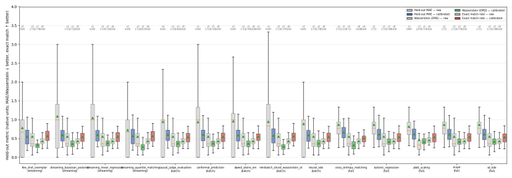
Figure 6 : Held-out MAE, Wasserstein distance, and exact-match rate per calibration method (raw vs. best-checkpoint calibrated), in native units. Methods are grouped by track (streaming, batch, full-batch); outlier counts and the most extreme outlier value are annotated above each box.
원문 · CC BY 4.0 · Ilija Subasic, Andrew Rabinovich, Zhao Chen · Quantiles, Not Points: Streaming Quantile Matching for Ordinal-Aware LLM-as-a-Judge Calibration · 원문 그림 인용 · 원본 PDF 16쪽에서 그림 영역을 추출했습니다.
Table 3 : Methods’ MAE, Wasserstein distance, and exact-match rate, pooled across all datasets, models, and prompts. Medianis the median calibrated value across held-out groups;Bestis that method’s single best-performing held-out group.Boldmarks the best value in each column and underline the second best; (∆ %) is the relative improvement over the raw scores;W/Lis the number of dataset ×metric combinations in which the method finished first / last by pairwise majority vote over metrics, with ties counted.
원문 · CC BY 4.0 · Ilija Subasic, Andrew Rabinovich, Zhao Chen · Quantiles, Not Points: Streaming Quantile Matching for Ordinal-Aware LLM-as-a-Judge Calibration · 원문 그림 인용 · 원본 PDF 17쪽에서 그림 영역을 추출했습니다.데이터 양과 적합 시점
스트리밍 SQM의 궤적은 전체 풀로 한 번 적합한 full-batch 체크포인트보다 적은 라벨 데이터로 더 낮은 held-out MAE에 도달했다고 보고됩니다. 평균 궤적 0.61은 10, 25, 50, 75, 100% 데이터로 적합한 full-batch 체크포인트들보다 낮습니다. 저자들은 이를 모든 점진적 방법에 일반화하지 않으며, 미니배치 sliced Wasserstein OT는 같은 초기 이점을 보이지 않는다고 구분합니다.
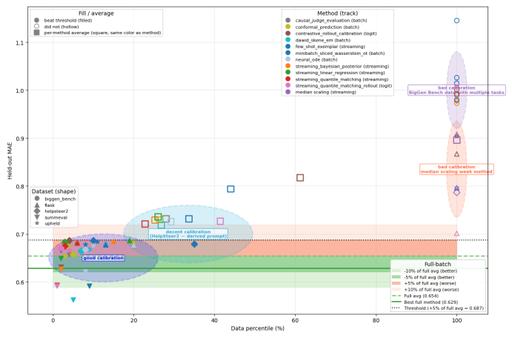
Figure 2 : For each (method, dataset) pair: held-out MAE at the first point in the stream where it falls within +5% of the full-batch reference (filled = reached; hollow = never reached, plotted at 100%; squares = per-method averages). Shaded bands mark±5% (darker) and±10% (lighter) around the full-batch average.
원문 · CC BY 4.0 · Ilija Subasic, Andrew Rabinovich, Zhao Chen · Quantiles, Not Points: Streaming Quantile Matching for Ordinal-Aware LLM-as-a-Judge Calibration · 원문 그림 인용 · 원본 PDF 7쪽에서 그림 영역을 추출했습니다.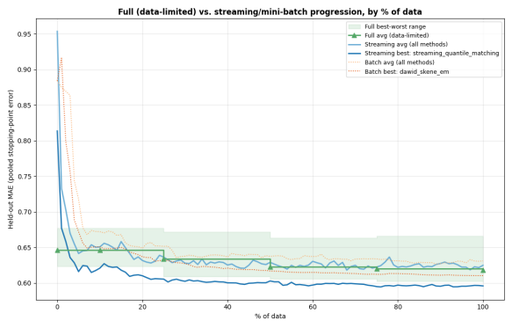
Figure 3 : Full-batch method fit on limited amounts of training data (10/25/50/75/100%, green step function with best–worst range shaded) versus streaming’s and batch’s own pooled stopping-point curves across every percentile of data (best method and across-method average for each track). Held-out MAE, pooled across all four judge models.
원문 · CC BY 4.0 · Ilija Subasic, Andrew Rabinovich, Zhao Chen · Quantiles, Not Points: Streaming Quantile Matching for Ordinal-Aware LLM-as-a-Judge Calibration · 원문 그림 인용 · 원본 PDF 8쪽에서 그림 영역을 추출했습니다.판단 모델 크기와 보정 격차
판단 모델 비교에서 GPT-5와 Kimi-K3는 대형 판단자, GPT-OSS-20b와 Qwen3-30b는 중형 판단자로 쓰였습니다. 보정 후 평균 기준으로 GPT-OSS-20b는 GPT-5와의 MAE 차이가 0.023이고, 이는 원시 격차의 83.9%를 줄인 것입니다. Qwen3-30b는 GPT-5와 0.072 이내, Kimi-K3와 0.130 이내로 보고됩니다. 작은 판단자들은 원시 격차의 34.5–45.5%를 줄였습니다. 다만 Qwen3.5-2b는 보정 후 격차가 늘어났으며, 출력 처리 오류율이 최대 20%였으므로 일부 효과가 출력 처리 실패를 반영할 수 있다고 제한됩니다.
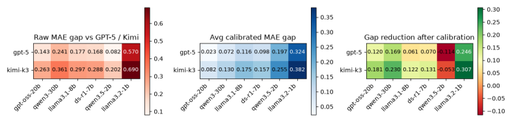
Figure 5 : Heat map of calibration gap between frontier and medium, and smaller model.
원문 · CC BY 4.0 · Ilija Subasic, Andrew Rabinovich, Zhao Chen · Quantiles, Not Points: Streaming Quantile Matching for Ordinal-Aware LLM-as-a-Judge Calibration · 원문 그림 인용 · 원본 PDF 9쪽에서 그림 영역을 추출했습니다.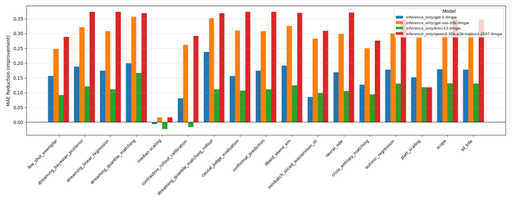
Figure 7 : Held-out MAE reduction (raw judge minus calibrated final MAE) per calibration method, one bar cluster per judge model. Larger is better. Improvement is consistently largest for the two weaker judges (gpt-oss-20b, qwen3-30b) and smallest for kimi-k3; median scaling is the exception, with near-zero improvement for every model.
원문 · CC BY 4.0 · Ilija Subasic, Andrew Rabinovich, Zhao Chen · Quantiles, Not Points: Streaming Quantile Matching for Ordinal-Aware LLM-as-a-Judge Calibration · 원문 그림 인용 · 원본 PDF 17쪽에서 그림 영역을 추출했습니다.데이터셋 균일성과 적용 범위
BiGGen Bench는 아홉 가지 능력에 대한 인스턴스별 루브릭을 가져 단일 전체 속성으로 점수화되었고, 여러 과제에서 보정이 어려운 데이터셋으로 보고됩니다. 저자들은 과제의 균일성이 보정이 쉽게 해결할 수 없는 데이터셋 성질이라고 해석합니다. 모든 프롬프트와 데이터는 영어로 제한되었으며, 언어 독립성은 가정으로 남습니다. 판단자 학습 방식이나 프롬프트 변화가 판단-사람 정렬에 미치는 영향은 이 논문의 범위 밖입니다.
중단 규칙 비교
논문은 손실 기반 적응형 중단 규칙 다섯 가지와 고정 horizon인 stop_at_100, stop_at_200을 비교합니다. 중앙값 후회 기준에서 stop_at_200이 가장 작고, stop_at_100이 그다음입니다. 적응형 규칙은 중앙값 후회가 더 높고 꼬리가 무거운 편입니다. 저자들은 이 결과를 본 설정에서 스트림 자체로 수렴을 감지하기보다 고정 horizon이 더 신뢰할 만하다는 해석으로 제시합니다.
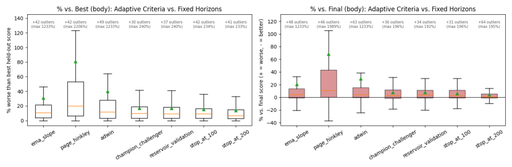
Figure 4 : Automatic stopping rules compared on two regret measures, pooled across all streaming and batch methods, datasets, and judge models.Left:% worse than that run’s own best-ever held-out score (lower is better).Right:% vs. the run’s eventual final score after consuming the full pool (negative means the stopping point already beat the eventual final score). Orange line: median; green triangle: mean; outlier counts and the most extreme outlier are annotated above each box. The two fixed-horizon rules (stop_at_100, stop_at_200) have the lowest median and mean regret of all seven rules on both measures.
원문 · CC BY 4.0 · Ilija Subasic, Andrew Rabinovich, Zhao Chen · Quantiles, Not Points: Streaming Quantile Matching for Ordinal-Aware LLM-as-a-Judge Calibration · 원문 그림 인용 · 원본 PDF 8쪽에서 그림 영역을 추출했습니다.논문 정보
- 저자
- Ilija Subasic, Andrew Rabinovich, Zhao Chen
- 학회·저널
- arXiv · 프리프린트
- 최초 공개일
- 2026년 10월 30일
- 등록일
- 2026년 11월 7일
- 수정일
- 2026년 10월 30일
- 버전
- v1
- arXiv
- 2611.00447
- 분류
- cs.AI · cs.CL
- 원문 이용 조건
- CC BY 4.0
- 제공 범위
- 논문 정보, 해설, 허용된 원문 그림
AI 해설은 논문 원문과 별개의 설명이며 오류가 있을 수 있습니다. 원문과 그림은 각 출처의 이용 조건과 따로 표시된 권리를 따릅니다.
초록
LLM-as-a-judge scores are often distributionally shifted from human ratings on any given evaluation task, and post-hoc calibration (mapping LLM to human scores in a small labeled anchor set) has become a popular method to correct for this shift. In this paper we derive the calibration from two positions: that LLMaJ scores are ordinal ratings drawn from a distribution rather than isolated points. We present streaming quantile matching (SQM), a version of a classical method not previously bench marked for LLMaJ calibration, which is built on the two positions by computing the optimal-transport map between the LLM and human score distributions. We develop an evaluation framework and within it we show that unlike point-wise calibrations, SQM respects the ordinality of the human anchor set and achieves the best distributional fidelity and the top overall rank across models and data. We also show that in general, post-hoc calibration narrows the raw error gap between smaller and larger judge models, which opens the possibility of more efficient LLM judges.
원문 인용
Ilija Subasic, Andrew Rabinovich, Zhao Chen (2026). Quantiles, Not Points: Streaming Quantile Matching for Ordinal-Aware LLM-as-a-Judge Calibration. arXiv:2611.00447v1. https://arxiv.org/abs/2611.00447v1
BibTeX
@misc{subasic2026quantiles,
  title = {{Quantiles, Not Points: Streaming Quantile Matching for Ordinal-Aware LLM-as-a-Judge Calibration}},
  author = {Ilija Subasic and Andrew Rabinovich and Zhao Chen},
  year = {2026},
  eprint = {2611.00447},
  archivePrefix = {arXiv},
  url = {https://arxiv.org/abs/2611.00447v1}
}