논문 해설
Robust AI Evaluation through Maximal Lotteries
최대 복권을 통한 견고한 AI 평가
- 연구 문제 대규모 언어모델의 주관적 평가에서 쌍대 비교를 단일 순위로 합치는 방식은 이질적인 선호를 가릴 수 있으며, 사회적 선택 규칙인 maximal lottery도 부분집단 간 격차를 남길 수 있습니다.
- 연구 방법 쌍대 비교로 만든 마진 행렬에 대해, 부분집단 혼합 가중치의 ℓ1 ball로 정의한 ambiguity set 위에서 최악의 승률 보장을 최대화하는 robust lottery를 선형계획으로 계산합니다.
- 주요 결과 LMArena와 HUMAINE에서 반경 ρ를 키우면 held-out 데이터의 최악 부분집단 승률이 개선되고 최고 성능 부분집단은 약간 낮아지며, 보조 모델로 확률이 분산됩니다.
문제: 쌍대 비교를 하나의 순위로 합칠 때 생기는 한계
대규모 언어모델을 주관적 과제에서 평가할 때 흔히 쓰는 방법은 두 응답 가운데 더 나은 쪽을 고르는 쌍대 비교입니다. 리더보드는 이런 비교를 Bradley-Terry (BT) 모델로 적합하여 하나의 잠재 강도 순위를 만듭니다. BT는 각 시스템에 강도 파라미터 하나를 부여하므로, 프롬프트마다 달라지는 성능이나 비이행적인 선호를 담기 어렵습니다. 논문은 이 문제를 피하는 사회적 선택 규칙으로 maximal lottery를 검토합니다. maximal lottery는 순위 대신 경쟁력 있는 모델들의 집합을 주며, 선호 구조에 가정을 두지 않습니다. 그러나 전체 집단의 선호를 합친 집계에 민감하기 때문에, 특정 사용자 부분집단에서 큰 성능 격차를 남길 수 있습니다.
논문의 예시에서 표준 maximal lottery는 LMArena 집계 선호에서 Gemini 2.5 Pro 한 모델에 확률을 집중시키지만, 프롬프트 언어별 부분집단에서는 그 모델의 성능이 일부 언어에서 뚜렷하게 낮게 남습니다.
Margin matrix와 maximal lottery의 기본 정의
방법의 출발점은 쌍대 비교 데이터를 majority margin matrix로 바꾸는 것입니다. 순서쌍 (i,j)에서 i가 j보다 선호된 횟수를 wij, 두 모델의 전체 비교 횟수를 nij=wij+wji라 하면, 마진 Mij는 nij가 0보다 클 때 (wij-wji)/nij이고 그 밖에는 0입니다. 이 행렬은 스큐 대칭이며 각 원소는 [-1,1] 안에 있습니다. 이 마진을 대칭 제로섬 게임의 payoff로 보면, 확률 분포 p는 모든 상대 혼합 q에 대해 최악의 마진을 최대화하는 전략이 됩니다. maximal lottery는 이 값을 최대화하는 p의 집합입니다. 여기서 p의 승률 보장은 Pr(p≻q)=1/2+p^T M q/2로 읽히므로, 최적 로터리는 어떤 고정 모델이나 혼합도 기대값에서 이기지 못하는 분포입니다.
이 정의는 전이성을 요구하지 않으므로 Bradley-Terry처럼 전역 순위를 가정하지 않습니다.
Ambiguity set에서 최악 값을 최대화하는 로버스트 로터리
로버스트 로터리는 단일 margin matrix 대신 margin matrix들의 집합인 ambiguity set M을 둡니다. 어떤 로터리 p의 값은 V(p,M)=min over M in M of min over q of p^T M q로 정의되며, robust lottery는 이 V(p,M)을 최대화하는 p입니다. 따라서 이 방법은 모든 가능한 margin matrix에서 가장 나쁜 승률 보장을 기준으로 삼습니다. 논문이 실제로 다루는 ambiguity set은 부분집단 혼합 가중치의 불확실성입니다. K개 부분집단 각각이 만든 margin matrix M(k)와 혼합 w에 대해 M(w)=sum over k of wk M(k)로 정의하고, 기준 혼합 w0 주변의 ℓ1 ball W(w0,ρ)에서 w를 허용합니다.
ρ=0이면 집계 행렬에 대한 표준 maximal lottery가 되고, ρ=1이면 모든 혼합에 대한 최악 경우를 다룹니다. 이 방식은 분포 이동을 구체적인 재가중 방식으로 표현하면서, 학습된 모델 가정을 요구하지 않습니다.
선형계획으로 계산하는 방법과 희소 해
최악 값을 최대화하는 문제는 min과 max가 얽혀 있어 직접 풀기 어렵습니다. 논문은 ℓ1 ball 안의 최소화를 쌍대화하여 하나의 선형계획으로 바꿉니다. 이 선형계획의 변수는 대안 위의 확률 p, 최악 값을 나타내는 t, 그리고 쌍대 변수들입니다. 제약식의 개수와 변수 수는 모두 모델 수 m과 부분집단 수 K에 대해 O(mK) 규모입니다. 이 형식은 예산이나 벤치마크 성능 같은 선형 제약을 추가하기도 쉬워서, 논문은 비용-성능 경계를 그리는 데 이를 사용합니다. 또한 ε-최적 해 중에는 지지 집합의 크기가 m과 K에 대해 로그 규모로 제한되는 희소 로터리가 존재한다는 결과가 있습니다. 이 결과는 로버스트 bipartisan set이 전체 대안 수에 비해 작을 수 있다는 실험 관찰과 연결됩니다.
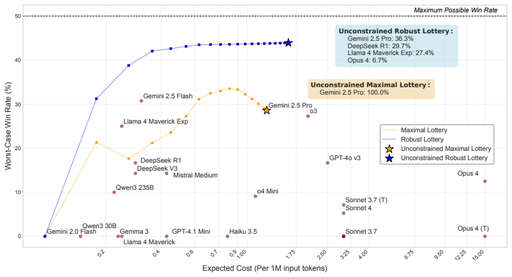
Figure 1 :Robust lotteries improve worst-case win rate across user subpopulations.We consider a fixed set of models (red points) and partition the LMArena votes according to the language of the prompt. We then evaluate any lottery (a probability distribution over models) by itsworst-case performanceon LMArena ( y-axis): the minimum win rate the lottery achieves across the four user subpopulations. Because the guarantee is minq Pr(p≻q) in a symmetric zero-sum game, it is at most 50%. Thex-axis reports the lottery’s expected inference cost per 1M input tokens. The orangecurve traces the cost–performance frontier obtained by solving for themaximal lotteryunder an expected-cost budget. Thebluecurve traces the corresponding frontier forrobust lotteries, which instead optimize the worst-case guarantee using a robust linear program. Across budgets, robust lotteries achieve substantially higher worst-case performance than the standard maximal lottery.
원문 · CC BY 4.0 · Hadi Khalaf, Serena L. Wang, Daniel Halpern, Itai Shapira, Flavio du Pin Calmon, Ariel D. Procaccia · Robust AI Evaluation through Maximal Lotteries · 원문 그림 인용 · 원본 PDF 2쪽에서 그림 영역을 추출했습니다.LMArena와 HUMAINE에서 반경 ρ를 바꾼 검증
검증은 LMArena와 HUMAINE 데이터에서 ρ 값을 여러 개로 바꾸어 로터리를 계산하고, 학습에 쓰지 않은 held-out 투표에서 승률을 측정하는 방식으로 이루어집니다. LMArena에서는 프롬프트 언어를 집단으로 사용하며, 영어, 폴란드어, 러시아어, 중국어 네 개 부분집단을 다룹니다. HUMAINE에서는 주석자의 민족 집단을 사용합니다. 평가는 held-out 투표 20%에서 전체 집단과 부분집단의 승률을 bootstrap 평균과 표준오차(200 samples)로 보고합니다. 결과를 보면 ρ가 커질수록 가장 낮은 성능의 부분집단 승률이 개선되고, 가장 높은 성능의 부분집단에서는 약간 감소합니다.
이는 최악 집단 보장과 최고 집단 성능 사이의 trade-off로 해석됩니다. 또한 LMArena에서 ρ=0의 train-test 승률 차이는 약 6%였고 ρ=1에서는 약 2%로 줄어, 혼합 가중치가 더 안정적으로 학습되었다고 저자들은 해석합니다. 로터리의 확률도 ρ가 커질수록 o3와 Llama 4 Maverick 같은 보조 모델로 분산됩니다.
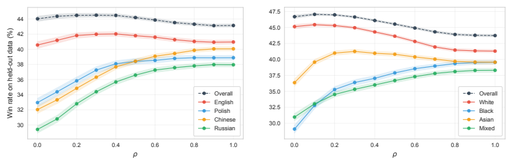
Figure 3 :Robust lotteries improve win rate guarantees across subpopulations.We compute robust lotteries for varying radius valuesρ and evaluate each lottery on held-out votes (20% split). We show bootstrap means of win rates achieved on the overall population and each subgroup with standard errors (200 samples). Asρ increases, robust lotteries improve the win rate guarantees for the lowest-performing groups with a modest decrease for the highest-performing groups, illustrating a robustness–accuracy trade-off.Left:LMArena, with groups defined by prompt language.Right: HUMAINE, with groups defined by annotator’s ethnic group.
원문 · CC BY 4.0 · Hadi Khalaf, Serena L. Wang, Daniel Halpern, Itai Shapira, Flavio du Pin Calmon, Ariel D. Procaccia · Robust AI Evaluation through Maximal Lotteries · 원문 그림 인용 · 원본 PDF 9쪽에서 그림 영역을 추출했습니다.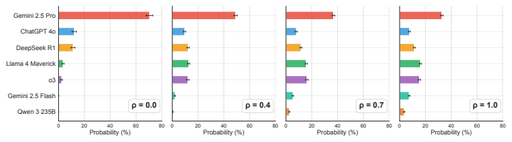
Figure 4 :Robust lotteries diversify the lottery to handle preference tradeoffs among subpopulations.We present the estimated probability assigned to each model with its standard error from LMArena (200 samples). Atρ= 0 , the lottery concentrates on the top aggregate performer (Gemini 2.5 Pro). Asρ increases, probability mass shifts toward additional strong models (e.g., o3 and Llama 4 Maverick), reflecting the need to hedge to improve win rate guarantees as seen in
원문 · CC BY 4.0 · Hadi Khalaf, Serena L. Wang, Daniel Halpern, Itai Shapira, Flavio du Pin Calmon, Ariel D. Procaccia · Robust AI Evaluation through Maximal Lotteries · 원문 그림 인용 · 원본 PDF 10쪽에서 그림 영역을 추출했습니다.적용 범위와 한계
이 방법의 개선은 ambiguity set을 부분집단 혼합 가중치로 정의한 조건에서 확인되었습니다. 다른 종류의 margin matrix 불확실성이나 다른 데이터셋에서의 효과는 본문의 주 실험으로 확인되지 않았습니다. 부록의 Search Arena와 Open LLM 실험은 프롬프트 언어, 주석자의 주요 의도, 벤치마크를 집단으로 삼아 같은 방식으로 수행되었으며, 이 결과들은 주 실험과 별도로 읽어야 합니다. 이론적으로 robust lottery는 m이 3 이상이면 population consistency를 만족하지 않으며, 두 집단에 공통의 strict RCW가 있을 때에만 성질이 보존된다고 증명되었습니다.
실험에서도 최악 집단 승률의 개선은 최고 성능 집단의 약간의 감소를 동반하므로, 실제 배치에서는 어떤 집단의 성능을 얼마나 희생할지에 대한 판단이 필요합니다.
논문 정보
- 저자
- Hadi Khalaf, Serena L. Wang, Daniel Halpern, Itai Shapira, Flavio du Pin Calmon, Ariel D. Procaccia
- 학회·저널
- arXiv · 프리프린트
- 최초 공개일
- 2026년 2월 24일
- 등록일
- 2026년 10월 29일
- 수정일
- 2026년 2월 24일
- 버전
- v1
- arXiv
- 2602.21297
- 분류
- cs.LG
- 원문 이용 조건
- CC BY 4.0
- 제공 범위
- 논문 정보, 해설, 허용된 원문 그림
AI 해설은 논문 원문과 별개의 설명이며 오류가 있을 수 있습니다. 원문과 그림은 각 출처의 이용 조건과 따로 표시된 권리를 따릅니다.
초록
The standard way to evaluate language models on subjective tasks is through pairwise comparisons: an annotator chooses the "better" of two responses to a prompt. Leaderboards aggregate these comparisons into a single Bradley-Terry (BT) ranking, forcing heterogeneous preferences into a total order and violating basic social-choice desiderata. In contrast, social choice theory provides an alternative approach called maximal lotteries, which aggregates pairwise preferences without imposing any assumptions on their structure. However, we show that maximal lotteries are highly sensitive to preference heterogeneity and can favor models that severely underperform on specific tasks or user subpopulations. We introduce robust lotteries that optimize worst-case performance under plausible shifts in the preference data. On large-scale preference datasets, robust lotteries provide more reliable win rate guarantees across the annotator distribution and recover a stable set of top-performing models. By moving from rankings to pluralistic sets of winners, robust lotteries offer a principled step toward an ecosystem of complementary AI systems that serve the full spectrum of human preferences.
원문 인용
Hadi Khalaf, Serena L. Wang, Daniel Halpern, Itai Shapira, Flavio du Pin Calmon, Ariel D. Procaccia (2026). Robust AI Evaluation through Maximal Lotteries. arXiv:2602.21297v1. https://arxiv.org/abs/2602.21297v1
BibTeX
@misc{khalaf2026robust,
  title = {{Robust AI Evaluation through Maximal Lotteries}},
  author = {Hadi Khalaf and Serena L. Wang and Daniel Halpern and Itai Shapira and Flavio du Pin Calmon and Ariel D. Procaccia},
  year = {2026},
  eprint = {2602.21297},
  archivePrefix = {arXiv},
  url = {https://arxiv.org/abs/2602.21297v1}
}