논문 해설
Graph Barlow Twins: A self-supervised representation learning framework for graphs
Graph Barlow Twins: 그래프를 위한 자기지도 표현 학습 프레임워크
- 연구 문제 음성 샘플과 비대칭 구조가 필요한 기존 그래프 자기지도 학습을 대체할 수 있는지 검토합니다.
- 연구 방법 두 증강 그래프 뷰의 임베딩 교차상관행렬을 항등행렬에 가깝게 만드는 대칭 구조의 Graph Barlow Twins를 제안합니다.
- 주요 결과 노드 분류 실험에서 G-BT는 일부 과제에서 기존 방법과 경쟁력을 보였고, 같은 실험 설정에서 BGRL보다 짧은 학습 시간을 보고합니다.
그래프 자기지도 학습의 문제
그래프 표현 학습은 라벨이 비싼 상황에서 노드 임베딩을 얻기 위해 자기지도 학습을 활용해 왔습니다. 대조 학습 계열의 방법들은 음성 샘플을 필요로 하며, 그래프에서는 어떤 노드를 음성으로 볼지에 대한 직관이 명확하지 않습니다. 또한 BGRL처럼 비대칭 구조를 쓰는 방법은 예측기, 기울기 정지, 지수 이동 평균 같은 장치에 의존해 개념적으로 복잡합니다. 이 논문은 음성 샘플과 비대칭 구조 없이 그래프 자기지도 표현 학습이 노드 분류에서 경쟁력을 가질 수 있는지를 검토합니다.
Graph Barlow Twins의 학습 절차
Graph Barlow Twins는 속성 그래프에 간선 제거와 노드 특징 마스킹을 적용해 두 증강 그래프 뷰를 만듭니다. 같은 인코더가 두 뷰를 처리해 임베딩 행렬을 얻으며, 임베딩은 배치 방향으로 정규화된 뒤 교차상관행렬 C로 요약됩니다. 손실은 C의 대각 원소를 1에 가깝게 하는 불변성 항과 비대각 원소를 0에 가깝게 하는 중복 감소 항의 합으로 구성되며, 두 항의 균형은 λ로 조절합니다. 저자들은 λ를 1/d로 두는 것을 기본값으로 사용합니다. 이 구조에서는 기울기가 인코더를 통해 대칭적으로 전파되므로 예측기나 기울기 정지가 필요하지 않습니다.
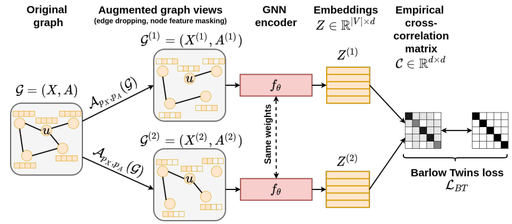
Figure 1 : Overview of our proposed Graph Barlow Twins framework. We transform an input graphG using an augmentation function and obtain two views:G(1) and G(2). We pass both of them through the same GNN encoderfθ to compute two embedding matricesZ(1), Z(2). We build a loss function such that the embeddings’ empirical cross-correlation matrixC is optimized into the identity matrix.
원문 · CC BY 4.0 · Piotr Bielak, Tomasz Kajdanowicz, Nitesh V. Chawla · Graph Barlow Twins: A self-supervised representation learning framework for graphs · 원문 그림 인용 · 원본 PDF 4쪽에서 그림 영역을 추출했습니다.중소형 및 대규모 노드 분류 결과
중소형 전이 설정에서 G-BT는 2계층 GCN 인코더로 학습되었고, 정확도는 20개 분할과 초기화에 대한 평균과 표준편차로 보고됩니다. ogb-arxiv에서는 3계층 GCN을 사용했으며 G-BT는 300 epochs에서 테스트 정확도 70.12 ± 0.18을 기록했습니다. 같은 표에서 BGRL은 10k epochs에서 71.64 ± 0.12입니다. PPI에서는 3계층 GAT 인코더와 Micro-F1 지표를 사용했으며 G-BT는 500 epochs에서 70.49 ± 0.19, BGRL GAT 인코더는 1k epochs에서 70.49 ± 0.05입니다. 이 수치들은 서로 다른 학습 예산과 인코더 조건에서 얻은 값이므로 같은 조건의 우위로 해석하지 않습니다.
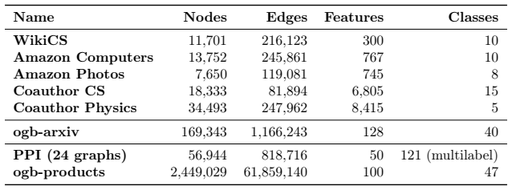
Table 1 : Dataset statistics. We use small to medium sized standard datasets together with the larger ogb-arxiv dataset in the transductive setting. We also evaluate the inductive setting using the ogb-products and PPI (multiple graphs) dataset.
원문 · CC BY 4.0 · Piotr Bielak, Tomasz Kajdanowicz, Nitesh V. Chawla · Graph Barlow Twins: A self-supervised representation learning framework for graphs · 원문 그림 인용 · 원본 PDF 5쪽에서 그림 영역을 추출했습니다.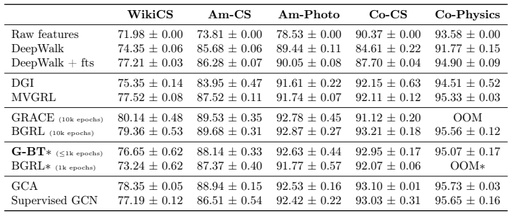
Table 2 : Mean and std accuracy of transductive node classification over 20 data splits and initializations obtained in BGRL paper [23] and our experiment (∗) within the same experimental setup. OOM denotes running out of memory on a 16GB V100 GPU.
원문 · CC BY 4.0 · Piotr Bielak, Tomasz Kajdanowicz, Nitesh V. Chawla · Graph Barlow Twins: A self-supervised representation learning framework for graphs · 원문 그림 인용 · 원본 PDF 7쪽에서 그림 영역을 추출했습니다.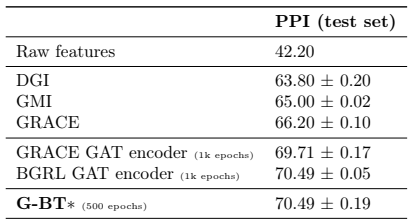
Table 4 : Mean and std Micro-F1 of multilabel node classification the PPI dataset over 20 model initializations obtained in BGRL paper [23] and our experiment (∗) within the same experimental setup.
원문 · CC BY 4.0 · Piotr Bielak, Tomasz Kajdanowicz, Nitesh V. Chawla · Graph Barlow Twins: A self-supervised representation learning framework for graphs · 원문 그림 인용 · 원본 PDF 7쪽에서 그림 영역을 추출했습니다.대규모 귀납 설정과 학습 시간
ogb-products에서는 GAT 기반 인코더와 배치 크기 512의 이웃 표본추출을 사용하고 100 epochs 동안 학습했습니다. 테스트 정확도는 G-BT*가 70.46 ± 0.38, BGRL*가 63.97 ± 1.62로 보고되었으며, 이 비교는 저자들이 BGRL을 배치 입력을 받도록 수정해 재측정한 결과입니다. 학습 시간 비교에서는 단일 epoch 시간을 10회 측정해 평균을 냈고, 저자들은 G-BT가 BGRL보다 약 17-42배 빠르다고 보고합니다. 이 속도 비교는 측정 조건이 달라 정확도 비교와 같은 통제 실험으로 볼 수는 없습니다.
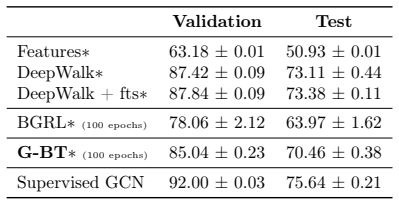
Table 5 : Mean and std accuracy of inductive node classification on the ogb-products dataset over 5 model initializations obtained in the OGB leaderboard and our experiment (∗) within the same experimental setup.
원문 · CC BY 4.0 · Piotr Bielak, Tomasz Kajdanowicz, Nitesh V. Chawla · Graph Barlow Twins: A self-supervised representation learning framework for graphs · 원문 그림 인용 · 원본 PDF 8쪽에서 그림 영역을 추출했습니다.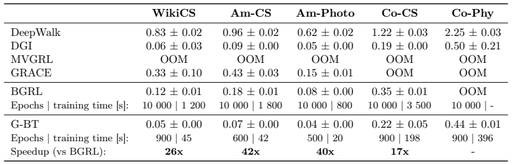
Table 6 : Single epoch running time (in seconds) averaged over 10 training epochs.
원문 · CC BY 4.0 · Piotr Bielak, Tomasz Kajdanowicz, Nitesh V. Chawla · Graph Barlow Twins: A self-supervised representation learning framework for graphs · 원문 그림 인용 · 원본 PDF 9쪽에서 그림 영역을 추출했습니다.배치 처리와 절제 실험의 범위
배치 처리 실험에서는 대부분의 데이터셋에서 전체 배치 설정보다 성능이 낮아졌으며, 저자들은 이를 추가 fine-tuning이 필요한 결과로 설명합니다. 절제 실험에서는 WikiCS에서 2계층 GCN과 두 증강을 함께 쓴 설정이 가장 좋았고, λ가 1/d 근처일 때 성능이 가장 높았습니다. λ가 1에 가까워지면 성능이 약 55% 수준으로 떨어진다고 보고됩니다. 이 결과는 WikiCS와 해당 학습 예산에서 얻은 것이므로 모든 데이터셋에 같은 λ가 최적이라는 주장으로 넓히지 않습니다.
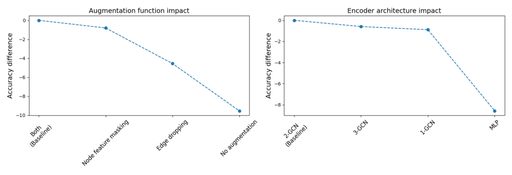
Figure 3 : Visualization of the ablation study. We consider the two most important parts of our model: the augmentation functions and the encoder architecture. We evaluate different settings and conclude that: (1) using both augmentation methods (node feature masking and edge dropping) at once, yields the best results, (2) the two-layer GCN model works the best, whereas a deeper one (three layers) suffers from the oversmoothing issue.
원문 · CC BY 4.0 · Piotr Bielak, Tomasz Kajdanowicz, Nitesh V. Chawla · Graph Barlow Twins: A self-supervised representation learning framework for graphs · 원문 그림 인용 · 원본 PDF 10쪽에서 그림 영역을 추출했습니다.논문 정보
- 저자
- Piotr Bielak, Tomasz Kajdanowicz, Nitesh V. Chawla
- 학회·저널
- arXiv · 프리프린트
- 최초 공개일
- 2021년 6월 4일
- 등록일
- 2026년 11월 6일
- 수정일
- 2023년 9월 12일
- 버전
- v3
- arXiv
- 2106.02466
- DOI
- 10.1016/j.knosys.2022.109631
- 분류
- cs.LG
- 원문 이용 조건
- CC BY 4.0
- 제공 범위
- 논문 정보, 해설, 허용된 원문 그림
AI 해설은 논문 원문과 별개의 설명이며 오류가 있을 수 있습니다. 원문과 그림은 각 출처의 이용 조건과 따로 표시된 권리를 따릅니다.
초록
The self-supervised learning (SSL) paradigm is an essential exploration area, which tries to eliminate the need for expensive data labeling. Despite the great success of SSL methods in computer vision and natural language processing, most of them employ contrastive learning objectives that require negative samples, which are hard to define. This becomes even more challenging in the case of graphs and is a bottleneck for achieving robust representations. To overcome such limitations, we propose a framework for self-supervised graph representation learning - Graph Barlow Twins, which utilizes a cross-correlation-based loss function instead of negative samples. Moreover, it does not rely on non-symmetric neural network architectures - in contrast to state-of-the-art self-supervised graph representation learning method BGRL. We show that our method achieves as competitive results as the best self-supervised methods and fully supervised ones while requiring fewer hyperparameters and substantially shorter computation time (ca. 30 times faster than BGRL).
원문 인용
Piotr Bielak, Tomasz Kajdanowicz, Nitesh V. Chawla (2021). Graph Barlow Twins: A self-supervised representation learning framework for graphs. arXiv:2106.02466v3. https://doi.org/10.1016/j.knosys.2022.109631
BibTeX
@article{bielak2021graph,
  title = {{Graph Barlow Twins: A self-supervised representation learning framework for graphs}},
  author = {Piotr Bielak and Tomasz Kajdanowicz and Nitesh V. Chawla},
  year = {2021},
  eprint = {2106.02466},
  archivePrefix = {arXiv},
  doi = {10.1016/j.knosys.2022.109631},
  url = {https://arxiv.org/abs/2106.02466v3}
}