논문 해설
A Survey on Malware Detection with Graph Representation Learning
그래프 표현 학습을 활용한 악성코드 탐지 서베이
- 연구 문제 기존 시그니처·휴리스틱 기반 malware 탐지는 알려지지 않은 공격과 난독화에 취약하며, 그래프 표현 학습을 malware 탐지에 적용한 문헌 정리가 부족했습니다.
- 연구 방법 이 서베이는 CFG, FCG, PDG, 시스템 호출 그래프, 시스템 개체 그래프, 네트워크 흐름 그래프로 malware를 모델링하는 방법과 GNN 기반 탐지 흐름을 정리합니다.
- 주요 결과 Hybroid는 CICAndMal2017에서 97% F1-score, hybrid-Falcon은 97.09% F1-score를, MAGIC은 MMCC에서 99.25% accuracy를 보고합니다. 이 수치는 각 연구의 설정에서 얻은 것입니다.
기존 malware 탐지의 한계와 그래프 표현 학습의 필요
Malware 탐지는 점점 많아지고 복잡해지는 악성 프로그램을 다루어야 합니다. 시그니처와 휴리스틱 기반 전통적 방법은 알려지지 않은 공격에 대한 일반화가 약하고 난독화로 쉽게 우회될 수 있습니다. 머신러닝과 딥러닝은 데이터에서 유용한 표현을 학습하며 이 문제에 활용되어 왔습니다. 그러나 malware는 프로그램 간의 호출, 제어 흐름, 시스템 상호작용처럼 관계 구조를 가지므로 유클리드 공간의 입력만으로는 이러한 연결 정보를 충분히 담기 어렵습니다.
이 서베이는 이러한 공백에서 출발합니다. 그래프 기반 딥러닝을 malware 탐지에 적용한 문헌을 하나로 정리하고, 그래프 구조 추출부터 그래프 임베딩을 이용한 분류까지의 흐름을 Android, Windows, Web 플랫폼별로 검토합니다. 또한 GNN 기반 탐지기를 속이려는 적대적 공격도 함께 다룹니다.
그래프 구조 추출과 GNN 기반 탐지 흐름
Malware 탐지는 바이너리에서 특징을 추출하고 하위 분류기로 판별하는 구조를 따릅니다. 그래프 기반 방법은 여기에 특징을 그래프 구조로 바꾸는 단계를 추가합니다. 논문은 CFG, FCG, PDG, 시스템 호출 그래프, 시스템 개체 그래프, 네트워크 흐름 그래프를 주요 구조로 제시합니다. CFG는 기본 블록을 노드로, 점프를 방향 간선으로 나타내고, FCG는 함수를 노드로 하여 함수 호출을 연결합니다.
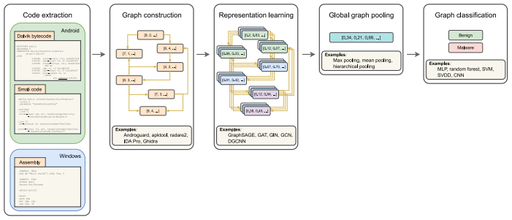
Fig. 2 . General architecture of malware detection from static code analysis based on graph representation learning.
원문 · CC BY 4.0 · Tristan Bilot, Nour El Madhoun, Khaldoun Al Agha, Anis Zouaoui · A Survey on Malware Detection with Graph Representation Learning · 원문 그림 인용 · 원본 PDF 9쪽에서 그림 영역을 추출했습니다.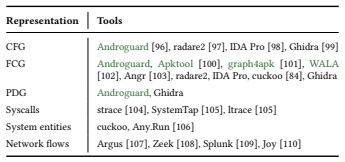
Table 1 . Common tools employed for data extraction and graph construction based on static or dynamic analysis.
원문 · CC BY 4.0 · Tristan Bilot, Nour El Madhoun, Khaldoun Al Agha, Anis Zouaoui · A Survey on Malware Detection with Graph Representation Learning · 원문 그림 인용 · 원본 PDF 9쪽에서 그림 영역을 추출했습니다.그래프가 만들어진 뒤 GNN은 노드 임베딩을 학습합니다. GCN은 인접 행렬로 이웃 정보를 전파하고, GraphSAGE는 이웃을 샘플링하여 집계하며, GAT는 어텐션으로 이웃별 중요도를 학습합니다. 대부분의 연구는 노드 임베딩을 전역 풀링으로 하나의 고정 길이 그래프 임베딩으로 만든 뒤 분류기에 넣어 malware를 그래프 분류 문제로 다룹니다.
Android 탐지 실험의 대표 결과
Android 연구에서 Hybroid는 CFG와 FCG 기반 임베딩에 네트워크 흐름 특징을 결합하고, 이 임베딩을 gradient boosting으로 분류합니다. 저자들은 CICAndMal2017 데이터셋에서 97% F1-score를 보고합니다. 같은 데이터셋에서 hybrid-Falcon은 네트워크 흐름을 2D 이미지로 바꾼 뒤 bi-directional LSTM으로 특징을 추출하여 F1-score를 97.09%로 보고합니다.
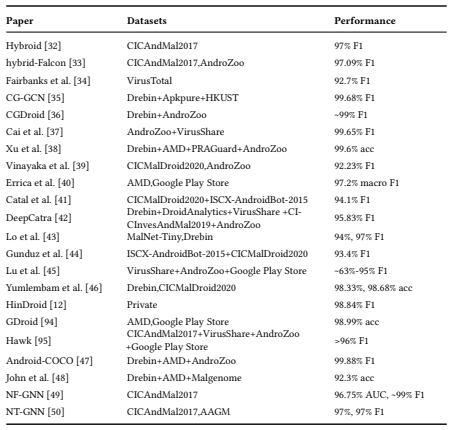
Table 3 . Datasets employed in Android malware detection studies.
원문 · CC BY 4.0 · Tristan Bilot, Nour El Madhoun, Khaldoun Al Agha, Anis Zouaoui · A Survey on Malware Detection with Graph Representation Learning · 원문 그림 인용 · 원본 PDF 16쪽에서 그림 영역을 추출했습니다.이 수치는 두 연구가 각자 제시한 설정에서 얻은 결과입니다. 두 방법은 CICAndMal2017에서 비교되었지만 본 서베이의 표는 이를 하나의 통제 실험으로 묶지 않습니다.
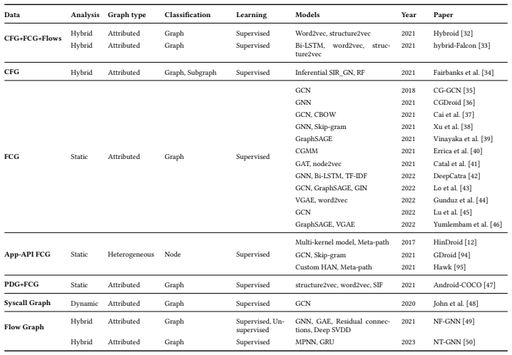
Table 2 . Summary of Android-based malware detection approaches leveraging graph representation learning
원문 · CC BY 4.0 · Tristan Bilot, Nour El Madhoun, Khaldoun Al Agha, Anis Zouaoui · A Survey on Malware Detection with Graph Representation Learning · 원문 그림 인용 · 원본 PDF 11쪽에서 그림 영역을 추출했습니다.Windows 탐지 실험의 대표 결과
Windows 연구에서 MAGIC은 PE 파일에서 추출한 어셈블리 기반 CFG를 DGCNN에 입력하여 악성 여부를 분류합니다. DGCNN은 그래프 분류를 위해 설계된 모델이며 MAGIC은 이를 malware 분류에 사용합니다. 저자들은 Microsoft Malware Classification Challenge 데이터셋에서 99.25% accuracy를 보고합니다.
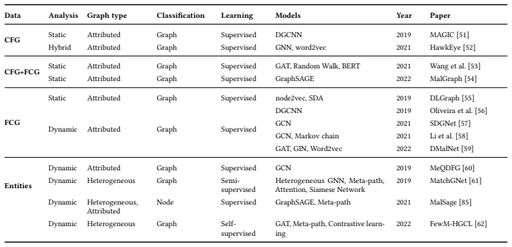
Table 4 . Summary of Windows-based malware detection approaches leveraging graph representation learning.
원문 · CC BY 4.0 · Tristan Bilot, Nour El Madhoun, Khaldoun Al Agha, Anis Zouaoui · A Survey on Malware Detection with Graph Representation Learning · 원문 그림 인용 · 원본 PDF 18쪽에서 그림 영역을 추출했습니다.이 결과는 MMCC 데이터셋의 조건에서 얻어진 것이며, Android나 Web 데이터셋의 결과와 직접 비교되지 않습니다.
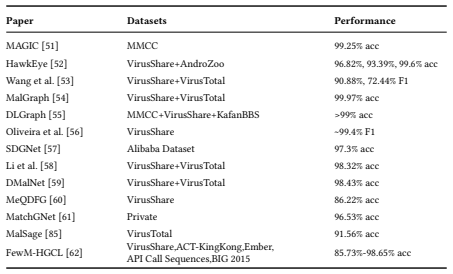
Table 5 . Datasets employed in Windows malware detection studies.
원문 · CC BY 4.0 · Tristan Bilot, Nour El Madhoun, Khaldoun Al Agha, Anis Zouaoui · A Survey on Malware Detection with Graph Representation Learning · 원문 그림 인용 · 원본 PDF 21쪽에서 그림 영역을 추출했습니다.데이터셋 차이와 적대적 취약성의 한계
서베이는 GNN 기반 malware 탐지 연구가 상대적으로 최근이며 많은 연구가 사설 데이터셋이나 추가 샘플로 평가되어 결과 비교가 어렵다고 지적합니다. 특히 Windows 분야에서는 많은 연구가 사설 데이터셋을 사용하여 성능을 직접 비교하기 어렵습니다.
또 적대적 공격은 그래프 구조를 바꾸어 탐지기를 속일 수 있으며, 실행 가능한 malware의 기능을 보존해야 한다는 제약이 추가로 필요합니다. 저자들은 이러한 방어 연구가 아직 충분하지 않다고 지적합니다.
논문 정보
- 저자
- Tristan Bilot, Nour El Madhoun, Khaldoun Al Agha, Anis Zouaoui
- 학회·저널
- arXiv · 프리프린트
- 최초 공개일
- 2023년 3월 28일
- 등록일
- 2026년 11월 6일
- 수정일
- 2023년 8월 17일
- 버전
- v2
- arXiv
- 2303.16004
- 분류
- cs.CR · cs.LG
- 원문 이용 조건
- CC BY 4.0
- 제공 범위
- 논문 정보, 해설, 허용된 원문 그림
AI 해설은 논문 원문과 별개의 설명이며 오류가 있을 수 있습니다. 원문과 그림은 각 출처의 이용 조건과 따로 표시된 권리를 따릅니다.
초록
Malware detection has become a major concern due to the increasing number and complexity of malware. Traditional detection methods based on signatures and heuristics are used for malware detection, but unfortunately, they suffer from poor generalization to unknown attacks and can be easily circumvented using obfuscation techniques. In recent years, Machine Learning (ML) and notably Deep Learning (DL) achieved impressive results in malware detection by learning useful representations from data and have become a solution preferred over traditional methods. More recently, the application of such techniques on graph-structured data has achieved state-of-the-art performance in various domains and demonstrates promising results in learning more robust representations from malware. Yet, no literature review focusing on graph-based deep learning for malware detection exists. In this survey, we provide an in-depth literature review to summarize and unify existing works under the common approaches and architectures. We notably demonstrate that Graph Neural Networks (GNNs) reach competitive results in learning robust embeddings from malware represented as expressive graph structures, leading to an efficient detection by downstream classifiers. This paper also reviews adversarial attacks that are utilized to fool graph-based detection methods. Challenges and future research directions are discussed at the end of the paper.
원문 인용
Tristan Bilot, Nour El Madhoun, Khaldoun Al Agha, Anis Zouaoui (2023). A Survey on Malware Detection with Graph Representation Learning. arXiv:2303.16004v2. https://arxiv.org/abs/2303.16004v2
BibTeX
@misc{bilot2023survey,
  title = {{A Survey on Malware Detection with Graph Representation Learning}},
  author = {Tristan Bilot and Nour El Madhoun and Khaldoun Al Agha and Anis Zouaoui},
  year = {2023},
  eprint = {2303.16004},
  archivePrefix = {arXiv},
  url = {https://arxiv.org/abs/2303.16004v2}
}