논문 해설
Effective control of two-dimensional Rayleigh--Bénard convection: invariant multi-agent reinforcement learning is all you need
- 연구 문제 2차원 Rayleigh–Bénard 대류에서 하단 벽 온도를 강화학습으로 제어해 대류 셀의 구조와 열전달을 줄일 수 있는지 검증합니다.
- 연구 방법 제어 세그먼트를 같은 정책을 공유하는 의사환경으로 다루는 불변 다중 에이전트 강화학습을 사용하여 행동 차원의 저주를 피합니다.
- 주요 결과 같은 350 CFD 에피소드 예산에서 MARL은 Nusselt 수를 22.7% 줄였고 SARL은 약 5.1% 줄였습니다. 학습된 MARL 정책은 두 셀을 단일 셀로 합치며 제어를 끈 뒤에도 Nusselt 수 2.05의 안정 구성을 유지합니다.
2차원 Rayleigh–Bénard 대류를 제어하려는 이유
Rayleigh–Bénard 대류는 아래쪽이 뜨겁고 위쪽이 차가운 유체층에서 부력 때문에 대류 셀이 생기는 현상으로, 산업 공정과 지구과학 유동에서 자주 나타납니다. 대류 셀은 공간적으로 고르지 않은 열전달과 큰 운동에너지를 만들어 효율과 품질을 떨어뜨릴 수 있어, 셀의 구조와 열전달을 조절하는 제어가 중요합니다. 이 논문은 하단 벽의 온도 분포를 바꾸는 능동 제어를 심층 강화학습으로 설계하는 문제를 다룹니다. 고전적인 선형 제어 기법인 수반(adjoint) 방법은 국소적이고 선형적인 성질 때문에 이런 비선형 현상에 적용 범위가 제한된다고 소개됩니다. 기존 연구인 GB는 강화학습으로 Rayleigh–Bénard 대류를 제어했지만, 이 논문은 더 넓은 영역과 더 많은 제어 세그먼트에서 같은 문제를 다룹니다.
그래서 핵심 질문은 제어 세그먼트 수가 늘어날 때 단일 에이전트 방식이 어떤 한계를 보이고, 불변 다중 에이전트 방식이 이를 어떻게 피하는지입니다.
지배방정식, 무차원 수, 수치 해법
이 논문은 Boussinesq 근사 아래의 무차원 Navier–Stokes 식과 에너지 식을 사용합니다. 연속 방정식은 ∇·u = 0이고, 운동량 방정식의 부력항에는 온도 변화가 들어갑니다. Rayleigh 수는 Ra = 10^4로 고정되었고 Prandtl 수는 공기에 해당하는 Pr = 0.71입니다. 영역은 높이 2H, 폭 L = 2πH이며 좌우 경계는 주기 조건입니다. 상단 벽은 일정 온도 T_C이고 하단 벽은 평균 온도 T_H를 유지하면서 세그먼트별로 온도가 조절됩니다. CFD 솔버는 Fourier 기저와 Chebyshev 기저를 쓰는 spectral Galerkin 방법이며 시간 적분에는 IMEX Runge–Kutta 방법이 사용됩니다.
제어 목표는 순간 Nusselt 수를 줄이는 것이고, Nusselt 수는 대류 열전달과 전도 열전달의 비로 정의됩니다. 이 설정은 주어진 Ra와 Pr 조건에서의 결과이며 다른 Ra나 종횡비로 확장된 결과는 아닙니다.
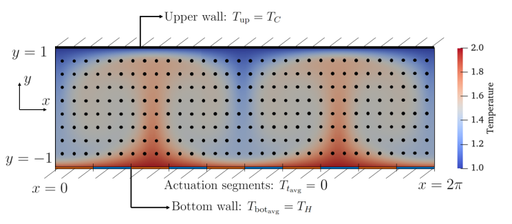
FIG. 1 : Schematic representation of the domain. Dimensions are normalized by H.
원문 · CC BY 4.0 · Colin Vignon, Jean Rabault, Joel Vasanth, Francisco Alcántara-Ávila, Mikael Mortensen, Ricardo Vinuesa · Effective control of two-dimensional Rayleigh--Bénard convection: invariant multi-agent reinforcement learning is all you need · 원문 그림 인용 · 원본 PDF 11쪽에서 그림 영역을 추출했습니다.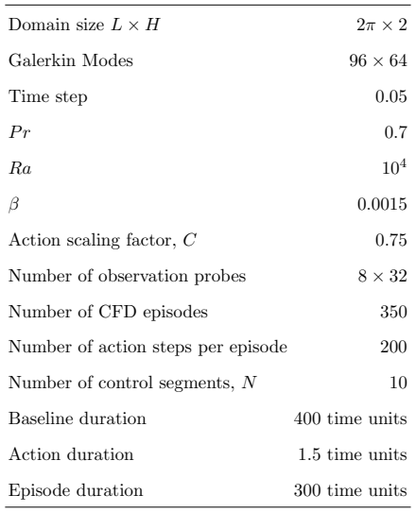
원문 그림 TABLE I: Parameters used in the CFD simulation and DRL control. Note that for MARL
원문 · CC BY 4.0 · Colin Vignon, Jean Rabault, Joel Vasanth, Francisco Alcántara-Ávila, Mikael Mortensen, Ricardo Vinuesa · Effective control of two-dimensional Rayleigh--Bénard convection: invariant multi-agent reinforcement learning is all you need · 원문 그림 인용 · 원본 PDF 21쪽에서 그림 영역을 추출했습니다.행동 변환과 불변 다중 에이전트 구조
DRL 에이전트는 proximal-policy optimization 알고리즘으로 학습되며 관측으로 시간 평균 속도와 온도 값을 받습니다. 단일 에이전트 설정에서는 N = 10개 세그먼트의 행동을 한 번에 출력합니다. 행동은 [-1, 1] 범위의 값이고, 평균 온도를 고정하기 위해 각 값에서 평균을 뺀 뒤 최대 절댓값이 0.75를 넘지 않도록 정규화합니다. 불변 다중 에이전트 설정은 RBC 문제가 x 방향으로 병진 불변이라는 점을 이용합니다. 각 세그먼트를 독립된 의사환경으로 보고 같은 정책 네트워크를 모든 세그먼트에 공유시킵니다. 각 의사환경의 보상은 전역 Nusselt 수와 국소 Nusselt 수를 β = 0.0015로 섞어 만들며, 이 보상은 전체 보상의 약 10% 기여를 목표로 설정되었습니다.
이 구조에서는 행동 차원이 세그먼트 수에 따라 커지지 않으므로 차원의 저주를 피하는 효과가 기대됩니다.
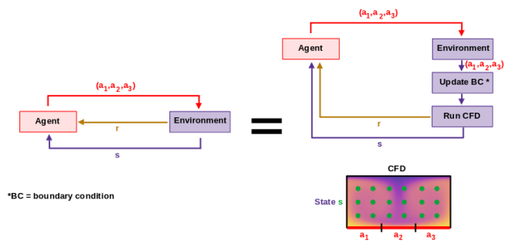
FIG. 3 : Illustration of the single-agent-reinforcement-learning (SARL) control setup. In
원문 · CC BY 4.0 · Colin Vignon, Jean Rabault, Joel Vasanth, Francisco Alcántara-Ávila, Mikael Mortensen, Ricardo Vinuesa · Effective control of two-dimensional Rayleigh--Bénard convection: invariant multi-agent reinforcement learning is all you need · 원문 그림 인용 · 원본 PDF 16쪽에서 그림 영역을 추출했습니다.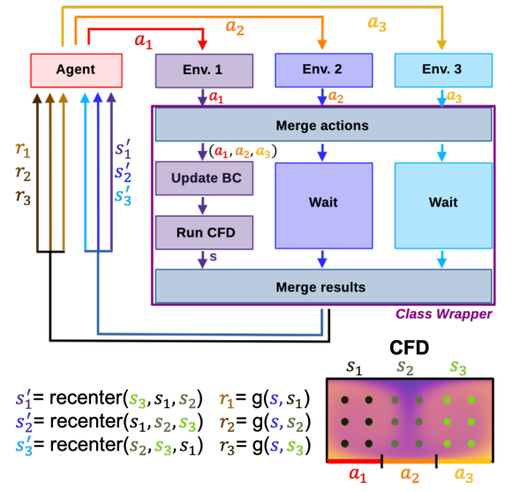
FIG. 4 : Schematic of the MARL control setup, where the same agent controls local regions
원문 · CC BY 4.0 · Colin Vignon, Jean Rabault, Joel Vasanth, Francisco Alcántara-Ávila, Mikael Mortensen, Ricardo Vinuesa · Effective control of two-dimensional Rayleigh--Bénard convection: invariant multi-agent reinforcement learning is all you need · 원문 그림 인용 · 원본 PDF 20쪽에서 그림 영역을 추출했습니다.기준 상태의 두 셀 흐름
제어를 시작하기 전에 학습 환경의 기준 상태를 만듭니다. 제어 없이 시뮬레이션을 400 시간 단위까지 진행하면 두 셀 구조가 안정 상태로 수렴하고, 이때 Nusselt 수는 2.68입니다. 이 기준 상태는 이후 모든 에피소드의 시작점으로 저장되어 사용됩니다. 기준 상태에서는 두 쌍의 반대 방향 와류가 존재하며, 이는 GB 연구의 단일 와류 기준 상태와 다릅니다. 저자들은 그 차이를 GB의 측벽 경계와 종횡비 1에서 비롯된 것으로 해석합니다. 본 설정은 주기 경계와 종횡비 π이므로 제어 전략도 GB와 다를 수 있습니다.
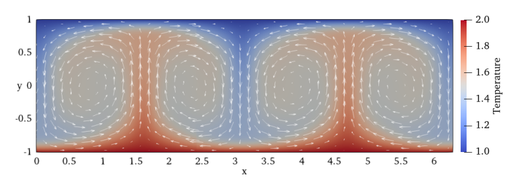
FIG. 5 : Instantaneous temperature (background color) and velocity (arrows) fields from
원문 · CC BY 4.0 · Colin Vignon, Jean Rabault, Joel Vasanth, Francisco Alcántara-Ávila, Mikael Mortensen, Ricardo Vinuesa · Effective control of two-dimensional Rayleigh--Bénard convection: invariant multi-agent reinforcement learning is all you need · 원문 그림 인용 · 원본 PDF 23쪽에서 그림 영역을 추출했습니다.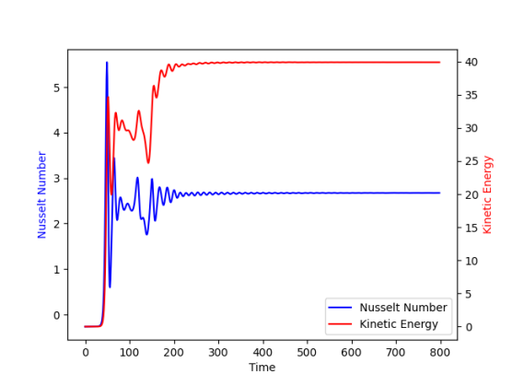
FIG. 6 : Evolution of the global Nusselt number and kinetic energy during the baseline
원문 · CC BY 4.0 · Colin Vignon, Jean Rabault, Joel Vasanth, Francisco Alcántara-Ávila, Mikael Mortensen, Ricardo Vinuesa · Effective control of two-dimensional Rayleigh--Bénard convection: invariant multi-agent reinforcement learning is all you need · 원문 그림 인용 · 원본 PDF 23쪽에서 그림 영역을 추출했습니다.SARL과 MARL의 학습 곡선 비교
두 설정은 같은 CFD 연산량으로 학습되었습니다. SARL과 MARL 모두 350 CFD 에피소드를 수행했고, 에피소드마다 200번의 행동 갱신을 적용했습니다. MARL의 배치 크기는 20 MARL 에피소드이며, 한 CFD 에피소드 안에는 N = 10개의 MARL 에피소드가 포함됩니다. 학습 결과로 SARL은 약 150 에피소드 이후 정체되고 Nusselt 수 감소가 매우 제한적이었습니다. 반면 MARL은 초기에는 SARL과 비슷하지만 더 오래 개선되어 350 에피소드 끝에 Nusselt 수를 22.7% 줄였습니다. 같은 기간 SARL은 약 5.1%의 감소를 보였습니다. 이 비교는 같은 CFD 시간과 자원 조건에서의 결과이며, 학습 예산이 더 늘어났을 때의 결과는 확인되지 않았습니다.
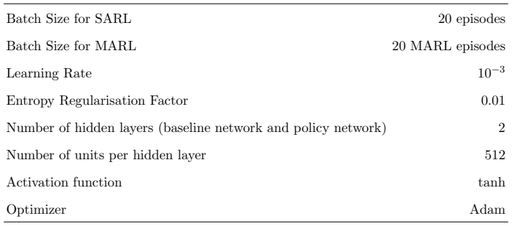
원문 그림 TABLE II: Hyperparameters used in the definition and training of the DRL agent. The
원문 · CC BY 4.0 · Colin Vignon, Jean Rabault, Joel Vasanth, Francisco Alcántara-Ávila, Mikael Mortensen, Ricardo Vinuesa · Effective control of two-dimensional Rayleigh--Bénard convection: invariant multi-agent reinforcement learning is all you need · 원문 그림 인용 · 원본 PDF 22쪽에서 그림 영역을 추출했습니다.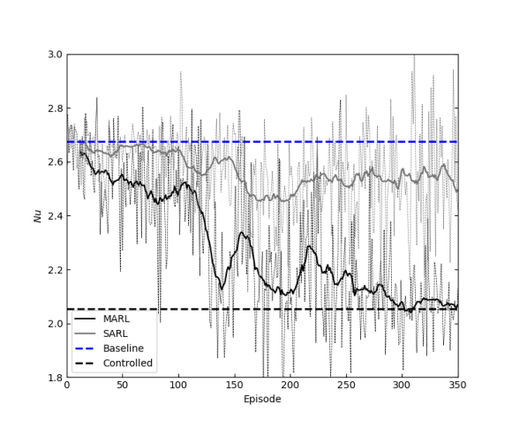
FIG. 7 : Learning curves obtained in both the SARL and MARL configurations. Note that
원문 · CC BY 4.0 · Colin Vignon, Jean Rabault, Joel Vasanth, Francisco Alcántara-Ávila, Mikael Mortensen, Ricardo Vinuesa · Effective control of two-dimensional Rayleigh--Bénard convection: invariant multi-agent reinforcement learning is all you need · 원문 그림 인용 · 원본 PDF 24쪽에서 그림 영역을 추출했습니다.단일 셀로의 위상 전이와 결정적 실행
학습된 MARL 정책을 결정적 모드로 실행하면 흐름이 단계적으로 변합니다. 1단계에서는 하강 플룸 아래 영역을 더 가열하고 상승 플룸 아래 영역을 덜 가열하여 기준 상태의 구동 힘을 약화시킵니다. 2단계에서는 두 셀이 깨지며 두 대류 셀이 하나로 합쳐집니다. 3단계에서는 단일 합쳐진 셀이 안정하게 유지되고, 이때 Nusselt 수는 2.07 수준까지 내려갑니다. 4단계는 제어를 끊고 기준 온도 경계 조건을 다시 적용하는 상황으로, 단일 셀 구성이 제어 없이도 유지되며 Nusselt 수는 2.05로 수렴합니다. 따라서 이 결과는 제어가 셀 구조 자체를 바꾸는 과정을 보여 줍니다. 다만 3단계 이후의 작은 행동은 탐색 잡음이나 정책의 불확실성으로 해석됩니다.
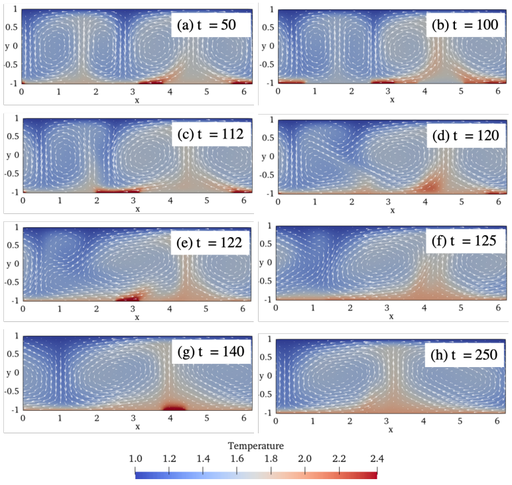
FIG. 8 : Sequence of temperature (background color) and velocity (arrows) fields showing
원문 · CC BY 4.0 · Colin Vignon, Jean Rabault, Joel Vasanth, Francisco Alcántara-Ávila, Mikael Mortensen, Ricardo Vinuesa · Effective control of two-dimensional Rayleigh--Bénard convection: invariant multi-agent reinforcement learning is all you need · 원문 그림 인용 · 원본 PDF 27쪽에서 그림 영역을 추출했습니다.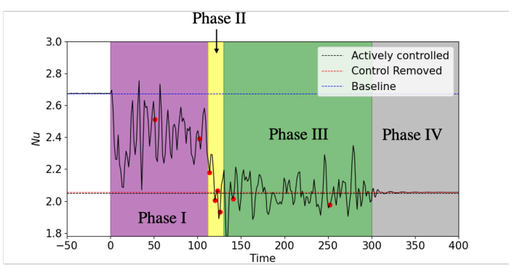
FIG. 9 : Evolution of the Nusselt number showing the control achieved by the DRL agent
원문 · CC BY 4.0 · Colin Vignon, Jean Rabault, Joel Vasanth, Francisco Alcántara-Ávila, Mikael Mortensen, Ricardo Vinuesa · Effective control of two-dimensional Rayleigh--Bénard convection: invariant multi-agent reinforcement learning is all you need · 원문 그림 인용 · 원본 PDF 28쪽에서 그림 영역을 추출했습니다.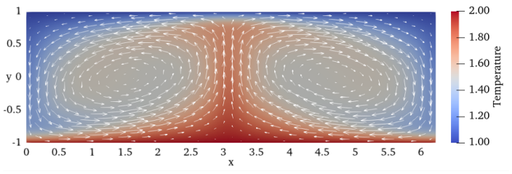
FIG. 10 : Illustration of the single-cell configuration maintained by the system after the
원문 · CC BY 4.0 · Colin Vignon, Jean Rabault, Joel Vasanth, Francisco Alcántara-Ávila, Mikael Mortensen, Ricardo Vinuesa · Effective control of two-dimensional Rayleigh--Bénard convection: invariant multi-agent reinforcement learning is all you need · 원문 그림 인용 · 원본 PDF 29쪽에서 그림 영역을 추출했습니다.해석 범위와 남은 질문
DRL 정책은 가중치 수준에서 직접 해석하기 어려운 블랙박스로 기술되며, 이 논문은 정책의 상위 수준 현상을 위상 분석으로 설명합니다. 본 연구는 2차원 RBC에 대한 첫 MARL 적용이며, 3차원 구성, 다른 Ra, 다른 채널 종횡비, 제어 권한의 강도가 제어 가능성에 주는 영향은 후속 연구로 남겨졌습니다. 또한 SARL의 낮은 성능은 같은 CFD 예산에서 관찰된 결과이므로 더 긴 학습이나 다른 하이퍼파라미터에서 SARL이 같은 구조를 학습할 수 있는지는 원문에서 다루지 않습니다.
논문 정보
- 저자
- Colin Vignon, Jean Rabault, Joel Vasanth, Francisco Alcántara-Ávila, Mikael Mortensen, Ricardo Vinuesa
- 학회·저널
- arXiv · 프리프린트
- 최초 공개일
- 2023년 4월 5일
- 등록일
- 2026년 11월 6일
- 수정일
- 2023년 6월 13일
- 버전
- v2
- arXiv
- 2304.02370
- DOI
- 10.1063/5.0153181
- 분류
- physics.flu-dyn · cs.LG
- 원문 이용 조건
- CC BY 4.0
- 제공 범위
- 논문 정보, 해설, 허용된 원문 그림
AI 해설은 논문 원문과 별개의 설명이며 오류가 있을 수 있습니다. 원문과 그림은 각 출처의 이용 조건과 따로 표시된 권리를 따릅니다.
초록
Rayleigh-Bénard convection (RBC) is a recurrent phenomenon in several industrial and geoscience flows and a well-studied system from a fundamental fluid-mechanics viewpoint. However, controlling RBC, for example by modulating the spatial distribution of the bottom-plate heating in the canonical RBC configuration, remains a challenging topic for classical control-theory methods. In the present work, we apply deep reinforcement learning (DRL) for controlling RBC. We show that effective RBC control can be obtained by leveraging invariant multi-agent reinforcement learning (MARL), which takes advantage of the locality and translational invariance inherent to RBC flows inside wide channels. The MARL framework applied to RBC allows for an increase in the number of control segments without encountering the curse of dimensionality that would result from a naive increase in the DRL action-size dimension. This is made possible by the MARL ability for re-using the knowledge generated in different parts of the RBC domain. We show in a case study that MARL DRL is able to discover an advanced control strategy that destabilizes the spontaneous RBC double-cell pattern, changes the topology of RBC by coalescing adjacent convection cells, and actively controls the resulting coalesced cell to bring it to a new stable configuration. This modified flow configuration results in reduced convective heat transfer, which is beneficial in several industrial processes. Therefore, our work both shows the potential of MARL DRL for controlling large RBC systems, as well as demonstrates the possibility for DRL to discover strategies that move the RBC configuration between different topological configurations, yielding desirable heat-transfer characteristics. These results are useful for both gaining further understanding of the intrinsic properties of RBC, as well as for developing industrial applications.
원문 인용
Colin Vignon, Jean Rabault, Joel Vasanth, Francisco Alcántara-Ávila, Mikael Mortensen, Ricardo Vinuesa (2023). Effective control of two-dimensional Rayleigh--Bénard convection: invariant multi-agent reinforcement learning is all you need. arXiv:2304.02370v2. https://doi.org/10.1063/5.0153181
BibTeX
@article{vignon2023effective,
  title = {{Effective control of two-dimensional Rayleigh--Bénard convection: invariant multi-agent reinforcement learning is all you need}},
  author = {Colin Vignon and Jean Rabault and Joel Vasanth and Francisco Alcántara-Ávila and Mikael Mortensen and Ricardo Vinuesa},
  year = {2023},
  eprint = {2304.02370},
  archivePrefix = {arXiv},
  doi = {10.1063/5.0153181},
  url = {https://arxiv.org/abs/2304.02370v2}
}