논문 해설
Generative Forecasting from Coarse-Grained Observations: When Does Cascading Help?
거친 입도의 관측으로부터 생성형 예측: 캐스케이딩은 언제 도움이 되는가?
- 연구 문제 거친 관측에서 생성형 예측기가 올바른 조건부 분포를 샘플링하는지 검증하기 어렵습니다.
- 연구 방법 관측 상태마다 미세 성분을 여러 개 샘플링해 만든 기준 앙상블로 검증하고, 호라이즌을 짧은 전이로 나눠 합성하는 캐스케이드를 제안합니다.
- 주요 결과 캐스케이드는 네 계열의 비선형 및 파동 시스템에서 중간 깊이의 최저 오차를 보였고, 수동 스칼라에서는 깊이가 늘수록 오차가 증가했습니다.
관측 한계에서 조건부 예측의 검증 문제
거친 격자에서 관측한 유체나 파동의 초기 상태로부터 나중 상태를 예측할 때, 관측되지 않은 미세 척도가 동역학에 영향을 주므로 같은 거친 초기 상태에서도 여러 미래가 나올 수 있습니다. 따라서 예측기는 한 개의 미래가 아니라 조건부 분포 P(X_T | X_0)를 학습해야 합니다. 그러나 학습 데이터에는 보통 각 초기 상태마다 궤적 하나만 있어서, 생성 모델이 그럴듯한 샘플을 만들더라도 올바른 조건부 분포를 샘플링하는지 확인하기 어렵습니다. 이 논문은 이 검증 문제를 먼저 다룹니다.
계층적 데이터 생성으로 만든 기준 앙상블
이 논문은 관측 초기 상태 x_0마다 서로 다른 미세 성분 z_0을 여러 개 샘플링하고, 전체 초기 상태를 수치 해법으로 전개합니다. 같은 x_0에서 출발한 모든 전개 결과의 관측 끝점은 P(X_T | X_0 = x_0)의 독립 표본이 되므로, 이것이 예측기 출력과 비교할 기준 앙상블이 됩니다. 예측기는 여전히 거친 관측만 보며, 같은 관측 상태에 속한 앙상블 구성원은 모두 같은 거친 초기 상태를 공유합니다. 학습·검증·테스트 앙상블은 서로 다른 관측 초기 상태로 분할되어 테스트 관측이 학습 중에 보이지 않게 합니다.
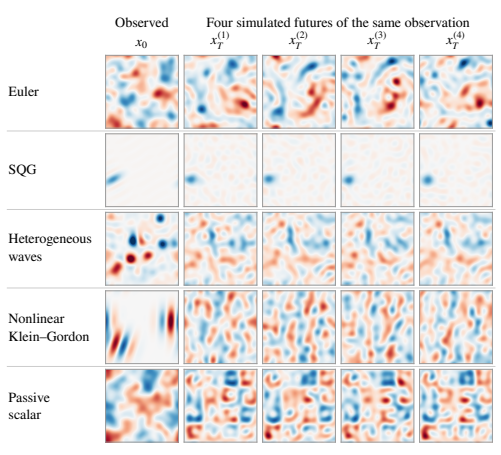
Figure 3 :Experimental systems.Each row shows one observed initial state and four simulated futures from its conditioning ensemble; the futures differ only in their unobserved initial fine scales. The fields shown are the observed vorticity, buoyancy, displacement, displacement, and concentration.
원문 · CC BY 4.0 · Alexandra Spitzer, Giovanni Abati, Lorenzo Baldassari, Till Muser, Cheng Shi, Ivan Dokmanić · Generative Forecasting from Coarse-Grained Observations: When Does Cascading Help? · 원문 그림 인용 · 원본 PDF 8쪽에서 그림 영역을 추출했습니다.직접 예측기의 분포 오류
Euler 흐름에서 Direct SI와 EDM은 한 관측 상태에 대해 10,000개의 샘플을 생성했습니다. 개별 샘플은 그럴듯해 보였지만, 평균과 표준편차의 큰 규모 구조는 기준 시뮬레이터와 달랐습니다. 기준 평균은 뚜렷한 대규모 기하를 가지고 표준편차는 강하게 이질적인데, 두 예측기의 평균은 흐려졌고 표준편차는 거의 균일했습니다. 이는 샘플 몇 개를 보는 것만으로는 조건부 분포의 잘못을 알아내기 어렵다는 것을 보여 줍니다.
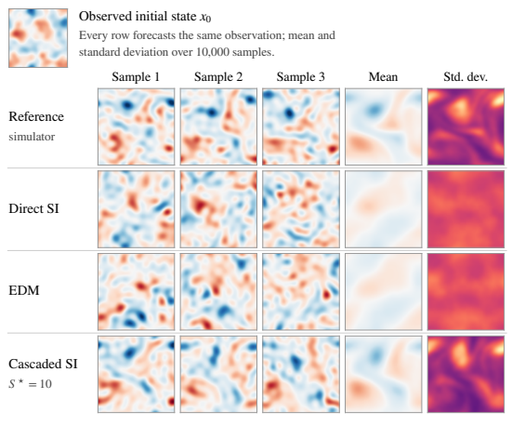
Figure 2 :Direct forecasters can sample the wrong conditional distribution.One held-out Euler observation (top left). Each row shows three samples of the vorticity at time T , followed by the conditional mean and the pointwise standard deviation over10,000 samples. Reference: the simulator, run from 10,000 fine-scale completions of the observation. Direct SI and EDM: generative forecasters trained on pairs (X0, XT ). Cascaded SI: the cascaded forecaster of Section 3 at the validation-selected depthS ⋆ = 10, discussed in Section 5.
원문 · CC BY 4.0 · Alexandra Spitzer, Giovanni Abati, Lorenzo Baldassari, Till Muser, Cheng Shi, Ivan Dokmanić · Generative Forecasting from Coarse-Grained Observations: When Does Cascading Help? · 원문 그림 인용 · 원본 PDF 4쪽에서 그림 영역을 추출했습니다.짧은 전이의 캐스케이드와 깊이 S
직접 예측은 P(X_T | X_0)를 한 번에 학습하지만, 캐스케이드는 호라이즌을 S개의 구간 t_i = iT/S로 나누고 연속된 관측 전이 P(X_{t_{i+1}} | X_{t_i})를 학습합니다. 샘플링할 때는 초기 상태에서 시작해 각 학습 전이를 생성된 현재 상태에만 조건화하여 차례로 적용합니다. 이 논문의 Cascaded SI는 확률적 보간법을 사용하며, 모든 전이가 하나의 공유 네트워크를 쓰고 물리적 시작·끝 시각으로 조건화됩니다. S = 1이면 직접 예측과 같습니다. 학습 쌍 수는 B = 16,000으로 맞추었으므로, 깊은 캐스케이드는 더 적은 궤적에서 쌍을 얻습니다.
근사 오차와 기억 손실의 절충
이 논문은 두 효과가 깊이를 결정한다고 봅니다. 한 쪽에서는 긴 전이의 조건부 평균이 고정된 함수 클래스로 표현하기 어려울 수 있고 짧은 전이는 더 쉽게 근사됩니다. 다른 쪽에서는 관측이 부분적이므로 미관측 미세 척도가 과거 정보를 담고 있어, 현재 관측에만 조건화하는 캐스케이드가 그 정보를 잃습니다. 이를 설명하는 부분 관측 캐스케이드 정리에서는 정확한 전이라도 미세해질수록 결정론적 흐름으로 수렴하고, 끝점 분포 오차가 남는다고 보입니다. 회전-OU 모델에서는 이 두 효과가 유한한 최적 깊이를 만든다는 것을 명시적으로 보입니다. 다만 이 모델은 명시된 가우시안 과정과 이차 SI 학습기에 대한 결과이며, 원문도 PDE 실험의 깊이 선택을 예측하지 않는다고 밝힙니다.
다섯 계열 실험의 깊이 의존성
테스트 csFID-10k 기준으로 Euler, SQG, 이질적 파동, 비선형 Klein–Gordon에서 캐스케이드가 직접 예측보다 낮은 오차를 보였고, 검증이 선택한 깊이는 각각 10, 10, 5, 20입니다. 이 깊이에서 Euler의 Cascaded SI 오차는 직접 예측 대비 약 3.5배 낮습니다. 수동 스칼라는 구조가 가우시안이고 조건부 공분산이 관측과 무관하므로 검증이 S = 1을 선택했고, 단계가 늘수록 오차가 증가했습니다. 깊이 민감도 결과는 중간 깊이에서 최소가 나타나는 비단조 형태를 보여 줍니다. 저자들은 깊은 캐스케이드의 악화가 기억 손실만이 아니라 깊어질수록 줄어드는 학습 샘플 궤적 수와 샘플러 누적 오차에서도 올 수 있다고 봅니다.
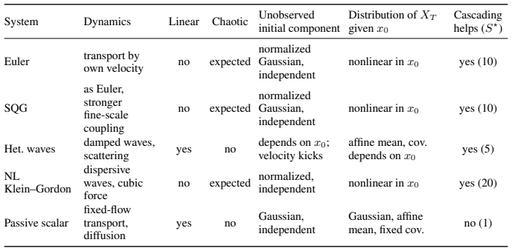
Table 1 :Properties of the five systems relevant for forecasting.“Independent” means independent of x0. The nonlinear systems are expected to be chaotic, but we do not show it formally or experi- mentally. Cascading helps whenS ⋆ >1.
원문 · CC BY 4.0 · Alexandra Spitzer, Giovanni Abati, Lorenzo Baldassari, Till Muser, Cheng Shi, Ivan Dokmanić · Generative Forecasting from Coarse-Grained Observations: When Does Cascading Help? · 원문 그림 인용 · 원본 PDF 8쪽에서 그림 영역을 추출했습니다.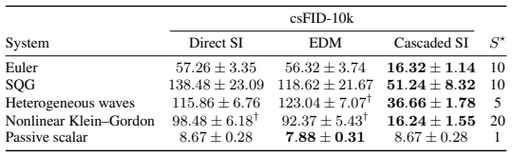
Table 2 : Conditional forecasting error. Test csFID-10k (lower is better), mean ± SEM (standard error of the mean) over the ten test observations, for one training seed. S ⋆ is selected on validation data; for the passive scalar, S ⋆ = 1, so Direct SI and Cascaded SI are the same fitted model. †The dagger signifies that the best value of one hyperparameter lay at the edge of the searched range, so a wider search might improve these baselines; Nonetheless, the last step of the search changed their validation score by much less than their gap to Cascaded SI (Appendix B.2).
원문 · CC BY 4.0 · Alexandra Spitzer, Giovanni Abati, Lorenzo Baldassari, Till Muser, Cheng Shi, Ivan Dokmanić · Generative Forecasting from Coarse-Grained Observations: When Does Cascading Help? · 원문 그림 인용 · 원본 PDF 9쪽에서 그림 영역을 추출했습니다.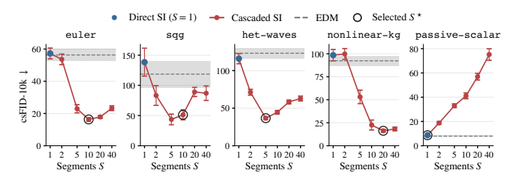
Figure 4 :Intermediate-depth cascades improve conditional forecasting in four of five systems. Test csFID-10k versus cascade depth S (values in Table 6). S= 1 is Direct SI; outlined markers: validation-selectedS ⋆; dashed lines: EDM; error bars:±1SEM over the ten test observations.
원문 · CC BY 4.0 · Alexandra Spitzer, Giovanni Abati, Lorenzo Baldassari, Till Muser, Cheng Shi, Ivan Dokmanić · Generative Forecasting from Coarse-Grained Observations: When Does Cascading Help? · 원문 그림 인용 · 원본 PDF 10쪽에서 그림 영역을 추출했습니다.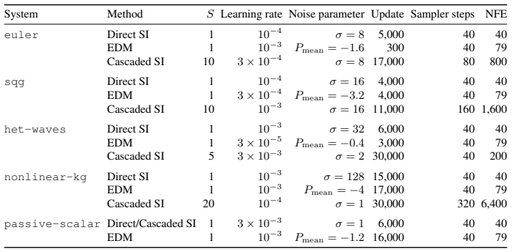
Table 5 : Selected configurations and sampling cost.
원문 · CC BY 4.0 · Alexandra Spitzer, Giovanni Abati, Lorenzo Baldassari, Till Muser, Cheng Shi, Ivan Dokmanić · Generative Forecasting from Coarse-Grained Observations: When Does Cascading Help? · 원문 그림 인용 · 원본 PDF 20쪽에서 그림 영역을 추출했습니다.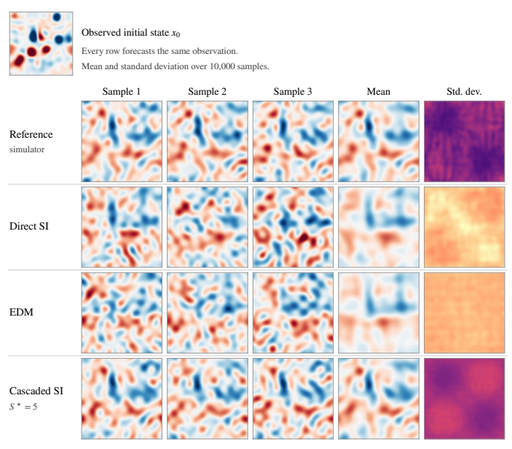
Figure 5 :Heterogeneous waves: direct and cascaded forecasts of one held-out observation.The displayed field is the displacement; the forecasters also predict a velocity proxy. Cascaded SI uses the validation-selected depth S⋆ = 5. Means and standard deviations are estimated from 10,000 samples.
원문 · CC BY 4.0 · Alexandra Spitzer, Giovanni Abati, Lorenzo Baldassari, Till Muser, Cheng Shi, Ivan Dokmanić · Generative Forecasting from Coarse-Grained Observations: When Does Cascading Help? · 원문 그림 인용 · 원본 PDF 22쪽에서 그림 영역을 추출했습니다.평가 지표와 적용 범위
이 논문의 주 지표 csFID-10k는 공간 배치에 민감한 Inception 중간 특징의 Fréchet 거리를 조건별로 계산해 평균한 것입니다. 원문은 이 지표가 공간 이동에 더 민감하다는 검증을 제시하지만, 이것이 모든 물리량 오류를 직접 측정한다는 뜻은 아닙니다. 캐스케이드의 메모리 오차가 PDE 실험의 깊은 악화를 얼마나 설명하는지는 실험만으로 분리되지 않았습니다. 결과는 다섯 계열의 시뮬레이션 벤치마크, 한 학습 시드, 고정된 학습 예산에서 얻은 것이므로 다른 모델이나 예산으로 일반화하려면 별도의 확인이 필요합니다.
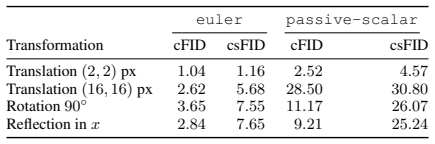
Table 8 :Response to spatial perturbations.Each entry is the ratio of the perturbed score to the truth-to-truth score, using means over ten conditioning states. Passive scalar has only two distinct outputs because Cascaded SI selectsS ⋆ = 1.
원문 · CC BY 4.0 · Alexandra Spitzer, Giovanni Abati, Lorenzo Baldassari, Till Muser, Cheng Shi, Ivan Dokmanić · Generative Forecasting from Coarse-Grained Observations: When Does Cascading Help? · 원문 그림 인용 · 원본 PDF 21쪽에서 그림 영역을 추출했습니다.논문 정보
- 저자
- Alexandra Spitzer, Giovanni Abati, Lorenzo Baldassari, Till Muser, Cheng Shi, Ivan Dokmanić
- 학회·저널
- arXiv · 프리프린트
- 최초 공개일
- 2026년 10월 31일
- 등록일
- 2026년 11월 3일
- 수정일
- 2026년 10월 31일
- 버전
- v1
- arXiv
- 2611.00686
- 분류
- cs.LG
- 원문 이용 조건
- CC BY 4.0
- 제공 범위
- 논문 정보, 해설, 허용된 원문 그림
AI 해설은 논문 원문과 별개의 설명이며 오류가 있을 수 있습니다. 원문과 그림은 각 출처의 이용 조건과 따로 표시된 권리를 따릅니다.
초록
We study probabilistic forecasting of dynamical systems such as fluids and waves from coarse observations. Since the unseen fine scales influence the dynamics, the same coarse initial state can evolve into a whole distribution of futures. Generative forecasters may produce visually plausible samples, but it is hard to tell whether they sample the right conditional distribution, since trajectory data contain a single future for each initial state. We address this problem by generating reference data in a hierarchical way: for each coarse initial state, we generate many different fine-scale components and numerically evolve the full states. Using these conditional ensembles, we show that standard diffusion models and stochastic interpolants make substantial distributional errors. We then show that cascading shorter forecasts greatly reduces these errors for the turbulent flows and waves we study, but we also find and characterize cases in which it hurts. Since the coarse process is not Markov, cascading discards information about the unresolved fine scales even with exact transitions. To understand this, we propose a solvable analytic model which shows that the optimal cascade depth decreases as the coupling between the unresolved and observed scales gets stronger, and increases as the dependence of the forecast on the observation becomes more oscillatory. Consistent with our experiments, cascading is detrimental when the direct forecast is ``easy'' to learn, for example Gaussian as in the passive scalar case. We release our datasets as a first benchmark for probabilistic forecasting with ground-truth conditional ensembles.
원문 인용
Alexandra Spitzer, Giovanni Abati, Lorenzo Baldassari, Till Muser, Cheng Shi, Ivan Dokmanić (2026). Generative Forecasting from Coarse-Grained Observations: When Does Cascading Help?. arXiv:2611.00686v1. https://arxiv.org/abs/2611.00686v1
BibTeX
@misc{spitzer2026generative,
  title = {{Generative Forecasting from Coarse-Grained Observations: When Does Cascading Help?}},
  author = {Alexandra Spitzer and Giovanni Abati and Lorenzo Baldassari and Till Muser and Cheng Shi and Ivan Dokmanić},
  year = {2026},
  eprint = {2611.00686},
  archivePrefix = {arXiv},
  url = {https://arxiv.org/abs/2611.00686v1}
}