논문 해설
Predicting Goal-directed Attention Control Using Inverse-Reinforcement Learning
역강화학습을 이용한 목표 지향 주의 제어 예측
- 연구 문제 목표 지향 시선 제어를 학습 기반 모델로 예측할 수 있는지를 MCS 데이터셋과 IRL 모델로 검증합니다.
- 연구 방법 사람의 탐색 고정을 전문가 행동으로 삼아 보상과 정책을 학습하는 적대적 IRL 모델을 사용합니다.
- 주요 결과 테스트 이미지에서 IRL 모델은 FDM과 scanpath를 예측했고, 여섯 번 안의 목표 고정은 행동 데이터보다 다소 낮았습니다.
목표 지향 주의 제어를 기계학습으로 예측하기
사람이 목표 객체를 찾을 때 시선이 어디로 향하는지는 목표 상태가 행동을 어떻게 통제하는지를 보여 주는 핵심 현상입니다. 기존 주의 제어 모델은 사람이 정한 특징과 단순한 탐색 상황에 의존하는 경우가 많았습니다. 이 논문은 이미지에서 특징을 직접 학습하고, 목표 범주를 찾는 categorical search의 시선 고정을 예측하는 모델을 다룹니다. 핵심 질문은 Inverse-Reinforcement Learning으로 학습한 모델이 새로운 이미지에서 사람의 탐색 고정을 예측할 수 있는지입니다.
IRL 모델의 상태, 행동, 정책 구성
IRL 모델은 사람의 탐색 고정을 전문가 행동으로 보고, Generative Adversarial Imitation Learning 방식으로 보상과 정책을 학습합니다. 생성기는 Actor-Critic 정책으로 고정 이동을 만들고, 판별기는 실제 사람의 고정과 생성된 고정을 구별합니다. 상태는 사전 학습된 ResNet-50으로 얻은 특징과 누적 중심와 인코딩을 포함하며, 행동은 512x320 이미지를 10x16 격자로 나눈 160개 위치 중 하나의 saccade입니다. 학습된 정책의 기대 보상은 saccade map으로 표현되며, 테스트에서는 여섯 번의 saccade를 수행합니다.
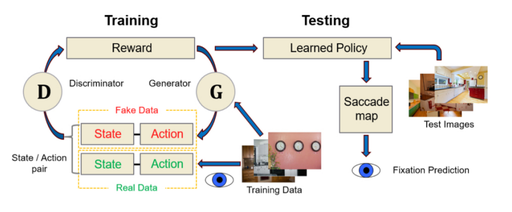
Figure 1 . The model’s adversarial imitation learning algorithm. During training it learned from fixation-annotated images a reward function and policy for predicting new search fixations in unseen test images.
원문 · CC BY 4.0 · Gregory J. Zelinsky, Yupei Chen, Seoyoung Ahn, Hossein Adeli, Zhibo Yang, Lihan Huang, Dimitrios Samaras, Minh Hoai · Predicting Goal-directed Attention Control Using Inverse-Reinforcement Learning · 원문 그림 인용 · 원본 PDF 2쪽에서 그림 영역을 추출했습니다.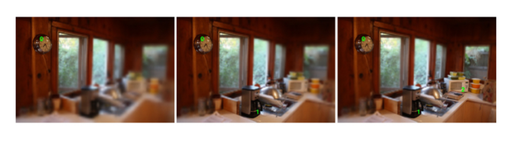
Figure 2 . The formation of a cumulative retina-transformed image over the first three fixations (0,1,2).
원문 · CC BY 4.0 · Gregory J. Zelinsky, Yupei Chen, Seoyoung Ahn, Hossein Adeli, Zhibo Yang, Lihan Huang, Dimitrios Samaras, Minh Hoai · Predicting Goal-directed Attention Control Using Inverse-Reinforcement Learning · 원문 그림 인용 · 원본 PDF 3쪽에서 그림 영역을 추출했습니다.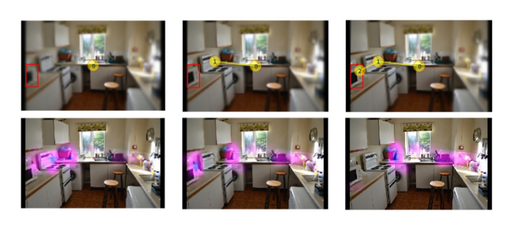
Figure 6 . Cumulative ReT-images (top row) and corresponding saccade maps (bottom row) for the initial and first two new fixations (left to right) made by the model in a microwave search task.
원문 · CC BY 4.0 · Gregory J. Zelinsky, Yupei Chen, Seoyoung Ahn, Hossein Adeli, Zhibo Yang, Lihan Huang, Dimitrios Samaras, Minh Hoai · Predicting Goal-directed Attention Control Using Inverse-Reinforcement Learning · 원문 그림 인용 · 원본 PDF 6쪽에서 그림 영역을 추출했습니다.Microwave-Clock Search 데이터셋 구성
MCS 데이터셋은 COCO2014 이미지 중 전자레인지나 시계가 있는 장면으로 구성됩니다. 학습 이미지는 사람과 동물이 있는 장면과 디지털 시계를 제외했고, 테스트 이미지는 두 목표가 모두 있는 장면 중에서 단일 목표, 작은 목표 면적, 중앙에서 떨어진 위치 조건으로 선택했습니다. 목표가 없는 TA 이미지도 함께 두어 탐색 맥락을 만들었습니다. 훈련 데이터는 4366장 이미지에서 16,184개의 탐색 고정을 남겼고, 테스트 데이터는 새로운 참가자 60명이 목표별 30명씩 탐색했습니다.
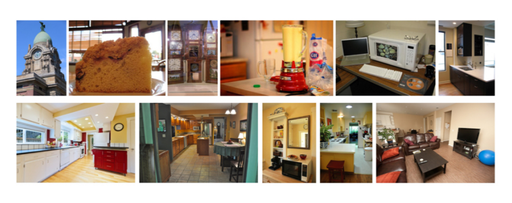
Figure 3 . Representative training images (top) and testing images (bottom) in the MCS dataset.
원문 · CC BY 4.0 · Gregory J. Zelinsky, Yupei Chen, Seoyoung Ahn, Hossein Adeli, Zhibo Yang, Lihan Huang, Dimitrios Samaras, Minh Hoai · Predicting Goal-directed Attention Control Using Inverse-Reinforcement Learning · 원문 그림 인용 · 원본 PDF 4쪽에서 그림 영역을 추출했습니다.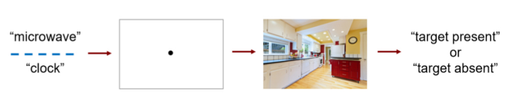
Figure 4 . The categorical search paradigm used for behavioral data collection.
원문 · CC BY 4.0 · Gregory J. Zelinsky, Yupei Chen, Seoyoung Ahn, Hossein Adeli, Zhibo Yang, Lihan Huang, Dimitrios Samaras, Minh Hoai · Predicting Goal-directed Attention Control Using Inverse-Reinforcement Learning · 원문 그림 인용 · 원본 PDF 4쪽에서 그림 영역을 추출했습니다.테스트 이미지에서의 FDM과 scanpath 예측
IRL 모델은 전자레인지와 시계 목표 각각에서 행동 FDM을 AUC 지표로 예측했습니다. 저자들은 피험자 모델의 leave-one-out 결과를 집단 행동 예측의 실용적 잡음 한계로 두고, IRL 모델이 이 범위 안에서 공간 분포를 예측했다고 해석합니다. 여섯 번 고정 scanpath는 제외된 고정 지속시간 요소를 둔 평균 MultiMatch 유사도로 비교되었습니다. 이 결과는 MCS 테스트 이미지와 여섯 번의 saccade 조건에서 얻은 것입니다.
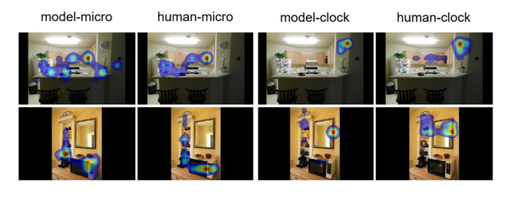
Figure 7 . Model and behavioral Fixation Density Maps computed for microwave (left four) and clock (right four) searches in two trials (top, bottom).
원문 · CC BY 4.0 · Gregory J. Zelinsky, Yupei Chen, Seoyoung Ahn, Hossein Adeli, Zhibo Yang, Lihan Huang, Dimitrios Samaras, Minh Hoai · Predicting Goal-directed Attention Control Using Inverse-Reinforcement Learning · 원문 그림 인용 · 원본 PDF 7쪽에서 그림 영역을 추출했습니다.목표 고정 정확도와 탐색 효율
정확도는 처음 여섯 번의 눈 움직임 안에 목표를 고정한 시행의 비율이며, 모델은 여섯 번의 saccade를 수행하도록 강제되었습니다. 원문 결과에서 모델은 행동 참가자보다 여섯 번 안의 목표 고정 비율이 다소 낮았지만, 목표를 찾은 경우에는 시계에서 약 0.5 고정 정도 더 필요했습니다. 누적 목표 고정 확률은 모델이 목표로 주의를 안내하는 경향을 보였다는 근거로 제시됩니다. 이 분석은 여섯 번의 탐색 조건에 한정된다는 점을 함께 읽어야 합니다.

Table 1 . Summary statistics showing mean errors and number of search fixations in the Microwave-Clock Search dataset.
원문 · CC BY 4.0 · Gregory J. Zelinsky, Yupei Chen, Seoyoung Ahn, Hossein Adeli, Zhibo Yang, Lihan Huang, Dimitrios Samaras, Minh Hoai · Predicting Goal-directed Attention Control Using Inverse-Reinforcement Learning · 원문 그림 인용 · 원본 PDF 5쪽에서 그림 영역을 추출했습니다.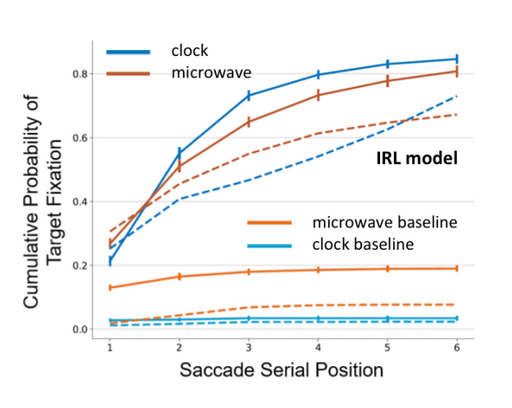
Figure 5 . Cumulative probability of fixating the microwave (red) or clock (blue) target on target-present trials for behavioral participants (solid lines) and the model (dashed lines). Bottom lines are object-based random baselines (see text for details).
원문 · CC BY 4.0 · Gregory J. Zelinsky, Yupei Chen, Seoyoung Ahn, Hossein Adeli, Zhibo Yang, Lihan Huang, Dimitrios Samaras, Minh Hoai · Predicting Goal-directed Attention Control Using Inverse-Reinforcement Learning · 원문 그림 인용 · 원본 PDF 5쪽에서 그림 영역을 추출했습니다.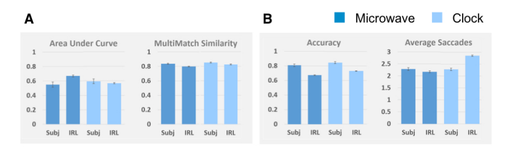
Figure 8 . Model Performance Results. (A) Left: Success in predicting FDMs by the IRL model and a Subject model using the Area-Under-the-Curve metric. Right: Corresponding predictions of search scanpaths using average MultiMatch similarity. (B) Left: Proportion of trials in which the target was fixated in the first six saccades (fixated-in-6 accuracy). Right: Average number of saccades to the target on the fixated-in-6 trials. Note that in the (A) plots “Subj” refers to a Subject model whereas in the (B) plots "Subj" refers to behavioral data.
원문 · CC BY 4.0 · Gregory J. Zelinsky, Yupei Chen, Seoyoung Ahn, Hossein Adeli, Zhibo Yang, Lihan Huang, Dimitrios Samaras, Minh Hoai · Predicting Goal-directed Attention Control Using Inverse-Reinforcement Learning · 원문 그림 인용 · 원본 PDF 7쪽에서 그림 영역을 추출했습니다.데이터 오류와 적용 범위
훈련 데이터의 오류율은 COCO 라벨이 잘못 표시된 객체의 영향을 받았을 가능성이 있어, 원문은 해석에 주의하라고 밝힙니다. 또한 분석은 처음 여섯 번의 시선 이동에 한정되었습니다. 이 결과는 전자레인지와 시계라는 두 목표, MCS 데이터셋, 여섯 번 탐색 조건에서 얻은 것이며, 다른 범주나 장시간 탐색으로 그대로 일반화할 수 있다는 근거는 제시되지 않습니다.
논문 정보
- 저자
- Gregory J. Zelinsky, Yupei Chen, Seoyoung Ahn, Hossein Adeli, Zhibo Yang, Lihan Huang, Dimitrios Samaras, Minh Hoai
- 학회·저널
- arXiv · 프리프린트
- 최초 공개일
- 2020년 1월 31일
- 등록일
- 2026년 11월 6일
- 수정일
- 2020년 1월 31일
- 버전
- v1
- arXiv
- 2001.11921
- 분류
- cs.CV
- 원문 이용 조건
- CC BY 4.0
- 제공 범위
- 논문 정보, 해설, 허용된 원문 그림
AI 해설은 논문 원문과 별개의 설명이며 오류가 있을 수 있습니다. 원문과 그림은 각 출처의 이용 조건과 따로 표시된 권리를 따릅니다.
초록
Understanding how goal states control behavior is a question ripe for interrogation by new methods from machine learning. These methods require large and labeled datasets to train models. To annotate a large-scale image dataset with observed search fixations, we collected 16,184 fixations from people searching for either microwaves or clocks in a dataset of 4,366 images (MS-COCO). We then used this behaviorally-annotated dataset and the machine learning method of Inverse-Reinforcement Learning (IRL) to learn target-specific reward functions and policies for these two target goals. Finally, we used these learned policies to predict the fixations of 60 new behavioral searchers (clock = 30, microwave = 30) in a disjoint test dataset of kitchen scenes depicting both a microwave and a clock (thus controlling for differences in low-level image contrast). We found that the IRL model predicted behavioral search efficiency and fixation-density maps using multiple metrics. Moreover, reward maps from the IRL model revealed target-specific patterns that suggest, not just attention guidance by target features, but also guidance by scene context (e.g., fixations along walls in the search of clocks). Using machine learning and the psychologically-meaningful principle of reward, it is possible to learn the visual features used in goal-directed attention control.
원문 인용
Gregory J. Zelinsky, Yupei Chen, Seoyoung Ahn, Hossein Adeli, Zhibo Yang, Lihan Huang, Dimitrios Samaras, Minh Hoai (2020). Predicting Goal-directed Attention Control Using Inverse-Reinforcement Learning. arXiv:2001.11921v1. https://arxiv.org/abs/2001.11921v1
BibTeX
@misc{zelinsky2020predicting,
  title = {{Predicting Goal-directed Attention Control Using Inverse-Reinforcement Learning}},
  author = {Gregory J. Zelinsky and Yupei Chen and Seoyoung Ahn and Hossein Adeli and Zhibo Yang and Lihan Huang and Dimitrios Samaras and Minh Hoai},
  year = {2020},
  eprint = {2001.11921},
  archivePrefix = {arXiv},
  url = {https://arxiv.org/abs/2001.11921v1}
}