논문 해설
Optimistic Gradient Algorithms with Randomized Coordinate and Variance Reduction Strategies for Composite Inclusions
합성 포함 문제를 위한 무작위 좌표 및 분산 감소 전략을 사용하는 낙관적 경사 알고리즘
- 연구 문제 비단조일 수 있는 유한합 복합 포함 문제를 큰 데이터와 고차원 블록 구조에서 확률적으로 푸는 방법이 필요합니다.
- 연구 방법 분산 감소 낙관적 경사 방향을 블록 단위로 갱신하는 VCOG와, 후진-전진 재구성을 쓰는 가속 방법 VCFOG를 제안합니다.
- 주요 결과 VCOG는 약한 Minty 해 아래에서 기대 제곱 잔차에 대해 O(1/k) 수렴률을 보고하고, VCFOG는 평균 co-coercivity와 co-hypomonotonicity 아래에서 O(1/k²) 수렴률을 보고합니다.
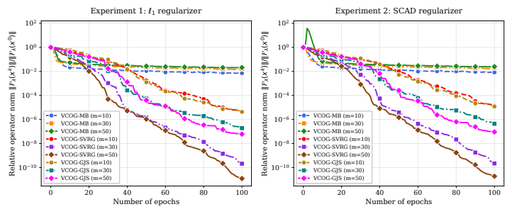
Figure 1 .Performance of VCOG with three estimators for(63) with ℓ1 and SCAD regularizers (averaged over 5 problem instances).
원문 · CC BY 4.0 · Nghĩa Nguyen-Trung, Ion Necoara, Quoc Tran-Dinh · Optimistic Gradient Algorithms with Randomized Coordinate and Variance Reduction Strategies for Composite Inclusions · 원문 그림 인용 · 원본 PDF 27쪽에서 그림 영역을 추출했습니다.문제 설정과 비단조 복합 포함
이 논문은 0 ∈ Gx⋆ + Tx⋆ 형태의 대규모 유한합 복합 포함 문제를 다룹니다. 여기서 G는 n개 단일값 연산자의 평균이고 T는 집합값 연산자입니다. 연산자 Ψ = G + T는 비단조일 수 있으므로 단조 포함에 대한 고전적 수렴 이론이 바로 적용되지 않습니다.
구성요소 수 n이 크면 G를 매번 전부 평가하는 비용이 크고, 차원 p가 크면 모든 좌표를 매 반복 갱신하는 비용도 큽니다.
분산 감소 낙관적 경사 추정기
낙관적 경사 방향은 S_k = Gx_k − γ_k ◦ Gx_{k−1}로 정의되며, 블록별 계수 γ_k가 이 방향의 구조를 정합니다. Definition 2.1은 추정기 Ŝ_k가 조건부 불편성과 분산 감소 부등식을 만족하도록 요구합니다.
이 정의 아래에서 mini-batch, L-SVRG, 일반화된 JacSketch형 추정기가 모두 조건을 만족한다고 보고합니다.
VCOG: 비가속 블록좌표 방법
VCOG는 블록 j_k를 확률 규칙으로 뽑고, 선택한 블록에 대해서만 y_k와 리졸벤트 출력을 갱신합니다. 수렴 분석은 약한 Minty 해의 존재, 블록별 평균 Lipschitz 연속성, 그리고 리졸벤트의 Lipschitz 성질을 가정합니다.
이 가정 아래에서 평균 기대 제곱 잔차는 O(1/k) 수렴률을 가진다고 보고합니다.
VCFOG: 가속 방법과 가정의 대가
VCFOG는 후진-전진 재구성 Gλ를 사용하여 블록 단위 가속 갱신을 수행합니다. 이 방법은 G에 평균 co-coercive 유형 가정을 부과하여 문제 클래스를 좁힙니다.
이 가정 아래에서 기대 제곱 잔차에 대해 O(1/k²) 경계를 보고합니다.
수치 실험과 비교 범위
실험은 n=5000, p=200(p1=133, p2=67)인 유한합 2차 minimax 문제에서 수행합니다. VCOG와 VCFOG 실험에서 블록 수는 m=50으로 고정하고, 결과는 100 epoch까지 보고합니다.
L-SVRG와 GJS에서는 m=50이 m=10 및 m=30보다 빠르게 수렴한다고 보고합니다. 이 결과는 합성 데이터의 ℓ1 및 SCAD 정규화 설정에 한정됩니다.
논문 정보
- 저자
- Nghĩa Nguyen-Trung, Ion Necoara, Quoc Tran-Dinh
- 학회·저널
- arXiv · 프리프린트
- 최초 공개일
- 2026년 10월 30일
- 등록일
- 2026년 11월 7일
- 수정일
- 2026년 10월 30일
- 버전
- v1
- arXiv
- 2611.00334
- 분류
- math.OC · stat.ML
- 원문 이용 조건
- CC BY 4.0
- 제공 범위
- 논문 정보, 해설, 허용된 원문 그림
AI 해설은 논문 원문과 별개의 설명이며 오류가 있을 수 있습니다. 원문과 그림은 각 출처의 이용 조건과 따로 표시된 권리를 따릅니다.
초록
In this paper, we consider a class of possibly nonmonotone finite-sum composite inclusions in which evaluating all components or updating all coordinates at every iteration can be computationally expensive. We develop two optimistic gradient frameworks that combine variance reduction with randomized block-coordinate updates. The first framework applies under a blockwise average Lipschitz continuity condition and the existence of a weak-Minty solution. It achieves an $\mathcal{O}(1/k)$ convergence rate for the expected squared residual, and its iterates converge almost surely under mild additional conditions. The second framework relies on a backward-forward reformulation under average co-coercivity and co-hypomonotonicity. It achieves faster $\mathcal{O}(1/k^2)$ and $o(1/k^2)$ rates for the expected squared residual, as well as $o(1/k^2)$ almost-sure rates. For both frameworks, we provide a generic condition on the stochastic estimator that covers mini-batch, loopless SVRG, and a generalized JacSketch-type estimator, and we derive the corresponding oracle complexities under importance-based block sampling. In particular, in highly heterogeneous regimes, the L-SVRG and JacSketch variants attain $\mathcal{O}\big(n + n^{2/3}ε^{-2}\big)$ and $\mathcal{O}\big(n + n^{2/3}ε^{-1}\big)$ oracle complexities for the nonaccelerated and accelerated methods, respectively. Numerical experiments illustrate the effects of variance reduction and block-coordinate sampling, and compare the proposed methods with existing baselines.
원문 인용
Nghĩa Nguyen-Trung, Ion Necoara, Quoc Tran-Dinh (2026). Optimistic Gradient Algorithms with Randomized Coordinate and Variance Reduction Strategies for Composite Inclusions. arXiv:2611.00334v1. https://arxiv.org/abs/2611.00334v1
BibTeX
@misc{nguyentrung2026optimistic,
  title = {{Optimistic Gradient Algorithms with Randomized Coordinate and Variance Reduction Strategies for Composite Inclusions}},
  author = {Nghĩa Nguyen-Trung and Ion Necoara and Quoc Tran-Dinh},
  year = {2026},
  eprint = {2611.00334},
  archivePrefix = {arXiv},
  url = {https://arxiv.org/abs/2611.00334v1}
}