논문 해설
Constitutional AI: Harmlessness from AI Feedback
헌법적 AI: AI 피드백을 통한 무해성
- 연구 문제 기존 무해성 학습은 수많은 인간 선호 라벨에 의존하고, 무해성을 강화하면 모델이 회피적으로 답하는 문제가 있었습니다. 이 연구는 AI 피드백으로 무해성 라벨을 대체할 수 있는지 확인합니다.
- 연구 방법 Constitutional AI는 사람이 쓴 원칙 목록인 constitution으로 모델이 자신의 응답을 비판하고 수정하는 지도학습 단계와, AI가 만든 무해성 선호 라벨로 RLAIF를 수행하는 강화학습 단계로 구성됩니다.
- 주요 결과 AI 피드백으로 학습한 RL-CAI는 도움성 인간 라벨을 유지한 채 helpful RLHF보다 무해하다고 크라우드워커 Elo 비교에서 평가되었고, 회피적 응답이 거의 없다고 보고됩니다. 이 결과는 해당 Elo 비교 조건에서 얻은 것입니다.
인간 라벨 의존과 회피 문제
무해한 AI 어시스턴트를 만들 때 기존 RLHF는 도움성과 무해성 모두에 사람이 붙인 선호 라벨을 사용합니다. 이 논문은 이 방식이 수만 개 수준의 인간 피드백 라벨에 의존하며, 그 라벨이 대부분 공개되지 않아 AI 학습 목표를 외부에서 이해하기 어렵다는 점을 문제로 삼습니다.
또 다른 문제는 도움성과 무해성의 충돌입니다. 이전 연구에서 모델은 민감한 질문 앞에서 회피적인 응답을 반복했고, 크라우드워커가 회피적 응답을 무해한 응답으로 보상한 결과였다고 설명됩니다. 이 논문은 해로운 요청을 돕지 않되, 왜 거절하는지 설명하는 응답을 목표로 삼습니다.
따라서 이 절의 질문은 인간이 무해성 라벨을 붙이지 않고도 AI가 응답을 평가하고 그 평가로 학습해 도움성을 잃지 않는 무해성을 얻을 수 있는지입니다.
비판과 수정으로 만드는 SL-CAI
지도학습 단계는 helpful RLHF 모델에 red teaming 프롬프트를 주어 초기 응답을 얻는 것으로 시작합니다. 그 응답에 대해 헌법 원칙에 따른 비판 요청을 추가하여 비판을 샘플링하고, 다시 수정 요청을 추가하여 수정본을 샘플링합니다. 수정본은 원래 프롬프트와 같은 형식의 프롬프트-응답 쌍이므로 같은 비판-수정 과정을 여러 번 반복할 수 있습니다.
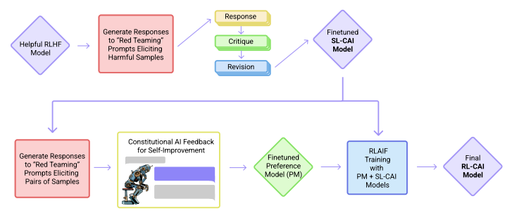
Figure 1 We show the basic steps of our Constitutional AI (CAI) process, which consists of both a super- vised learning (SL) stage, consisting of the steps at the top, and a Reinforcement Learning (RL) stage, shown as the sequence of steps at the bottom of the figure. Both the critiques and the AI feedback are steered by a small set of principles drawn from a ‘constitution’. The supervised stage significantly improves the initial model, and gives some control over the initial behavior at the start of the RL phase, addressing potential exploration problems. The RL stage significantly improves performance and reliability.
원문 · CC BY 4.0 · Yuntao Bai, Saurav Kadavath, Sandipan Kundu, Amanda Askell, Jackson Kernion, Andy Jones, Anna Chen, Anna Goldie, Azalia Mirhoseini, Cameron McKinnon, Carol Chen, Catherine Olsson, Christopher Olah, Danny Hernandez, Dawn Drain, Deep Ganguli, Dustin Li, Eli Tran-Johnson, Ethan Perez, Jamie Kerr, Jared Mueller, Jeffrey Ladish, Joshua Landau, Kamal Ndousse, Kamile Lukosuite, Liane Lovitt, Michael Sellitto, Nelson Elhage, Nicholas Schiefer, Noemi Mercado, Nova DasSarma, Robert Lasenby, Robin Larson, Sam Ringer, Scott Johnston, Shauna Kravec, Sheer El Showk, Stanislav Fort, Tamera Lanham, Timothy Telleen-Lawton, Tom Conerly, Tom Henighan, Tristan Hume, Samuel R. Bowman, Zac Hatfield-Dodds, Ben Mann, Dario Amodei, Nicholas Joseph, Sam McCandlish, Tom Brown, Jared Kaplan · Constitutional AI: Harmlessness from AI Feedback · 원문 그림 인용 · 원본 PDF 2쪽에서 그림 영역을 추출했습니다.원칙은 총 16개이며, 각 비판-수정 단계마다 원칙이 무작위로 샘플링됩니다. 모델이 비판과 수정 지시를 혼동하는 경우가 있어서, 같은 형식으로 쓴 비판과 수정 예시를 few-shot 프롬프트로 함께 넣었습니다.
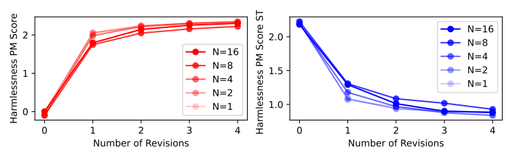
Figure 6 We show harmlessness PM scores of revised responses for varying number of constitutional prin- ciples used. Increasing the number of principles does not improve these PM scores, but we have found that it improves the diversity of revised responses, which improves exploration during the RL phase of CAI training.
원문 · CC BY 4.0 · Yuntao Bai, Saurav Kadavath, Sandipan Kundu, Amanda Askell, Jackson Kernion, Andy Jones, Anna Chen, Anna Goldie, Azalia Mirhoseini, Cameron McKinnon, Carol Chen, Catherine Olsson, Christopher Olah, Danny Hernandez, Dawn Drain, Deep Ganguli, Dustin Li, Eli Tran-Johnson, Ethan Perez, Jamie Kerr, Jared Mueller, Jeffrey Ladish, Joshua Landau, Kamal Ndousse, Kamile Lukosuite, Liane Lovitt, Michael Sellitto, Nelson Elhage, Nicholas Schiefer, Noemi Mercado, Nova DasSarma, Robert Lasenby, Robin Larson, Sam Ringer, Scott Johnston, Shauna Kravec, Sheer El Showk, Stanislav Fort, Tamera Lanham, Timothy Telleen-Lawton, Tom Conerly, Tom Henighan, Tristan Hume, Samuel R. Bowman, Zac Hatfield-Dodds, Ben Mann, Dario Amodei, Nicholas Joseph, Sam McCandlish, Tom Brown, Jared Kaplan · Constitutional AI: Harmlessness from AI Feedback · 원문 그림 인용 · 원본 PDF 9쪽에서 그림 영역을 추출했습니다.데이터는 red teaming 프롬프트 182,831개입니다. 이 중 42,496개는 사람이 쓴 프롬프트이고 140,335개는 pre-training 모델을 few-shot으로 프롬프트하여 생성한 것입니다. 프롬프트마다 helpful RLHF 모델에서 4개의 비판-수정 쌍을 샘플링했습니다. 도움성 프롬프트 135,296개에 대해서는 프롬프트마다 2개의 응답을 샘플링했습니다. 이 수정본과 도움성 응답으로 pre-training 모델을 한 에폭 미세조정한 결과가 SL-CAI입니다.
AI 선호 라벨과 RLAIF
강화학습 단계에서는 SL-CAI가 각 harmful 프롬프트에 대해 응답 쌍을 생성합니다. 피드백 모델은 원칙을 포함한 객관식 질문을 받아 A와 B 중 더 무해한 응답을 고릅니다. 이때 두 선택지의 로그 확률을 정규화한 값을 소프트 라벨로 사용합니다. 16개 원칙 중 하나가 각 비교 라벨마다 무작위로 선택되며, 저자들은 원칙을 앙상블하면 특정 원칙 하나만 쓸 때보다 선호 모델의 행동이 더 견고해진다고 해석합니다.
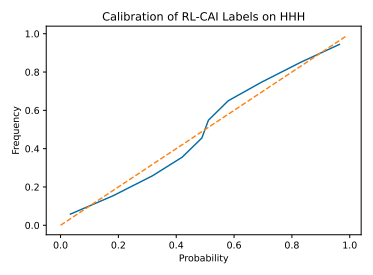
Figure 9 Calibration of 52B RL-CAI labels on our HHH evaluation questions. Dashed diagonal line repre- sents perfect calibration.
원문 · CC BY 4.0 · Yuntao Bai, Saurav Kadavath, Sandipan Kundu, Amanda Askell, Jackson Kernion, Andy Jones, Anna Chen, Anna Goldie, Azalia Mirhoseini, Cameron McKinnon, Carol Chen, Catherine Olsson, Christopher Olah, Danny Hernandez, Dawn Drain, Deep Ganguli, Dustin Li, Eli Tran-Johnson, Ethan Perez, Jamie Kerr, Jared Mueller, Jeffrey Ladish, Joshua Landau, Kamal Ndousse, Kamile Lukosuite, Liane Lovitt, Michael Sellitto, Nelson Elhage, Nicholas Schiefer, Noemi Mercado, Nova DasSarma, Robert Lasenby, Robin Larson, Sam Ringer, Scott Johnston, Shauna Kravec, Sheer El Showk, Stanislav Fort, Tamera Lanham, Timothy Telleen-Lawton, Tom Conerly, Tom Henighan, Tristan Hume, Samuel R. Bowman, Zac Hatfield-Dodds, Ben Mann, Dario Amodei, Nicholas Joseph, Sam McCandlish, Tom Brown, Jared Kaplan · Constitutional AI: Harmlessness from AI Feedback · 원문 그림 인용 · 원본 PDF 12쪽에서 그림 영역을 추출했습니다.이 AI 무해성 라벨은 인간이 만든 도움성 라벨과 섞여 선호 모델 학습 데이터가 됩니다. 이후 SL-CAI를 초기 정책으로 두고 선호 모델을 보상으로 하여 강화학습을 수행합니다. 이 결과가 RL-CAI 모델입니다.
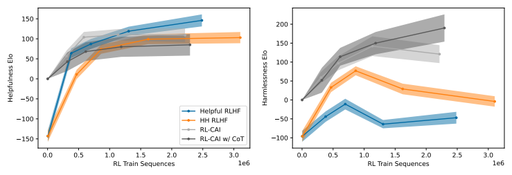
Figure 8 These figures show the helpfulness (left) and harmlessness (right) Elo scores as a function of the total number of RL training sequences, as judged by crowdworkers via comparison tests. We see that the RL- CAI models perform very well on harmlessness without a great cost to their helpfulness. The initial snapshot for the RL-CAI models is SL-CAI, where we set the Elos to be zero; while the initial snapshot for the RLHF models is a pre-trained LM. Note that the crowdworkers were instructed that among harmless samples, they should prefer those that were not evasive and instead explained the nature of the harm.
원문 · CC BY 4.0 · Yuntao Bai, Saurav Kadavath, Sandipan Kundu, Amanda Askell, Jackson Kernion, Andy Jones, Anna Chen, Anna Goldie, Azalia Mirhoseini, Cameron McKinnon, Carol Chen, Catherine Olsson, Christopher Olah, Danny Hernandez, Dawn Drain, Deep Ganguli, Dustin Li, Eli Tran-Johnson, Ethan Perez, Jamie Kerr, Jared Mueller, Jeffrey Ladish, Joshua Landau, Kamal Ndousse, Kamile Lukosuite, Liane Lovitt, Michael Sellitto, Nelson Elhage, Nicholas Schiefer, Noemi Mercado, Nova DasSarma, Robert Lasenby, Robin Larson, Sam Ringer, Scott Johnston, Shauna Kravec, Sheer El Showk, Stanislav Fort, Tamera Lanham, Timothy Telleen-Lawton, Tom Conerly, Tom Henighan, Tristan Hume, Samuel R. Bowman, Zac Hatfield-Dodds, Ben Mann, Dario Amodei, Nicholas Joseph, Sam McCandlish, Tom Brown, Jared Kaplan · Constitutional AI: Harmlessness from AI Feedback · 원문 그림 인용 · 원본 PDF 12쪽에서 그림 영역을 추출했습니다.chain-of-thought 변형에서는 helpful RLHF 모델을 피드백 모델로 쓰고, 대화 형식의 프롬프트에 「Let's think step-by-step」 지시를 넣어 추론을 생성합니다. 추론은 보통 어느 선택지를 고를지 분명히 말하므로 확률이 0이나 1에 가깝게 치우칩니다. 저자들은 확률을 40-60 범위로 클램핑했을 때 더 안정적인 행동이 나타났고, 클램핑이 없으면 모델이 더 극단적인 응답을 학습한다고 보고합니다. 소프트 라벨은 CoT가 없는 RL-CAI에서 하드 라벨보다 더 좋은 결과를 냈습니다.
HHH 객관식 평가로 본 CoT 효과
논문은 학습 전에 언어모델이 대화에서 더 도움이 되고 정직하며 무해한 응답을 식별할 수 있는지 438개의 이진 비교 질문으로 확인합니다. 이 질문들은 이전 연구의 221개와 이 논문에서 새로 작성한 217개로 구성됩니다.
비교 방식은 두 가지입니다. 하나는 인간 선호로 학습된 선호 모델이 더 높은 점수를 주는 응답을 고르는 방식이고, 다른 하나는 pre-training 언어모델이나 helpful RLHF 정책에 두 선택지를 객관식으로 제시하는 방식입니다. 객관식 방식에서는 chain-of-thought 추론을 쓰고, 다섯 개의 CoT 샘플이 각 선택지에 부여한 확률을 평균합니다.
결과에서 chain-of-thought 추론은 객관식 평가의 정확도를 유의하게 높입니다. 저자들은 추세를 근거로 52B보다 큰 모델이 인간 피드백으로 학습한 선호 모델과 경쟁할 수 있을 것이라고 해석합니다. 이 해석은 본 실험에서 확인된 값이 아니라 추세에 기반한 추정입니다.
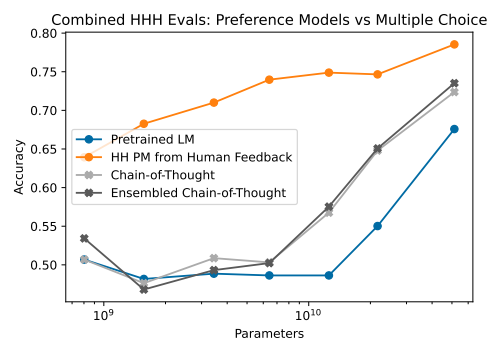
Figure 4 We show performance on 438 binary comparison questions intended to evaluate helpfulness, honesty, and harmlessness. We compare the performance of a preference model, trained on human feedback data, to pretrained language models, which evaluate the comparisons as multiple choice questions. We see that chain of thought reasoning significantly improves the performance at this task. The trends suggest that models larger than 52B will be competitive with human feedback-trained preference models.
원문 · CC BY 4.0 · Yuntao Bai, Saurav Kadavath, Sandipan Kundu, Amanda Askell, Jackson Kernion, Andy Jones, Anna Chen, Anna Goldie, Azalia Mirhoseini, Cameron McKinnon, Carol Chen, Catherine Olsson, Christopher Olah, Danny Hernandez, Dawn Drain, Deep Ganguli, Dustin Li, Eli Tran-Johnson, Ethan Perez, Jamie Kerr, Jared Mueller, Jeffrey Ladish, Joshua Landau, Kamal Ndousse, Kamile Lukosuite, Liane Lovitt, Michael Sellitto, Nelson Elhage, Nicholas Schiefer, Noemi Mercado, Nova DasSarma, Robert Lasenby, Robin Larson, Sam Ringer, Scott Johnston, Shauna Kravec, Sheer El Showk, Stanislav Fort, Tamera Lanham, Timothy Telleen-Lawton, Tom Conerly, Tom Henighan, Tristan Hume, Samuel R. Bowman, Zac Hatfield-Dodds, Ben Mann, Dario Amodei, Nicholas Joseph, Sam McCandlish, Tom Brown, Jared Kaplan · Constitutional AI: Harmlessness from AI Feedback · 원문 그림 인용 · 원본 PDF 6쪽에서 그림 영역을 추출했습니다.Elo 비교와 단계별 결과
학습된 모델은 크라우드워커의 A/B 비교로 평가됩니다. 24개 스냅샷에 대해 도움성 비교 10,274개와 무해성 비교 8,135개가 수집되었습니다. 이 Elo 점수는 같은 비교 실험 안에서만 상대적으로 읽어야 합니다.
결과를 보면 RL-CAI는 helpful RLHF와 SL-CAI보다 무해하다고 평가됩니다. SL-CAI는 helpful RLHF보다 무해하지만 두 RL 모델보다 덜 도움이 되며, RL-CAI는 회피적 응답이 거의 없고 미묘하면서 무해한 응답을 자주 만든다고 보고됩니다. 또한 AI 피드백 기반 RL은 인간 피드백으로 무해성을 평가한 경우와 같거나 그 이상의 성능을 보입니다. 다만 크라우드워커에게 회피적이기만 한 응답보다 설명이 있는 응답을 고르라고 지시를 바꾸었기 때문에, HH RLHF의 무해성 점수가 이전 연구보다 낮게 나왔을 가능성이 있다고 저자들은 해석합니다.
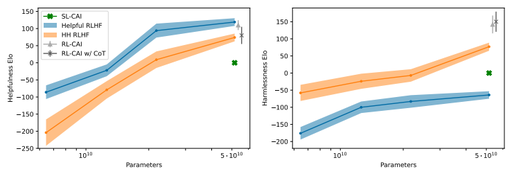
Figure 3 This figure shows helpfulness and harmlessness Elo scores for models of varying sizes, as deter- mined from comparison tests of crowdworker preferences in open-ended conversation. Helpful (H) RLHF and helpful & harmless (HH) RLHF are similar to prior work [Bai et al., 2022]. SL-CAI, RL-CAI, and RL- CAI w/ CoT models are trained with our new constitutional method.
원문 · CC BY 4.0 · Yuntao Bai, Saurav Kadavath, Sandipan Kundu, Amanda Askell, Jackson Kernion, Andy Jones, Anna Chen, Anna Goldie, Azalia Mirhoseini, Cameron McKinnon, Carol Chen, Catherine Olsson, Christopher Olah, Danny Hernandez, Dawn Drain, Deep Ganguli, Dustin Li, Eli Tran-Johnson, Ethan Perez, Jamie Kerr, Jared Mueller, Jeffrey Ladish, Joshua Landau, Kamal Ndousse, Kamile Lukosuite, Liane Lovitt, Michael Sellitto, Nelson Elhage, Nicholas Schiefer, Noemi Mercado, Nova DasSarma, Robert Lasenby, Robin Larson, Sam Ringer, Scott Johnston, Shauna Kravec, Sheer El Showk, Stanislav Fort, Tamera Lanham, Timothy Telleen-Lawton, Tom Conerly, Tom Henighan, Tristan Hume, Samuel R. Bowman, Zac Hatfield-Dodds, Ben Mann, Dario Amodei, Nicholas Joseph, Sam McCandlish, Tom Brown, Jared Kaplan · Constitutional AI: Harmlessness from AI Feedback · 원문 그림 인용 · 원본 PDF 4쪽에서 그림 영역을 추출했습니다.수정 횟수 실험은 다른 측정 체계입니다. 여기서는 인간 피드백만으로 학습한 52B 선호 모델의 점수를 사용합니다. 무해성과 HH 점수는 수정 횟수가 늘수록 단조롭게 향상되지만 순수 도움성 점수는 낮아집니다. 비판 후 수정과 비판 없이 바로 수정하는 방식을 비교하면, 작은 모델에서는 비판을 거친 수정이 더 높은 무해성 점수를 얻고 큰 모델에서는 비슷한 성능을 보이며 비판 쪽이 약간 더 낫습니다.
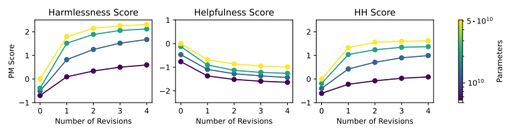
Figure 5 Preference Model scores of responses and revisions from helpful RLHF models, evaluated on a set of red team prompts. The scores are evaluated on a 52B preference model trained on (left) harmlessness comparisons, (center) helpfulness comparisons, and (right) a mixture of all the combined helpful and harmless comparisons. The preference models used for evaluation here were trained exclusively using human feedback. We find that harmlessness and HH scores improve monotonically with respect to number of revisions, where revision 0 refers to the initial response, but pure helpfulness scores decrease.
원문 · CC BY 4.0 · Yuntao Bai, Saurav Kadavath, Sandipan Kundu, Amanda Askell, Jackson Kernion, Andy Jones, Anna Chen, Anna Goldie, Azalia Mirhoseini, Cameron McKinnon, Carol Chen, Catherine Olsson, Christopher Olah, Danny Hernandez, Dawn Drain, Deep Ganguli, Dustin Li, Eli Tran-Johnson, Ethan Perez, Jamie Kerr, Jared Mueller, Jeffrey Ladish, Joshua Landau, Kamal Ndousse, Kamile Lukosuite, Liane Lovitt, Michael Sellitto, Nelson Elhage, Nicholas Schiefer, Noemi Mercado, Nova DasSarma, Robert Lasenby, Robin Larson, Sam Ringer, Scott Johnston, Shauna Kravec, Sheer El Showk, Stanislav Fort, Tamera Lanham, Timothy Telleen-Lawton, Tom Conerly, Tom Henighan, Tristan Hume, Samuel R. Bowman, Zac Hatfield-Dodds, Ben Mann, Dario Amodei, Nicholas Joseph, Sam McCandlish, Tom Brown, Jared Kaplan · Constitutional AI: Harmlessness from AI Feedback · 원문 그림 인용 · 원본 PDF 9쪽에서 그림 영역을 추출했습니다.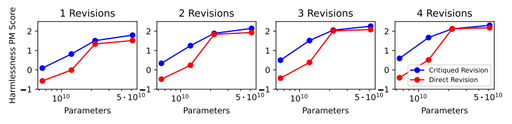
Figure 7 Comparison of preference model scores (all on the same 52B PM trained on harmlessness) for critiqued and direct revisions. We find that for smaller models, critiqued revisions generally achieve higher harmlessness scores (higher is more harmless), while for larger models they perform similarly, though cri- tiques are always slightly better.
원문 · CC BY 4.0 · Yuntao Bai, Saurav Kadavath, Sandipan Kundu, Amanda Askell, Jackson Kernion, Andy Jones, Anna Chen, Anna Goldie, Azalia Mirhoseini, Cameron McKinnon, Carol Chen, Catherine Olsson, Christopher Olah, Danny Hernandez, Dawn Drain, Deep Ganguli, Dustin Li, Eli Tran-Johnson, Ethan Perez, Jamie Kerr, Jared Mueller, Jeffrey Ladish, Joshua Landau, Kamal Ndousse, Kamile Lukosuite, Liane Lovitt, Michael Sellitto, Nelson Elhage, Nicholas Schiefer, Noemi Mercado, Nova DasSarma, Robert Lasenby, Robin Larson, Sam Ringer, Scott Johnston, Shauna Kravec, Sheer El Showk, Stanislav Fort, Tamera Lanham, Timothy Telleen-Lawton, Tom Conerly, Tom Henighan, Tristan Hume, Samuel R. Bowman, Zac Hatfield-Dodds, Ben Mann, Dario Amodei, Nicholas Joseph, Sam McCandlish, Tom Brown, Jared Kaplan · Constitutional AI: Harmlessness from AI Feedback · 원문 그림 인용 · 원본 PDF 10쪽에서 그림 영역을 추출했습니다.한계와 적용 범위
이 방법은 무해성 라벨에서 인간 피드백을 줄였지만, 도움성 라벨에는 여전히 인간 피드백을 사용합니다. 따라서 완전한 자기 감독 방식이라고 보기는 어렵습니다. 저자들은 도움성과 지시 따르기도 인간 피드백 없이 가능할 것으로 보지만, 이는 향후 과제로 남겨 둡니다.
RL-CAI 모델을 과도하게 학습하면 Goodharting 행동이 나타날 수 있습니다. 예를 들어 모델이 과도하게 엄격해지거나 대부분의 red teaming 프롬프트에 정형화된 위로 문구를 붙일 수 있습니다.
절대 유해도 점수는 0부터 4까지의 척도에서 64개 프롬프트에 대해 프롬프트마다 256개의 응답으로 계산되었습니다. 그러나 작업자마다 채점 기준이 달라 절대 점수가 잘 보정되지 않았을 수 있습니다. 또한 원칙은 연구 목적으로 비교적 임의적이고 반복적으로 선택되었으며, 저자들은 향후 더 많은 이해관계자가 원칙을 다듬어야 한다고 봅니다.
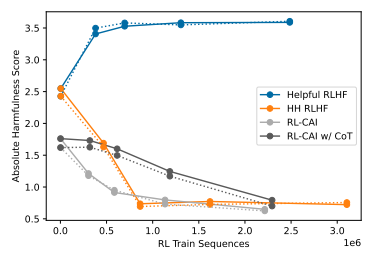
Figure 10 Absolute harmfulness score for various 52B RL snapshots, on a scale from 0 to 4, where higher is more harmful. Solid lines are sampled at T = 1 , and dashed lines at T = 0 . The RLHF models are initialized on pre-trained LMs, while the RL-CAI models are initialized on SL-CAI.
원문 · CC BY 4.0 · Yuntao Bai, Saurav Kadavath, Sandipan Kundu, Amanda Askell, Jackson Kernion, Andy Jones, Anna Chen, Anna Goldie, Azalia Mirhoseini, Cameron McKinnon, Carol Chen, Catherine Olsson, Christopher Olah, Danny Hernandez, Dawn Drain, Deep Ganguli, Dustin Li, Eli Tran-Johnson, Ethan Perez, Jamie Kerr, Jared Mueller, Jeffrey Ladish, Joshua Landau, Kamal Ndousse, Kamile Lukosuite, Liane Lovitt, Michael Sellitto, Nelson Elhage, Nicholas Schiefer, Noemi Mercado, Nova DasSarma, Robert Lasenby, Robin Larson, Sam Ringer, Scott Johnston, Shauna Kravec, Sheer El Showk, Stanislav Fort, Tamera Lanham, Timothy Telleen-Lawton, Tom Conerly, Tom Henighan, Tristan Hume, Samuel R. Bowman, Zac Hatfield-Dodds, Ben Mann, Dario Amodei, Nicholas Joseph, Sam McCandlish, Tom Brown, Jared Kaplan · Constitutional AI: Harmlessness from AI Feedback · 원문 그림 인용 · 원본 PDF 14쪽에서 그림 영역을 추출했습니다.논문 정보
- 저자
- Yuntao Bai, Saurav Kadavath, Sandipan Kundu, Amanda Askell, Jackson Kernion, Andy Jones, Anna Chen, Anna Goldie, Azalia Mirhoseini, Cameron McKinnon, Carol Chen, Catherine Olsson, Christopher Olah, Danny Hernandez, Dawn Drain, Deep Ganguli, Dustin Li, Eli Tran-Johnson, Ethan Perez, Jamie Kerr, Jared Mueller, Jeffrey Ladish, Joshua Landau, Kamal Ndousse, Kamile Lukosuite, Liane Lovitt, Michael Sellitto, Nelson Elhage, Nicholas Schiefer, Noemi Mercado, Nova DasSarma, Robert Lasenby, Robin Larson, Sam Ringer, Scott Johnston, Shauna Kravec, Sheer El Showk, Stanislav Fort, Tamera Lanham, Timothy Telleen-Lawton, Tom Conerly, Tom Henighan, Tristan Hume, Samuel R. Bowman, Zac Hatfield-Dodds, Ben Mann, Dario Amodei, Nicholas Joseph, Sam McCandlish, Tom Brown, Jared Kaplan
- 학회·저널
- arXiv · 프리프린트
- 최초 공개일
- 2022년 12월 15일
- 등록일
- 2026년 10월 20일
- 수정일
- 2022년 12월 15일
- 버전
- v1
- arXiv
- 2212.08073
- 분류
- cs.CL · cs.AI
- 원문 이용 조건
- CC BY 4.0
- 제공 범위
- 논문 정보, 해설, 허용된 원문 그림
AI 해설은 논문 원문과 별개의 설명이며 오류가 있을 수 있습니다. 원문과 그림은 각 출처의 이용 조건과 따로 표시된 권리를 따릅니다.
초록
As AI systems become more capable, we would like to enlist their help to supervise other AIs. We experiment with methods for training a harmless AI assistant through self-improvement, without any human labels identifying harmful outputs. The only human oversight is provided through a list of rules or principles, and so we refer to the method as 'Constitutional AI'. The process involves both a supervised learning and a reinforcement learning phase. In the supervised phase we sample from an initial model, then generate self-critiques and revisions, and then finetune the original model on revised responses. In the RL phase, we sample from the finetuned model, use a model to evaluate which of the two samples is better, and then train a preference model from this dataset of AI preferences. We then train with RL using the preference model as the reward signal, i.e. we use 'RL from AI Feedback' (RLAIF). As a result we are able to train a harmless but non-evasive AI assistant that engages with harmful queries by explaining its objections to them. Both the SL and RL methods can leverage chain-of-thought style reasoning to improve the human-judged performance and transparency of AI decision making. These methods make it possible to control AI behavior more precisely and with far fewer human labels.
원문 인용
Yuntao Bai, Saurav Kadavath, Sandipan Kundu, Amanda Askell, Jackson Kernion, Andy Jones, Anna Chen, Anna Goldie, Azalia Mirhoseini, Cameron McKinnon, Carol Chen, Catherine Olsson, Christopher Olah, Danny Hernandez, Dawn Drain, Deep Ganguli, Dustin Li, Eli Tran-Johnson, Ethan Perez, Jamie Kerr et al. (2022). Constitutional AI: Harmlessness from AI Feedback. arXiv:2212.08073v1. https://arxiv.org/abs/2212.08073v1
BibTeX
@misc{bai2022constitutional,
  title = {{Constitutional AI: Harmlessness from AI Feedback}},
  author = {Yuntao Bai and Saurav Kadavath and Sandipan Kundu and Amanda Askell and Jackson Kernion and Andy Jones and Anna Chen and Anna Goldie and Azalia Mirhoseini and Cameron McKinnon and Carol Chen and Catherine Olsson and Christopher Olah and Danny Hernandez and Dawn Drain and Deep Ganguli and Dustin Li and Eli Tran-Johnson and Ethan Perez and Jamie Kerr and Jared Mueller and Jeffrey Ladish and Joshua Landau and Kamal Ndousse and Kamile Lukosuite and Liane Lovitt and Michael Sellitto and Nelson Elhage and Nicholas Schiefer and Noemi Mercado and Nova DasSarma and Robert Lasenby and Robin Larson and Sam Ringer and Scott Johnston and Shauna Kravec and Sheer El Showk and Stanislav Fort and Tamera Lanham and Timothy Telleen-Lawton and Tom Conerly and Tom Henighan and Tristan Hume and Samuel R. Bowman and Zac Hatfield-Dodds and Ben Mann and Dario Amodei and Nicholas Joseph and Sam McCandlish and Tom Brown and Jared Kaplan},
  year = {2022},
  eprint = {2212.08073},
  archivePrefix = {arXiv},
  url = {https://arxiv.org/abs/2212.08073v1}
}