논문 해설
Beyond Row-Level Prediction: Evaluating and Learning Composition for Reusable Table Representations
행 단위 예측을 넘어서: 재사용 가능한 테이블 표현을 위한 구성 평가와 학습
- 연구 문제 표 수준 임베딩은 행 단위 예측으로는 품질을 제대로 재기 어렵습니다.
- 연구 방법 표 임베딩을 지역 상태와 합성 규칙으로 나누고, 동결된 ConTextTab 위에서 SCDM으로 합성 헤드만 학습합니다.
표 임베딩을 행 단위 예측으로 평가하는 한계
표는 스키마, 셀 값, 행과 열 구조에 걸쳐 내용이 퍼져 있으며, 검색·중복 제거·데이터 큐레이션 같은 작업은 표 하나당 재사용 가능한 임베딩 벡터 하나를 필요로 합니다. 그런데 기존 표 표현 방법은 주로 행 수준 예측이나 지도 학습 다운스트림 과제로 평가되어, 표 수준 임베딩의 품질을 직접 재지 못합니다. 이 논문은 표 수준 임베딩을 부분 뷰 일관성, 라벨 세분성별 판별력, 벤ign 섭동에 대한 강건성, 효율성의 네 가지 기준으로 직접 평가하는 벤치마크를 제안합니다. 이후 절에서는 고정 풀링으로 만든 임베딩의 약점이 인코더 상태 때문인지, 합성 규칙 때문인지를 나눠 봅니다.
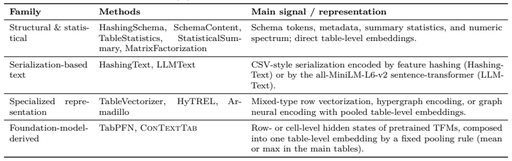
Table 1 : Benchmark summary. Part (A) lists the families of table representation methods compared under the shared observation interface, and part (B) lists the desiderata, main metrics, and corresponding evaluation targets. Full details are provided in Appendix A.1 and Appendix A.2.
원문 · CC BY 4.0 · Ali Younes, Saeed Ghoorchian, Maximilian Schambach, Georgia Chalvatzaki, Johannes Höhne · Beyond Row-Level Prediction: Evaluating and Learning Composition for Reusable Table Representations · 원문 그림 인용 · 원본 PDF 5쪽에서 그림 영역을 추출했습니다.지역 상태와 합성 규칙의 분리
이 논문은 표 수준 임베딩을 인코더가 만든 지역 상태 집합 H(T)와 그 집합을 하나의 벡터로 바꾸는 합성 규칙 C의 조합으로 봅니다. 고정 풀링 실험에서 C는 평균, 최댓값, 합, 최솟값, 표준편차 풀링처럼 매개변수가 없는 규칙입니다. 두 표 임베딩의 비교는 모든 방법에서 코사인 유사도로 통일했습니다. 두 번째 단계에서는 TFM 인코더 ConTextTab을 동결하고 합성 규칙만 학습 가능한 헤드로 바꿉니다. 헤드는 원본 표를 보지 않고 동결된 셀 상태만 받으므로, 기준선은 같은 상태에 대한 고정 풀링입니다.
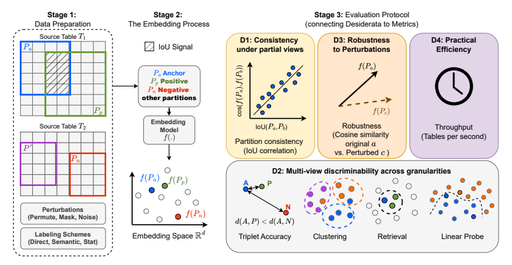
Figure 1 : The evaluation pipeline. Stage 1 samples partitions from source tables and attaches labeling schemes and perturbations. Stage 2 maps each partition to a single table-level embedding, either directly or by composing local encoder states with a fixed or learned compositional rule. Stage 3 measures the four desiderata through concrete metrics, so lightweight baselines and foundation-model-derived representations are compared under the same observation interface. or supervised downstream tasks (Hollmann et al., 2025; Spinaci et al., 2025; Hoppe et al., 2025). Naturally, these evaluations show how well a model predicts, not how good its table-level embedding is.
원문 · CC BY 4.0 · Ali Younes, Saeed Ghoorchian, Maximilian Schambach, Georgia Chalvatzaki, Johannes Höhne · Beyond Row-Level Prediction: Evaluating and Learning Composition for Reusable Table Representations · 원문 그림 인용 · 원본 PDF 2쪽에서 그림 영역을 추출했습니다.SCDM 손실로 합성 헤드를 학습하기
SCDM은 임베딩 유사도의 분포를 파티션 사이 IoU로 정한 목표 분포에 맞추는 손실입니다. 목표 분포 T는 같은 원본 표에서 온 후보들에 대해 앵커와의 IoU를 합으로 나눈 값이며, 국소 지지 집합에서는 같은 표의 후보들로, 전역 지지 집합에서는 배치 전체로 정규화된 확률 분포 P_local과 P_global을 씁니다. 전체 손실은 L = α D_KL(T||P_local) + (1−α) D_KL(T||P_global)입니다. 여기서 α는 같은 표 안의 세밀한 중첩 구조와 표 사이 판별의 균형을 조절합니다. 학습은 실제 표에서만 이루어지고 학습 파티션 정책은 평가 정책과 다르며, 헤드마다 세 개의 시드로 학습한 뒤 검증 점수가 가장 높은 체크포인트를 고릅니다.
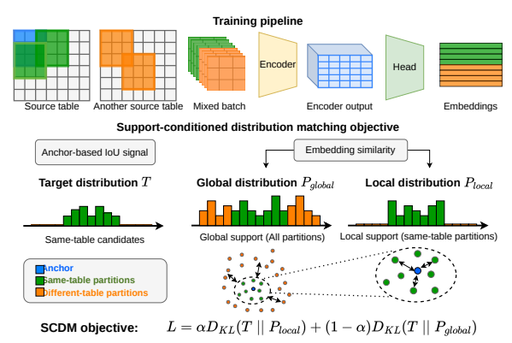
Figure 4 : Learning table-level composition on top of frozenConTextTab. At the top, partitions sampled from one source table and from other source tables are collated into mixed batches, encoded by the frozen backbone, and aggregated by a trainable representation head into table embeddings. At the bottom, support- conditioned distribution matching defines a target distributionT from anchor-based overlap and matches it with local and global similarity distributions induced by the learned embeddings.
원문 · CC BY 4.0 · Ali Younes, Saeed Ghoorchian, Maximilian Schambach, Georgia Chalvatzaki, Johannes Höhne · Beyond Row-Level Prediction: Evaluating and Learning Composition for Reusable Table Representations · 원문 그림 인용 · 원본 PDF 9쪽에서 그림 영역을 추출했습니다.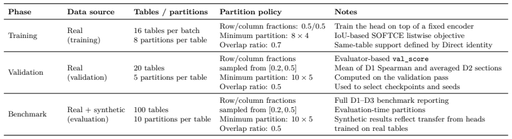
Table 25 : Training, validation, and final benchmark protocols for learned representation heads.
원문 · CC BY 4.0 · Ali Younes, Saeed Ghoorchian, Maximilian Schambach, Georgia Chalvatzaki, Johannes Höhne · Beyond Row-Level Prediction: Evaluating and Learning Composition for Reusable Table Representations · 원문 그림 인용 · 원본 PDF 31쪽에서 그림 영역을 추출했습니다.고정 풀링 임베딩의 벤치마크 성능
고정 풀링으로 만든 TabPFN과 ConTextTab의 임베딩은 합성 데이터에서 D1 Spearman 상관이 −0.17에서 0.04 사이에 머물렀고, 같은 조건의 HashingText와 HashingSchema는 0.54에서 0.59를 기록했습니다. 다섯 가지 풀링 규칙을 같은 단일 순전파 상태에 적용했을 때도 결론은 바뀌지 않았으며, 평균과 합은 코사인 기반 지표에서 같은 값을 냈습니다. 저자들은 이 약점이 특정 풀링 규칙만의 문제가 아니라 고정된 집계 방식에서 나온다고 해석합니다.
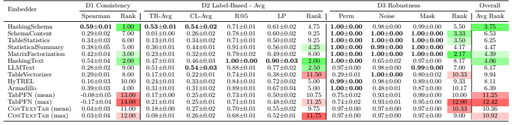
Table 2 : Evaluation Results for Synthetic data (mean±95% CI over 10 seeds).
원문 · CC BY 4.0 · Ali Younes, Saeed Ghoorchian, Maximilian Schambach, Georgia Chalvatzaki, Johannes Höhne · Beyond Row-Level Prediction: Evaluating and Learning Composition for Reusable Table Representations · 원문 그림 인용 · 원본 PDF 7쪽에서 그림 영역을 추출했습니다.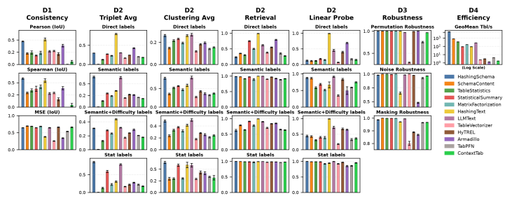
Figure 2 : Metric summary for Synthetic data across the benchmark dimensions.
원문 · CC BY 4.0 · Ali Younes, Saeed Ghoorchian, Maximilian Schambach, Georgia Chalvatzaki, Johannes Höhne · Beyond Row-Level Prediction: Evaluating and Learning Composition for Reusable Table Representations · 원문 그림 인용 · 원본 PDF 7쪽에서 그림 영역을 추출했습니다.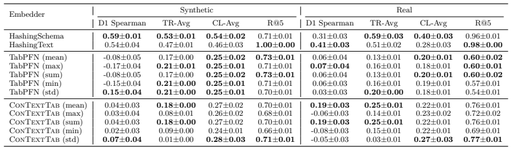
Table 4 : Five parameter-free pooling rules applied to the same TabPFN andConTextTabstates (Ap- pendix A.7), with the two strongest fingerprints for reference (mean± 95% CI over 10 seeds). Mean and max rows match Tables 2 and 3. Bold marks the best value per column within each group.
원문 · CC BY 4.0 · Ali Younes, Saeed Ghoorchian, Maximilian Schambach, Georgia Chalvatzaki, Johannes Höhne · Beyond Row-Level Prediction: Evaluating and Learning Composition for Reusable Table Representations · 원문 그림 인용 · 원본 PDF 8쪽에서 그림 영역을 추출했습니다.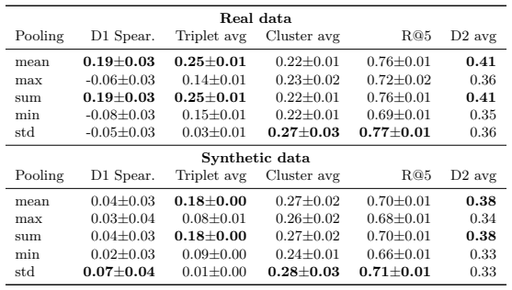
Table 14 :ConTextTabunder all non-learned poolings (mean± 95% CI over 10 seeds). D2 avg averages the triplet, clustering, and retrieval columns as displayed. Best value per column inbold.
원문 · CC BY 4.0 · Ali Younes, Saeed Ghoorchian, Maximilian Schambach, Georgia Chalvatzaki, Johannes Höhne · Beyond Row-Level Prediction: Evaluating and Learning Composition for Reusable Table Representations · 원문 그림 인용 · 원본 PDF 26쪽에서 그림 영역을 추출했습니다.학습된 헤드의 개선 폭
예외는 α=1의 Attention으로, D1 0.17과 트리플렛 순위 0.24를 기록해 풀링 기준선을 넘지 못했습니다. 이 개선은 인코더가 바뀌지 않았다는 조건에서 얻은 것이며, 실데이터에서는 개선 폭이 합성 데이터보다 작았습니다.
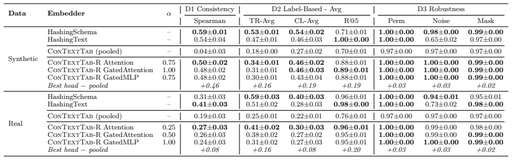
Table 5 : Learned compositional rules on frozenConTextTabstates, compared with fixed pooling of the same states and with the two strongest fingerprints (mean± 95% CI over 10 seeds). Each head is the validation-selected checkpoint at theα with the lowest D1–D3 average rank (allα in Appendix A.10). Bold marks the best value per column within each group; italic rows give the best head’s gain over pooling.
원문 · CC BY 4.0 · Ali Younes, Saeed Ghoorchian, Maximilian Schambach, Georgia Chalvatzaki, Johannes Höhne · Beyond Row-Level Prediction: Evaluating and Learning Composition for Reusable Table Representations · 원문 그림 인용 · 원본 PDF 11쪽에서 그림 영역을 추출했습니다.상위 표 검색으로 본 검증
하위 검증으로 부모 표 검색 과제를 두었습니다. 질의는 샘플링된 파티션이고, 후보 코퍼스는 100개 원본 표이며, 지표는 Recall@1, Recall@5, Recall@10, MRR입니다. 다만 SCDM은 검색 지표로 학습하지 않았지만 중첩과 같은 표 신호를 쓰므로 이 부분은 독립 시험이 아니라 일관성 점검으로 읽어야 합니다.
대표 설정과 남은 질문
이 논문의 고정 풀링 결과는 TabPFN과 ConTextTab 두 모델에 대한 것이며, 다른 TFM은 더 나은 또는 나쁜 임베딩을 낼 수 있습니다. 학습 실험은 하나의 백본만 사용해 합성 규칙이 유일하게 학습된 구성요소가 되도록 했습니다. 검색 과제는 100개 표로 닫힌 코퍼스에서 수행했으므로 개방형 검색이나 다중 표 추론은 범위 밖입니다. 학습된 헤드의 신뢰 구간은 학습 실행 간 변동이 아니라 평가 샘플링을 반영하며, 라벨 유형별로 이득이 고르게 나타나는지는 분석하지 않았습니다. 특히 실데이터에서 학습된 헤드가 최고 지문과 남기는 격차의 원인은 백본, 헤드 용량, 목적 함수, 학습과 평가 파티션의 차이 중 무엇인지 이 실험으로 구분되지 않습니다.
논문 정보
- 저자
- Ali Younes, Saeed Ghoorchian, Maximilian Schambach, Georgia Chalvatzaki, Johannes Höhne
- 학회·저널
- arXiv · 프리프린트
- 최초 공개일
- 2026년 11월 10일
- 등록일
- 2026년 11월 13일
- 수정일
- 2026년 11월 10일
- 버전
- v1
- arXiv
- 2611.14697
- 분류
- cs.LG
- 원문 이용 조건
- CC BY 4.0
- 제공 범위
- 논문 정보, 해설, 허용된 원문 그림
AI 해설은 논문 원문과 별개의 설명이며 오류가 있을 수 있습니다. 원문과 그림은 각 출처의 이용 조건과 따로 표시된 권리를 따릅니다.
초록
Tables are compositional, with content spread across a schema, cell values, rows, and columns. Large-scale operations such as retrieval, overlap estimation, deduplication, and data curation need these local signals composed into one reusable embedding vector per table. Table representation methods, however, are mostly evaluated through row-level prediction or supervised downstream tasks, which do not measure table-level embedding quality directly. We introduce a benchmark that evaluates table-level embeddings through four desiderata: consistency under partial views, discriminability across label granularities, robustness to benign perturbations, and efficiency. Across twelve methods on synthetic and real corpora, lightweight schema- and text-based fingerprints are among the strongest. The sharpest contrast comes from two tabular foundation models, TabPFN and ConTextTab: although both are strong row-level predictors, their states, composed by mean, max, or three further parameter-free pooling rules, trail the strongest fingerprints. We therefore ask whether the gap lies in the encoder or in the compositional rule. Keeping ConTextTab frozen, we learn only the compositional rule over its cell states, using support-conditioned distribution matching (SCDM), a self-supervised loss we propose that matches the distribution of embedding similarities to the distribution of partition overlaps within and across tables. Across all fifteen head configurations, the learned rule raises the Spearman correlation between embedding similarity and partial-view overlap from 0.04 to 0.43-0.50 on synthetic data and improves triplet ranking, clustering, and retrieval, with smaller but systematic gains on real data. A downstream parent-table retrieval task confirms these findings. How local states are composed, and with what objective, substantially affects the quality of table-level embeddings.
원문 인용
Ali Younes, Saeed Ghoorchian, Maximilian Schambach, Georgia Chalvatzaki, Johannes Höhne (2026). Beyond Row-Level Prediction: Evaluating and Learning Composition for Reusable Table Representations. arXiv:2611.14697v1. https://arxiv.org/abs/2611.14697v1
BibTeX
@misc{younes2026beyond,
  title = {{Beyond Row-Level Prediction: Evaluating and Learning Composition for Reusable Table Representations}},
  author = {Ali Younes and Saeed Ghoorchian and Maximilian Schambach and Georgia Chalvatzaki and Johannes Höhne},
  year = {2026},
  eprint = {2611.14697},
  archivePrefix = {arXiv},
  url = {https://arxiv.org/abs/2611.14697v1}
}